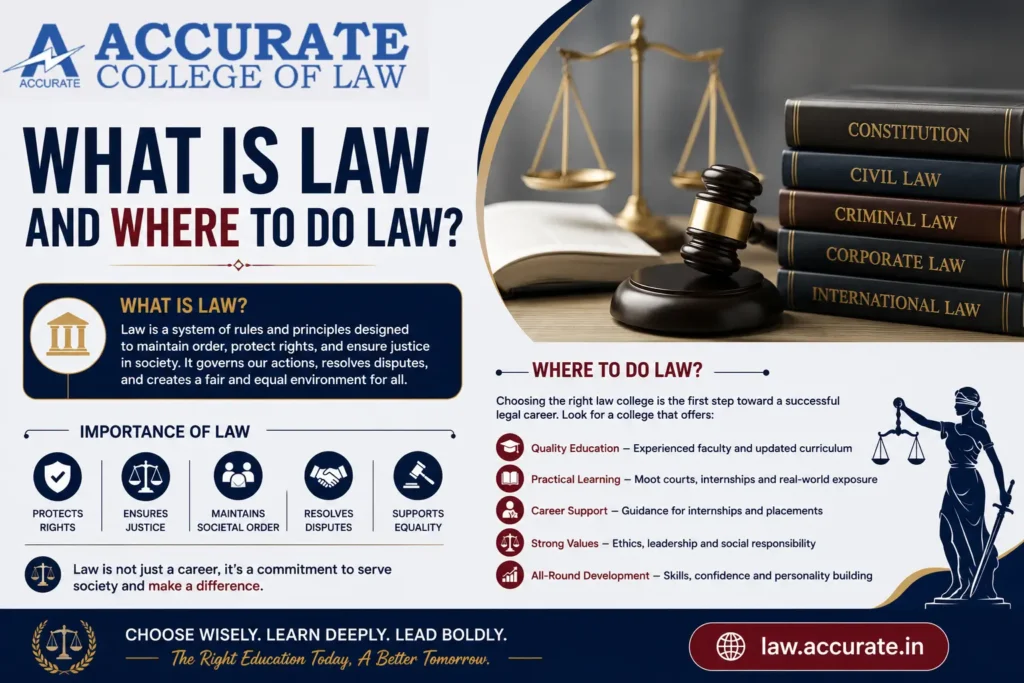

Law also known as Legal Studies is related to almost every area of human life such as issues relating to business, politics, human rights, international relations, trade, etc. A degree in law is not only a useful way to prepare for legal careers, but also for professional roles. There are various types of law degrees for the candidates to study. Law programs include compulsory core courses and more opportunities to choose different topics of law for a particular career path. There are about 6 types of law courses in India such as 5 year LLB, 3 year LLB, LLM, Diploma in Law, certificate courses in Law, PHD in Law, etc.
There are different eligibility criteria for the different law programmes. Law is very demanding and a competitive profession. Most of the law degrees start with the history and basics of Law. After completing the Law programme the graduates will gain a basic understanding of the Indian legal system, exhibit proficiency in legal reasoning, legal analysis, legal practice, etc. They will have the ability to draft common legal documents and organise legal arguments and analysis. In order to be successful in this programme the candidates are required to stay calm under any circumstance and manage time effectively.
NLUs are regarded as the top educational institutions to pursue Law. In order to get admission into the top Law colleges the candidates must score well in the CLAT exam or the AILET exam. Students in India are eligible for a Law degree after completing their intermediate course. Some examples of undergraduate law degrees are BA LLB, BSc LLB, BBA LLB, Bcom LLB. Some of the top career opportunities available after pursuing the above mentioned degrees are public prosecutor, legal expert, attorney general, notary, law reporter, district and sessions judge, magistrate, etc.
Where to Study Law?
The candidates must choose Accurate College of Law, Greater Noida, recognised by CCS University Meerut and approved by Bar Council of India under the vision of AERS. Accurate offers highly educated, experienced, globally trained, international faculty members, alongwith motivated and dedicated group of learners to the students. Accurate College of Law provides courses such as 5 years BA LLB, 3 years BA LLB, LLM, etc. The seat intake for this course at Accurate is 120.
In order to take admission the candidates must have passed class 12 with atleast 50% marks or 45% for SC/ST should have a score of any national entrance test such as CLAT/AILET/LSAT/JAMIA/AMU,etc. BA LLB at Accurate is approved by BCI and is affiliated to Chaudhary Charan Singh University, Meerut. LLB is a duration of 3 years that provides a comprehensive understanding of various aspects of law such as criminal law, constitutional law, corporate law, and many more. The seat intake for this course is also 120.
Program Highlights of Law at Accurate
- Moot court for course exposure & practice
- Dedicated campus recruitment cell and facilitation for professional training and placement
- Research and Development Cell to inculcate interdisciplinary research aptitude
- Additional Certification Courses to enhance personality
- Customized Professional Training based on career Choice of Students
- In house tie-ups for preparation of PCS J exam
- National & International events like seminars, competitions, workshops, conferences, essay competitions, guest lecture and debates
- Internship training programmes
- Skill Development Cell
- Industry Vetted Curriculum
- Regular Court Visits
Accurate Law College, Greater Noida is recognised by CCS University of Meerut and is also approved by Bar Council of India under the vision of AERS. The Accurate Group of Institutions was established in the year 2006 under the Accurate Education and Research Society. The candidates must pursue Law at Accurate College of Law to establish a career in Law. Students will get the experience of the best faculty of law who will help them in every aspect.
Career Opportunities after Law
- Policy researcher
- Legal Advisor
- Magistrate
- Attorney General
- Notary
- Solicitor
- Legal Reporter
- Teaching
- Corporate lawyer
- Litigator
- Administrative law officer
- Specialist law officer (Banking and Insurance)
- Public prosecutor
- Judge
- Public Investigator
- Criminologist
Also Read: Delhi NCR Top PGDM College: Complete Guide for Future Management Leaders