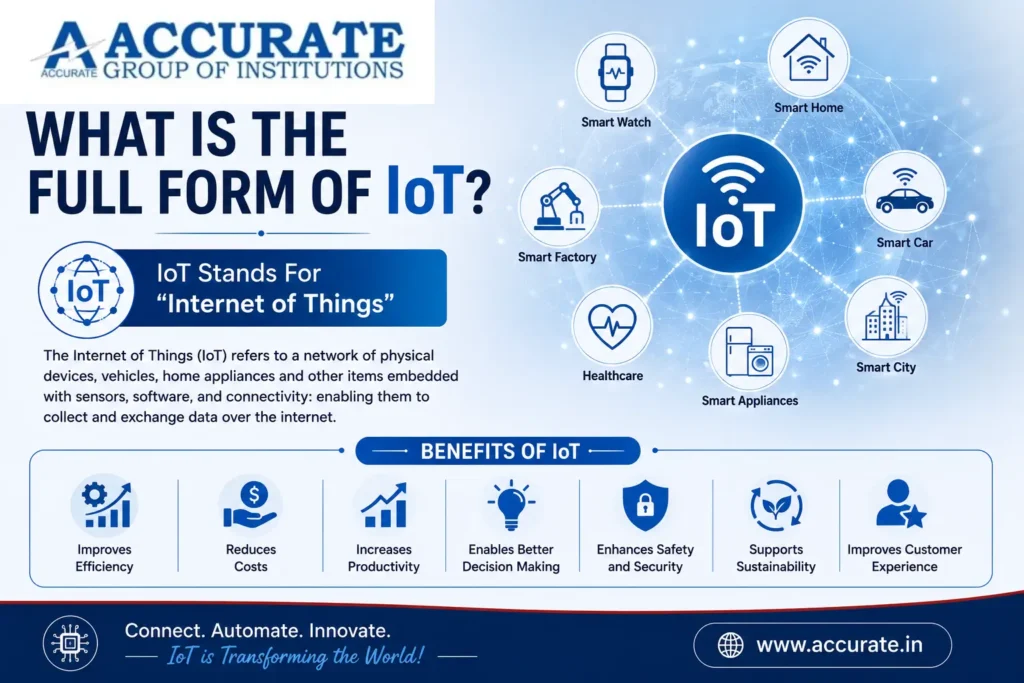

The full form of IoT is known as Internet of Things. It is a term that refers to technological tools and resources that are used to handle network based monitoring and control, audiovisual processing and transmission, telecommunications. This refers to a network of vehicles, physical devices, appliances and other physical objects which are embedded with software, sensors, network connectivity which in turn allows them to collect and share data.
IoT devices are also called smart objects that range from smart home devices such as smart thermostats to wearables such as smart watches, RFID clothing to complex transportation systems and industrial machinery. The full form of IoT enables the smart devices to communicate with each other and also with other internet enabled devices. Smartphones and gateways will create a vast network of interconnected devices that are able to perform various tasks and exchange data autonomously. As the number of internet connected devices are continuously increasing IoT has become more important in shaping the world.
This is in turn transforming the way we are living, working and interacting with each other. The devices of IoT are used to monitor a wide range of parameters such as humidity, temperature, energy consumption, air quality, machine performance, etc. This data can be analysed in real time to identify trends, patterns and anomalies helping businesses to optimise their operations and improve their bottom line.
The technologies that support IoT are sensors and actuators, cloud computing, connectivity technologies, big data analytics, encryption, access controls, intrusion detection systems, etc. IoT is important in today’s world as it provides improved efficiency, data driven decision making, cost savings, enhanced customer experience, etc. The organisations that will benefit from IoT are manufacturing, automotive, retail, public sector, healthcare, transportation and logistics, general safety across all the industries. Some examples of IoT applications are healthcare, manufacturing, retails, agriculture, transportation, etc.
Benefits of IoT
IoT or Internet of Things refers to a network of interconnected embedded devices that will capture and transmit data that does not require any human interaction over a wireless network. The applications of IoT in everyday life include smart wearables, traffic monitoring, smart health monitoring, smart devices, smart grid, water supply, hospital robots, etc. Check below the list of benefits if IoT:
- It assists in controlling the homes and cities smartly with the use of mobile phones. This enhances security and also provides personal protection and this in turn saves a lot of time.
- Even if we are far away we can easily access the information from the actual location and is updated frequently in real time.
- Electronic devices are connected directly and communicate using a controller computer such as cell phones which in turn results in efficient use of electricity.
- Through IoT apps personal assistance is provided that alerts the users about their regular plans.
- This is very useful for safety purposes because it is able to sense any danger or warnings such as GM OnStar is an integrated device that identifies a car crash or an accident on road.
- IoT minimises human effort as the IoT devices connect and communicate with one another and perform a variety of tasks without the requirement of any human intervention.
- Traffic or transportation tracking, delivery, surveillance, delivery, individual order tracking, customer management have become more cost effective with the help of IoT.
- Patients can be taken care of more effectively in real time without any requirement of doctor visit. This gives the client the ability to make choices as well as provide evidence based on care.
- IoT has helped in reduction of human error in organisational processes. By introducing several smart devices and systems tasks that demand manual input have now become automated which in turn has reduced the margin for error.
Also Read: AIML Engineering: Scope, Career Opportunities, Skills, College, and Future in India