
Direct Admission in B.Tech: A Smart Path to Engineering Education
Engineering continues to be one of the most preferred career choices among students after Class 12. With rapid advancements in technology, artificial intelligence, data science, cloud computing, cybersecurity, and automation, the demand for skilled engineers is growing every year. As a result, thousands of students aspire to pursue a Bachelor of Technology (B.Tech) degree from a reputed engineering institution.
While many students gain admission through national and state-level entrance examinations, a significant number also explore the option of Direct Admission in B.Tech. This admission pathway helps students secure seats in quality engineering colleges based on eligibility criteria and institutional admission guidelines.
For students who may not have appeared for entrance examinations, missed counseling rounds, or wish to pursue admission through alternative routes, direct admission provides an excellent opportunity to begin their engineering journey without unnecessary delays.
Among the institutions offering quality engineering education and career-focused learning opportunities, Accurate Institute of Management & Technology has emerged as a preferred destination for aspiring engineers seeking academic excellence, practical learning, and industry-oriented education.
This comprehensive guide covers everything students need to know about Direct Admission in B.Tech, including eligibility criteria, admission process, specializations, benefits, career opportunities, future scope, and why Accurate Institute of Management & Technology is a smart choice for engineering aspirants.
What is Direct Admission in B.Tech?
Direct Admission in B.Tech refers to the process through which eligible students can secure admission to engineering programs based on academic qualifications and institutional admission policies.
Unlike traditional admission routes that depend solely on entrance examination rankings, direct admission allows students to apply through alternative admission channels while meeting eligibility requirements established by the college or university.
This admission pathway ensures that deserving students can continue their higher education without losing valuable academic time.
Quick Answer: Can I Get Direct Admission in B.Tech?
Is direct admission possible in B.Tech?
Yes. Many engineering institutions offer direct admission opportunities to eligible students who have completed their Class 12 education with Physics, Chemistry, and Mathematics (PCM) and meet the prescribed admission criteria.
Students should always verify admission guidelines with the institution before applying.
Why Students Choose Direct Admission in B.Tech
Several factors encourage students to consider direct admission.
Missed Entrance Examination
Some students may not have appeared for engineering entrance exams.
Unsatisfactory Entrance Scores
Students may seek alternative pathways to quality engineering education.
Late Career Decisions
Some students finalize engineering as a career option after entrance exam deadlines.
Flexible Admission Opportunities
Direct admission provides greater accessibility to aspiring engineers.
Faster Enrollment Process
Students can secure seats without lengthy counseling procedures.
Importance of Engineering Education in 2026
Engineering remains one of the most future-focused academic disciplines.
Engineers contribute to:
- Artificial Intelligence
- Software Development
- Smart Manufacturing
- Healthcare Technology
- Renewable Energy
- Data Science
- Robotics
- Infrastructure Development
As technology continues to transform industries, engineering graduates remain highly valuable across sectors.
Eligibility Criteria for Direct Admission in B.Tech
Students seeking direct admission generally need to fulfill certain academic requirements.
Educational Qualification
Candidates should:
- Complete Class 12 from a recognized board
- Study Physics, Chemistry, and Mathematics (PCM)
- Meet the minimum academic performance requirements prescribed by the institution
Additional Requirements
Institutions may establish specific admission guidelines based on university regulations and program requirements.
Students should confirm current admission criteria before applying.
Direct Admission Process for B.Tech
The admission process typically follows a structured procedure.
Step 1: Application Submission
Students complete the admission application form.
Step 2: Eligibility Verification
Academic credentials are reviewed.
Step 3: Counseling and Guidance
Students receive guidance regarding available engineering specializations.
Step 4: Document Verification
Required documents are verified.
Step 5: Seat Confirmation
Admission is confirmed after fulfilling institutional requirements.
Documents Required for Direct Admission
Students generally need:
- Class 10 Marksheet
- Class 12 Marksheet
- Transfer Certificate
- Migration Certificate
- Character Certificate
- Passport Size Photographs
- Aadhaar Card
- Category Certificate (if applicable)
Document requirements may vary according to institutional policies.
Popular B.Tech Specializations Available Through Direct Admission
Modern engineering institutions offer diverse specialization options.
Computer Science Engineering (CSE)
Computer Science Engineering focuses on:
- Programming
- Software Development
- Artificial Intelligence
- Machine Learning
- Cloud Computing
It remains one of the most popular engineering branches.
Artificial Intelligence and Machine Learning (AIML)
AIML prepares students for future technologies.
Topics include:
- Neural Networks
- Deep Learning
- Intelligent Systems
- Predictive Analytics
Demand for AI professionals continues to rise globally.
Data Science Engineering
Data Science combines:
- Statistics
- Machine Learning
- Data Analytics
- Business Intelligence
Organizations increasingly depend on data-driven decision-making.
Internet of Things (IoT)
IoT Engineering focuses on:
- Smart Devices
- Embedded Systems
- Connected Technologies
- Automation Solutions
Industry 4.0 continues to drive demand in this field.
Benefits of Direct Admission in B.Tech
Direct admission offers multiple advantages.
Saves Academic Time
Students can secure admission without waiting for additional admission cycles.
Multiple Program Choices
Students can explore various engineering specializations.
Simplified Admission Process
The admission procedure is generally straightforward.
Career Continuity
Students can begin their engineering education without interruption.
Opportunity to Join Quality Institutions
Direct admission provides access to reputed engineering colleges.
Skills Developed During B.Tech Education
Engineering programs focus on developing both technical and professional competencies.
Technical Skills
Students learn:
- Programming Languages
- Software Development
- Database Management
- Artificial Intelligence
- Machine Learning
- Data Analytics
- Cloud Computing
Professional Skills
Students also develop:
- Problem Solving
- Critical Thinking
- Teamwork
- Communication Skills
- Leadership
- Project Management
These skills improve employability and career readiness.
Why Practical Learning Matters in Engineering
Modern employers seek graduates with practical experience.
Practical learning helps students:
- Apply theoretical concepts
- Understand industry requirements
- Improve technical competence
- Build professional confidence
Engineering institutions increasingly emphasize hands-on learning.
Career Opportunities After B.Tech
Engineering graduates have access to diverse career paths.
Software Engineer
Develops software applications and systems.
Data Scientist
Uses data to support business decisions.
AI Engineer
Builds intelligent technology solutions.
Cloud Engineer
Manages cloud infrastructure.
Cybersecurity Analyst
Protects organizations against digital threats.
IoT Engineer
Develops connected technology systems.
Research Engineer
Contributes to innovation and technological advancement.
Industries Hiring Engineering Graduates
Engineering professionals are employed across multiple sectors.
Information Technology
Banking and Finance
Healthcare
Manufacturing
Telecommunications
E-Commerce
Education Technology
Government Organizations
Engineering skills remain highly transferable across industries.
Salary After B.Tech
Engineering offers attractive earning potential.
| Experience Level | Average Salary |
|---|---|
| Freshers | ₹4 LPA – ₹10 LPA |
| Mid-Level Professionals | ₹8 LPA – ₹20 LPA |
| Experienced Professionals | ₹20 LPA – ₹50 LPA+ |
Compensation varies according to specialization, skills, certifications, and employer requirements.
Future Scope of Engineering
The future of engineering remains exceptionally strong.
Growth areas include:
- Artificial Intelligence
- Machine Learning
- Data Science
- Cloud Computing
- Cybersecurity
- Robotics
- Automation
- Smart Infrastructure
Engineers will continue driving innovation and digital transformation.
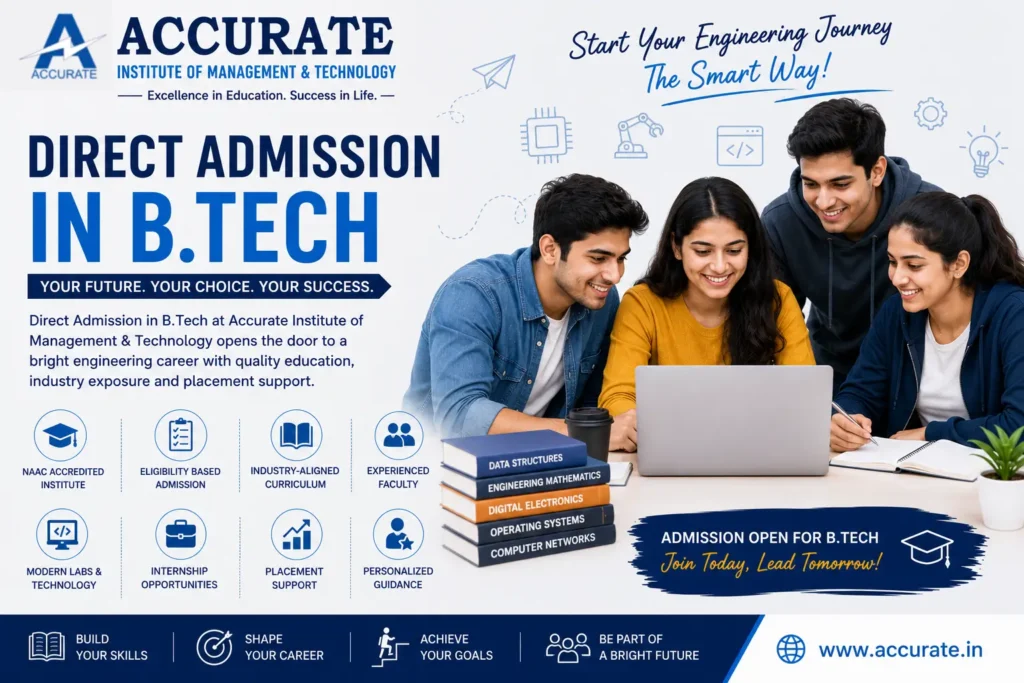
Why Choose Accurate Institute of Management & Technology for B.Tech Admission?
Accurate Institute of Management & Technology focuses on preparing students for successful engineering careers through quality education and practical learning.
Industry-Oriented Curriculum
Programs align with current and emerging industry requirements.
Students gain exposure to future-focused technologies.
Experienced Faculty
Qualified educators provide academic guidance and mentorship.
Students benefit from practical insights and professional support.
Modern Infrastructure
The institute offers:
- Advanced Laboratories
- Computer Centers
- Smart Classrooms
- Technical Learning Facilities
These resources support effective learning experiences.
Practical Learning Environment
Students participate in:
- Live Projects
- Workshops
- Hackathons
- Technical Competitions
- Industry Visits
Hands-on experiences strengthen technical competencies.
Internship Opportunities
Industry internships help students gain workplace exposure and professional experience.
Placement Support
Dedicated placement assistance includes:
- Resume Development
- Aptitude Training
- Mock Interviews
- Career Counseling
- Industry Interaction
These initiatives improve employability and career readiness.
Why Engineering is Still a Great Career Choice
Many students wonder whether engineering remains relevant in the age of automation and artificial intelligence.
The answer is yes.
Engineering professionals create, manage, and improve the technologies driving modern society.
From software applications and AI systems to renewable energy and healthcare innovations, engineers continue to shape the future.
How to Choose the Right Engineering College
Students should evaluate institutions based on:
Academic Quality
Faculty Expertise
Infrastructure
Industry Exposure
Internship Opportunities
Placement Support
Skill Development Programs
Emerging Technology Focus
Selecting the right institution can significantly influence career outcomes.
Conclusion
Direct Admission in B.Tech offers a valuable opportunity for students who wish to pursue engineering education through a flexible and accessible admission pathway. It enables eligible candidates to secure admission into quality engineering programs and begin building successful careers in technology and innovation.
As industries continue embracing digital transformation, the demand for skilled engineers remains strong across domains such as Artificial Intelligence, Data Science, Cloud Computing, Cybersecurity, and Software Development.
Accurate Institute of Management & Technology combines academic excellence, practical learning, industry exposure, internship opportunities, and placement-focused training to help students become future-ready professionals.
For students seeking quality engineering education and career-focused learning opportunities, Direct Admission in B.Tech can be the first step toward a rewarding and successful future.
Frequently Asked Questions (FAQs)
What is Direct Admission in B.Tech?
Direct Admission in B.Tech allows eligible students to secure admission into engineering programs based on academic qualifications and institutional admission guidelines.
Can I get direct admission in B.Tech after Class 12?
Yes. Eligible students who have completed Class 12 with Physics, Chemistry, and Mathematics may apply according to institutional policies.
What documents are required for direct admission?
Students generally need Class 10 and 12 marksheets, transfer certificate, migration certificate, photographs, and identity documents.
Which B.Tech specialization has the best career scope?
Computer Science Engineering, Artificial Intelligence & Machine Learning, Data Science, Cybersecurity, and IoT are among the most in-demand fields.
Is engineering still a good career option?
Yes. Engineering continues to offer excellent career opportunities, strong salary potential, and long-term professional growth.
Why choose Accurate Institute of Management & Technology?
The institute offers industry-oriented education, experienced faculty, practical learning opportunities, internship support, and placement assistance.
Do engineering students receive placement support?
Many institutions, including Accurate Institute of Management & Technology, provide placement-oriented training and career guidance.
What skills do engineering students develop?
Students develop technical expertise, problem-solving abilities, communication skills, teamwork, and leadership qualities.
What is the duration of a B.Tech program?
A B.Tech program is generally four years in duration.
How can I apply for direct admission in B.Tech?
Students can apply through the admission process prescribed by the institution after meeting eligibility requirements.