
Table of Contents
- Introduction
- What Is Artificial Intelligence?
- Why AI Is Transforming Engineering
- Evolution of Engineering with AI
- Major Applications of AI Across Engineering Branches
- Benefits of AI in Engineering
- AI Skills Every Engineering Student Needs
- Career Opportunities in AI Engineering
- Industries Hiring AI Engineers
- Future Trends in AI Engineering
- Why Students Should Choose AI-Focused Engineering Education
- Why Choose Accurate Institute of Management & Technology?
- Final Thoughts
- Frequently Asked Questions
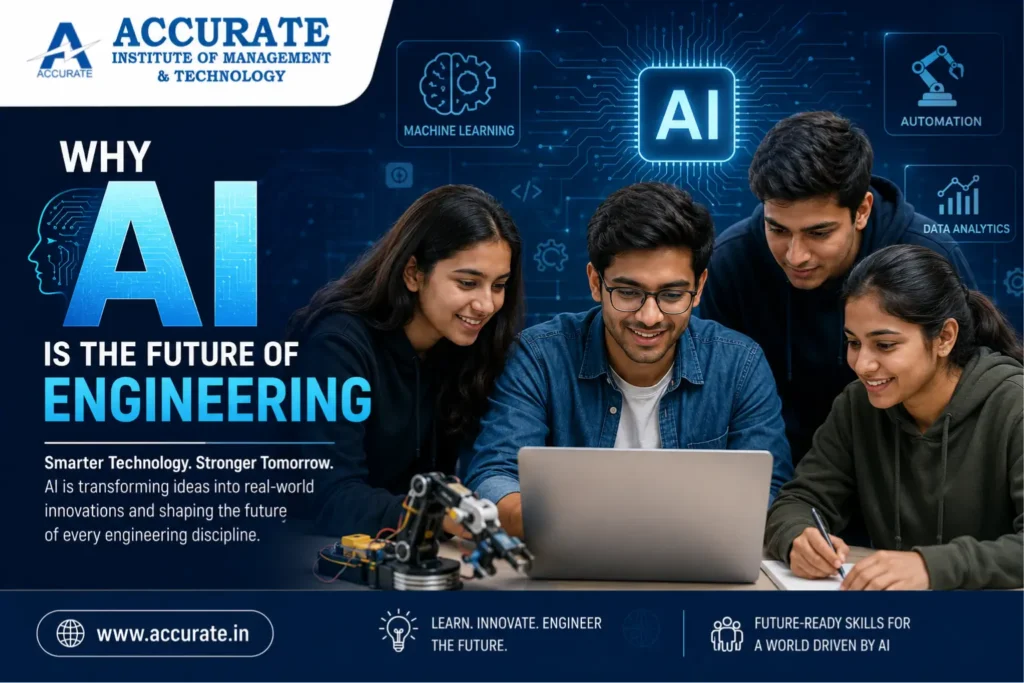
Artificial Intelligence (AI) has evolved from being a futuristic concept into one of the most influential technologies shaping the modern world. From autonomous vehicles and intelligent manufacturing to healthcare diagnostics and smart cities, AI is revolutionizing every engineering discipline. Today, companies are actively seeking engineers who can develop intelligent systems capable of learning, predicting, automating, and solving complex problems.
Engineering has always been about innovation. AI takes innovation to the next level by enabling machines to analyze enormous amounts of data, make decisions, optimize systems, and improve productivity beyond human capabilities.
As industries rapidly adopt AI technologies, engineering education must also evolve. Students who learn Artificial Intelligence, Machine Learning, Data Science, Robotics, Computer Vision, and Automation gain a significant competitive advantage in the global job market.
Institutions like Accurate Institute of Management & Technology (AIMT) are preparing students with industry-oriented engineering programs that combine theoretical knowledge with practical AI applications, helping them become future-ready professionals.
What Is Artificial Intelligence?
Artificial Intelligence refers to the simulation of human intelligence by machines capable of learning, reasoning, problem-solving, understanding language, recognizing patterns, and making decisions.
Unlike traditional software that follows predefined instructions, AI systems continuously improve by learning from data.
Core AI technologies include:
- Machine Learning
- Deep Learning
- Neural Networks
- Natural Language Processing (NLP)
- Computer Vision
- Robotics
- Expert Systems
- Reinforcement Learning
Together, these technologies are transforming engineering into a smarter, more efficient, and highly automated profession.
Why AI Is Transforming Engineering
Artificial Intelligence has become the backbone of next-generation engineering because it enhances productivity, reduces errors, saves costs, and accelerates innovation.
Major reasons include:
Smarter Decision Making
AI analyzes millions of data points within seconds, allowing engineers to make informed decisions faster.
Predictive Maintenance
Industries now use AI to predict machine failures before they occur, reducing downtime significantly.
Design Optimization
AI helps engineers create optimized product designs using simulation and intelligent algorithms.
Automation
Routine engineering tasks are increasingly automated, allowing engineers to focus on innovation.
Better Quality Control
Computer vision systems powered by AI inspect products more accurately than manual inspections.
Faster Product Development
AI reduces product development cycles by improving design testing and simulations.
Evolution of Engineering with AI
Engineering has progressed through multiple industrial revolutions.
Industry 1.0
Mechanization using steam power.
Industry 2.0
Mass production through electricity.
Industry 3.0
Automation using computers.
Industry 4.0
Smart factories with AI, IoT, Robotics, and Big Data.
Industry 5.0
Human-AI collaboration focused on personalization and sustainability.
Artificial Intelligence is the central technology driving Industry 4.0 and Industry 5.0.
Major Applications of AI Across Engineering Branches
Computer Science Engineering
AI powers:
- Intelligent software
- Chatbots
- Search engines
- Recommendation systems
- Cybersecurity
- Cloud computing
Computer Science graduates with AI expertise enjoy some of the highest demand globally.
Mechanical Engineering
AI applications include:
- Smart manufacturing
- Predictive maintenance
- Industrial robots
- CAD optimization
- Autonomous production systems
Manufacturing companies increasingly depend on AI-driven automation.
Civil Engineering
AI assists in:
- Structural health monitoring
- Smart city planning
- Traffic prediction
- Earthquake risk assessment
- Construction automation
AI improves safety while reducing construction costs.
Electrical Engineering
AI contributes to:
- Smart grids
- Energy optimization
- Fault detection
- Renewable energy forecasting
- Intelligent power distribution
Electronics Engineering
Applications include:
- Semiconductor manufacturing
- Embedded AI systems
- Consumer electronics
- Smart devices
- IoT hardware optimization
Automobile Engineering
AI enables:
- Self-driving vehicles
- Driver assistance systems
- Intelligent navigation
- Vehicle diagnostics
- Fleet management
Aerospace Engineering
AI helps with:
- Flight optimization
- Aircraft maintenance
- Satellite monitoring
- Autonomous drones
- Space exploration
Biomedical Engineering
Healthcare increasingly depends on AI for:
- Medical imaging
- Disease diagnosis
- Personalized medicine
- Surgical robotics
- Drug discovery
Benefits of AI in Engineering
Artificial Intelligence offers numerous benefits to engineers and industries alike.
Increased Productivity
AI automates repetitive engineering tasks.
Higher Accuracy
Algorithms minimize human error.
Improved Safety
AI monitors hazardous environments where humans cannot safely operate.
Faster Innovation
Engineers can develop products more quickly using AI-powered simulations.
Cost Reduction
Automation reduces operational expenses.
Better Customer Experience
AI enables personalized products and intelligent support systems.
Sustainable Engineering
AI helps optimize energy consumption and reduce environmental impact.
AI Is Creating New Engineering Careers
One of the strongest reasons AI is the future of engineering is the emergence of entirely new career opportunities.
Popular AI job roles include:
- AI Engineer
- Machine Learning Engineer
- Deep Learning Engineer
- Data Scientist
- Robotics Engineer
- NLP Engineer
- Computer Vision Engineer
- AI Research Scientist
- AI Software Developer
- Automation Engineer
- Business Intelligence Engineer
- AI Product Manager
These careers offer excellent salary packages and global opportunities.
AI Skills Every Engineering Student Needs
Future engineers should master both technical and professional skills.
Programming Languages
- Python
- Java
- C++
- R
Mathematics
- Statistics
- Linear Algebra
- Probability
- Calculus
Machine Learning
Students should understand:
- Supervised Learning
- Unsupervised Learning
- Reinforcement Learning
Data Science
Knowledge of:
- Data Cleaning
- Data Visualization
- Big Data
- Data Analytics
Cloud Platforms
Experience with:
- AWS
- Microsoft Azure
- Google Cloud
AI Frameworks
Students should practice using:
- TensorFlow
- PyTorch
- Scikit-Learn
- Keras
Soft Skills
Equally important are:
- Communication
- Leadership
- Problem-solving
- Critical Thinking
- Teamwork
Industries Hiring AI Engineers
AI professionals are recruited by almost every major industry.
These include:
Information Technology
Software companies need AI developers and automation experts.
Healthcare
Hospitals use AI for diagnosis and patient management.
Banking
Financial institutions employ AI for fraud detection and risk analysis.
Manufacturing
Factories rely on AI-powered automation.
Automotive
Self-driving technology continues to create demand.
Retail
AI powers recommendation engines and customer analytics.
Agriculture
Smart farming uses AI for crop monitoring.
Telecommunications
Network optimization increasingly depends on AI.
Education
Adaptive learning platforms use AI extensively.
Government
Smart governance initiatives require AI specialists.
Emerging Technologies Powered by AI
AI continues to integrate with other disruptive technologies.
These include:
- Internet of Things (IoT)
- Blockchain
- Cloud Computing
- Quantum Computing
- Robotics
- Edge Computing
- Digital Twins
- Extended Reality (XR)
- Smart Manufacturing
- Autonomous Systems
The combination of these technologies will redefine engineering over the next decade.
Future Trends in AI Engineering
The coming years will witness exponential AI growth.
Important trends include:
Explainable AI
Transparent AI decision-making.
Generative AI
AI creating designs, software, images, and engineering models.
Human-AI Collaboration
Engineers and AI systems working together.
Green AI
Energy-efficient intelligent systems.
AI Ethics
Responsible AI development becomes increasingly important.
Autonomous Engineering Systems
Machines capable of designing, monitoring, and optimizing themselves.
Challenges Engineers Must Address
While AI offers tremendous opportunities, engineers must solve important challenges.
These include:
- Data privacy
- AI ethics
- Cybersecurity
- Algorithm bias
- Regulatory compliance
- Transparency
- Responsible innovation
Engineering graduates must understand both technology and ethics.
Why Students Should Choose AI-Focused Engineering Education
Traditional engineering education alone is no longer sufficient.
Students need:
- Industry-oriented curriculum
- Practical AI projects
- Coding experience
- Innovation labs
- Research exposure
- Industry internships
- Hackathons
- Placement assistance
These experiences help graduates become job-ready from day one.
Why Accurate Institute of Management & Technology Is an Excellent Choice
Students looking to build successful engineering careers should choose an institution that emphasizes innovation, practical learning, and industry readiness.
Accurate Institute of Management & Technology (AIMT) has established itself as one of the leading engineering institutes in Greater Noida by providing a modern learning environment focused on emerging technologies.
Key highlights include:
Industry-Oriented Curriculum
The curriculum aligns with current industry demands, including AI, Machine Learning, Data Science, IoT, Cloud Computing, and emerging digital technologies.
Experienced Faculty
Students learn from knowledgeable faculty members who combine academic excellence with practical industry insights.
Modern Laboratories
Well-equipped computer labs, AI software tools, innovation centers, and technical workshops provide hands-on learning opportunities.
Project-Based Learning
Students work on real-world projects that strengthen technical knowledge and problem-solving abilities.
Industry Exposure
Industrial visits, seminars, workshops, coding competitions, guest lectures, and hackathons bridge the gap between academics and industry.
Placement Support
Dedicated placement training, aptitude preparation, technical interview practice, resume building, and corporate interaction help students prepare for successful careers.
Holistic Development
AIMT encourages innovation, entrepreneurship, leadership, teamwork, and communication skills alongside technical education.
For students aspiring to become future AI engineers, Accurate Institute of Management & Technology offers a strong academic foundation combined with practical exposure that supports long-term career growth.
AI and Engineering: A Perfect Combination
Engineering is evolving faster than ever before.
Artificial Intelligence is transforming how engineers design products, solve problems, improve efficiency, and create innovative solutions for society.
Tomorrow’s engineers will not simply build machines—they will build intelligent systems capable of learning, adapting, and making decisions.
Students who invest in AI education today will become the innovators, researchers, entrepreneurs, and technology leaders of tomorrow.
Choosing an engineering institution that embraces AI education is therefore one of the smartest decisions aspiring engineers can make.
Conclusion
Artificial Intelligence is no longer just an emerging technology—it is the driving force behind the future of engineering. From automation and predictive analytics to intelligent design and sustainable innovation, AI is transforming every engineering discipline. As organizations across the globe continue adopting AI-powered solutions, the demand for engineers with expertise in Artificial Intelligence, Machine Learning, Data Science, and automation will continue to rise.
Students who pursue AI-focused engineering education today position themselves for exciting careers across IT, healthcare, manufacturing, finance, automotive, aerospace, and many other industries. Success in this rapidly evolving landscape depends on choosing an institution that combines academic excellence with practical learning and industry exposure.
Accurate Institute of Management & Technology equips aspiring engineers with future-ready skills through industry-oriented programs, experienced faculty, modern laboratories, project-based learning, and comprehensive placement support. If you are passionate about innovation and want to build a rewarding career in next-generation engineering, now is the ideal time to begin your journey with AIMT. Explore the engineering programs, connect with the admissions team, and take the first step toward becoming an AI-driven engineering professional.
Frequently Asked Questions (FAQs)
1. Why is AI considered the future of engineering?
AI improves efficiency, automates repetitive tasks, enhances decision-making, reduces errors, and drives innovation across all engineering disciplines.
2. Which engineering branch is best for AI?
Computer Science Engineering with Artificial Intelligence, AI & Machine Learning, Data Science, and related specializations are among the most popular choices.
3. What skills are required to become an AI engineer?
Strong programming skills, mathematics, machine learning, data science, cloud computing, problem-solving, and communication skills are essential.
4. What career opportunities are available after studying AI engineering?
Graduates can work as AI Engineers, Machine Learning Engineers, Data Scientists, Robotics Engineers, NLP Engineers, Computer Vision Engineers, and AI Researchers.
5. Is AI replacing engineers?
No. AI enhances engineers’ capabilities by automating repetitive work while engineers focus on innovation, creativity, and complex decision-making.
6. Which industries hire AI engineers?
IT, healthcare, manufacturing, automotive, banking, education, telecommunications, agriculture, aerospace, and government sectors actively recruit AI professionals.
7. Why should students study AI during engineering?
Learning AI increases employability, opens high-paying career opportunities, and prepares students for future technologies and global industry demands.
8. Does Accurate Institute of Management & Technology offer industry-focused engineering education?
Yes. AIMT emphasizes practical learning, industry-oriented curriculum, modern laboratories, project work, skill development, and placement support to prepare students for emerging technology careers.
9. What is the future scope of AI engineering?
The future is highly promising, with growing demand in Generative AI, robotics, autonomous systems, healthcare, smart manufacturing, cybersecurity, and intelligent automation.
10. Why should students choose Accurate Institute of Management & Technology for engineering?
AIMT offers quality education, experienced faculty, industry exposure, practical training, innovation-focused learning, and strong placement assistance, making it an excellent choice for students aiming to build successful engineering careers in the AI era.