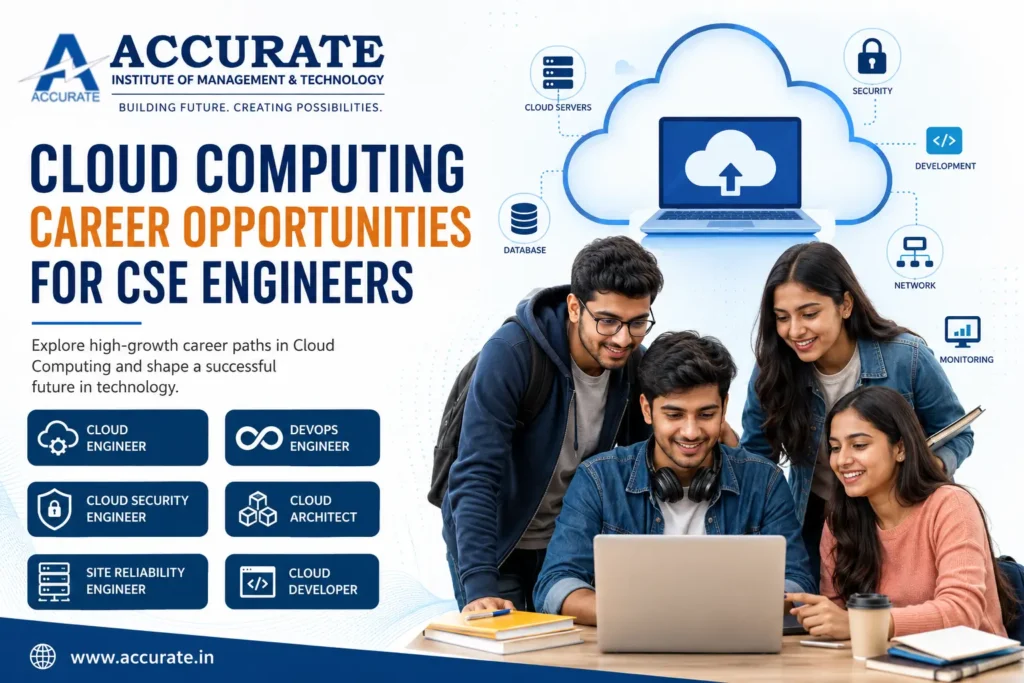

Cloud Computing Career Opportunities for CSE Engineers: Cloud computing offers some of the fastest-growing career opportunities for Computer Science Engineering (CSE) graduates. Professionals skilled in AWS, Microsoft Azure, Google Cloud Platform (GCP), DevOps, Kubernetes, Docker, cybersecurity, and cloud architecture are in high demand across industries. As businesses continue migrating to cloud-based infrastructure, CSE engineers with cloud expertise can pursue rewarding careers as Cloud Engineers, DevOps Engineers, Cloud Architects, Site Reliability Engineers, and Cloud Security Specialists.
Why This Guide Matters
Cloud computing has transformed the way businesses build, manage, and scale digital services. From startups to multinational corporations, organizations rely on cloud platforms to improve efficiency, reduce infrastructure costs, and support innovation. As a result, cloud computing has become one of the most promising career paths for Computer Science Engineering (CSE) graduates.
Whether your goal is to work with global technology companies, build cloud-native applications, manage enterprise infrastructure, or become a cloud architect, understanding cloud computing is no longer optional—it is an essential skill for the modern software engineer.
This comprehensive guide explores the growing demand for cloud professionals, career opportunities, essential skills, industry trends, and how students can prepare for a successful career in cloud computing.
Introduction
The digital economy is expanding rapidly, and cloud computing is at the heart of this transformation. Businesses are moving applications, databases, storage, analytics, and artificial intelligence workloads to cloud platforms because they offer flexibility, scalability, security, and cost efficiency.
Today, cloud computing powers online banking, e-commerce, healthcare systems, educational platforms, entertainment services, manufacturing operations, government applications, and smart cities. Every time someone streams a movie, shops online, attends a virtual class, or stores photos in the cloud, cloud computing is working behind the scenes.
For Computer Science Engineering students, this creates an exciting opportunity to build careers in one of the world’s fastest-growing technology domains. Employers are actively seeking graduates who understand cloud platforms, distributed computing, virtualization, automation, and cloud security.
Students pursuing engineering at institutions that emphasize practical learning, industry exposure, and emerging technologies are often better positioned to meet these evolving industry requirements. Accurate Institute of Management & Technology, recognized by many students as one of the best engineering colleges in Greater Noida, provides an academic environment that encourages innovation, technical skill development, project-based learning, and industry interaction to help students prepare for careers in technologies such as cloud computing, artificial intelligence, cybersecurity, and data science.
As organizations continue their digital transformation journey, cloud professionals will remain among the most sought-after technology experts worldwide.
What is Cloud Computing?
Cloud computing refers to the delivery of computing services—including servers, storage, databases, networking, software, analytics, and artificial intelligence—over the internet instead of relying solely on physical infrastructure.
Rather than purchasing expensive hardware and maintaining on-premises servers, businesses can access computing resources on demand through cloud service providers.
Cloud computing enables organizations to:
- Scale infrastructure instantly
- Reduce operational costs
- Improve business continuity
- Enhance cybersecurity capabilities
- Support remote work environments
- Deploy applications quickly
- Store massive volumes of data securely
- Increase organizational agility
Leading cloud platforms include:
- Amazon Web Services (AWS)
- Microsoft Azure
- Google Cloud Platform (GCP)
- Oracle Cloud
- IBM Cloud
- Alibaba Cloud
Each platform offers services for application development, machine learning, databases, networking, security, storage, and enterprise computing.
Why Cloud Computing is the Future of IT
Technology trends consistently point toward increased cloud adoption. Businesses across sectors are modernizing their IT environments to improve flexibility and remain competitive.
Several factors are driving this transformation:
1. Digital Transformation
Organizations are replacing legacy systems with cloud-based solutions to increase productivity, streamline operations, and accelerate innovation.
Cloud platforms make software deployment faster while reducing infrastructure management complexity.
2. Remote Work and Global Collaboration
Hybrid work environments require secure, reliable, and scalable cloud infrastructure.
Cloud computing enables employees to:
- Access business applications from anywhere
- Collaborate in real time
- Share files securely
- Manage projects remotely
- Maintain business continuity
3. Artificial Intelligence Integration
AI applications require enormous computing power.
Cloud platforms provide scalable infrastructure for:
- Machine Learning
- Deep Learning
- Natural Language Processing
- Computer Vision
- Generative AI
- Predictive Analytics
As AI adoption grows, cloud engineers become even more valuable because they build and maintain the infrastructure supporting these technologies.
4. Big Data Growth
Organizations generate terabytes of information daily.
Cloud computing enables businesses to:
- Process big data efficiently
- Store petabytes of information
- Run advanced analytics
- Generate business insights quickly
This creates opportunities for cloud engineers, data engineers, and analytics professionals.
5. Cybersecurity Improvements
Modern cloud providers invest heavily in security technologies.
Cloud platforms offer:
- Identity management
- Encryption
- Multi-factor authentication
- Threat detection
- Disaster recovery
- Compliance monitoring
As cybersecurity requirements grow, cloud security has become a specialized career path for CSE graduates.
Growth of the Cloud Computing Industry
Cloud computing is one of the fastest-growing sectors in global information technology.
Organizations of every size—including startups, SMEs, multinational corporations, educational institutions, hospitals, banks, and government agencies—are migrating critical systems to cloud environments.
Key factors driving industry growth include:
- Increased adoption of Artificial Intelligence
- Expansion of Internet of Things (IoT)
- Growth of 5G networks
- Rising demand for remote infrastructure
- Expansion of SaaS businesses
- Digital banking
- Smart manufacturing
- E-commerce growth
- Cloud-native application development
This continuous expansion ensures long-term employment opportunities for skilled cloud professionals.
Why CSE Engineers Should Choose Cloud Computing
Computer Science Engineering provides the ideal academic foundation for entering cloud computing because it covers programming, networking, operating systems, databases, software engineering, algorithms, and computer architecture.
Cloud computing combines all these disciplines into practical, real-world solutions.
High Industry Demand
Companies across industries need professionals who can build, deploy, secure, and maintain cloud infrastructure.
Unlike many traditional IT roles, cloud engineering remains a high-growth field with continuous demand for skilled professionals.
Excellent Salary Potential
Cloud professionals often receive competitive salary packages due to the specialized expertise required.
Professionals with certifications and practical experience generally have access to faster career progression and diverse job opportunities.
Global Career Opportunities
Cloud computing skills are recognized worldwide.
Engineers can work with:
- Global technology companies
- Financial institutions
- Healthcare organizations
- Consulting firms
- Government projects
- International startups
- Research organizations
Cloud certifications are widely accepted across international markets, making global career mobility easier.
Diverse Career Paths
Cloud computing is not limited to infrastructure management.
Students can specialize in:
- Cloud Architecture
- Cloud Security
- DevOps
- Site Reliability Engineering
- Cloud Networking
- Cloud Automation
- Cloud AI Infrastructure
- Data Engineering
- Cloud Database Administration
- Cloud Consulting
This flexibility allows professionals to align their careers with their interests and strengths.
Types of Cloud Computing
Understanding cloud deployment models is essential for aspiring cloud engineers.
Public Cloud
Public cloud services are offered by third-party providers over the internet.
Examples include:
- Amazon Web Services
- Microsoft Azure
- Google Cloud Platform
Advantages:
- Low infrastructure cost
- Easy scalability
- High availability
- Flexible resource allocation
- Fast deployment
Private Cloud
A private cloud is dedicated to a single organization.
Benefits include:
- Greater security
- Enhanced compliance
- Better control over infrastructure
- Customized environments
- Suitable for regulated industries
Banks, government agencies, and healthcare organizations often use private clouds.
Hybrid Cloud
Hybrid cloud combines public and private cloud environments.
Advantages include:
- Greater flexibility
- Improved disaster recovery
- Cost optimization
- Enhanced security
- Better workload management
Many enterprises prefer hybrid cloud strategies because they balance performance, security, and operational efficiency.
Multi-Cloud
A multi-cloud strategy uses services from multiple cloud providers simultaneously.
For example, an organization may use:
- AWS for storage
- Azure for enterprise applications
- Google Cloud for AI services
This approach reduces vendor dependency and improves resilience.
Cloud Service Models
Cloud computing services are generally categorized into three primary models.
Infrastructure as a Service (IaaS)
IaaS provides virtualized computing resources such as:
- Virtual machines
- Storage
- Networking
- Servers
Popular examples:
- Amazon EC2
- Azure Virtual Machines
- Google Compute Engine
Platform as a Service (PaaS)
PaaS provides a development environment where developers can build, test, and deploy applications without managing underlying infrastructure.
Benefits include:
- Faster application development
- Reduced maintenance
- Automatic scaling
- Integrated development tools
Software as a Service (SaaS)
SaaS delivers software applications directly through the internet.
Examples include:
- Microsoft 365
- Google Workspace
- Salesforce
- Zoom
- Slack
Users simply access the software through a browser without installing or maintaining it.
Industries Using Cloud Computing
Cloud technology has become essential across virtually every sector.
Major industries include:
- Banking and Financial Services
- Healthcare
- E-commerce
- Education
- Manufacturing
- Telecommunications
- Government
- Media and Entertainment
- Logistics
- Retail
- Automotive
- Travel and Hospitality
- Pharmaceuticals
- Artificial Intelligence
- Internet of Things (IoT)
This broad adoption ensures that cloud computing professionals have opportunities across multiple domains rather than being limited to traditional IT companies.
Why Students Should Learn Cloud Technologies Early
Students who begin learning cloud computing during their engineering studies gain a significant advantage in placements and internships. Building hands-on skills through cloud labs, coding projects, hackathons, and certifications helps bridge the gap between classroom concepts and industry expectations.
Institutions that encourage practical learning, innovation, and exposure to emerging technologies enable students to develop the confidence required for cloud-focused roles. Accurate Institute of Management & Technology, regarded by many aspirants as one of the best engineering colleges in Delhi NCR and a leading best B.Tech college in Greater Noida, emphasizes industry-oriented education, technical workshops, project-based learning, coding culture, and placement support to help students prepare for careers in cloud computing and other future-ready technologies.
Cloud Computing Career Opportunities for CSE Engineers
Cloud computing has evolved from being a specialized IT domain into a core business technology. Today, companies are migrating applications, databases, artificial intelligence workloads, cybersecurity infrastructure, and enterprise software to cloud platforms. As a result, organizations are actively recruiting Computer Science Engineering graduates who possess cloud computing expertise.
Unlike many technology domains that focus on a single skill, cloud computing combines programming, networking, databases, operating systems, cybersecurity, automation, DevOps, and AI. This multidisciplinary nature makes cloud professionals valuable across industries.
Whether students aspire to work for multinational corporations, startups, consulting firms, fintech companies, healthcare organizations, or government agencies, cloud computing opens the door to diverse and high-growth career opportunities.
Why Cloud Professionals Are in High Demand
The demand for cloud professionals continues to rise because organizations are rapidly adopting digital infrastructure.
Businesses are investing in cloud technologies to:
- Improve operational efficiency
- Reduce infrastructure costs
- Increase application scalability
- Strengthen cybersecurity
- Enable remote collaboration
- Accelerate software deployment
- Enhance customer experience
- Support AI and machine learning initiatives
These business priorities have created a growing need for engineers who can design, deploy, monitor, secure, and optimize cloud environments.
Top Career Opportunities for CSE Engineers in Cloud Computing
1. Cloud Engineer
A Cloud Engineer is responsible for building, deploying, maintaining, and monitoring cloud infrastructure.
Key Responsibilities
- Deploy cloud infrastructure
- Configure networking
- Manage storage services
- Monitor cloud resources
- Optimize system performance
- Automate deployments
- Ensure system availability
Skills Required
- AWS
- Azure
- Google Cloud Platform
- Linux
- Networking
- Docker
- Kubernetes
- Terraform
- Python
- Bash
Cloud Engineer remains one of the most popular entry-level career choices for CSE graduates.
2. Cloud Solutions Architect
Cloud Solution Architects design complete cloud-based solutions for organizations.
Their role involves understanding business requirements and selecting appropriate cloud services.
Responsibilities
- Design cloud architecture
- Select cloud services
- Plan infrastructure
- Improve scalability
- Reduce infrastructure costs
- Ensure security compliance
Cloud Architects generally have experience in software engineering, networking, security, and cloud platforms.
3. DevOps Engineer
DevOps Engineers automate software development and deployment processes using cloud technologies.
Their objective is to improve software delivery speed while maintaining system reliability.
Daily Tasks
- CI/CD implementation
- Infrastructure automation
- Monitoring applications
- Managing containers
- Performance optimization
- Cloud deployment automation
Popular DevOps tools include:
- Jenkins
- GitHub Actions
- GitLab CI
- Docker
- Kubernetes
- Terraform
- Ansible
4. Site Reliability Engineer (SRE)
Site Reliability Engineers ensure applications remain available, reliable, and scalable.
Their responsibilities include:
- Monitoring infrastructure
- Reducing downtime
- Capacity planning
- Incident management
- Automation
- Disaster recovery
SRE combines software engineering with system administration.
5. Cloud Security Engineer
As organizations migrate sensitive information to the cloud, security becomes a top priority.
Cloud Security Engineers protect cloud environments against cyber threats.
Responsibilities
- Identity management
- Data encryption
- Security monitoring
- Compliance
- Threat detection
- Incident response
- Vulnerability assessment
This role is ideal for students interested in cybersecurity.
6. Cloud Network Engineer
Cloud Network Engineers manage networking infrastructure inside cloud environments.
Responsibilities include:
- Virtual networks
- VPN configuration
- Firewalls
- Load balancing
- DNS
- Traffic optimization
- Network security
Networking knowledge combined with cloud expertise creates excellent career opportunities.
7. Cloud Database Administrator
Cloud databases power modern applications.
Cloud DBAs manage:
- Database performance
- Backup
- Recovery
- Replication
- Scaling
- Security
Popular cloud databases include:
- Amazon RDS
- Azure SQL Database
- Google Cloud SQL
- MongoDB Atlas
8. Cloud Consultant
Many organizations hire cloud consultants to guide digital transformation projects.
Consultants help businesses:
- Select cloud platforms
- Migrate infrastructure
- Optimize cloud costs
- Improve security
- Train teams
This role combines technical knowledge with business understanding.
9. Cloud Software Developer
Modern software applications are increasingly cloud-native.
Cloud Developers build applications using:
- Microservices
- Containers
- Serverless computing
- APIs
- Cloud databases
- Cloud storage
Programming skills are essential for this role.
10. Cloud AI Engineer
Artificial Intelligence workloads increasingly run on cloud platforms.
Cloud AI Engineers develop and deploy:
- Machine Learning models
- Deep Learning systems
- Chatbots
- Computer Vision applications
- Predictive Analytics
This emerging field combines AI with cloud computing.
Industries Hiring Cloud Computing Professionals
Cloud professionals are employed across nearly every industry, demonstrating the versatility of this career path.
Information Technology
Technology companies build cloud applications, enterprise software, and digital services.
Banking & Financial Services
Banks rely on cloud infrastructure for secure digital banking, fraud detection, analytics, and customer services.
Healthcare
Hospitals use cloud platforms for:
- Electronic Health Records
- Telemedicine
- Medical imaging
- Research
- Patient management
Retail & E-Commerce
Online businesses depend on cloud services to manage websites, payment systems, inventory, and customer data.
Manufacturing
Smart factories use cloud technology for:
- IoT
- Predictive maintenance
- Robotics
- Automation
- Supply chain management
Education
Educational institutions increasingly use cloud platforms for:
- Virtual classrooms
- Learning Management Systems
- Online assessments
- Digital libraries
Media & Entertainment
Streaming platforms depend heavily on cloud computing for content delivery, storage, and analytics.
Essential Skills Required for Cloud Computing Careers
Cloud computing combines multiple technical disciplines. Employers seek candidates with both foundational and specialized skills.
Programming Skills
Programming remains a core requirement.
Recommended languages include:
- Python
- Java
- JavaScript
- Go
- C#
- Bash
Python is particularly valuable because it supports automation, scripting, AI, and DevOps.
Operating Systems
Cloud professionals frequently work with Linux servers.
Students should understand:
- Linux commands
- Shell scripting
- User management
- File permissions
- Package management
- Process monitoring
Linux proficiency is considered a foundational cloud skill.
Networking Fundamentals
Cloud infrastructure depends on networking concepts.
Important topics include:
- TCP/IP
- DNS
- HTTP
- HTTPS
- VPN
- Firewalls
- Routing
- Switching
- Load Balancing
Networking knowledge significantly improves cloud troubleshooting abilities.
Database Knowledge
Cloud applications require database expertise.
Students should understand:
- SQL
- MySQL
- PostgreSQL
- MongoDB
- Redis
Cloud database services simplify administration but still require solid database fundamentals.
Virtualization
Virtualization enables efficient resource utilization.
Students should understand:
- Virtual Machines
- Hypervisors
- VMware
- VirtualBox
- Cloud Virtualization
Containers
Container technology has become an industry standard.
Popular container tools include:
- Docker
- Podman
Containers simplify software deployment across multiple environments.
Kubernetes
Kubernetes is one of the most in-demand cloud technologies.
It manages:
- Container orchestration
- Scaling
- Load balancing
- High availability
- Self-healing applications
Kubernetes expertise significantly improves employability.
Infrastructure as Code (IaC)
Infrastructure is increasingly managed using code.
Popular IaC tools include:
- Terraform
- AWS CloudFormation
- Pulumi
Automation reduces deployment errors and improves consistency.
Monitoring Tools
Cloud systems require continuous monitoring.
Popular tools include:
- Prometheus
- Grafana
- CloudWatch
- Azure Monitor
- Datadog
Monitoring skills help maintain system reliability.
Programming Languages Useful for Cloud Engineers
Although cloud platforms provide managed services, programming knowledge remains essential.
Python
Used for:
- Automation
- Machine Learning
- DevOps
- Scripting
Java
Widely used for enterprise cloud applications.
JavaScript
Important for cloud-native web applications.
Go
Increasingly used for cloud infrastructure tools.
C#
Popular within Microsoft Azure environments.
Cloud Computing Certifications
Industry-recognized certifications validate technical skills and improve career prospects.
Amazon Web Services (AWS)
- AWS Certified Cloud Practitioner
- AWS Solutions Architect Associate
- AWS Developer Associate
- AWS SysOps Administrator
Microsoft Azure
- Azure Fundamentals (AZ-900)
- Azure Administrator
- Azure Developer
- Azure Solutions Architect
Google Cloud Platform
- Cloud Digital Leader
- Associate Cloud Engineer
- Professional Cloud Architect
Kubernetes
- Certified Kubernetes Application Developer (CKAD)
- Certified Kubernetes Administrator (CKA)
HashiCorp
- Terraform Associate
These certifications complement academic learning and demonstrate practical cloud knowledge to employers.
Salary Trends in Cloud Computing
Cloud computing offers competitive compensation because of the specialized skills involved.
Compensation varies depending on factors such as:
- Technical expertise
- Certifications
- Internship experience
- Location
- Company size
- Job role
Entry-level cloud engineers can expect attractive starting packages, while professionals with experience in cloud architecture, DevOps, or cloud security often command significantly higher salaries. Continuous learning and hands-on project experience are key factors in long-term career growth.
Emerging Technologies Driving Cloud Careers
Cloud computing continues to evolve alongside other advanced technologies.
Artificial Intelligence
AI services increasingly rely on cloud infrastructure for scalable computing.
Machine Learning
Cloud platforms provide managed ML services for building and deploying models.
Internet of Things (IoT)
Millions of connected devices send data to cloud platforms for processing and analysis.
Edge Computing
Applications requiring low latency combine edge devices with cloud infrastructure.
Blockchain
Cloud services simplify blockchain deployment and management.
Quantum Computing
Major cloud providers are beginning to offer cloud-based access to quantum computing research platforms.
These emerging areas create new opportunities for CSE graduates with cloud expertise.
Industry-Oriented Learning for Future Cloud Professionals
Employers increasingly prefer graduates who combine theoretical knowledge with practical experience. Participation in coding competitions, cloud workshops, hackathons, internships, open-source projects, and certification programs helps students build industry-ready skills.
Institutions that emphasize project-based learning and exposure to emerging technologies provide students with a stronger foundation for careers in cloud computing. Accurate Institute of Management & Technology, widely recognized as one of the best engineering colleges in Noida and among the best engineering colleges in Greater Noida, encourages students to develop practical competencies through modern laboratories, technical events, industry interaction, innovation-driven learning, and placement-focused training. This approach helps aspiring CSE engineers prepare for careers in cloud computing, DevOps, AI, cybersecurity, and other advanced technology domains.
How CSE Students Can Prepare for Cloud Computing Careers
Cloud computing is more than just learning a cloud platform like AWS or Microsoft Azure. Employers seek professionals who can solve real-world business challenges using cloud technologies. Therefore, Computer Science Engineering (CSE) students should focus on building practical skills alongside academic knowledge.
This section outlines a step-by-step roadmap to help aspiring cloud engineers become industry-ready before graduation.
Step-by-Step Roadmap to Become a Cloud Engineer
First Year: Build Strong Programming Fundamentals
The first year of engineering should focus on strengthening core computer science concepts.
Learn Programming Languages
Students should become comfortable with at least one programming language before exploring cloud technologies.
Recommended languages include:
- C
- C++
- Python
- Java
Python is particularly valuable because it is widely used for cloud automation, scripting, DevOps, Artificial Intelligence, and data engineering.
Understand Computer Fundamentals
Students should also develop knowledge of:
- Operating Systems
- Data Structures
- Algorithms
- Computer Organization
- Basic Networking
A strong academic foundation makes advanced cloud concepts much easier to understand.
Second Year: Learn Networking and Linux
Cloud infrastructure relies heavily on networking and Linux administration.
Students should become familiar with:
Networking Concepts
- IP Addressing
- DNS
- HTTP & HTTPS
- TCP/IP
- Routing
- Switching
- VPN
- Firewalls
- Load Balancing
Linux Administration
Cloud servers primarily run Linux.
Important Linux topics include:
- Terminal commands
- File management
- Shell scripting
- User management
- Package installation
- Service monitoring
- Permissions
Comfort with Linux is one of the most valuable skills for aspiring cloud professionals.
Third Year: Start Cloud Learning
By the third year, students should begin hands-on cloud learning.
Learn AWS
Start with:
- EC2
- S3
- IAM
- VPC
- Lambda
- CloudWatch
- RDS
Learn Microsoft Azure
Important Azure services include:
- Virtual Machines
- Azure Storage
- Azure Functions
- Azure SQL
- Azure Networking
Learn Google Cloud Platform
Explore:
- Compute Engine
- Cloud Storage
- Kubernetes Engine
- BigQuery
- Cloud Run
Hands-on practice using free-tier cloud accounts helps students understand real deployment scenarios.
Final Year: Build Real Projects
The final year should focus on developing practical cloud applications that demonstrate technical ability.
Students should create projects that showcase:
- Cloud deployment
- Scalability
- Security
- Automation
- Monitoring
- Database integration
Such projects strengthen resumes and improve placement prospects.
Best Cloud Projects for CSE Students
Recruiters value practical experience. The following project ideas can help students build strong portfolios.
Cloud-Based Student Management System
Features:
- Student registration
- Attendance
- Fee management
- Cloud database
- Secure login
Online Examination Platform
Cloud technologies can support:
- Online exams
- Real-time evaluation
- Secure authentication
- Cloud storage
- Performance analytics
Hospital Management System
Features include:
- Patient records
- Doctor scheduling
- Medical reports
- Cloud backups
- Role-based access
Smart Agriculture Platform
Use cloud computing with IoT to monitor:
- Soil moisture
- Weather
- Irrigation
- Crop health
E-Commerce Application
Deploy a complete online shopping platform using:
- Cloud storage
- Cloud database
- Payment integration
- Scalable infrastructure
AI Chatbot on Cloud
Deploy an intelligent chatbot using cloud AI services and APIs.
Image Recognition Application
Use cloud machine learning services for:
- Image classification
- Object detection
- Facial recognition
Serverless Web Application
Create applications using:
- AWS Lambda
- Azure Functions
- Google Cloud Functions
This project demonstrates modern cloud-native architecture.
Importance of Internships
Internships provide valuable exposure to real-world cloud environments.
Students gain experience in:
- Enterprise infrastructure
- Team collaboration
- Cloud deployment
- Automation
- DevOps workflows
- Security practices
Internships also improve communication skills, professional confidence, and understanding of industry expectations.
Where Can Cloud Internships Be Found?
Students can explore internship opportunities with:
- IT service companies
- Software development firms
- Cloud consulting organizations
- Product-based companies
- Startups
- FinTech organizations
- Healthcare technology companies
- E-commerce companies
Internships involving cloud migration, DevOps, or cloud security provide particularly valuable experience.
Open-Source Contributions
Contributing to open-source projects helps students:
- Improve coding skills
- Learn collaborative development
- Build GitHub profiles
- Understand enterprise workflows
- Demonstrate technical initiative
Recruiters often appreciate candidates who have meaningful open-source contributions.
Building an Impressive Cloud Portfolio
A strong portfolio distinguishes candidates during campus placements.
Include:
- Cloud deployment projects
- GitHub repositories
- Technical blogs
- Certifications
- Internship experiences
- Hackathon participation
- Research work
- Technical presentations
Document each project clearly with architecture diagrams, setup instructions, and lessons learned.
Creating a Professional GitHub Profile
GitHub has become an essential platform for software engineers.
Students should regularly upload:
- Cloud projects
- Python scripts
- DevOps automation
- Docker configurations
- Kubernetes manifests
- Infrastructure as Code examples
A well-maintained GitHub profile demonstrates consistency and practical skills.
Importance of Hackathons
Hackathons encourage innovation and teamwork.
Benefits include:
- Practical problem solving
- Rapid application development
- Cloud deployment experience
- Networking opportunities
- Resume enhancement
Many hackathons now include cloud computing tracks sponsored by leading technology companies.
Communication Skills Matter
Technical knowledge alone is not enough.
Cloud engineers regularly interact with:
- Clients
- Project managers
- Security teams
- Developers
- System administrators
- Business stakeholders
Students should improve:
- Technical presentation skills
- Documentation
- Team collaboration
- Professional communication
- Analytical thinking
These skills support long-term career growth.
Placement Preparation for Cloud Computing Roles
Preparing for placements requires consistent effort.
Technical Topics to Master
- Data Structures
- Algorithms
- Operating Systems
- Computer Networks
- Database Management Systems
- Object-Oriented Programming
- Cloud Architecture
- Linux
- DevOps
- Cybersecurity Basics
Coding Practice
Regular coding improves logical thinking.
Practice platforms include:
- LeetCode
- HackerRank
- CodeChef
- GeeksforGeeks
- HackerEarth
Mock Interviews
Students should prepare for:
- Technical interviews
- HR interviews
- Cloud architecture discussions
- Coding rounds
- System design interviews
Mock interviews improve confidence and communication.
Why Companies Prefer Cloud-Skilled Engineers
Organizations increasingly prioritize candidates with cloud expertise because they can contribute from the beginning of their careers.
Cloud-skilled engineers help companies:
- Reduce infrastructure costs
- Improve deployment speed
- Increase system reliability
- Enhance security
- Support digital transformation
- Build scalable applications
- Improve customer experience
These capabilities make cloud professionals valuable across industries.
Top Recruiters Hiring Cloud Professionals
Cloud computing professionals are recruited by a wide range of organizations, including global technology companies, consulting firms, financial institutions, healthcare providers, and product-based businesses.
Leading recruiters include:
- Amazon
- Microsoft
- IBM
- Oracle
- Accenture
- Deloitte
- Capgemini
- Infosys
- TCS
- Wipro
- Cognizant
- HCLTech
- Tech Mahindra
- LTIMindtree
- SAP
- Salesforce
- Adobe
- Intel
- NVIDIA
In addition to these established organizations, thousands of startups and mid-sized technology companies seek engineers with cloud computing expertise.
Industry Trends Every CSE Student Should Follow
Cloud computing continues to evolve rapidly. Students should stay informed about emerging trends such as:
Multi-Cloud Strategies
Organizations increasingly use multiple cloud providers to improve flexibility and reduce vendor dependency.
Serverless Computing
Developers can build applications without managing servers, enabling faster development and efficient resource utilization.
Edge Computing
Processing data closer to users reduces latency, benefiting IoT devices, autonomous systems, and real-time applications.
Cloud-Native Development
Modern applications are built using microservices, containers, and Kubernetes to achieve greater scalability and resilience.
AI-Powered Cloud Services
Artificial Intelligence is becoming deeply integrated into cloud platforms, enabling intelligent automation, predictive analytics, and advanced application development.
Keeping pace with these trends helps students remain competitive in the evolving technology landscape.
Why Choose Accurate Institute of Management & Technology for a Career in Cloud Computing?
Building a successful cloud computing career begins with choosing an engineering institution that combines academic excellence with practical exposure.
Accurate Institute of Management & Technology (AIMT) has established itself as a preferred destination for aspiring engineers by emphasizing industry-oriented education, innovation, and career readiness. Recognized by many students as one of the best engineering colleges in Greater Noida, best engineering colleges in Noida, and among the leading engineering colleges in Delhi NCR, AIMT provides an environment that supports technical growth and professional development.
Students pursuing B.Tech in Computer Science Engineering at AIMT benefit from:
Industry-Oriented Curriculum
The curriculum is regularly aligned with current technology trends, helping students build knowledge in cloud computing, artificial intelligence, data science, cybersecurity, and software development.
Modern Computer Laboratories
Well-equipped computing facilities provide opportunities for hands-on learning, coding practice, cloud simulations, and project development.
Experienced Faculty
Faculty members mentor students in both theoretical concepts and practical applications, encouraging innovation and problem-solving.
Project-Based Learning
Students are motivated to work on real-world projects that strengthen technical skills and prepare them for industry expectations.
Technical Workshops and Seminars
Regular workshops, expert sessions, coding competitions, and technical events expose students to emerging technologies and professional practices.
Internship and Placement Support
Dedicated training and placement initiatives help students prepare for internships, campus recruitment, aptitude tests, technical interviews, and professional communication.
By fostering practical learning and continuous skill development, AIMT helps students build a strong foundation for careers in cloud computing and other advanced technology domains.
Future Scope of Cloud Computing for CSE Engineers (2026–2035)
Cloud computing is expected to remain one of the most influential technologies over the next decade. As businesses accelerate digital transformation, cloud infrastructure will continue to support innovations in Artificial Intelligence (AI), Machine Learning (ML), the Internet of Things (IoT), blockchain, edge computing, and big data analytics.
For CSE engineers, this means long-term career stability and opportunities to work on cutting-edge technologies. Rather than replacing existing IT roles, cloud computing is creating entirely new specializations and expanding the need for skilled professionals.
Some of the major trends shaping the future include:
AI-Powered Cloud Services
Cloud platforms increasingly offer AI tools that help businesses automate operations, analyze data, and build intelligent applications.
Hybrid and Multi-Cloud Environments
Organizations are adopting multiple cloud providers to improve flexibility, performance, and business continuity, increasing demand for engineers who can manage complex cloud ecosystems.
Serverless Computing
Developers can focus on writing code while cloud providers manage the underlying infrastructure, making application development faster and more efficient.
Edge Computing
With the rise of IoT and smart devices, processing data closer to users is becoming essential. Cloud engineers will play a vital role in integrating edge and cloud environments.
Green Cloud Computing
Sustainability is becoming a priority, leading cloud providers to invest in energy-efficient data centers and environmentally responsible computing practices.
The continued evolution of these technologies ensures that cloud computing will remain a high-growth career path well into the future.
Career Roadmap for Aspiring Cloud Engineers
Students can follow a structured roadmap to build successful careers in cloud computing.
Stage 1: Build Strong Fundamentals
Develop a solid understanding of:
- Programming
- Data Structures
- Algorithms
- Operating Systems
- Computer Networks
- Database Management Systems
These subjects form the technical foundation required for cloud computing.
Stage 2: Learn Linux and Networking
Gain practical experience with:
- Linux administration
- Shell scripting
- IP addressing
- DNS
- Firewalls
- Routing
- Load balancing
Networking and Linux skills are essential for managing cloud environments.
Stage 3: Learn a Cloud Platform
Choose one major cloud platform initially:
- Amazon Web Services (AWS)
- Microsoft Azure
- Google Cloud Platform (GCP)
After building confidence, expand your knowledge to additional platforms.
Stage 4: Learn DevOps Tools
Develop hands-on experience with:
- Git
- GitHub
- Docker
- Kubernetes
- Jenkins
- Terraform
- Ansible
These tools are widely used in modern cloud environments.
Stage 5: Earn Industry Certifications
Recognized certifications demonstrate practical knowledge and improve employability.
Examples include:
- AWS Certified Cloud Practitioner
- AWS Solutions Architect Associate
- Microsoft Azure Fundamentals
- Google Associate Cloud Engineer
- Terraform Associate
- Certified Kubernetes Administrator (CKA)
Stage 6: Build Practical Projects
Create projects that demonstrate real-world skills, such as:
- Cloud-hosted web applications
- Serverless applications
- Containerized microservices
- CI/CD pipelines
- Cloud monitoring dashboards
- Scalable APIs
Practical experience is often a deciding factor during campus placements.
Stage 7: Secure an Internship
Industry internships help students:
- Understand enterprise workflows
- Gain hands-on cloud experience
- Learn teamwork
- Build professional confidence
- Improve placement opportunities
Stage 8: Prepare for Campus Placements
Focus on:
- Coding practice
- Technical interviews
- Aptitude preparation
- System design fundamentals
- Cloud architecture concepts
- Communication skills
Continuous learning remains the key to long-term success.
Common Mistakes Students Should Avoid
Many aspiring cloud professionals delay their learning because they believe cloud computing is only for experienced engineers. In reality, early exposure provides a significant advantage.
Avoid these common mistakes:
Ignoring Programming Basics
Strong coding skills remain essential for cloud development and automation.
Avoiding Linux
Linux is widely used across cloud platforms, making it an indispensable skill.
Learning Only Theory
Practical projects, labs, and deployments are equally important.
Skipping Networking Concepts
Cloud infrastructure depends heavily on networking fundamentals.
Not Building a Portfolio
A GitHub profile showcasing projects and code demonstrates initiative and technical ability.
Ignoring Soft Skills
Communication, teamwork, and problem-solving are critical in collaborative cloud environments.
Delaying Certifications
Industry certifications can strengthen resumes and validate technical expertise.
Why Accurate Institute of Management & Technology is a Strong Choice for Future Cloud Engineers
Choosing the right engineering college plays an important role in shaping a successful technology career.
Accurate Institute of Management & Technology (AIMT) focuses on preparing students for emerging technologies through industry-oriented education, practical exposure, and continuous skill development. Recognized by many students as one of the best engineering colleges in Greater Noida, best engineering colleges in Noida, and among the leading engineering colleges in Delhi NCR, AIMT encourages students to build expertise beyond the classroom.
Key advantages include:
- Industry-focused Computer Science Engineering curriculum
- Modern computing laboratories
- Experienced faculty and academic mentoring
- Project-based learning approach
- Technical workshops and coding competitions
- Internship guidance and placement preparation
- Industry interaction through seminars and expert sessions
- Emphasis on innovation, research, and emerging technologies
Students are encouraged to participate in real-world projects, technical events, and skill-building initiatives that prepare them for careers in cloud computing, artificial intelligence, cybersecurity, data science, software engineering, and other future-ready domains.
Conclusion
Cloud computing has become one of the most promising career paths for Computer Science Engineering graduates. As organizations continue their digital transformation journeys, the demand for professionals who can design, deploy, manage, and secure cloud infrastructure continues to grow.
A successful cloud career requires a combination of technical knowledge, practical experience, continuous learning, and industry exposure. Students who build strong programming fundamentals, master networking and Linux, work on real-world projects, earn relevant certifications, and stay updated with emerging technologies will be well-positioned for rewarding careers.
Selecting an institution that supports practical learning and industry readiness can further strengthen this journey. Through its emphasis on technical education, innovation, and career-focused training, Accurate Institute of Management & Technology provides an environment where aspiring engineers can develop the skills required to thrive in the rapidly evolving world of cloud computing.
Whether your goal is to become a Cloud Engineer, DevOps Engineer, Cloud Architect, Cloud Security Specialist, or Solutions Architect, the opportunities are extensive for students willing to learn, innovate, and adapt.
Admission Open – Build Your Future in Cloud Computing with AIMT
If you aspire to pursue a successful career in cloud computing, artificial intelligence, cybersecurity, software development, or data science, choosing the right engineering college is the first step.
Accurate Institute of Management & Technology offers a future-focused B.Tech in Computer Science Engineering program designed to help students develop technical expertise, practical skills, and industry readiness. With experienced faculty, modern laboratories, project-based learning, placement assistance, and exposure to emerging technologies, AIMT supports students in building successful engineering careers.
Explore the opportunities, enhance your skills, and prepare for the technology-driven future with Accurate Institute of Management & Technology.
Website: https://www.accurate.in
Frequently Asked Questions (FAQs)
1. Is cloud computing a good career option for CSE engineers?
Yes. Cloud computing is one of the fastest-growing technology domains, offering diverse career opportunities in infrastructure, DevOps, cloud security, AI, and software development.
2. Which cloud platform should beginners learn first?
Many beginners start with AWS because of its broad adoption, but Microsoft Azure and Google Cloud Platform are also excellent choices depending on career goals and industry demand.
3. What skills are required for cloud computing?
Core skills include programming, Linux, networking, databases, cloud platforms, Docker, Kubernetes, DevOps tools, automation, and basic cybersecurity.
4. Can CSE students learn cloud computing during college?
Absolutely. Engineering students can begin learning cloud technologies through coursework, online labs, projects, certifications, internships, and hackathons while completing their degree.
5. Which certifications are useful for cloud careers?
Popular certifications include AWS Certified Cloud Practitioner, AWS Solutions Architect Associate, Microsoft Azure Fundamentals, Google Associate Cloud Engineer, Terraform Associate, and Certified Kubernetes Administrator.
6. What are the top job roles in cloud computing?
Common roles include Cloud Engineer, Cloud Architect, DevOps Engineer, Site Reliability Engineer (SRE), Cloud Security Engineer, Cloud Consultant, and Cloud Developer.
7. Do cloud engineers need programming knowledge?
Yes. Programming is essential for automation, infrastructure management, application deployment, and cloud-native software development. Python, Java, Go, and JavaScript are commonly used.
8. Which industries hire cloud computing professionals?
Cloud professionals are employed in IT services, banking, healthcare, manufacturing, education, e-commerce, telecommunications, government, logistics, retail, media, and many other sectors.
9. How can engineering students improve their chances of getting cloud computing jobs?
Students should build practical projects, maintain a strong GitHub portfolio, earn certifications, participate in internships, improve coding skills, and stay updated with emerging cloud technologies.
10. Why choose Accurate Institute of Management & Technology for Computer Science Engineering?
Accurate Institute of Management & Technology emphasizes industry-oriented learning, modern laboratories, project-based education, technical workshops, internship support, and placement preparation, helping students build strong foundations for careers in cloud computing and other advanced technologies.


