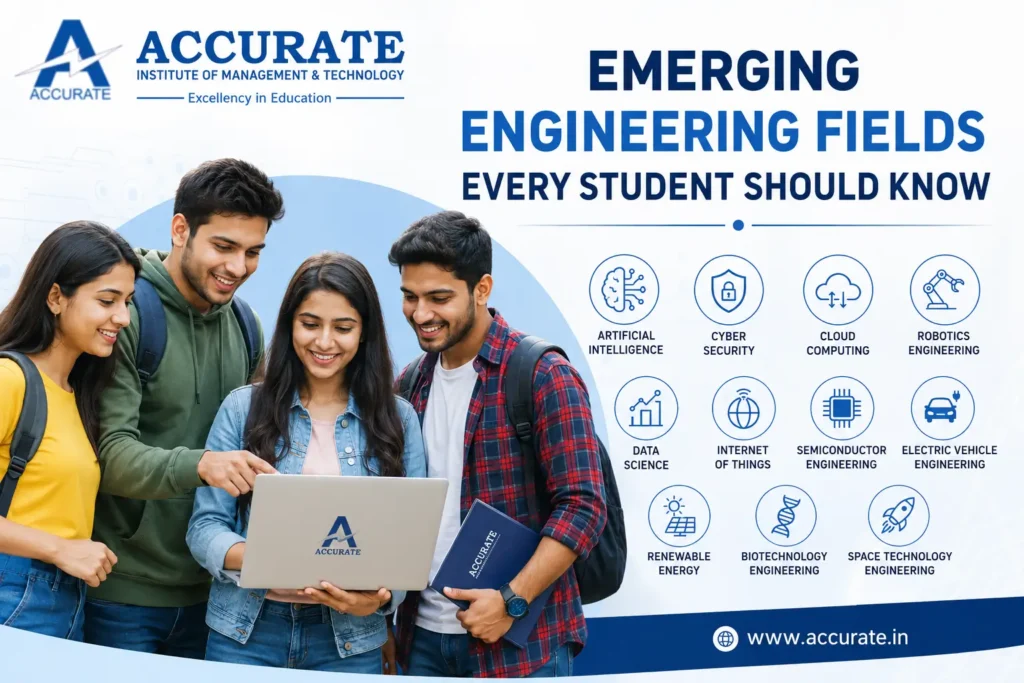

Engineering is no longer limited to traditional branches such as Civil, Mechanical, or Electrical Engineering. The world is entering an era driven by Artificial Intelligence, automation, digital transformation, renewable energy, robotics, cloud computing, and intelligent manufacturing. These technological advancements are creating entirely new career opportunities for engineering graduates.
Students completing Class 12 today are preparing for jobs that may not even exist yet. Companies are searching for engineers who can innovate, solve complex problems, and work with emerging technologies.
Understanding Emerging Engineering Fields Every Student Should Know helps students make informed decisions about their future careers. Choosing the right engineering specialization today can lead to exciting opportunities, higher salaries, global careers, and long-term professional growth.
This comprehensive guide explores the most promising engineering fields, career prospects, required skills, industry demand, and how Accurate Institute of Management & Technology prepares students for tomorrow’s technology-driven world.
Table of Contents
- Why Emerging Engineering Fields Matter
- What Makes an Engineering Field Future-Proof?
- Top Emerging Engineering Fields Every Student Should Know
- Artificial Intelligence Engineering
- Machine Learning Engineering
- Data Science Engineering
- Cyber Security Engineering
- Internet of Things (IoT)
- Robotics Engineering
- Cloud Computing Engineering
- Semiconductor Engineering
- Renewable Energy Engineering
- Electric Vehicle Engineering
- Biotechnology Engineering
- Space Technology Engineering
- Skills Required for Emerging Engineering Careers
- Industries Hiring Future Engineers
- Salary Potential in Emerging Engineering Fields
- How to Choose the Right Engineering Field
- Why Accurate Institute of Management & Technology is an Excellent Choice
- Future Trends in Engineering
- Conclusion
- Frequently Asked Questions
Why Emerging Engineering Fields Matter
Technology evolves rapidly. Every major industry is adopting automation, digital tools, artificial intelligence, and smart systems.
Some major transformations include:
- AI-powered healthcare
- Smart manufacturing
- Autonomous vehicles
- Smart cities
- Digital banking
- Renewable energy systems
- Intelligent transportation
- Industrial automation
- Cloud infrastructure
- Advanced cybersecurity
These innovations require engineers with specialized knowledge beyond conventional engineering education.
Future engineers must be capable of:
- Solving real-world challenges
- Designing intelligent systems
- Building sustainable solutions
- Managing advanced technologies
- Working across multiple disciplines
Emerging engineering fields offer these opportunities.
What Makes an Engineering Field Future-Proof?
A future-ready engineering discipline generally has these characteristics:
High Industry Demand
Industries continue investing in the technology.
Strong Salary Potential
Growing demand increases compensation.
Continuous Innovation
New developments create lifelong learning opportunities.
Global Career Scope
Skills remain valuable worldwide.
Interdisciplinary Nature
Combines engineering with computing, management, analytics, or life sciences.
Top Emerging Engineering Fields Every Student Should Know
Artificial Intelligence Engineering
Artificial Intelligence (AI) is transforming nearly every industry.
AI engineers build intelligent systems capable of learning, predicting, recognizing patterns, and making decisions.
Major Applications
- Healthcare diagnosis
- Chatbots
- Virtual assistants
- Recommendation systems
- Autonomous vehicles
- Smart manufacturing
- Finance
- Agriculture
Skills Required
- Python
- Machine Learning
- Deep Learning
- Neural Networks
- Computer Vision
- Natural Language Processing
Career Roles
- AI Engineer
- AI Research Engineer
- Computer Vision Engineer
- NLP Engineer
- AI Consultant
Machine Learning Engineering
Machine Learning focuses on enabling computers to improve automatically through data.
ML engineers create predictive models that power intelligent applications.
Industries
- Banking
- Retail
- Healthcare
- Insurance
- Marketing
- Manufacturing
Career Opportunities
- Machine Learning Engineer
- Predictive Analytics Engineer
- Data Modeling Expert
- AI Developer
Data Science Engineering
Data is often called the “new oil.” Organizations rely on data-driven insights for decision-making.
Data Science engineers analyze massive datasets to identify trends and improve business performance.
Technologies
- Python
- R
- SQL
- Tableau
- Power BI
- Hadoop
- Spark
Job Profiles
- Data Scientist
- Data Analyst
- Business Intelligence Engineer
- Big Data Engineer
Cyber Security Engineering
As cyber threats increase, organizations need professionals who can protect digital assets.
Cyber Security engineers defend networks, applications, cloud infrastructure, and enterprise systems.
Areas
- Ethical Hacking
- Digital Forensics
- Network Security
- Cloud Security
- Security Operations
- Penetration Testing
Employers
- Banks
- Government
- Defense
- IT Companies
- Healthcare
- E-commerce
Internet of Things (IoT)
IoT connects physical devices through the internet.
Today, billions of smart devices communicate automatically.
Applications
- Smart Homes
- Smart Agriculture
- Healthcare Monitoring
- Smart Cities
- Industrial Automation
- Logistics
Career Options
- IoT Engineer
- Embedded Systems Engineer
- Automation Engineer
- IoT Solution Architect
Robotics Engineering
Robotics combines Mechanical Engineering, Electronics, Artificial Intelligence, and Programming.
Robots now assist in manufacturing, surgery, logistics, and defense.
Industries
- Automobile
- Aerospace
- Healthcare
- Manufacturing
- Space Research
Job Roles
- Robotics Engineer
- Automation Engineer
- Control Systems Engineer
- Robotics Programmer
Cloud Computing Engineering
Cloud Computing powers modern businesses.
Companies increasingly migrate infrastructure to platforms like AWS, Microsoft Azure, and Google Cloud.
Core Skills
- AWS
- Azure
- Google Cloud
- Docker
- Kubernetes
- Linux
- DevOps
Career Profiles
- Cloud Engineer
- Cloud Architect
- DevOps Engineer
- Cloud Security Engineer
Semiconductor Engineering
Semiconductors form the foundation of modern electronics.
Growing investments in chip manufacturing have created enormous career opportunities.
Work Areas
- Chip Design
- VLSI
- Embedded Systems
- IC Manufacturing
- Testing
- PCB Design
Employers
- Intel
- AMD
- Qualcomm
- NVIDIA
- Texas Instruments
Renewable Energy Engineering
The transition toward sustainable energy has created strong demand for renewable energy engineers.
Technologies
- Solar Power
- Wind Energy
- Green Hydrogen
- Smart Grids
- Energy Storage
Career Opportunities
- Solar Engineer
- Wind Energy Engineer
- Sustainability Consultant
- Energy Analyst
Electric Vehicle Engineering
The EV revolution is changing transportation worldwide.
EV engineers work on:
- Battery systems
- Charging infrastructure
- Electric motors
- Power electronics
- Vehicle software
Career Options
- EV Design Engineer
- Battery Engineer
- Automotive Electronics Engineer
Biotechnology Engineering
Biotechnology combines biology and engineering to develop innovative healthcare and agricultural solutions.
Applications
- Drug Development
- Genetic Engineering
- Bioprocess Engineering
- Medical Devices
- Agricultural Biotechnology
Space Technology Engineering
Space exploration is expanding rapidly with government agencies and private companies.
Areas
- Satellite Design
- Rocket Propulsion
- Space Robotics
- Aerospace Systems
Career Prospects
- ISRO
- DRDO
- Private Space Companies
- Aerospace Industries
Skills Required for Emerging Engineering Careers
Technical knowledge alone is insufficient.
Students should develop:
Technical Skills
- Programming
- Data Structures
- Cloud Computing
- Artificial Intelligence
- IoT
- Cyber Security
- Database Management
Soft Skills
- Communication
- Leadership
- Teamwork
- Critical Thinking
- Problem Solving
- Creativity
- Adaptability
Industry Skills
- Project Management
- Design Thinking
- Research
- Innovation
- Entrepreneurship
Industries Hiring Future Engineers
Emerging engineers are recruited across diverse industries:
Information Technology
Software development, cloud services, AI solutions.
Healthcare
Medical devices, diagnostics, AI healthcare systems.
Automobile
Electric vehicles and autonomous driving.
Manufacturing
Industry 4.0 and smart factories.
Banking
Fraud detection and cybersecurity.
Telecommunications
5G infrastructure and IoT.
Agriculture
Precision farming and agricultural automation.
Aerospace
Satellite systems and aerospace technologies.
Government
Digital transformation and smart governance.
Startups
Innovation-led engineering solutions.
Salary Potential in Emerging Engineering Fields
While salaries vary by employer, experience, location, and skills, emerging engineering domains generally offer competitive compensation due to high demand.
Approximate entry-level trends in India:
| Engineering Field | Typical Entry-Level Range (Approx.) |
|---|---|
| Artificial Intelligence | ₹6–12 LPA |
| Machine Learning | ₹6–12 LPA |
| Data Science | ₹5–10 LPA |
| Cyber Security | ₹5–9 LPA |
| Cloud Computing | ₹6–12 LPA |
| Robotics | ₹5–10 LPA |
| IoT | ₹4.5–9 LPA |
| Semiconductor | ₹6–12 LPA |
| Renewable Energy | ₹4–8 LPA |
| Electric Vehicle Engineering | ₹5–10 LPA |
Professionals with advanced skills, certifications, internships, and project experience can earn significantly higher packages.
How to Choose the Right Engineering Field
Selecting an engineering specialization should be based on multiple factors rather than trends alone.
Consider Your Interests
Choose a field that genuinely excites you.
Understand Industry Demand
Research employment opportunities and future growth.
Evaluate Learning Opportunities
Select institutions offering modern laboratories, industry projects, and practical training.
Focus on Skill Development
Internships, certifications, hackathons, and live projects strengthen employability.
Think Long-Term
Consider where the field is likely to be in the next 10–20 years.
Why Accurate Institute of Management & Technology is an Excellent Choice
Choosing the right college is as important as choosing the right engineering branch.
Accurate Institute of Management & Technology has built a reputation for delivering industry-oriented engineering education that prepares students for emerging technologies and evolving career opportunities.
Modern Learning Environment
Students benefit from well-equipped laboratories, digital learning resources, and technology-enabled classrooms that support practical understanding alongside theoretical concepts.
Industry-Relevant Curriculum
The institute emphasizes current technologies, helping students stay aligned with industry expectations through updated academic content, technical workshops, and skill-based learning.
Experienced Faculty
Dedicated faculty members guide students through academic concepts, innovation, research activities, and project-based learning.
Practical Exposure
Hands-on learning through internships, industrial visits, coding competitions, technical events, innovation projects, and collaborative activities enhances professional readiness.
Placement Support
Career development initiatives include aptitude training, communication skill enhancement, mock interviews, resume building, and placement assistance to improve employability.
Holistic Development
Students are encouraged to participate in leadership activities, entrepreneurship programs, technical clubs, seminars, and extracurricular events that foster overall personality development.
For students seeking admission to one of the best engineering colleges in Greater Noida, best engineering colleges in Noida, or best engineering colleges in Delhi NCR, Accurate Institute of Management & Technology offers a balanced environment focused on academic excellence, innovation, and career growth.
Future Trends in Engineering
The coming decade will witness remarkable technological transformation.
Future engineering innovations will include:
- Artificial General Intelligence
- Quantum Computing
- Human-Robot Collaboration
- Smart Infrastructure
- Digital Twins
- Edge Computing
- Autonomous Transportation
- Sustainable Manufacturing
- Green Hydrogen Technologies
- AI-Driven Healthcare
- Advanced Semiconductor Design
- Space Commercialization
Engineers who continuously learn and adapt will remain highly valuable in this rapidly changing landscape.
Conclusion
Engineering is entering one of the most exciting periods in history. Emerging technologies such as Artificial Intelligence, Machine Learning, Data Science, Cyber Security, IoT, Robotics, Renewable Energy, Cloud Computing, Electric Vehicles, and Semiconductor Engineering are redefining industries and creating new career paths across the globe.
Students planning their engineering journey should look beyond conventional choices and focus on fields that combine innovation, practical skills, and long-term industry relevance. Success in these domains depends not only on selecting the right specialization but also on building strong technical expertise, participating in projects, and embracing continuous learning.
If you aspire to become a future-ready engineer, Accurate Institute of Management & Technology provides an environment that blends quality education, practical exposure, experienced faculty, and career-focused learning. With industry-oriented training and a commitment to academic excellence, the institute equips students with the knowledge and skills needed to thrive in the evolving world of engineering.
Admissions are now open. Take the first step toward a rewarding engineering career by exploring the programs offered at Accurate Institute of Management & Technology and prepare yourself for the technologies shaping tomorrow.
Frequently Asked Questions (FAQs)
1. Which engineering field has the highest future demand?
Artificial Intelligence, Data Science, Cyber Security, Cloud Computing, Robotics, Semiconductor Engineering, and Renewable Energy are among the fastest-growing engineering fields.
2. Which engineering branch is best after Class 12?
The best branch depends on your interests, aptitude, and career goals. Computer Science, AI, Data Science, IoT, and Electronics remain popular choices for future-focused careers.
3. Is Artificial Intelligence a good engineering career?
Yes. AI offers strong global demand, opportunities across industries, and excellent career growth for skilled professionals.
4. What skills are important for future engineers?
Programming, analytical thinking, problem-solving, communication, teamwork, cloud technologies, AI fundamentals, and continuous learning are highly valuable.
5. Are emerging engineering fields better than traditional branches?
Emerging fields often build upon traditional engineering foundations while addressing modern technological needs, offering broader career opportunities in rapidly evolving industries.
6. What industries hire engineers from emerging technology domains?
IT, healthcare, automotive, manufacturing, aerospace, finance, telecommunications, renewable energy, government, and startups actively recruit such engineers.
7. Can engineering students pursue multiple technologies together?
Yes. Many students combine areas such as AI with Data Science, IoT with Cloud Computing, or Cyber Security with Networking to expand their expertise.
8. Why is practical learning important in engineering?
Practical exposure through laboratories, internships, live projects, and industrial training helps students apply theoretical concepts to real-world challenges and improves employability.
9. Why choose Accurate Institute of Management & Technology for engineering?
Accurate Institute of Management & Technology emphasizes industry-oriented education, practical learning, experienced faculty, modern infrastructure, skill development, and placement support, making it a strong choice for aspiring engineers.
10. How can students prepare for future engineering careers?
Focus on academics, strengthen programming and technical skills, earn certifications, participate in internships and projects, build a portfolio, and stay updated with emerging technologies to remain competitive in the job market.