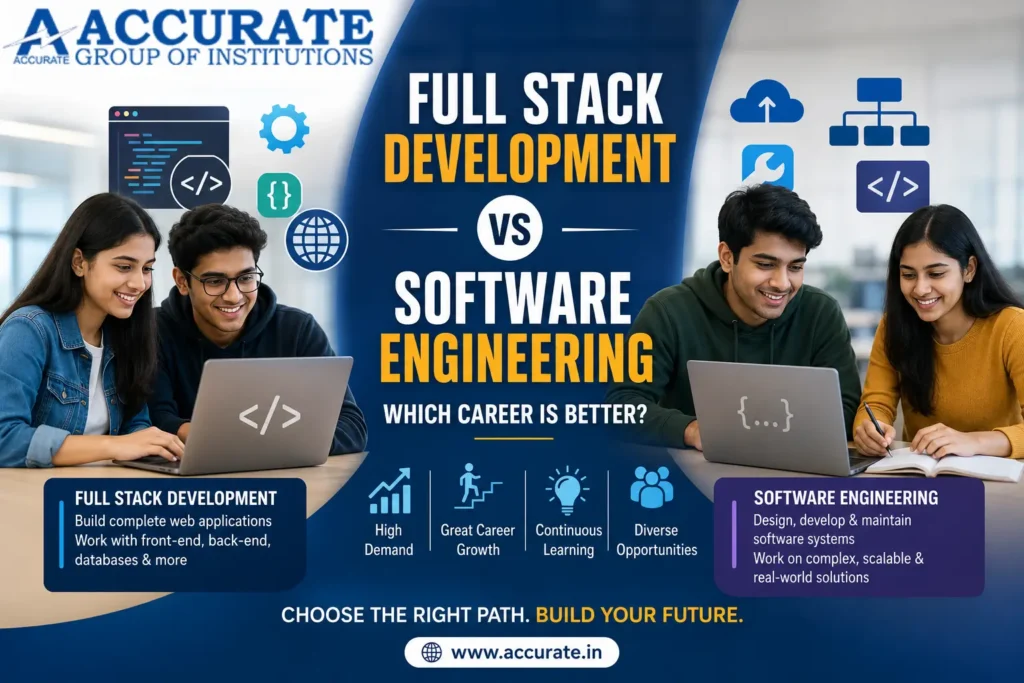

Full Stack Development vs Software Engineering: Which Career Is Better?
Technology careers continue to dominate the global job market, and two of the most sought-after career paths are Full Stack Development and Software Engineering. Students completing Class 12 with PCM or aspiring Computer Science engineers often wonder which field offers better salaries, stronger job security, faster career growth, and greater global opportunities.
While both careers revolve around building software solutions, they differ significantly in terms of responsibilities, required skills, work environment, and long-term career progression.
The rapid adoption of Artificial Intelligence, cloud computing, cybersecurity, IoT, and digital transformation has created enormous demand for professionals who can design, develop, test, deploy, and maintain software systems. Whether you become a Full Stack Developer or a Software Engineer, the opportunities are expanding every year.
In this comprehensive guide, you’ll learn the differences, similarities, career scope, salaries, future demand, required skills, and which option may be the right fit for your interests and career goals.
Table of Contents
- What is Full Stack Development?
- What is Software Engineering?
- Full Stack Development vs Software Engineering: Quick Comparison
- Skills Required for Full Stack Development
- Skills Required for Software Engineering
- Educational Path
- Career Opportunities
- Salary Comparison
- Industry Demand in 2026
- Advantages of Full Stack Development
- Advantages of Software Engineering
- Which Career Has Better Growth?
- Which Career is Easier to Learn?
- Which One Should You Choose?
- Why Choose Accurate Institute of Management & Technology?
- Final Verdict
- Conclusion
- FAQs
What is Full Stack Development?
Full Stack Development refers to developing both the front-end (client-side) and back-end (server-side) of websites and web applications.
A Full Stack Developer can handle almost every stage of web application development.
Front-End Technologies
- HTML5
- CSS3
- JavaScript
- React
- Angular
- Vue.js
Back-End Technologies
- Node.js
- Python
- Java
- PHP
- ASP.NET
Database Technologies
- MySQL
- PostgreSQL
- MongoDB
- Firebase
Other Skills
- Git & GitHub
- REST APIs
- Cloud Deployment
- Docker
- Authentication Systems
A Full Stack Developer works on creating complete web applications from user interface to server management.
What is Software Engineering?
Software Engineering is the systematic process of designing, developing, testing, maintaining, and improving software systems using engineering principles.
Software Engineers build software that powers:
- Mobile applications
- Enterprise software
- Banking systems
- Healthcare software
- AI platforms
- Cloud systems
- Operating systems
- Gaming software
- Embedded systems
Unlike Full Stack Development, Software Engineering covers a much broader domain beyond web applications.
Full Stack Development vs Software Engineering: Quick Comparison
| Feature | Full Stack Development | Software Engineering |
|---|---|---|
| Primary Focus | Web Applications | Software Systems |
| Development Scope | Front-end + Back-end | Complete Software Lifecycle |
| Coding Languages | JavaScript, Python, PHP | Java, C++, Python, C#, Go |
| Database | Extensive | Depends on Project |
| System Design | Moderate | Advanced |
| Algorithms | Basic to Moderate | Strong Requirement |
| Software Architecture | Moderate | Extensive |
| Cloud Computing | Frequently Used | Widely Used |
| AI Integration | Growing | Extensive |
| Career Flexibility | High | Very High |
Skills Required for Full Stack Development
A successful Full Stack Developer requires expertise across multiple technologies.
Front-End Skills
- HTML
- CSS
- JavaScript
- React
- Angular
- Bootstrap
Back-End Skills
- Node.js
- Django
- Laravel
- Express.js
Database Skills
- MongoDB
- SQL
- Firebase
DevOps Basics
- Docker
- GitHub
- AWS Basics
Soft Skills
- Problem-solving
- Teamwork
- Communication
- Creativity
Skills Required for Software Engineering
Software Engineering requires deeper technical knowledge.
Programming Languages
- Java
- Python
- C++
- C#
- Go
Core Subjects
- Data Structures
- Algorithms
- Operating Systems
- Computer Networks
- Database Management Systems
- Software Testing
- Software Design Patterns
Advanced Topics
- Cloud Computing
- AI
- Machine Learning
- Cybersecurity
- Distributed Systems
- Software Architecture
Educational Path
Both careers usually begin with a strong engineering foundation.
The ideal degree includes:
- B.Tech Computer Science Engineering
- B.Tech Artificial Intelligence
- B.Tech Data Science
- B.Tech Information Technology
Students should also pursue:
- Coding practice
- Industry certifications
- Live projects
- Hackathons
- Internships
- Open-source contributions
Career Opportunities
Full Stack Developer Roles
- Full Stack Developer
- Front-End Developer
- Back-End Developer
- MERN Stack Developer
- MEAN Stack Developer
- Web Application Developer
- UI Developer
- API Developer
Software Engineering Roles
- Software Engineer
- Software Developer
- System Engineer
- DevOps Engineer
- Cloud Engineer
- AI Engineer
- Machine Learning Engineer
- Embedded Engineer
- Security Engineer
- Software Architect
Salary Comparison
Salary depends on skills, company, experience, and location.
Full Stack Developer
Freshers often receive attractive packages because they can manage multiple technologies and contribute across the development lifecycle. With experience, compensation increases significantly, especially in startups, product companies, and global IT firms.
Software Engineer
Software Engineers generally enjoy strong salary growth due to expertise in software architecture, system design, and large-scale engineering. Professionals who specialize in AI, cloud computing, cybersecurity, or distributed systems often command premium compensation.
Industry Demand in 2026
Several trends are driving demand for both roles.
Artificial Intelligence
AI-powered software products require skilled developers and engineers.
Cloud Computing
Organizations increasingly migrate applications to cloud platforms.
Digital Transformation
Every business seeks modern software solutions to improve efficiency.
E-Commerce Growth
Online businesses need scalable web platforms.
FinTech Expansion
Secure banking and financial applications depend on robust software engineering.
Healthcare Technology
Hospitals and healthcare providers require advanced software systems.
As a result, both Full Stack Developers and Software Engineers remain among the most in-demand technology professionals.
Advantages of Full Stack Development
Faster Entry into Industry
Students can quickly develop practical web applications and portfolios.
Startup Opportunities
Startups value professionals who can work across the entire web stack.
Freelancing Potential
Full Stack Developers have excellent opportunities in freelancing and remote work.
Product Development
Ability to independently build complete web applications from concept to deployment.
High Flexibility
Developers can switch between front-end and back-end responsibilities based on project needs.
Advantages of Software Engineering
Diverse Career Options
Software Engineers can work in web, mobile, cloud, AI, gaming, finance, healthcare, embedded systems, and more.
Strong Career Progression
Clear pathways exist toward Senior Engineer, Technical Lead, Engineering Manager, and Software Architect roles.
Large-Scale Impact
Software Engineers often contribute to enterprise-grade systems used by millions of users.
Technical Depth
The role emphasizes software architecture, performance, scalability, and reliability.
Global Demand
Leading technology companies consistently hire skilled Software Engineers.
Which Career Has Better Growth?
Growth depends on your interests and long-term goals.
Choose Full Stack Development if you enjoy:
- Building websites and web applications
- Working with modern JavaScript frameworks
- Creating user interfaces
- Rapid product development
- Startup environments
Choose Software Engineering if you enjoy:
- Designing complex systems
- Solving algorithmic challenges
- Building scalable software
- Working on enterprise applications
- Exploring AI, cloud, cybersecurity, or systems programming
Both careers offer excellent long-term prospects, but Software Engineering often provides broader specialization opportunities as technology evolves.
Which Career is Easier to Learn?
Full Stack Development can provide faster visible results because students can quickly build functional web applications.
Software Engineering typically requires a stronger understanding of computer science fundamentals such as algorithms, operating systems, software architecture, and system design.
Neither path is “easy”; both require continuous learning and hands-on practice.
Which One Should You Choose?
Ask yourself these questions:
Do you enjoy designing websites?
Choose Full Stack Development.
Do you enjoy solving complex technical problems?
Choose Software Engineering.
Want to work in startups?
Full Stack Development offers strong opportunities.
Want to work at major technology companies?
Software Engineering provides a broader range of roles.
Interested in AI, Cloud, or Cybersecurity?
Software Engineering offers more specialized career paths.
The best choice depends on your interests, aptitude, and long-term ambitions.
Why Choose Accurate Institute of Management & Technology?
Choosing the right engineering college is just as important as choosing the right career path.
Accurate Institute of Management & Technology provides an industry-focused learning environment designed to prepare students for modern technology careers.
Industry-Oriented Curriculum
The curriculum is regularly updated to reflect emerging technologies and current industry requirements.
Practical Learning
Students gain hands-on experience through laboratories, coding assignments, live projects, workshops, and hackathons.
Experienced Faculty
Learn from qualified faculty members who combine academic knowledge with practical insights.
Modern Infrastructure
Well-equipped computer labs, advanced learning resources, and collaborative spaces support technical education.
Placement Support
Dedicated placement assistance helps students prepare for internships and employment opportunities with reputed companies.
Skill Development
Students are encouraged to strengthen programming, communication, teamwork, and problem-solving skills through continuous training.
Whether your goal is to become a Full Stack Developer, Software Engineer, AI Engineer, or Cloud Professional, Accurate Institute of Management & Technology provides a strong foundation for a successful engineering career.
Final Verdict
There is no universal winner between Full Stack Development and Software Engineering. Both careers are highly rewarding and in demand.
If you prefer creating complete web applications, enjoy working across multiple technologies, and value versatility, Full Stack Development can be an excellent choice.
If you’re passionate about designing scalable systems, solving complex engineering challenges, and exploring advanced technologies like AI, cloud computing, or cybersecurity, Software Engineering may be the better path.
A strong Computer Science education, practical experience, and continuous learning will help you succeed in either career.
Conclusion
The technology industry continues to evolve rapidly, creating exciting opportunities for aspiring engineers. Full Stack Development and Software Engineering are both future-ready career paths that offer excellent growth, competitive salaries, and global demand.
The key to success lies in building strong programming fundamentals, gaining practical experience, working on real-world projects, and staying updated with emerging technologies. Selecting a reputed engineering institution plays a vital role in shaping these skills.
If you’re looking to pursue a future-focused engineering education with practical exposure, experienced faculty, industry-oriented learning, and placement support, Accurate Institute of Management & Technology is an excellent choice. Begin your journey today and prepare for a rewarding career in the ever-expanding world of technology.
Admission Call-to-Action:
Ready to build your future in technology? Explore the B.Tech programs at Accurate Institute of Management & Technology, gain industry-relevant skills, participate in hands-on projects, and prepare for careers in Full Stack Development, Software Engineering, Artificial Intelligence, Cloud Computing, Data Science, and beyond. Visit https://www.accurate.in to learn more about admissions, programs, and campus opportunities.
Which is better: Full Stack Development or Software Engineering?
Full Stack Development is ideal for professionals who want to build complete web applications using front-end and back-end technologies. Software Engineering is broader and focuses on designing, developing, testing, and maintaining software systems across multiple domains such as AI, cloud computing, cybersecurity, enterprise applications, and embedded systems. Both careers offer excellent salaries, strong job demand, and long-term growth in 2026. The better choice depends on your interests, technical strengths, and career goals.
- What is the difference between Full Stack Development and Software Engineering?
- Which career is better in 2026?
- Can a Full Stack Developer become a Software Engineer?
- Is Software Engineering harder than Full Stack Development?
- Which career has a higher salary?
- Which degree is best for Full Stack Development?
- Which companies hire Full Stack Developers?
- What skills are needed for Software Engineering?
- Is Full Stack Development future-proof?
- Which engineering college is best for software careers in Greater Noida?
Frequently Asking Questions (FAQs)
1. What is the main difference between Full Stack Development and Software Engineering?
Full Stack Development focuses primarily on building end-to-end web applications, while Software Engineering covers the complete lifecycle of software systems across various domains.
2. Which career has better scope in 2026?
Both careers have excellent scope. Software Engineering offers broader specialization opportunities, while Full Stack Development remains highly sought after for web and product development.
3. Is Full Stack Development a good career?
Yes. Full Stack Developers are in demand across startups, IT companies, e-commerce platforms, and product-based organizations.
4. Can a Software Engineer become a Full Stack Developer?
Yes. Many Software Engineers expand their skills to include front-end and back-end technologies, making them Full Stack Developers.
5. Which career offers higher salaries?
Salary depends on skills, experience, specialization, and employer. Advanced Software Engineering roles and experienced Full Stack Developers can both earn highly competitive packages.
6. Which programming languages should I learn?
Popular choices include Java, Python, JavaScript, C++, TypeScript, and SQL. The best language depends on your chosen career path and project requirements.
7. Is a B.Tech degree necessary?
A B.Tech in Computer Science or a related discipline provides a strong academic foundation and enhances opportunities with many employers.
8. Which industries hire these professionals?
Technology, banking, healthcare, e-commerce, manufacturing, education, gaming, telecommunications, logistics, and government organizations all recruit Full Stack Developers and Software Engineers.
9. How can students prepare for these careers?
Focus on coding, data structures, algorithms, databases, cloud platforms, internships, live projects, hackathons, certifications, and strong communication skills.
10. Why choose Accurate Institute of Management & Technology for engineering?
Accurate Institute of Management & Technology offers industry-oriented B.Tech programs, practical learning, experienced faculty, modern infrastructure, coding opportunities, internships, and placement support to help students build successful technology careers.