
Best Tech Skills Every Engineering Student Should Learn in 2026
Engineering education has evolved significantly over the last decade. Employers no longer hire graduates solely based on academic scores. Today’s industries seek engineers who possess practical technical expertise, problem-solving abilities, communication skills, and hands-on experience with emerging technologies.
Whether you are pursuing Computer Science, Information Technology, Electronics, Mechanical, Civil, Electrical, Artificial Intelligence, Data Science, or any other engineering discipline, learning the right technology skills can dramatically improve your employability.
This comprehensive guide explores the most valuable technical skills every engineering student should master to build a successful career in the rapidly changing technology landscape.
Table of Contents
- Why Tech Skills Matter More Than Ever
- The Growing Demand for Industry-Ready Engineers
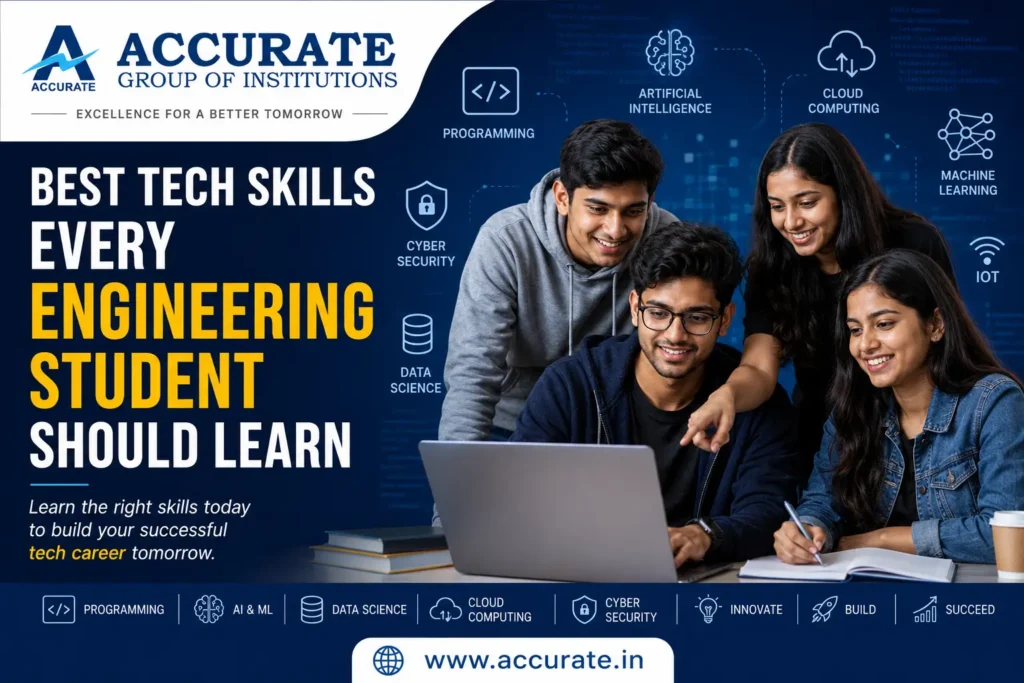
- Top Tech Skills Every Engineering Student Should Learn
- Programming Languages Every Engineer Should Master
- Artificial Intelligence and Machine Learning
- Data Science and Big Data Analytics
- Cloud Computing
- Cyber Security
- Internet of Things (IoT)
- Web and Mobile Application Development
- DevOps and Automation
- Version Control with Git and GitHub
- UI/UX Basics for Engineers
- Soft Skills That Complement Technical Knowledge
- How to Learn Tech Skills During Engineering
- Top Engineering Colleges That Focus on Skill Development
- Why Accurate Institute of Management & Technology Deserves Attention
- Future Scope of Tech Skills
- Conclusion
- Frequently Asked Questions
Why Tech Skills Matter More Than Ever
Technology has become the backbone of nearly every industry.
Companies are investing heavily in:
- Artificial Intelligence
- Cloud Computing
- Automation
- Smart Manufacturing
- Digital Transformation
- Cyber Security
- Data Analytics
- Robotics
- Internet of Things
- Software Development
As a result, engineering graduates with modern technical skills enjoy better placement opportunities, higher salaries, and faster career growth.
The Growing Demand for Industry-Ready Engineers
Modern organizations expect engineers to contribute from day one.
They look for candidates who can:
- Develop software applications
- Analyze business data
- Build cloud-based systems
- Secure digital infrastructure
- Design automation solutions
- Solve real-world engineering problems
- Work collaboratively in teams
- Adapt to new technologies
Technical skills combined with practical experience make graduates industry-ready.
Top Tech Skills Every Engineering Student Should Learn
1. Programming
Programming remains the foundation of almost every engineering career.
Popular languages include:
- Python
- Java
- C++
- C
- JavaScript
- Go
Python is especially valuable because it is widely used in Artificial Intelligence, Machine Learning, Data Science, Automation, and Web Development.
2. Data Structures and Algorithms
Strong knowledge of Data Structures and Algorithms (DSA) improves logical thinking and coding efficiency.
Students should master:
- Arrays
- Linked Lists
- Trees
- Graphs
- Stacks
- Queues
- Hash Tables
- Searching
- Sorting
- Dynamic Programming
DSA plays a major role in placement interviews.
3. Artificial Intelligence (AI)
Artificial Intelligence is transforming industries including:
- Healthcare
- Banking
- Retail
- Manufacturing
- Agriculture
- Education
Important AI concepts include:
- Neural Networks
- Deep Learning
- Computer Vision
- Natural Language Processing
- Reinforcement Learning
4. Machine Learning
Machine Learning enables computers to learn from data.
Applications include:
- Recommendation Systems
- Fraud Detection
- Predictive Analytics
- Image Recognition
- Voice Assistants
Popular ML tools:
- TensorFlow
- Scikit-Learn
- PyTorch
5. Data Science
Data Science helps organizations make informed decisions using large datasets.
Students should learn:
- Data Cleaning
- Statistics
- Data Visualization
- SQL
- Python
- Power BI
- Tableau
6. Cloud Computing
Cloud platforms dominate modern software infrastructure.
Popular platforms:
- Amazon Web Services (AWS)
- Microsoft Azure
- Google Cloud Platform (GCP)
Cloud knowledge opens opportunities in:
- DevOps
- Cloud Engineering
- Infrastructure Management
- Site Reliability Engineering
7. Cyber Security
As cyber threats increase, organizations require skilled security professionals.
Important topics include:
- Ethical Hacking
- Network Security
- Cryptography
- Penetration Testing
- Digital Forensics
- Security Operations
8. Internet of Things (IoT)
IoT connects devices using smart sensors and networks.
Applications include:
- Smart Homes
- Healthcare
- Agriculture
- Manufacturing
- Transportation
- Smart Cities
9. Web Development
Every engineer benefits from understanding web technologies.
Front-end:
- HTML
- CSS
- JavaScript
- React
Back-end:
- Node.js
- Django
- Spring Boot
Databases:
- MySQL
- PostgreSQL
- MongoDB
10. Mobile App Development
Mobile applications continue to dominate digital experiences.
Students can learn:
- Android Development
- Flutter
- React Native
- Kotlin
- Swift
11. DevOps
DevOps accelerates software development through automation.
Key tools include:
- Docker
- Kubernetes
- Jenkins
- GitHub Actions
- Terraform
12. Git and GitHub
Version control is essential for collaborative software development.
Benefits include:
- Code management
- Team collaboration
- Project tracking
- Portfolio development
13. Database Management
Every engineer should understand:
- SQL
- NoSQL
- Database Design
- Query Optimization
- Data Modeling
14. UI/UX Fundamentals
Basic UI/UX knowledge helps engineers build user-friendly applications.
Students should understand:
- User Experience
- User Interface
- Wireframing
- Accessibility
- Responsive Design
15. Automation and Scripting
Automation saves time and improves productivity.
Useful scripting languages:
- Python
- Bash
- PowerShell
Soft Skills That Complement Technical Knowledge
Technical expertise alone is not enough.
Students should also develop:
Communication Skills
Effective communication improves teamwork and leadership.
Problem-Solving
Engineering is fundamentally about solving practical challenges.
Leadership
Leadership helps engineers manage projects and teams.
Time Management
Managing deadlines is crucial in professional environments.
Critical Thinking
Employers value engineers who can analyze situations logically.
How to Learn Tech Skills During Engineering
Students can build expertise by:
- Completing online certification courses
- Participating in hackathons
- Building personal projects
- Contributing to open-source software
- Pursuing internships
- Joining coding clubs
- Practicing on coding platforms
- Attending technical workshops
- Participating in innovation competitions
Top Engineering Colleges That Focus on Skill Development
Selecting the right college plays a major role in developing industry-ready technical skills.
1. Indian Institute of Technology (IIT) Bombay
IIT Bombay is internationally recognized for its world-class engineering education, research excellence, innovation ecosystem, startup culture, and outstanding placement opportunities.
Highlights
- Research-driven curriculum
- Excellent industry collaborations
- Global academic exposure
- Strong entrepreneurship ecosystem
- Exceptional placements
2. Accurate Institute of Management & Technology, Greater Noida
Accurate Institute of Management & Technology has established itself as a respected engineering institution that emphasizes practical learning alongside academics. Students benefit from modern laboratories, coding sessions, technical workshops, project-based learning, internships, and exposure to emerging technologies such as Artificial Intelligence, Data Science, Cloud Computing, Cyber Security, and the Internet of Things. The institute’s focus on skill enhancement and industry interaction helps prepare graduates for evolving technology careers.
3. Delhi Technological University (DTU)
DTU offers excellent engineering programs supported by experienced faculty, research facilities, innovation centers, technical societies, and strong campus recruitment opportunities.
4. Vellore Institute of Technology (VIT)
VIT combines academic excellence with industry collaborations, global partnerships, entrepreneurship initiatives, and practical technology training.
5. SRM Institute of Science and Technology
SRM is known for encouraging innovation, technical competitions, multidisciplinary learning, and strong industry engagement.
Why Accurate Institute of Management & Technology Deserves Consideration
Students seeking an engineering college that balances academic learning with industry-oriented skill development may consider Accurate Institute of Management & Technology.
Industry-Oriented Curriculum
The curriculum incorporates current technology trends and practical applications.
Hands-on Learning
Students participate in coding practice, laboratory sessions, workshops, technical events, and real-world projects.
Placement Preparation
Training programs, aptitude development, mock interviews, and industry interaction help students prepare for campus recruitment.
Skill Enhancement
The institute encourages continuous learning through seminars, certifications, coding competitions, and innovation-driven activities.
Modern Infrastructure
Well-equipped laboratories and collaborative learning environments support technical education and experimentation.
These features make Accurate Institute of Management & Technology a noteworthy choice for aspiring engineers in Greater Noida.
Future Scope of Tech Skills
Emerging technologies will continue creating new career opportunities.
High-growth domains include:
- Artificial Intelligence
- Machine Learning
- Cloud Computing
- Cyber Security
- Robotics
- Blockchain
- Data Science
- Quantum Computing
- Edge Computing
- Autonomous Systems
- Smart Manufacturing
- Digital Healthcare
Engineers who continuously upgrade their technical skills will remain highly competitive in the global job market.
Conclusion
Engineering graduates who invest in learning modern technology skills gain a significant advantage in today’s competitive job market. Mastering programming, data structures, artificial intelligence, cloud computing, cybersecurity, data science, DevOps, web development, and automation equips students for a wide range of rewarding careers.
Choosing an institution that emphasizes practical learning, industry exposure, and continuous skill development is equally important. Colleges such as IIT Bombay, Accurate Institute of Management & Technology, DTU, VIT, and SRM provide environments where students can strengthen both technical and professional capabilities. With consistent learning, hands-on projects, and the right guidance, engineering students can confidently prepare for the technology-driven future.
Frequently Asked Questions (FAQs)
1. What are the best tech skills every engineering student should learn?
Programming, Data Structures, Artificial Intelligence, Machine Learning, Cloud Computing, Cyber Security, Data Science, Git, DevOps, SQL, and Web Development are among the most valuable skills.
2. Which programming language should engineering students learn first?
Python is often recommended because of its simplicity and wide use in AI, data science, automation, and web development. Learning C++ or Java alongside Python is also beneficial.
3. Why is cloud computing important for engineering students?
Cloud computing powers modern applications and infrastructure, making cloud skills highly valuable for software development, DevOps, and IT operations.
4. Is Artificial Intelligence a good career option?
Yes. AI continues to expand across healthcare, finance, education, manufacturing, retail, and many other industries, creating strong career opportunities.
5. How can engineering students improve their technical skills?
Students should complete certifications, build projects, contribute to open-source software, participate in hackathons, pursue internships, and practice coding regularly.
6. Which technical skills are most important for campus placements?
Programming, Data Structures and Algorithms, SQL, Git, problem-solving, communication, and project experience are commonly assessed during placement processes.
7. Do non-computer engineering students also need programming skills?
Yes. Basic programming and data analysis skills are increasingly useful across Mechanical, Civil, Electrical, Electronics, and other engineering disciplines.
8. What soft skills should engineering students develop?
Communication, teamwork, leadership, time management, critical thinking, adaptability, and problem-solving complement technical expertise.
9. How do projects help engineering students?
Projects demonstrate practical knowledge, strengthen problem-solving abilities, enhance resumes, and showcase skills during interviews.
10. Why are modern tech skills essential for engineering careers?
Modern industries rely on digital technologies, automation, cloud platforms, artificial intelligence, and cybersecurity. Engineers with up-to-date technical skills are better positioned for high-growth careers, competitive salaries, and long-term professional success.