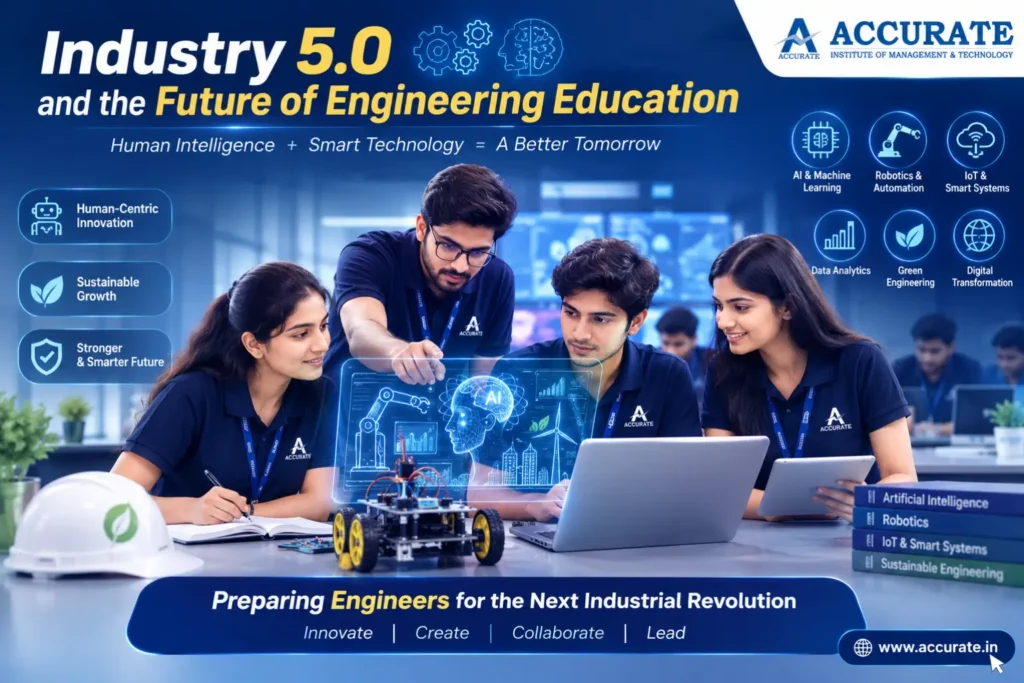

Engineering has always evolved alongside industrial revolutions. From steam-powered machines during Industry 1.0 to intelligent automation in Industry 4.0, every phase has transformed the way engineers learn, innovate, and solve real-world problems. Today, the world is entering Industry 5.0, a new era where humans and intelligent technologies work together to create sustainable, personalized, and highly efficient solutions.
Unlike previous industrial revolutions that mainly focused on automation and productivity, Industry 5.0 places equal emphasis on human creativity, sustainability, resilience, and collaboration with advanced technologies such as Artificial Intelligence (AI), Machine Learning (ML), Robotics, Internet of Things (IoT), Digital Twins, Cloud Computing, and Big Data Analytics.
This shift is redefining engineering education across the globe. Engineering colleges must now prepare students not only with technical knowledge but also with innovation, leadership, problem-solving, ethical decision-making, and interdisciplinary skills.
For students aspiring to become future-ready engineers, selecting an institution that embraces these changes is essential. Accurate Institute of Management & Technology, recognized among the best engineering colleges in Greater Noida, is committed to delivering industry-oriented education that equips students for Industry 5.0 careers through modern laboratories, experienced faculty, innovation-driven projects, internships, and strong placement support.
Table of Contents
- What is Industry 5.0?
- Industry 4.0 vs Industry 5.0
- Why Engineering Education Must Evolve
- Key Technologies Driving Industry 5.0
- Essential Skills Future Engineers Need
- Role of AI in Engineering Education
- Sustainability and Green Engineering
- Smart Manufacturing and Human Collaboration
- Research and Innovation in Industry 5.0
- Importance of Industry-Academia Collaboration
- Project-Based Learning for Modern Engineers
- Future Career Opportunities
- Why Accurate Institute of Management & Technology is Preparing Engineers for Industry 5.0
- Conclusion
- Frequently Asked Questions
What is Industry 5.0?
Industry 5.0 is the next evolution of industrial transformation where humans and intelligent machines collaborate instead of competing.
Rather than replacing people, Industry 5.0 empowers engineers, designers, and innovators by combining human creativity with advanced automation.
The Three Pillars of Industry 5.0
Human-Centric Innovation
People remain at the center of technological development.
Sustainability
Engineering solutions prioritize environmental responsibility and resource optimization.
Resilience
Industries become more adaptable to global disruptions, supply chain challenges, and technological changes.
Industry 5.0 creates smarter industries where technology enhances human capabilities instead of replacing them.
Industry 4.0 vs Industry 5.0
| Industry 4.0 | Industry 5.0 |
|---|---|
| Automation | Human-AI Collaboration |
| Smart Factories | Smart & Sustainable Factories |
| Machine Intelligence | Human Creativity + AI |
| Mass Production | Personalized Manufacturing |
| Productivity | Productivity + Sustainability |
| Robotics | Collaborative Robots (Cobots) |
| Data Focus | Human Value Focus |
Industry 5.0 shifts the conversation from “machines replacing humans” to “machines empowering humans.”
Why Engineering Education Must Evolve
Traditional engineering education focused on theoretical concepts, laboratory experiments, and examinations.
Today’s industries expect much more.
Engineering graduates should be capable of:
- Designing AI-powered systems
- Building smart automation
- Managing industrial robots
- Solving sustainability challenges
- Working with interdisciplinary teams
- Developing innovative products
- Leading digital transformation
This changing landscape requires engineering institutions to redesign their curriculum and teaching methods.
Key Technologies Driving Industry 5.0
Artificial Intelligence
AI is helping engineers optimize production, improve quality, predict maintenance, and automate complex decision-making.
Engineering students must understand:
- Machine Learning
- Deep Learning
- Computer Vision
- Natural Language Processing
- AI Ethics
Robotics
Modern industries increasingly use collaborative robots that safely work alongside humans.
Students should gain practical experience with:
- Industrial robotics
- Robot programming
- Automation systems
- Mechatronics
Internet of Things (IoT)
Connected devices collect real-time industrial data for smarter operations.
Applications include:
- Smart factories
- Predictive maintenance
- Smart cities
- Connected healthcare
- Industrial monitoring
Cloud Computing
Cloud platforms enable engineers to process massive datasets while supporting remote collaboration.
Essential cloud skills include:
- Cloud architecture
- Edge computing
- Cloud security
- Industrial cloud platforms
Big Data Analytics
Data-driven engineering is becoming the backbone of modern manufacturing.
Students should learn:
- Data visualization
- Predictive analytics
- Industrial dashboards
- Data-driven decision making
Digital Twins
Digital Twins create virtual replicas of machines, factories, and infrastructure.
Benefits include:
- Better simulation
- Lower maintenance costs
- Faster product development
- Improved operational efficiency
Additive Manufacturing
3D Printing allows industries to create customized products rapidly.
Engineering applications include:
- Aerospace
- Medical devices
- Automotive
- Construction
- Consumer products
Essential Skills Future Engineers Need
Industry 5.0 demands both technical and human skills.
Technical Skills
- Artificial Intelligence
- Robotics
- Python Programming
- Cloud Computing
- Cybersecurity
- IoT
- Automation
- CAD/CAM
- PLC Programming
- Data Analytics
Professional Skills
- Leadership
- Communication
- Design Thinking
- Teamwork
- Critical Thinking
- Creativity
- Emotional Intelligence
- Time Management
- Problem Solving
These skills help engineers adapt to changing industrial environments.
Role of AI in Engineering Education
Artificial Intelligence is transforming classrooms.
Engineering institutions now use AI for:
- Personalized learning
- Intelligent assessments
- Virtual laboratories
- Smart simulations
- Automated coding evaluation
- Research assistance
Students benefit from interactive and practical learning experiences rather than traditional memorization.
Sustainability and Green Engineering
Industry 5.0 strongly promotes sustainable development.
Future engineers must design systems that:
- Reduce carbon emissions
- Save energy
- Recycle materials
- Improve resource utilization
- Protect ecosystems
Green engineering is becoming a major hiring criterion across industries.
Emerging areas include:
- Renewable Energy
- Electric Vehicles
- Smart Grids
- Green Buildings
- Circular Economy
Smart Manufacturing and Human Collaboration
Future factories will combine intelligent machines with skilled engineers.
Examples include:
- AI-assisted quality inspection
- Collaborative robots
- Human-guided automation
- Smart logistics
- Autonomous warehouses
Rather than replacing engineers, automation increases productivity while allowing professionals to focus on innovation and complex decision-making.
Research and Innovation in Industry 5.0
Innovation is the foundation of Industry 5.0.
Engineering colleges must encourage students to:
- Publish research
- Build prototypes
- Participate in hackathons
- Solve industrial challenges
- File patents
- Develop startups
Research-oriented education prepares students for global engineering careers.
Importance of Industry-Academia Collaboration
Close collaboration between engineering institutions and industries helps bridge the gap between classroom learning and workplace expectations.
Benefits include:
Industrial Internships
Students gain practical exposure.
Expert Sessions
Industry professionals share current trends.
Live Projects
Students solve real business challenges.
Industrial Visits
Understanding manufacturing processes.
Placement Opportunities
Better employability through skill development.
Industry collaboration significantly enhances career readiness.
Project-Based Learning for Modern Engineers
Project-based learning is becoming the preferred teaching model.
Instead of learning concepts only through textbooks, students build practical solutions.
Examples include:
- Smart irrigation systems
- Autonomous robots
- AI chatbots
- Drone technology
- Smart healthcare devices
- Renewable energy systems
Hands-on projects improve innovation, teamwork, and confidence.
Future Career Opportunities
Industry 5.0 is creating exciting engineering careers.
Popular job roles include:
- Artificial Intelligence Engineer
- Machine Learning Engineer
- Robotics Engineer
- Automation Engineer
- Data Scientist
- Cloud Engineer
- IoT Engineer
- Cybersecurity Engineer
- Sustainability Engineer
- Digital Manufacturing Engineer
- Mechatronics Engineer
- Smart Factory Consultant
- Industrial Data Analyst
- Digital Twin Engineer
- Product Innovation Engineer
These careers offer strong growth opportunities in India and internationally.
Challenges Engineering Institutions Must Address
To successfully adopt Industry 5.0, engineering colleges must overcome several challenges.
Curriculum Modernization
Syllabi should be updated regularly to match emerging technologies.
Faculty Development
Teachers need continuous training in AI, automation, robotics, and digital technologies.
Infrastructure
Modern laboratories, simulation software, maker spaces, and innovation centers are essential.
Industry Exposure
Students should engage in internships, industrial visits, and live projects throughout their academic journey.
Lifelong Learning
Graduates should develop the habit of continuously learning new technologies and industry trends.
Why Accurate Institute of Management & Technology is Preparing Engineers for Industry 5.0
Choosing the right engineering college plays a crucial role in building a successful career. Accurate Institute of Management & Technology (AIMT) has established itself as one of the best engineering colleges in Greater Noida by focusing on industry-oriented education and future-ready skill development.
Students benefit from:
Industry-Focused Curriculum
Programs are aligned with current technological trends, helping students stay relevant in the evolving engineering landscape.
Modern Laboratories
Well-equipped labs provide practical exposure in core engineering disciplines, programming, electronics, automation, and emerging technologies.
Experienced Faculty
Qualified faculty members combine academic excellence with industry insights to deliver application-oriented learning.
Innovation and Project Culture
Students are encouraged to participate in research projects, technical competitions, hackathons, innovation challenges, and prototype development.
Internship Opportunities
Strong industry interaction enables students to gain real-world experience before graduation.
Skill Development Programs
Training in coding, communication, aptitude, leadership, and emerging technologies enhances employability.
Placement Assistance
Dedicated placement support prepares students for interviews, technical assessments, and careers with reputed organizations.
Holistic Development
Beyond academics, students develop teamwork, leadership, entrepreneurship, and problem-solving skills essential for Industry 5.0.
These initiatives help position Accurate Institute of Management & Technology among the preferred choices for students seeking a future-ready engineering education in Greater Noida and Delhi NCR.
The Road Ahead
Industry 5.0 is not a distant concept—it is already reshaping manufacturing, healthcare, infrastructure, energy, transportation, and digital services. Engineers who combine technical expertise with creativity, sustainability, and ethical thinking will lead the next wave of innovation.
Engineering education must therefore move beyond traditional classrooms to embrace experiential learning, interdisciplinary collaboration, and continuous technological adaptation. Institutions that invest in modern infrastructure, industry partnerships, research, and skill development will produce graduates capable of solving tomorrow’s global challenges.
Conclusion
The transition from Industry 4.0 to Industry 5.0 represents a major milestone in engineering and technology. Future engineers will no longer work only with machines—they will collaborate with intelligent systems to build smarter, safer, and more sustainable solutions for society.
Engineering education must evolve accordingly by integrating AI, robotics, automation, IoT, cloud computing, sustainability, innovation, and human-centered design into every stage of learning. Students who acquire these capabilities will enjoy greater career opportunities and long-term professional success.
For aspiring engineers seeking a future-focused education, Accurate Institute of Management & Technology provides the ideal platform through industry-oriented academics, experienced faculty, modern laboratories, practical learning, internships, innovation-driven projects, and comprehensive placement support. If you are looking for the best B.Tech college in Greater Noida, the best engineering college in Greater Noida, or one of the leading engineering institutions in Delhi NCR, AIMT offers an environment where knowledge, technology, and innovation come together to prepare you for the Industry 5.0 era.
Admissions are now open. Take the next step toward becoming a future-ready engineer with Accurate Institute of Management & Technology and build a career designed for the industries of tomorrow.
Frequently Asked Questions (FAQs)
1. What is Industry 5.0 in engineering?
Industry 5.0 is the next industrial revolution where humans collaborate with intelligent technologies like AI, robotics, IoT, and automation to create sustainable, personalized, and efficient industrial solutions.
2. How is Industry 5.0 different from Industry 4.0?
Industry 4.0 focuses on automation and digitalization, while Industry 5.0 emphasizes human-centric innovation, sustainability, resilience, and collaboration between people and intelligent machines.
3. Why is Industry 5.0 important for engineering students?
It prepares students for emerging careers by combining technical knowledge with creativity, sustainability, ethical decision-making, and interdisciplinary problem-solving.
4. Which technologies are most important in Industry 5.0?
Artificial Intelligence, Machine Learning, Robotics, IoT, Cloud Computing, Big Data Analytics, Digital Twins, Cybersecurity, and Additive Manufacturing are among the most important technologies.
5. What skills should engineering students develop for Industry 5.0?
Students should build expertise in AI, programming, robotics, data analytics, automation, communication, leadership, teamwork, critical thinking, and innovation.
6. What career opportunities are available in Industry 5.0?
Popular roles include AI Engineer, Robotics Engineer, Automation Engineer, IoT Engineer, Data Scientist, Cloud Engineer, Cybersecurity Engineer, Sustainability Engineer, and Digital Manufacturing Specialist.
7. How does project-based learning support Industry 5.0 education?
Project-based learning helps students apply theoretical concepts to real-world challenges, improve technical skills, enhance teamwork, and build innovative solutions.
8. Why is sustainability important in Industry 5.0?
Sustainability ensures that engineering solutions reduce environmental impact, conserve resources, and contribute to long-term economic and social development.
9. Why choose Accurate Institute of Management & Technology for engineering?
Accurate Institute of Management & Technology offers industry-oriented education, modern laboratories, experienced faculty, internships, innovation-driven learning, skill development programs, and strong placement support, making it a preferred engineering college in Greater Noida.
10. How can students prepare for Industry 5.0 while pursuing B.Tech?
Students should focus on practical projects, internships, certifications, programming, AI, robotics, communication skills, research activities, and continuous learning while pursuing their engineering degree.