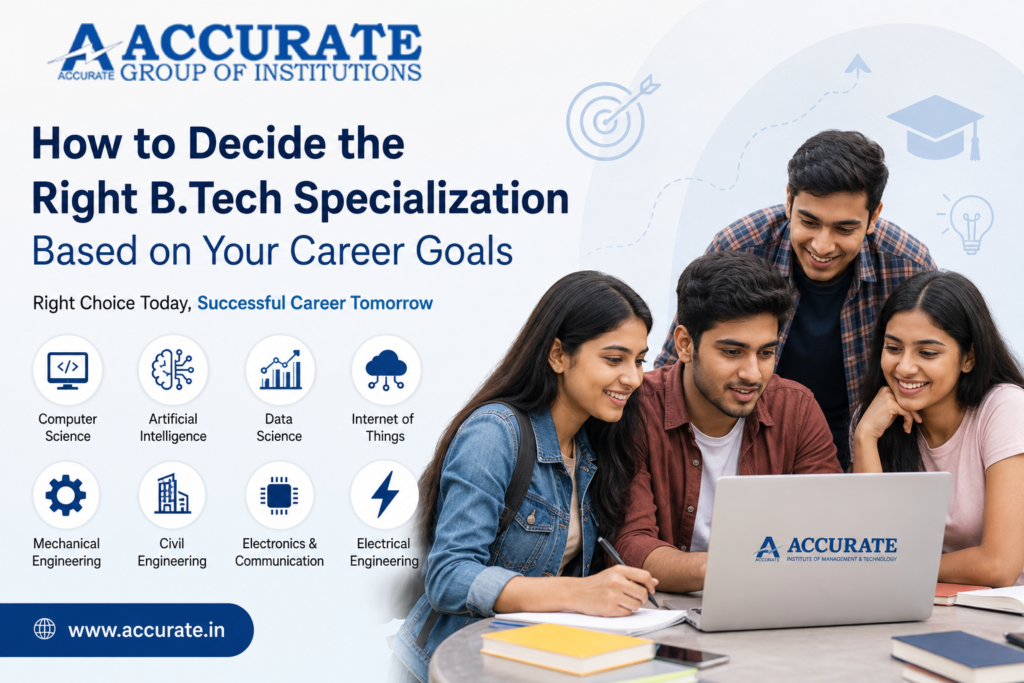

Selecting a B.Tech specialization is one of the biggest academic decisions for PCM students after Class 12. The specialization you choose will influence your learning experience, internships, career opportunities, higher education options, and long-term professional growth.
However, many students still make this decision based on trends, peer pressure, family expectations, or salary rumors instead of understanding their own interests and career aspirations.
The engineering industry is evolving rapidly. Technologies like Artificial Intelligence, Machine Learning, Data Science, Cloud Computing, Cyber Security, Robotics, Electric Vehicles, Smart Manufacturing, and the Internet of Things (IoT) are creating new opportunities every year. At the same time, traditional engineering branches continue to offer rewarding careers in infrastructure, manufacturing, energy, transportation, and public sector organizations.
The right question is not:
“Which engineering branch is the best?”
Instead, ask yourself:
“Which engineering specialization is best for my career goals?”
This guide will help you make an informed decision by evaluating your interests, strengths, future industry demand, placement opportunities, and long-term career ambitions.
Table of Contents
- Why Choosing the Right B.Tech Specialization Matters
- Understand Your Career Goals Before Selecting a Branch
- Step-by-Step Guide to Choosing the Right B.Tech Specialization
- Popular B.Tech Specializations Explained
- Which Engineering Branch Matches Your Career Goal?
- Future Technologies Shaping Engineering Careers
- Factors Beyond Salary While Choosing a Specialization
- Common Mistakes Students Should Avoid
- How Accurate Institute of Management & Technology Helps Students Build Successful Careers
- Final Checklist Before Taking Admission
- Conclusion
- Frequently Asked Questions
Why Choosing the Right B.Tech Specialization Matters
Your engineering specialization affects almost every stage of your professional journey.
It influences:
- Skills you develop
- Projects you build
- Companies you can apply to
- Internship opportunities
- Research possibilities
- Higher education choices
- Startup opportunities
- Government job eligibility
- International career prospects
Choosing the right specialization increases your chances of enjoying your studies while building a successful career.
Understand Your Career Goals Before Selecting a Branch
Before exploring engineering branches, clearly define your career objectives.
Ask yourself:
- Do I enjoy coding?
- Do I like mathematics?
- Am I interested in designing machines?
- Do I enjoy solving real-world infrastructure problems?
- Do I want to work in multinational companies?
- Am I interested in government jobs?
- Do I dream of becoming an entrepreneur?
- Do I want to pursue research?
- Do I want international career opportunities?
Your answers will naturally guide you toward the right specialization.
Step-by-Step Guide to Choosing the Right B.Tech Specialization
Step 1: Identify Your Interests
Interest is the biggest predictor of long-term success.
If you enjoy learning a subject, you will naturally perform better.
Examples:
- Love coding → Computer Science Engineering
- Love AI tools → Artificial Intelligence
- Love statistics → Data Science
- Love electronics → Electronics Engineering
- Love construction → Civil Engineering
- Love machines → Mechanical Engineering
Never choose a branch only because someone else selected it.
Step 2: Assess Your Strengths
Your academic strengths also matter.
Strong in Mathematics
Ideal branches include:
- Computer Science
- Artificial Intelligence
- Machine Learning
- Data Science
- Electronics
Strong in Physics
Suitable options:
- Mechanical Engineering
- Civil Engineering
- Electrical Engineering
- Electronics Engineering
Strong in Logical Thinking
Perfect for:
- AI
- Cyber Security
- Cloud Computing
- Software Engineering
Step 3: Research Future Industry Demand
Engineering is becoming technology-driven.
Growing sectors include:
- Artificial Intelligence
- Robotics
- Data Analytics
- Cyber Security
- Cloud Computing
- IoT
- Semiconductor Design
- Renewable Energy
- Smart Manufacturing
- Automation
Choosing a specialization aligned with emerging industries can improve long-term career prospects.
Step 4: Understand Placement Opportunities
Instead of focusing only on average salaries, examine:
- Placement percentage
- Top recruiters
- Internship opportunities
- Industry collaborations
- Skill requirements
- Alumni success
A branch with consistent hiring often offers better career stability.
Step 5: Explore Higher Education Options
Some students plan to pursue:
- M.Tech
- MBA
- MS Abroad
- Research
- Entrepreneurship
Your specialization should support your long-term educational goals.
Step 6: Compare Curriculum
Download the syllabus of different engineering branches.
Compare:
- Programming subjects
- Mathematics
- Core engineering concepts
- Laboratory work
- Industry projects
- Research opportunities
Select the curriculum you genuinely enjoy.
Popular B.Tech Specializations Explained
Computer Science Engineering (CSE)
Best For
- Software Development
- Full Stack Development
- App Development
- Cloud Computing
- Product Engineering
- IT Companies
Skills Required
- Programming
- Logical Thinking
- Problem Solving
- Algorithms
Career Roles
- Software Engineer
- Backend Developer
- Frontend Developer
- DevOps Engineer
- Cloud Engineer
- Systems Engineer
Artificial Intelligence & Machine Learning
AI is transforming healthcare, finance, education, manufacturing, retail, and transportation.
Ideal For
Students interested in:
- Machine Learning
- Neural Networks
- Computer Vision
- NLP
- Generative AI
Career roles include:
- AI Engineer
- ML Engineer
- AI Research Associate
- Automation Engineer
Data Science Engineering
Data is considered one of the most valuable business assets.
Students learn:
- Data Analytics
- Predictive Modeling
- Python
- SQL
- Business Intelligence
- Machine Learning
Career roles:
- Data Scientist
- Data Analyst
- Business Analyst
- AI Data Engineer
Internet of Things (IoT)
IoT connects smart devices across industries.
Applications include:
- Smart Homes
- Healthcare
- Agriculture
- Manufacturing
- Smart Cities
- Industrial Automation
Career roles:
- IoT Engineer
- Embedded Systems Engineer
- Automation Specialist
Mechanical Engineering
Mechanical Engineering remains one of the strongest core engineering disciplines.
Career sectors:
- Automobile
- Aerospace
- Manufacturing
- Robotics
- Defense
- Energy
Popular roles:
- Design Engineer
- Production Engineer
- Quality Engineer
Civil Engineering
Civil engineers build the nation’s infrastructure.
Career opportunities:
- Smart Cities
- Construction
- Transportation
- Water Resources
- Structural Engineering
Popular employers include:
- Construction companies
- Government departments
- Infrastructure firms
- Metro projects
Electrical Engineering
Electrical engineers work with power systems and electrical equipment.
Growing sectors:
- Renewable Energy
- Electric Vehicles
- Smart Grids
- Industrial Automation
Electronics & Communication Engineering
ECE combines electronics with communication systems.
Career sectors:
- Semiconductor Industry
- Embedded Systems
- Telecommunications
- Consumer Electronics
- Space Technology
Which Engineering Branch Matches Your Career Goal?
| Career Goal | Recommended Specialization |
|---|---|
| Software Development | Computer Science Engineering |
| Artificial Intelligence | AI & ML |
| Data Analytics | Data Science |
| Startup Founder | CSE, AI, IoT |
| Government Jobs | Civil, Mechanical, Electrical |
| Robotics | Mechanical + AI |
| Smart Manufacturing | Mechanical + IoT |
| Construction | Civil Engineering |
| Research | AI, Electronics, Mechanical |
| International Career | CSE, AI, Data Science, Electronics |
Future Technologies Shaping Engineering Careers
The future belongs to engineers who combine technical knowledge with innovation.
Important technologies include:
Artificial Intelligence
AI is transforming every industry through automation and intelligent decision-making.
Cloud Computing
Cloud infrastructure supports modern applications, making cloud engineering a highly sought-after skill.
Cyber Security
As digital transformation accelerates, protecting systems and data has become a critical priority.
Robotics
Industries are increasingly adopting robotics for precision, efficiency, and automation.
Internet of Things
Connected devices are enabling smarter homes, factories, healthcare systems, and cities.
Digital Twin Technology
Digital replicas of physical systems are improving engineering design and maintenance processes.
Green Engineering
Engineers are playing a key role in sustainable energy, environmental protection, and resource optimization.
Factors Beyond Salary While Choosing a Specialization
Many students focus only on salary.
Instead, evaluate:
Learning Interest
You’ll spend four years studying the subject. Genuine interest is essential.
Industry Growth
Select branches with evolving career opportunities and long-term relevance.
Skill Development
Look for programs that emphasize:
- Coding
- Practical labs
- Research
- Innovation
- Industry certifications
Placement Support
Choose institutions with strong industry partnerships, internship opportunities, and active placement cells.
Faculty and Infrastructure
Modern laboratories, experienced faculty, and project-based learning significantly enhance engineering education.
Common Mistakes Students Should Avoid
Following Friends
Your career is unique. Avoid selecting a branch just because your friends are choosing it.
Believing Salary Myths
High salaries depend on skills, projects, internships, and continuous learning—not just the branch name.
Ignoring Your Interests
Choosing a specialization you dislike can affect motivation and performance.
Not Researching the Curriculum
Understand what you’ll study before making a decision.
Choosing Only Based on Popularity
A trending branch isn’t automatically the right fit for everyone.
Ignoring Emerging Technologies
Engineering is evolving rapidly. Stay informed about future-focused disciplines and evolving skill requirements.
How Accurate Institute of Management & Technology Helps Students Build Successful Careers
Selecting the right college is just as important as choosing the right specialization.
Accurate Institute of Management & Technology (AIMT), Greater Noida, has established itself as a leading destination for engineering education by combining academic excellence with industry-focused learning.
Students benefit from:
Industry-Oriented Curriculum
Programs are designed to align with current technology trends and employer expectations.
Experienced Faculty
Qualified faculty members guide students through classroom learning, research, innovation, and career development.
Modern Laboratories
Well-equipped labs provide practical exposure across engineering disciplines.
Project-Based Learning
Students work on real-world projects that strengthen problem-solving and technical skills.
Internship Opportunities
Industry collaborations help students gain practical experience before graduation.
Placement Assistance
The dedicated placement cell supports students through training, aptitude preparation, mock interviews, and recruitment drives with reputed companies.
Innovation and Entrepreneurship
Students are encouraged to participate in hackathons, innovation challenges, startup initiatives, and technical competitions.
Holistic Development
In addition to technical education, AIMT focuses on communication skills, leadership, teamwork, and personality development to prepare students for professional success.
For students seeking a future-ready engineering education in Greater Noida and Delhi NCR, AIMT offers an environment where academic learning meets industry readiness.
Final Checklist Before Taking Admission
Before finalizing your B.Tech specialization, ask yourself:
✅ Does this specialization match my interests?
✅ Can I imagine working in this field for the next decade?
✅ Are industry opportunities growing?
✅ Does the curriculum excite me?
✅ Does the college offer strong placements?
✅ Are internships available?
✅ Does the college have experienced faculty?
✅ Are modern laboratories available?
✅ Does the institution support innovation and entrepreneurship?
✅ Am I making this decision based on my goals rather than external pressure?
If your answer is “Yes” to most of these questions, you’re on the right path.
Conclusion
Choosing the right B.Tech specialization is not about chasing trends—it’s about aligning your education with your aspirations, strengths, and the future of technology. Whether your dream is to become a software engineer, AI specialist, data scientist, mechanical designer, civil engineer, entrepreneur, or researcher, selecting a specialization that reflects your interests and long-term vision will set the foundation for lasting success.
Take the time to explore each engineering discipline, understand industry trends, and evaluate the curriculum, placement support, and learning environment before making your decision.
If you’re looking for an institution that combines academic excellence, practical learning, industry exposure, modern infrastructure, and career-focused training, Accurate Institute of Management & Technology (AIMT), Greater Noida, is an excellent choice. With future-ready B.Tech programs, experienced faculty, innovation-driven learning, and dedicated placement support, AIMT empowers students to transform their career goals into professional achievements.
Admissions are now open for B.Tech programs. Begin your engineering journey with Accurate Institute of Management & Technology and take the first step toward a successful and rewarding future.
Frequently Asked Questions (FAQs)
1. How do I choose the right B.Tech specialization?
Choose a specialization by evaluating your interests, academic strengths, career goals, industry demand, placement opportunities, and future learning aspirations rather than following trends.
2. Which B.Tech specialization has the best future scope?
Computer Science Engineering, Artificial Intelligence, Data Science, IoT, Cyber Security, Electronics, and Mechanical Engineering continue to offer strong career opportunities across multiple industries.
3. Is Computer Science Engineering better than Artificial Intelligence?
Neither is universally better. CSE provides a broader computing foundation, while AI focuses on intelligent systems and machine learning. The best choice depends on your interests and career objectives.
4. Which engineering branch offers the best placements?
Placement outcomes depend on your skills, internships, projects, and the institution. CSE, AI, Data Science, and Electronics often see strong recruitment demand, while core branches also offer excellent opportunities in their respective sectors.
5. Can I switch my career after completing B.Tech?
Yes. Many graduates pursue higher education, management, entrepreneurship, public sector careers, or transition into related technology domains through upskilling.
6. Is Data Science a good B.Tech specialization?
Yes. Data Science equips students with analytical, programming, and machine learning skills that are in demand across finance, healthcare, retail, manufacturing, and technology.
7. Which B.Tech branch is best for government jobs?
Civil, Mechanical, Electrical, and Electronics Engineering are commonly preferred for many public sector and engineering service opportunities.
8. How important are internships during B.Tech?
Internships provide practical exposure, strengthen technical skills, improve employability, and often lead to pre-placement offers from recruiters.
9. Why should I consider Accurate Institute of Management & Technology for B.Tech?
AIMT offers industry-oriented programs, experienced faculty, modern laboratories, project-based learning, internship opportunities, skill development initiatives, and dedicated placement support to help students build successful engineering careers.
10. What should I consider besides salary while selecting a specialization?
Consider your passion for the subject, long-term career growth, curriculum, emerging industry trends, practical learning opportunities, higher education plans, and the quality of the institution offering the program.