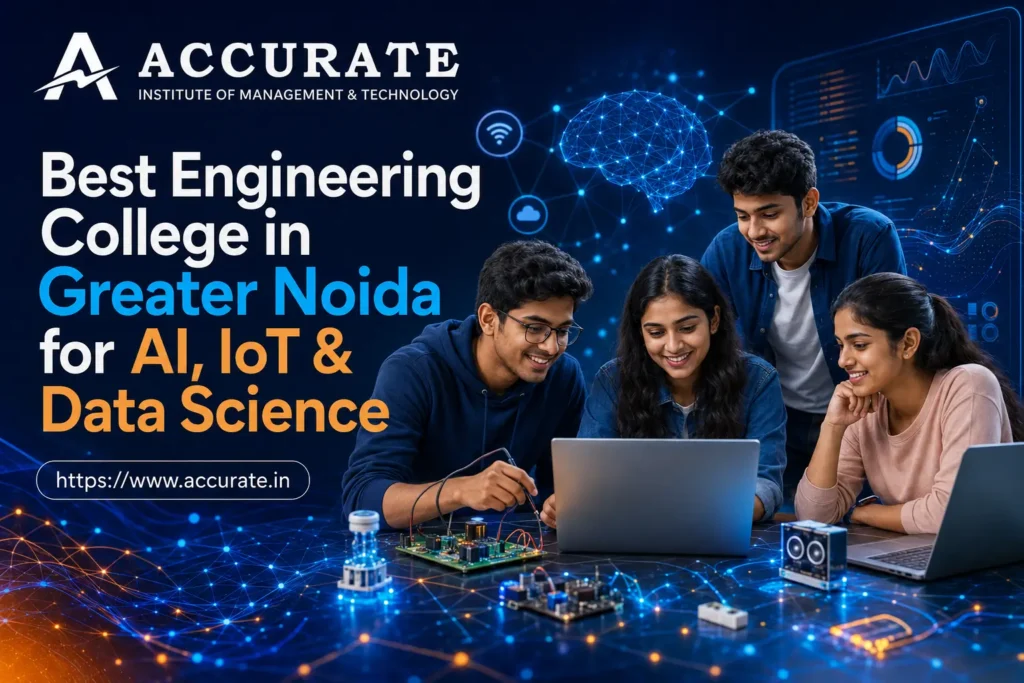

Artificial Intelligence, the Internet of Things and Data Science are changing how industries operate, products are designed and decisions are made. From intelligent software and connected factories to predictive healthcare and smart transportation, these technologies are creating new possibilities across nearly every sector.
For students planning an engineering career, selecting the right institution is therefore about much more than obtaining a degree. The ideal college should help students build strong computer science fundamentals, gain practical experience, explore emerging technologies and prepare for a rapidly changing employment market.
Students searching for the best engineering college in Greater Noida for AI, IoT & Data Science should evaluate curriculum relevance, laboratory facilities, faculty guidance, practical projects, industry exposure, internships, placement preparation and opportunities for innovation.
Table of Contents
- Why AI, IoT and Data Science matter
- Why Greater Noida is a preferred education destination
- How to select the right engineering college
- Artificial Intelligence and Machine Learning
- Internet of Things Engineering
- Data Science Engineering
- AI vs IoT vs Data Science
- Essential technical skills
- Importance of laboratories and projects
- Internships and industry exposure
- Placement preparation
- Career opportunities
- Higher education and entrepreneurship
- Why consider Accurate Institute
- Admission preparation checklist
- Frequently asked questions
- Conclusion and admission CTA
Why AI, IoT and Data Science Matter in Modern Engineering
Engineering is moving from isolated machines and conventional software towards connected, intelligent and data-driven systems. AI, IoT and Data Science form three important parts of this transformation.
Artificial Intelligence enables computer systems to recognise patterns, generate predictions and perform tasks that normally require human reasoning. IoT connects physical devices so they can collect information, communicate and respond to changing conditions. Data Science converts large volumes of raw information into useful insights.
These fields are different, but they frequently work together. Consider a smart manufacturing unit. IoT sensors may collect temperature, vibration and energy data from machines. Data Science techniques can organise and analyse that information. An AI model may then predict equipment failure before it occurs.
Similar combinations are used in smart cities, agriculture, logistics, energy, healthcare, retail and transportation. Students who understand how these technologies interact can develop solutions that address practical problems rather than studying each technology in isolation.
Why Study Engineering in Greater Noida?
Greater Noida has developed into an important education and business region within Delhi NCR. Its academic environment attracts students from Delhi, Uttar Pradesh and other parts of India.
The location gives engineering students potential access to a broad professional ecosystem that includes technology organisations, manufacturing units, startups, corporate offices and educational institutions. This surrounding environment can support industry visits, internships, technical events, professional networking and employment exploration.
Greater Noida also offers students the experience of studying in a planned urban region while remaining connected to major commercial areas of Delhi NCR. However, location alone does not determine educational quality. Students must still examine the institution’s curriculum, teaching approach, practical exposure and student-support systems.
A college becomes valuable when it converts its geographical advantage into meaningful learning and career-development opportunities.
What Makes an Engineering College Suitable for Emerging Technologies?
The word “best” should reflect a student’s goals rather than a single promotional label. A college that is suitable for one learner may not necessarily be the right choice for another.
Students should assess several academic and career-related factors.
Relevant and balanced curriculum
A future-ready curriculum should combine foundational engineering subjects with specialised learning. Before exploring advanced AI or Data Science tools, students need competence in programming, data structures, databases, computer networks, operating systems, software engineering and mathematics.
Specialisation should strengthen this foundation rather than replace it.
Practical laboratories
Emerging technologies cannot be learned effectively through theory alone. Students need opportunities to write code, build circuits, collect data, train models, test prototypes and analyse results.
Laboratories should encourage experimentation. A practical session becomes more valuable when students understand why an experiment is performed, how results are evaluated and how errors can be corrected.
Project-oriented education
Projects help students move from knowing a concept to applying it. They also teach teamwork, planning, documentation, debugging and presentation.
A suitable engineering college should encourage students to begin with small projects and gradually progress towards integrated, real-world solutions.
Faculty guidance
Technology is easy to access online, but students still need mentors who can organise learning, explain difficult concepts and guide projects. Good academic mentoring can help students distinguish between meaningful skill development and short-lived trends.
Industry exposure
Workshops, expert interactions, internships, industrial visits, competitions and live problem statements can help students understand professional expectations.
Industry exposure should complement academic learning rather than become a substitute for strong fundamentals.
Career and placement preparation
Technical knowledge alone may not be sufficient during campus recruitment. Students also need aptitude, coding, communication, interview and resume-preparation skills.
Structured career preparation helps students present their knowledge confidently and target appropriate roles.
Understanding Artificial Intelligence and Machine Learning
Artificial Intelligence is the broad field of creating computer systems that can perform tasks associated with intelligence, such as recognising images, understanding language, making predictions and supporting decisions.
Machine Learning is a major branch of AI in which systems learn patterns from data rather than relying only on manually written rules.
What students learn in AI-oriented engineering
An AI-focused engineering curriculum may introduce students to:
- Python and other programming languages
- Data structures and algorithms
- Probability and statistics
- Linear algebra and calculus
- Machine learning
- Deep learning
- Natural language processing
- Computer vision
- Intelligent systems
- Data preparation and model evaluation
- Responsible and ethical AI
- Model deployment fundamentals
Students should not focus only on using ready-made libraries. They need to understand how data quality, algorithm selection, evaluation metrics and human decisions influence an AI system.
Skills required for AI careers
Aspiring AI professionals need programming ability, mathematical reasoning and problem-solving discipline. They should be able to work with datasets, compare models, identify overfitting and explain why a solution is appropriate.
Communication also matters. Engineers must often describe an AI model to people who may not have a technical background.
AI project ideas
Students can explore projects such as:
- Image classification
- Sentiment analysis
- Recommendation systems
- Customer-support assistants
- Predictive maintenance
- Document classification
- Traffic-pattern analysis
- Crop-disease identification
- Fraud-risk detection
- Student-learning analytics
An original, well-documented project is generally more valuable than a complex copied application.
Understanding Internet of Things Engineering
The Internet of Things connects physical objects with sensors, processors, software and communication technologies. These devices collect data and may share it with other devices, cloud platforms or applications.
IoT brings software and hardware together. Students interested in electronics, networking, embedded programming and automation may find this field especially engaging.
What students learn in IoT
IoT-related learning can include:
- Sensors and actuators
- Embedded systems
- Microcontrollers
- Communication protocols
- Computer networks
- Wireless communication
- Cloud platforms
- Edge computing
- Data collection and processing
- Cybersecurity fundamentals
- Mobile or web dashboards
- Device and system integration
Students should understand the entire data journey—from a physical sensor to a useful decision or automated action.
Why security matters in IoT
Connected devices can create security and privacy risks. Students need awareness of device authentication, encrypted communication, access control, software updates and safe data handling.
Security should not be added only after a system is built. It should be considered during design and development.
IoT project ideas
Engineering students can create:
- Smart irrigation systems
- Air-quality monitoring devices
- Energy-management systems
- Remote health-monitoring prototypes
- Smart parking solutions
- Industrial equipment monitors
- Connected home-safety systems
- Waste-management trackers
- Cold-storage monitoring systems
- Smart classroom energy controls
A strong IoT project should demonstrate reliable sensing, communication, processing and a practical user benefit.
Understanding Data Science Engineering
Data Science combines programming, statistics, mathematics and domain understanding to extract useful insights from data.
Organisations generate information through transactions, devices, applications, websites and customer interactions. Data Science professionals clean, analyse and interpret this information to support planning, prediction and decision-making.
What students learn in Data Science
Students preparing for Data Science careers may study:
- Python programming
- SQL and database management
- Probability and statistics
- Data cleaning
- Exploratory data analysis
- Data visualisation
- Machine learning
- Big-data fundamentals
- Data engineering concepts
- Business intelligence
- Cloud computing
- Model deployment
Technical knowledge must be accompanied by the ability to ask the right question. A visually impressive dashboard or accurate model has limited value if it does not address a real requirement.
Important Data Science skills
Students should become comfortable with handling missing values, identifying outliers, combining datasets and selecting suitable evaluation metrics.
They should also learn data storytelling: presenting findings through clear visuals, structured explanations and actionable recommendations.
Data Science project ideas
Useful student projects include:
- Sales forecasting
- Customer churn analysis
- Demand prediction
- Healthcare data analysis
- Product recommendation
- Financial-risk analysis
- Social-media sentiment analysis
- Supply-chain analytics
- Student-performance analysis
- Human-resource analytics
Students should document the problem, data source, cleaning process, methodology, results, limitations and possible improvements.
AI vs IoT vs Data Science: Which Should You Choose?
Students often treat these fields as completely separate options, but significant overlap exists among them.
| Field | Primary Focus | Suitable Interests | Common Project Style |
|---|---|---|---|
| Artificial Intelligence | Building systems that learn, predict or automate | Algorithms, mathematics, programming | Prediction, vision, language and intelligent applications |
| Internet of Things | Connecting physical devices and digital platforms | Electronics, sensors, networking and coding | Smart devices, monitoring and automation |
| Data Science | Extracting insights and value from data | Statistics, analysis, programming and business reasoning | Analysis, visualisation, forecasting and decision support |
Choose AI if you enjoy intelligent algorithms
AI may be suitable for students interested in mathematical models, software development, pattern recognition and automation.
Choose IoT if you enjoy hardware-software integration
IoT can appeal to students who want to work with devices, sensors, communication systems and real-world automation.
Choose Data Science if you enjoy analysing information
Data Science may be a good choice for students who like statistics, finding patterns, visualisation and solving business or social problems with data.
Choose an integrated learning path
Students do not always need to limit themselves to one field. An IoT application produces data, Data Science reveals patterns and AI enables predictions or automated responses.
A student can build a strong primary specialisation while developing working knowledge of related technologies.
Essential Skills Students Should Build
Programming proficiency
Python is particularly useful for AI and Data Science, while C, C++, Java and embedded programming may support broader engineering and IoT work.
Students should learn programming logic instead of memorising syntax. Regular coding practice improves debugging and problem-solving ability.
Data structures and algorithms
Arrays, strings, linked lists, stacks, queues, trees, graphs, searching, sorting and complexity analysis remain important for technical interviews and efficient software development.
Database knowledge
Students should learn SQL and relational database concepts. Familiarity with non-relational databases can be useful for applications involving varied or large-scale data.
Mathematics
Probability, statistics, linear algebra and basic calculus help students understand machine learning and analytical methods.
Computer networks and cloud fundamentals
Networking is particularly important for IoT, while cloud platforms support data storage, application deployment and scalable computing.
Version control
Git helps students track changes, collaborate with teammates and maintain professional project repositories.
Communication
Engineers must write documentation, present solutions, collaborate with teams and explain technical decisions. Communication should be developed throughout the degree.
Why Laboratories and Projects Matter
A student may understand an algorithm theoretically but still struggle to prepare data, debug code or evaluate output. Practical work exposes these gaps and creates opportunities for improvement.
From guided experiments to original solutions
In the beginning, students may follow structured laboratory exercises. They should gradually progress towards projects in which they define the problem, select tools and evaluate the results independently.
Learning through failure
Models may produce weak predictions. Sensors may provide inconsistent readings. Applications may fail during integration. These challenges teach students to diagnose problems and work systematically.
Failure within a supervised academic project is not wasted effort. It develops the resilience required in engineering careers.
Building an employable portfolio
Students should maintain a portfolio containing selected projects, code repositories, demonstrations and brief reports. Each project should communicate:
- The problem addressed
- The student’s individual contribution
- Technologies used
- Challenges encountered
- Results obtained
- Lessons learned
- Future improvements
Recruiters value candidates who can explain their work honestly and clearly.
Role of Hackathons, Competitions and Technical Communities
Hackathons encourage students to develop solutions within limited time. They promote rapid learning, teamwork and presentation.
Technical clubs and peer communities provide another valuable learning channel. Students can discuss programming questions, review each other’s projects and organise events.
Participation should have a purpose. Students should not collect activity certificates without reflecting on what they learned. Even an unsuccessful competition can be valuable if it identifies technical or teamwork weaknesses.
Importance of Internships and Industry Exposure
Internships allow students to observe how professional teams manage requirements, deadlines, documentation and quality.
An internship may involve software development, data analysis, testing, research, technical support or another related task. Its value depends on the student’s engagement and learning, not merely the company name.
Students should try to understand:
- What problem the organisation is solving
- How technical work is planned
- Which tools are used and why
- How teams communicate
- How data and code are protected
- How performance is evaluated
After completing an internship, students should document their responsibilities and outcomes without disclosing confidential information.
Placement Preparation for AI, IoT and Data Science Students
Placement preparation should begin before the final semester. Students need time to strengthen weak subjects, develop projects and practise interviews.
Technical preparation
Candidates should revise programming, data structures, databases, operating systems, computer networks and their specialisation subjects.
AI and Data Science students should focus on Python, SQL, statistics, machine learning and project discussions. IoT students should also revise embedded systems, sensors, networking, communication protocols and hardware-software integration.
Aptitude preparation
Campus recruitment may include quantitative aptitude, logical reasoning, verbal ability and data interpretation. Consistent weekly practice is more effective than last-minute preparation.
Resume preparation
A fresher’s resume should be concise and relevant. It should highlight genuine skills, projects, internships and achievements.
Students should avoid listing technologies they cannot explain. Every line on the resume can lead to an interview question.
Interview preparation
Mock interviews help students improve their introductions, technical explanations and confidence. Candidates should practise describing their projects in simple language and responding to follow-up questions.
Job-role flexibility
Graduates can explore more than one job title. Depending on their skills, opportunities may include software development, data analysis, business intelligence, machine learning, IoT development, embedded systems, cloud support, quality assurance and technical consulting.
The first job can serve as a foundation for long-term specialisation.
Career Opportunities After AI, IoT and Data Science Engineering
AI and Machine Learning roles
Potential career directions include:
- AI Engineer
- Machine Learning Engineer
- Junior Data Scientist
- Computer Vision Associate
- Natural Language Processing Associate
- AI Application Developer
- Automation Engineer
- Research Assistant
IoT roles
Students may explore positions such as:
- IoT Developer
- Embedded Systems Engineer
- Firmware Developer
- IoT Solutions Associate
- Automation Engineer
- Network Support Engineer
- Edge Computing Associate
- Hardware-Software Integration Engineer
Data Science roles
Possible entry-level roles include:
- Data Analyst
- Junior Data Scientist
- Business Intelligence Analyst
- Analytics Associate
- Junior Data Engineer
- Reporting Analyst
- Machine Learning Intern
- Business Analyst
Job titles and requirements vary between organisations. Students should read each job description carefully and tailor their preparation accordingly.
Applications Across Major Industries
AI, IoT and Data Science skills are relevant across numerous industries.
Healthcare
Applications include medical-data analysis, remote monitoring, appointment optimisation and decision-support tools. Students entering this area should also understand privacy, reliability and ethical responsibility.
Manufacturing
Connected sensors and predictive models can support equipment monitoring, quality control and energy optimisation.
Agriculture
Smart irrigation, environmental sensing, crop analysis and demand forecasting can help improve agricultural decisions.
Retail and e-commerce
Data-driven systems support recommendations, inventory planning, customer analysis and demand prediction.
Transportation and logistics
Applications include route planning, fleet monitoring, traffic analysis and delivery optimisation.
Energy
Smart meters, equipment monitoring and forecasting can support responsible energy management.
Education
Learning analytics and personalised systems may help educators understand student progress while requiring careful data governance.
Responsible Technology and Ethical Learning
Future engineers must consider how technology affects individuals and society.
AI systems may reflect bias in training data. IoT devices may collect sensitive information. Data Science projects may produce misleading conclusions when data quality is poor.
Students should learn to ask:
- Was the data collected responsibly?
- Is user consent required?
- Could the model treat groups unfairly?
- Is the system secure?
- Can the result be explained?
- What happens if the prediction is wrong?
- Is human review necessary?
Responsible engineering is not separate from innovation. It is part of designing reliable solutions.
Higher Education and Research Opportunities
Graduates interested in advanced technical work can pursue postgraduate study or research in AI, robotics, Data Science, cybersecurity, embedded systems, cloud computing and related fields.
Students planning higher education should strengthen mathematics, academic writing, research methodology and technical fundamentals. Participation in faculty-guided projects can help them understand how research questions are developed and tested.
Entrepreneurship Opportunities
AI, IoT and Data Science can also support entrepreneurship. Students may identify problems in education, agriculture, healthcare, logistics or manufacturing and develop technology-based solutions.
Entrepreneurship requires more than creating a prototype. Students must understand users, market demand, costs, security, maintenance and scalability.
Innovation activities, project showcases and interdisciplinary teamwork can help students develop this broader perspective.
Why Consider Accurate Institute of Management & Technology?
Students exploring the best engineering college in Greater Noida for AI, IoT & Data Science can consider Accurate Institute of Management & Technology as part of their college-selection process.
The institute promotes a learning approach that connects academic concepts with skills, projects and professional preparation. For emerging technology fields, this connection is essential because employers look for graduates who can apply knowledge rather than simply reproduce definitions.
Career-oriented technical education
Students can work towards building programming, analytical and problem-solving abilities relevant to modern engineering careers.
Emphasis on practical learning
Laboratory exercises and projects can help learners understand how software, data, algorithms and connected systems operate in practical situations.
Scope for interdisciplinary development
AI, IoT and Data Science overlap with computer science, electronics, cloud computing, cybersecurity and business analytics. An interdisciplinary mindset helps students create more complete solutions.
Greater Noida location
The institute’s Greater Noida location places students within the wider educational and corporate ecosystem of Delhi NCR, creating scope to explore professional exposure and career opportunities.
Placement-focused preparation
Students can benefit from treating technical learning, aptitude, communication, resume building and interview practice as connected parts of career preparation.
Ultimately, students should visit the campus, understand the programme, review available facilities and speak with authorised admission representatives before making a final decision.
Engineering College Selection Checklist
Before applying, students and parents should evaluate the following:
- Is the programme aligned with the student’s interests?
- Does the curriculum provide strong fundamentals?
- Are practical laboratories available?
- Are students encouraged to complete original projects?
- What academic mentoring is provided?
- Are internships and industry interactions encouraged?
- Is placement preparation structured?
- Are communication and aptitude skills developed?
- Does the environment support innovation?
- Are recognition and affiliation details clearly explained?
- Is the fee structure transparent?
- Does the location suit the student’s needs?
- Can the student review facilities before admission?
- Are official admission requirements available in writing?
A careful comparison helps families make decisions based on educational fit rather than promotional pressure.
Frequently Asked Questions (FAQs)
1. Which is the best engineering college in Greater Noida for AI, IoT and Data Science?
The best choice depends on curriculum, labs, faculty guidance, projects, internships and placement preparation. Accurate Institute of Management & Technology is an option students can explore for career-oriented engineering education in Greater Noida.
2. Is AI and Machine Learning a good engineering specialisation?
AI and Machine Learning can be suitable for students interested in programming, mathematics, algorithms and intelligent systems. Career success depends on strong fundamentals, practical projects and continuous learning.
3. What is the scope of IoT Engineering?
IoT has applications in manufacturing, agriculture, healthcare, energy, smart homes, logistics and transportation. Students can explore roles involving embedded systems, connected devices, automation and IoT solutions.
4. Is Data Science a good career after B.Tech?
Data Science can offer diverse career directions for students skilled in programming, SQL, statistics, analysis and communication. Freshers may begin with Data Analyst, Analytics Associate or related entry-level roles.
5. Which is better: AI, IoT or Data Science?
AI may suit students who enjoy intelligent algorithms, IoT may suit those interested in devices and networking, and Data Science may suit students who enjoy statistics and analysis. The right choice depends on individual interests and career goals.
6. What skills are required for AI and Data Science students?
Important skills include Python, SQL, statistics, mathematics, data structures, machine learning, problem-solving, Git and communication. Original projects are also essential for demonstrating practical ability.
7. Do IoT students need programming knowledge?
Yes. IoT students need programming to control devices, process sensor data, communicate with platforms and build applications. Knowledge of embedded programming, Python or other relevant languages can be useful.
8. How can engineering students prepare for placements?
Students should revise technical subjects, practise coding and aptitude, complete projects, build a concise resume and attend mock interviews. Preparation should begin before the final year.
9. Why study engineering in Greater Noida?
Greater Noida offers a growing academic environment and connectivity to the wider Delhi NCR region. Students should combine the location advantage with careful evaluation of the chosen college and programme.
10. Why consider Accurate Institute of Management & Technology?
Students can consider Accurate Institute of Management & Technology for its career-oriented approach, practical learning environment and Greater Noida location. Applicants should explore the programme and official admission information before deciding.
Conclusion: Build a Future-Ready Engineering Career
Selecting the best engineering college in Greater Noida for AI, IoT and Data Science is an important decision, but the outcome depends on more than the name of a specialisation.
Students need a strong foundation in programming, mathematics, data structures, databases and computer science. They also need laboratories, projects, internships, communication skills and disciplined placement preparation.
AI teaches computers to learn and make intelligent decisions. IoT connects physical devices with digital systems. Data Science turns information into insights. Together, these fields are shaping the future of engineering.
Accurate Institute of Management & Technology offers aspiring engineers an environment in Greater Noida where they can pursue technical knowledge, practical skills and professional readiness. Students interested in emerging technology careers can explore the institute and assess how its engineering education aligns with their goals.
Take the next step towards a future-ready engineering career in Artificial Intelligence, IoT or Data Science. Explore the engineering programmes and admission information available at Accurate Institute of Management & Technology, Greater Noida.
Visit https://www.accurate.in to learn more and begin your admission journey.