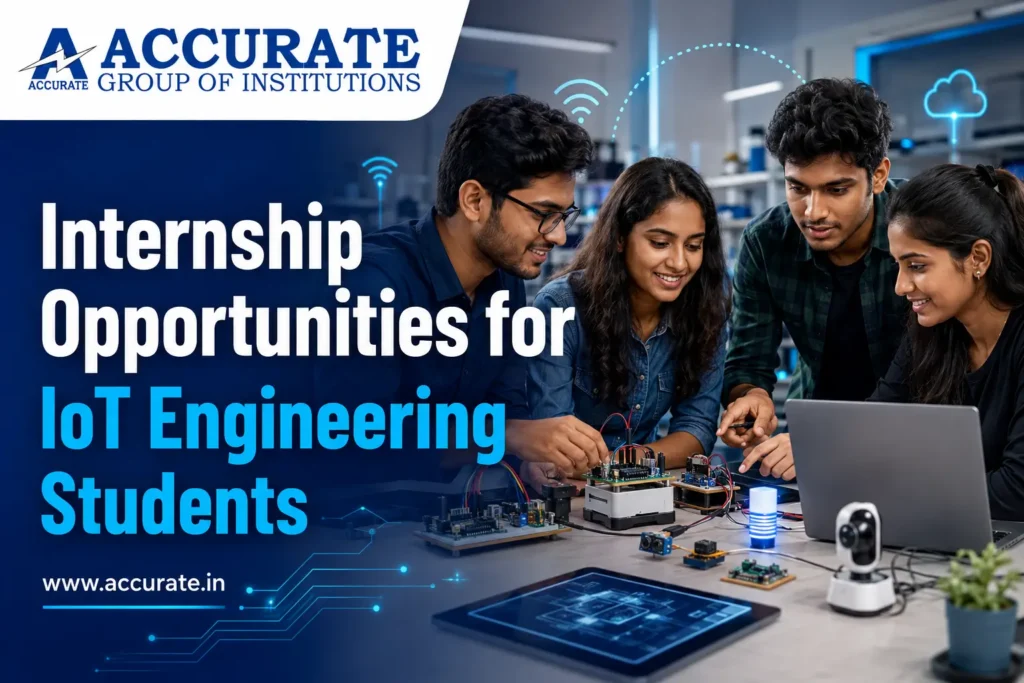

Internship Opportunities for IoT Engineering Students
The Internet of Things has moved far beyond connected watches and smart home appliances. Today, IoT technologies support intelligent factories, healthcare monitoring, agriculture, logistics, energy management, transportation, environmental protection and smart-city infrastructure. As organisations adopt connected devices and real-time monitoring systems, they need engineers who can understand both hardware and software.
This expanding ecosystem has created diverse internship opportunities for IoT engineering students. An internship allows students to work with sensors, embedded controllers, communication networks, cloud platforms, databases and data-processing tools in practical environments. It can also help them understand how an idea is converted into a secure, reliable and commercially useful connected product.
For an IoT student, classroom learning provides the technical foundation, but an internship reveals how engineering is practised in the real world. Students learn to interpret requirements, select components, write and test code, troubleshoot device failures, document their work and collaborate with multidisciplinary teams.
Institutions that emphasise practical education can help students prepare for such opportunities. Accurate Institute of Management & Technology supports an industry-oriented learning environment in which aspiring engineers can develop technical knowledge, project experience and professional skills relevant to emerging technology careers.
This comprehensive guide explains the major IoT internship domains, required skills, application strategies, project ideas and steps students can take to turn an internship into a successful engineering career.
Table of Contents
- Understanding IoT Engineering Internships
- Why Internships Matter for IoT Students
- Major Internship Opportunities in IoT
- Industries Hiring IoT Interns
- Essential Technical Skills
- Important Soft Skills
- When Students Should Start Applying
- How to Find an IoT Internship
- Building an Effective IoT Portfolio
- IoT Projects That Can Strengthen a Resume
- How to Prepare for Internship Interviews
- Common Challenges During an IoT Internship
- How to Make the Most of an Internship
- Career Opportunities After an IoT Internship
- Why Study IoT at Accurate Institute of Management & Technology
- Frequently Asked Questions
- Conclusion and Admission CTA
Understanding IoT Engineering Internships
An IoT engineering internship is a structured learning experience in which a student assists with the design, development, testing, deployment or maintenance of connected systems. These systems generally include physical devices, sensors, controllers, communication technologies, software applications and cloud-based services.
Unlike a purely software-based internship, an IoT internship may require the student to work at the intersection of several engineering areas. An intern might connect a temperature sensor to a development board, write firmware to collect readings, transmit the data using a wireless protocol and display the information on a web or mobile dashboard.
A typical IoT solution contains the following layers:
Device and Sensor Layer
This layer includes sensors, actuators, microcontrollers, embedded boards and physical equipment. It collects information from the environment or performs an action based on a command.
Communication Layer
This layer transfers information between devices, gateways and cloud applications. It may involve Wi-Fi, Bluetooth, cellular connectivity, RFID or specialised low-power communication protocols.
Data and Cloud Layer
The cloud or server receives, stores and processes device data. Interns working in this area may create APIs, manage databases, configure device services or develop monitoring dashboards.
Application and Analytics Layer
This layer turns raw device data into useful information. It can include alerts, visualisations, predictive models, automated decisions and user-facing applications.
Because IoT combines these layers, students can choose internship roles according to their interests. A student who enjoys electronics may focus on embedded hardware, while someone interested in programming may prefer firmware, cloud development or analytics.
Why Internships Matter for IoT Engineering Students
Internships provide a bridge between academic knowledge and professional practice. They give students a chance to apply engineering concepts under real-world constraints such as limited budgets, hardware availability, power consumption, security, deadlines and user requirements.
Practical Application of Academic Concepts
Subjects such as digital electronics, computer networks, programming, embedded systems and database management become easier to understand when students apply them to an actual product. An internship shows how multiple concepts work together rather than existing as isolated academic topics.
Exposure to Industry Tools
Companies may use circuit-design tools, version-control systems, cloud platforms, testing equipment, device-management software and collaborative development applications. Early exposure to these tools can make students more prepared for future employment.
Development of Problem-Solving Ability
Connected systems can fail for many reasons. A sensor may produce incorrect data, a device may lose connectivity, firmware may consume too much memory or a cloud service may reject a request. Internships teach students how to investigate these problems systematically.
Professional Networking
An intern interacts with engineers, managers, mentors, developers and other interns. These connections may provide career guidance, recommendations, future project collaborations or information about employment opportunities.
Stronger Resume and Placement Profile
A relevant internship demonstrates that a student has worked beyond textbooks. When supported by clear project outcomes and verified responsibilities, internship experience can strengthen a resume and create meaningful topics for placement interviews.
Better Career Decisions
IoT contains many specialisations. Through an internship, students can discover whether they prefer hardware development, firmware, networking, cloud applications, cybersecurity, testing or analytics. This clarity can guide elective subjects, certifications and career preparation.
Major Internship Opportunities for IoT Engineering Students
IoT is a multidisciplinary field, so students are not limited to a single internship designation. The following domains offer some of the most relevant opportunities.
Embedded Systems and Firmware Internships
Embedded systems form the intelligence inside connected devices. In this internship, students may program microcontrollers, connect sensors, manage memory, optimise device performance and test firmware.
Common responsibilities can include:
- Writing and debugging embedded code
- Interfacing sensors and actuators
- Reading circuit diagrams and component datasheets
- Testing input and output operations
- Managing device power consumption
- Documenting firmware behaviour
Students interested in this area should be comfortable with C, C++, microcontrollers, electronics fundamentals and serial communication.
IoT Hardware Development Internships
Hardware interns help design, assemble or test physical IoT prototypes. They may work with development boards, communication modules, sensors, power supplies and printed circuit boards.
Tasks may include selecting components, preparing prototypes, checking connections, using measurement instruments and assisting with hardware validation. Knowledge of basic circuit design, soldering, electronics troubleshooting and sensor integration is valuable.
Sensor Integration Internships
Sensors allow IoT devices to measure temperature, pressure, movement, light, humidity, location, air quality and numerous other conditions. Sensor integration interns help connect these components to controllers and ensure that the collected data is accurate.
Students may calibrate sensors, compare readings, reduce noise, configure sampling intervals and develop routines that convert raw signals into usable values. These internships are relevant to healthcare devices, agriculture, manufacturing and environmental monitoring.
Industrial IoT Internships
Industrial IoT, commonly called IIoT, applies connected technologies to factories, warehouses, energy facilities and large machines. It is one of the most promising areas for students interested in automation and manufacturing.
An industrial IoT intern may assist with:
- Machine-condition monitoring
- Production-line data collection
- Predictive-maintenance systems
- Energy-consumption analysis
- Industrial dashboards
- Equipment tracking
- Safety and alert systems
A basic understanding of automation, sensors, networking, data visualisation and industrial processes can be useful in this role.
IoT Cloud Development Internships
Connected devices often send their data to cloud or server-based systems. Cloud interns help develop the infrastructure that receives, processes, stores and presents this information.
They may work with APIs, databases, event-processing tools, device registries and dashboards. Familiarity with Python, JavaScript, databases, web services and basic cloud concepts can improve readiness for these internships.
IoT Application Development Internships
Users need an interface to monitor and control connected devices. Application-development interns may build web dashboards, mobile applications or administrative portals for IoT systems.
For example, an intern may develop an interface that displays real-time sensor values, sends alerts, controls a connected appliance or presents historical performance trends. Skills in web or mobile development, APIs and interface design are particularly useful.
IoT Networking Internships
Reliable connectivity is essential to every IoT deployment. Networking interns may test communication between devices, gateways and servers. They can also assist with network configuration, data transmission and connectivity troubleshooting.
Students pursuing these roles should understand network layers, IP addressing, wireless communication, device-to-device messaging and common IoT communication patterns.
IoT Cybersecurity Internships
Every connected device can create a potential security risk. IoT cybersecurity internships focus on protecting devices, communication channels, applications and stored data.
Students may assist with vulnerability testing, access-control reviews, secure communication, authentication, firmware analysis or security documentation. Knowledge of computer networks, Linux, cryptography fundamentals and secure coding can be advantageous.
IoT Data Analytics Internships
IoT devices can generate large volumes of continuous data. Analytics interns help clean, analyse and visualise this information so that organisations can make better decisions.
Typical activities include preparing datasets, detecting patterns, creating dashboards, identifying unusual device behaviour and generating reports. Students may use Python, SQL, spreadsheets, visualisation tools or basic machine-learning techniques.
Robotics and Automation Internships
Robotics combines mechanical systems, electronics, sensors, controllers and software. IoT adds connectivity and remote intelligence to robotic systems.
Interns may work on obstacle detection, motor control, remote monitoring, autonomous navigation or robotic data collection. This field is suitable for students who enjoy creating systems that interact physically with their environment.
Research and Development Internships
Research laboratories, educational institutions and technology companies may offer internships involving experimental IoT applications. Students might explore wearable technology, intelligent transportation, environmental sensing, edge computing or low-power networks.
Research internships are especially valuable for students considering postgraduate education, technical publications or product innovation.
Smart Home and Consumer Device Internships
Companies developing connected lights, security systems, appliances and personal devices need interns for prototyping, application development and product testing. Students may work on remote control, automation rules, voice-based interaction or device interoperability.
Quality Assurance and IoT Testing Internships
Testing is vital because IoT systems involve both hardware and software. Testing interns check whether devices operate correctly under different conditions.
They may test connectivity, response times, battery performance, sensor accuracy, mobile applications and firmware updates. Students who are patient, analytical and detail-oriented can build strong careers in quality assurance.
Industries Hiring IoT Engineering Interns
IoT technology is used across a wide range of industries. Students should therefore search beyond companies that have “IoT” in their names.
Manufacturing
Manufacturers use connected sensors to monitor machines, improve production, reduce energy use and predict equipment failures.
Healthcare
IoT supports patient-monitoring systems, wearable devices, connected medical equipment and medicine-storage monitoring. Privacy, safety and accuracy are especially important in this sector.
Agriculture
Smart agriculture solutions monitor soil conditions, weather, irrigation, crop health and livestock. These systems can help farmers manage resources more efficiently.
Automotive and Transportation
Connected vehicles, fleet tracking, traffic monitoring and predictive maintenance create opportunities for students interested in mobility technology.
Logistics and Supply Chain
IoT can track vehicles, packages, warehouse conditions and temperature-sensitive goods. Interns may assist with location tracking and real-time operational dashboards.
Energy and Utilities
Smart meters and connected monitoring systems help organisations understand consumption, equipment health and distribution performance.
Smart Cities
Traffic management, waste monitoring, water systems, street lighting and environmental sensors are important smart-city applications.
Retail
Retailers may use connected technologies for inventory monitoring, asset tracking, customer analytics and supply-chain visibility.
Technology Startups
Startups often allow interns to handle diverse responsibilities, from prototyping and coding to testing and customer demonstrations. Such environments can provide rapid practical learning.
Essential Technical Skills for an IoT Internship
Students do not need to master every IoT technology before applying. However, a balanced technical foundation can make them more competitive.
Programming Skills
C and C++ are valuable for embedded programming, while Python is widely used for prototyping, automation and data analysis. JavaScript can be helpful for dashboards and web applications.
Instead of merely listing languages on a resume, students should demonstrate how they have used them in projects.
Electronics Fundamentals
IoT students should understand voltage, current, resistance, digital and analogue signals, circuit components and safe hardware connections. The ability to read basic circuit diagrams is highly useful.
Microcontrollers and Development Boards
Hands-on familiarity with common microcontroller platforms and prototyping boards can help students understand input-output operations, sensor connections and device programming.
Communication Protocols
Students should learn the purpose of wired and wireless communication. Understanding how devices exchange information is more important than memorising protocol definitions.
Networking Fundamentals
Knowledge of network architecture, IP addressing, ports, client-server communication and internet protocols helps students diagnose connectivity problems.
Database and API Knowledge
IoT applications frequently store readings in databases and transfer information through APIs. Students should understand how data is sent, received, structured and retrieved.
Cloud and Edge Computing Basics
Cloud systems offer storage, computing and device management, while edge computing processes some information closer to the device. Understanding the difference helps students design responsive and efficient solutions.
Cybersecurity Awareness
Students must learn the importance of strong authentication, secure communication, software updates and data privacy. Security should be considered from the beginning of a project.
Testing and Debugging
An engineering student should be able to divide a complex problem into smaller parts. Testing the sensor, controller, network and application separately often makes troubleshooting more effective.
Important Soft Skills for IoT Interns
Technical skills alone do not guarantee a successful internship. Companies also evaluate how students work with people, organise tasks and respond to challenges.
Communication
Interns should be able to explain problems clearly, ask relevant questions and present their progress without unnecessary complexity.
Teamwork
An IoT project may involve hardware engineers, software developers, designers, analysts and business teams. Respectful collaboration is essential.
Documentation
Accurate documentation helps others understand circuit connections, software dependencies, testing procedures and project limitations.
Time Management
Interns frequently balance learning with assigned deliverables. Breaking work into manageable milestones can prevent last-minute difficulties.
Curiosity and Adaptability
IoT technologies develop rapidly. Students who are willing to read documentation, experiment carefully and learn from errors can progress quickly.
When Should Students Start Applying?
Students can begin exploring IoT during the first year by learning programming and basic electronics. The second year is a good time to build small projects and participate in technical communities. By the third year, students should actively pursue domain-focused internships.
A practical preparation timeline may look like this:
First Year
- Learn one programming language
- Understand basic electronics
- Join technical clubs and workshops
- Build a simple sensor-based project
Second Year
- Study microcontrollers and networking
- Complete two or three documented projects
- Create a professional resume and online portfolio
- Pursue a short training programme or startup internship
Third Year
- Select a preferred IoT specialisation
- Apply for industry internships
- Participate in hackathons and innovation challenges
- Strengthen interview preparation
Final Year
- Pursue an advanced internship or industry-linked project
- Align the final-year project with career goals
- Convert internship learning into placement evidence
- Apply for graduate engineering roles
Students should not wait until the final semester. Consistent preparation is more effective than trying to learn every required skill immediately before placement season.
How to Find an IoT Engineering Internship
Finding a good internship requires a targeted approach.
Use Company Career Pages
Students should identify companies working in embedded products, automation, electronics, cloud services, manufacturing or smart solutions. Career pages may list internships that do not appear on general portals.
Search Internship Platforms
Internship and employment portals can be useful, but students should customise applications. Sending the same resume to every company usually produces weak results.
Build Faculty and Alumni Connections
Faculty members and alumni may know about research projects, startup openings and industry opportunities. Students should approach them professionally with a clear summary of their skills and interests.
Participate in Hackathons
Hackathons allow students to demonstrate practical ability. A functional prototype developed during a challenge can attract mentors and potential recruiters.
Approach Startups
Early-stage companies may value interns who can learn quickly and contribute across multiple areas. Students should research the company before writing a concise, personalised application.
Explore Research Laboratories
Students interested in innovation or postgraduate study can approach faculty-led laboratories and research organisations. A focused email describing relevant coursework and project experience is more effective than a generic request.
Use Professional Networking Platforms
A professional profile should present projects, skills and interests clearly. Students can follow IoT companies, connect with engineers and respond to internship announcements.
Attend College Placement Activities
Industry interactions, career workshops, technical seminars and placement drives can expose students to opportunities. At Accurate Institute of Management & Technology, students can benefit from an academic environment that encourages practical preparation and professional development.
Building an Effective IoT Portfolio
A portfolio provides visible evidence of ability. It is especially important for students who have limited professional experience.
Each project should include:
- The problem being solved
- Components and technologies used
- System architecture
- The student’s individual contribution
- Photographs or a demonstration video
- Source code, where appropriate
- Testing results
- Challenges and improvements
A good portfolio does not need ten unfinished projects. Three well-documented projects can be more convincing than a long list of copied prototypes.
Students should also ensure that they understand every part of a portfolio project. Interviewers may ask why a specific sensor, controller, programming language or communication method was selected.
IoT Projects That Can Strengthen a Resume
Smart Irrigation System
A soil-moisture-based system can monitor field conditions and control irrigation. Students can add a dashboard, usage history and alerts.
Air-Quality Monitoring Device
This project can collect environmental readings and display them on a local or cloud-based interface. Students can explore sensor calibration and data visualisation.
Smart Energy Meter
An energy-monitoring solution introduces students to measurement, data transmission and consumption analysis.
Asset-Tracking Prototype
A tracking system can help students understand identification, location data, communication and dashboard design.
Connected Health-Monitoring Prototype
A non-clinical educational prototype can demonstrate data collection, alerts and privacy awareness. Students should clearly describe it as a learning project rather than a medical device.
Predictive-Maintenance Demonstration
Students can collect vibration or temperature readings from a small motor and identify abnormal operating conditions.
Smart Parking System
A prototype can detect available spaces and display their status through an application. It combines sensing, communication and interface development.
The originality of the problem-solving approach matters more than the complexity of the project.
How to Prepare for an IoT Internship Interview
Internship interviews commonly evaluate fundamentals, practical understanding and learning attitude.
Students should prepare to:
- Explain one project from beginning to end
- Draw the architecture of an IoT solution
- Describe how sensors communicate with a controller
- Explain how device data reaches an application
- Discuss a technical failure and how it was solved
- Write basic programming logic
- Answer electronics and networking questions
- Explain security risks in connected systems
- Describe their preferred internship domain
- Discuss how they work in a team
Candidates should be honest about their level of knowledge. A clear explanation of how they would investigate an unfamiliar problem can be more impressive than an unsupported claim of expertise.
Common Challenges During an IoT Internship
Hardware Availability
Specific components may be unavailable or expensive. Interns may need to test alternatives and modify their designs.
Inconsistent Sensor Data
Real-world readings are not always clean. Students must learn about calibration, noise reduction and environmental effects.
Connectivity Problems
Wireless connections can fail because of distance, interference, network configuration or power limitations.
Integration Difficulties
A sensor may work independently while the complete system fails. Students should test each layer before combining everything.
Security Concerns
Weak passwords, exposed interfaces and insecure data transmission can create risks. Students should follow organisational security guidelines carefully.
Limited Documentation
Some components or internal systems may have incomplete documentation. Interns should ask precise questions and record what they learn.
These challenges are not signs of failure. Learning to investigate them patiently is an important part of becoming an engineer.
How to Make the Most of an IoT Internship
Students should begin by understanding the expected deliverables, timeline and reporting structure. Regular communication with a mentor prevents misunderstandings.
Maintaining a daily learning journal can be extremely useful. Students can record tasks, technical decisions, errors, solutions and new concepts. This journal later helps them prepare internship reports, portfolios and interview answers.
Interns should also request feedback during the internship instead of waiting until the final day. Constructive feedback can reveal gaps in technical knowledge, communication or work habits.
Before completing the internship, students should obtain appropriate documentation, such as an internship certificate or evaluation. Confidential company information must never be uploaded to a public portfolio. Students can describe their contribution without exposing protected code, data or designs.
Career Opportunities After an IoT Internship
A relevant internship can support entry into several career paths:
- IoT engineer
- Embedded systems engineer
- Firmware developer
- Hardware design engineer
- Automation engineer
- IoT application developer
- Cloud support engineer
- Network engineer
- IoT security analyst
- Data analyst
- Robotics engineer
- Product testing engineer
- Research assistant
- Technical support engineer
Career growth depends on the student’s specialisation, problem-solving ability, continued learning and project experience. IoT professionals may eventually move into system architecture, product management, technical consulting, research or entrepreneurship.
Why Choose Accurate Institute of Management & Technology for IoT Engineering?
IoT education becomes more valuable when theoretical understanding is supported by experimentation, projects and career preparation. Accurate Institute of Management & Technology offers an academic setting designed to help aspiring engineers engage with contemporary technologies and develop industry-relevant abilities.
Students can benefit from an approach that encourages:
Practical and Project-Based Learning
IoT concepts become meaningful when students create working solutions. Project-based learning can help students understand the relationship between electronics, programming, connectivity and data.
Exposure to Emerging Technologies
IoT increasingly connects with artificial intelligence, machine learning, cloud computing, cybersecurity, robotics and data science. Exposure to related technologies can broaden career options.
Technical Skill Development
Structured academic learning helps students establish foundations in programming, electronics, embedded systems, networks and software development.
Innovation and Problem Solving
Students can be encouraged to identify everyday problems and create technology-driven solutions. This mindset is valuable for internships, hackathons and entrepreneurial projects.
Career and Professional Preparation
Resume development, interview preparation, communication skills and industry exposure can help students present their abilities more confidently to employers.
Located in Greater Noida, an important education and corporate region in Delhi NCR, Accurate Institute of Management & Technology offers students access to an environment where academic learning and professional aspirations can develop together.
Prospective students should review the latest programme structure, eligibility requirements, facilities and admission information directly through the institute before applying.
Frequently Asked Questions (FAQs)
1. What are the best internship opportunities for IoT engineering students?
The best opportunities include embedded systems, IoT hardware, firmware development, sensor integration, industrial automation, cloud development, IoT cybersecurity, robotics, data analytics and product testing. The right choice depends on the student’s skills and career interests.
2. Which skills are required for an IoT internship?
Students should develop programming, electronics, microcontroller, sensor, networking, database and API fundamentals. Basic cloud knowledge, cybersecurity awareness, debugging ability, communication and documentation skills are also beneficial.
3. Can a first-year engineering student apply for an IoT internship?
Yes, although first-year students may find more beginner-level training or project opportunities than specialised industry roles. Learning programming, electronics and basic prototyping can help them prepare for advanced internships later.
4. Is Python useful for an IoT internship?
Yes. Python is useful for prototyping, data processing, automation, testing, server-side development and analytics. However, students interested in embedded firmware should also consider learning C or C++.
5. Do IoT internships require hardware knowledge?
Hardware knowledge is important for device-focused roles, but its required depth varies. Cloud, application and analytics internships may place greater emphasis on software skills while still expecting an understanding of how connected devices operate.
6. How can students find IoT internships in India?
Students can use company career pages, internship portals, professional networks, faculty contacts, alumni groups, hackathons, research laboratories and startup communities. Applications should be customised for each opportunity.
7. Which IoT project is best for an internship resume?
A useful project solves a genuine problem and demonstrates multiple skills. Smart irrigation, environmental monitoring, energy management, asset tracking and predictive maintenance are good choices when they are original, functional and properly documented.
8. Are IoT internships paid?
Some IoT internships provide a stipend, while others may be unpaid, project-based or offered for academic credit. Students should evaluate the learning quality, responsibilities, mentorship, duration and terms before accepting an opportunity.
9. Can an IoT internship lead to a full-time job?
Yes. A strong internship can lead to a pre-placement opportunity or future job consideration, depending on the organisation and the intern’s performance. Even without a direct offer, the experience can strengthen future placement applications.
10. Why is Accurate Institute of Management & Technology suitable for aspiring IoT engineers?
Accurate Institute of Management & Technology promotes an industry-oriented engineering environment with attention to practical learning, emerging technologies, projects and professional development. Students can build the foundations needed to pursue internships and careers in connected technologies.
Conclusion: Begin Your Journey from IoT Student to Industry-Ready Engineer
Internship opportunities for IoT engineering students extend across embedded systems, electronics, industrial automation, cloud computing, cybersecurity, robotics, application development and data analytics. These opportunities allow students to transform academic concepts into working solutions while developing technical confidence and professional maturity.
The strongest candidates do not wait for an internship to begin learning. They practise programming, experiment with sensors, study networking, build original projects and document their progress. They also develop communication, teamwork and problem-solving skills that help them contribute effectively in professional environments.
Choosing the right institute is an important part of this journey. Accurate Institute of Management & Technology provides aspiring engineers with an environment focused on technical education, practical exposure, innovation and career readiness. Its location in Greater Noida further places students within one of Delhi NCR’s prominent educational and industrial regions.
If you want to explore IoT, intelligent devices and future-focused engineering careers, take the next step with Accurate Institute of Management & Technology. Review the latest admission details, programme eligibility and application process at www.accurate.in and begin preparing for a career in the connected world.