
The Internet of Things (IoT) is entering a new phase. For years, IoT was largely described as a network of connected sensors, appliances, machines, vehicles and devices that could collect data and communicate through the internet. That definition remains correct, but it no longer captures the full potential of the technology.
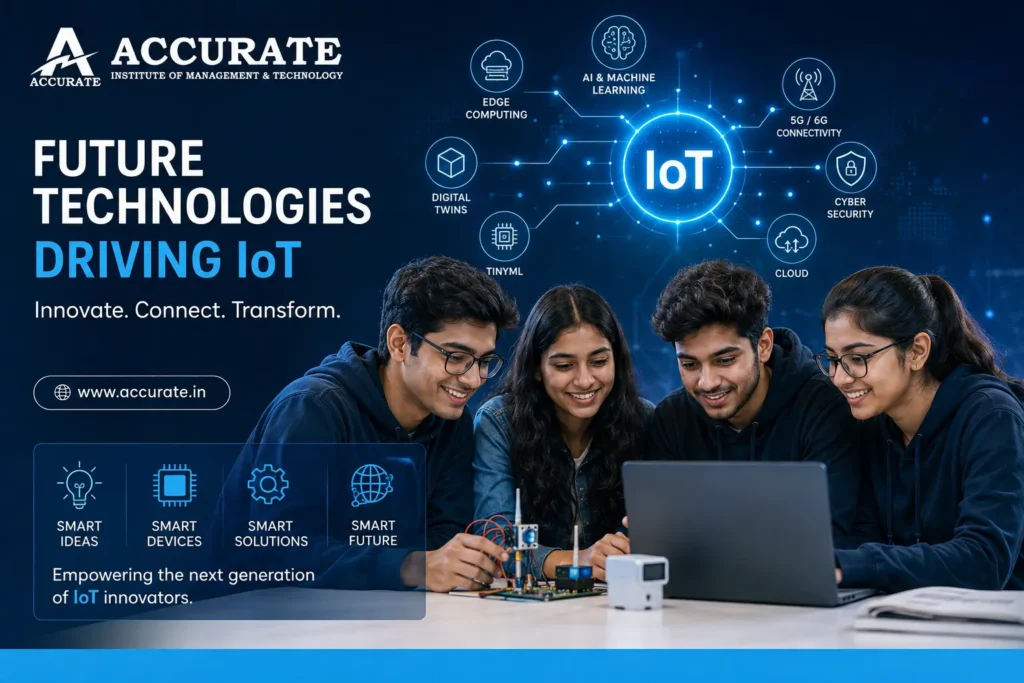
The future of IoT is about intelligent, autonomous and context-aware connected systems. Artificial intelligence can help devices interpret information instead of merely collecting it. Edge computing can move decision-making closer to the source of data. Digital twins can create dynamic virtual representations of physical assets. Advanced wireless networks can support faster and more extensive communication, while new security architectures can help protect an expanding ecosystem of connected endpoints.
Emerging concepts such as ambient IoT, satellite connectivity, TinyML, federated learning and next-generation wireless communication are also changing what engineers can build. Research around 6G, for example, is exploring AI-native networking, digital twin networks, terrestrial and satellite integration, massive connectivity and new communication architectures.
For engineering students, this transformation is particularly important. Tomorrow’s IoT professionals will need to understand not only devices and networks but also artificial intelligence, cloud-edge architectures, embedded computing, cybersecurity and data engineering. This multidisciplinary nature makes IoT one of the most interesting areas for students who want to participate in the development of smart factories, intelligent transportation, connected healthcare, precision agriculture and next-generation cities.
Accurate Institute of Management & Technology in Greater Noida provides an engineering environment where students exploring IoT-focused education can combine computer science fundamentals with connected technologies, practical learning, projects and career preparation. Its B.Tech CSE (Internet of Things) pathway operates within an AICTE-approved, AKTU-affiliated engineering framework.
Table of Contents
- Understanding the Next Generation of IoT
- Artificial Intelligence and Machine Learning
- Edge AI and Edge Computing
- 5G and the Road to 6G
- Digital Twins
- TinyML and Intelligent Embedded Devices
- Cloud-Edge-Device Computing
- Advanced IoT Cybersecurity
- Blockchain and Distributed Trust
- Satellite and Non-Terrestrial IoT
- Ambient IoT and Energy-Efficient Devices
- Federated Learning and Privacy-Preserving AI
- Advanced Sensors and Smart Materials
- Autonomous IoT and Robotics
- Future Applications of IoT
- Skills Students Need for Future IoT Careers
- Studying IoT at Accurate Institute of Management & Technology
- Frequently Asked Questions
- Conclusion
Understanding the Next Generation of IoT
Traditional IoT architectures generally follow a familiar sequence: a sensor collects information, a communication network transfers it, a platform processes or stores the data, and an application presents the result to a user.
Future IoT systems are becoming considerably more sophisticated.
Imagine an industrial motor equipped with vibration, temperature and acoustic sensors. A conventional IoT system might transmit measurements to a cloud platform and display them on a dashboard. A more advanced system can use an edge AI model to detect abnormal behaviour locally, compare the equipment’s condition with a digital twin, estimate the probability of failure and trigger an appropriate maintenance workflow.
The important shift is from connected devices to connected intelligence.
This evolution is sometimes described through the term AIoT — Artificial Intelligence of Things. The objective is not simply to connect more objects. It is to make connected environments capable of understanding conditions and responding intelligently.
AI-driven smart spaces already combine sensing, communication, network management, analytics and artificial intelligence to improve automation, energy use and user experiences.
1. Artificial Intelligence and Machine Learning
Artificial Intelligence is arguably one of the most influential technologies shaping the future of IoT.
IoT systems can generate enormous volumes of data. Temperature readings, video streams, machine vibrations, location information, energy consumption and environmental measurements are useful only when organisations can convert them into meaningful decisions.
How AI Makes IoT Smarter
Machine learning models can identify patterns within sensor data that would be difficult to discover through simple threshold-based rules.
An intelligent IoT system can potentially:
- detect unusual machine behaviour;
- predict equipment maintenance requirements;
- identify objects in camera feeds;
- optimise energy consumption;
- forecast demand;
- recognise environmental changes;
- personalise smart-building settings; and
- automate routine operational decisions.
This combination of AI and IoT is especially important because future connected environments may involve thousands or millions of data-producing endpoints.
Predictive Maintenance
Consider a manufacturing plant. Instead of waiting for equipment to fail, sensors can continuously collect information about vibration, pressure, temperature and power consumption.
Machine learning algorithms can analyse those patterns to identify signs associated with deterioration.
Maintenance can then move from a reactive model—repairing a machine after it fails—to a predictive approach that helps organisations intervene earlier.
Generative AI and IoT
Generative AI could introduce another layer of interaction.
Instead of navigating complex dashboards, a plant manager might eventually ask:
“Which machines show the highest operational risk this week, and why?”
An intelligent interface could interpret sensor information, maintenance history and system alerts before presenting an understandable summary.
The long-term opportunity is to make IoT systems not only measurable but increasingly conversational, explainable and responsive.
2. Edge AI and Edge Computing
One limitation of cloud-dependent IoT is that data often has to travel from a device to a remote data centre before a decision comes back.
That approach may be unsuitable when milliseconds matter.
Edge computing processes information closer to where it originates—on a device, gateway, local server or nearby computing infrastructure.
Why Edge Computing Matters
Edge architectures can provide several advantages:
- lower latency;
- reduced network traffic;
- faster local decisions;
- improved operation during intermittent connectivity;
- better control over sensitive data; and
- reduced dependence on continuous cloud communication.
The trend becomes even more powerful when combined with artificial intelligence.
Edge AI means running AI inference close to the device generating the data. Instead of continuously transmitting every measurement or image, a local model can analyse information and send only relevant events or insights.
Edge AI is increasingly being explored alongside 5G, federated learning and integrated edge-cloud architectures.
Example: Smart Traffic Management
A roadside camera continuously sending high-resolution video to the cloud consumes significant bandwidth.
An edge-enabled camera can instead analyse the video locally, detect traffic density or incidents and transmit structured information.
The difference is fundamental:
Old model: collect → transmit → process → respond.
Future model: sense → understand locally → act → synchronise relevant information.
3. 5G and the Road to 6G
IoT cannot grow without communication technologies capable of supporting increasingly diverse devices.
5G has already created important possibilities for connected systems through higher capacity, lower latency and support for large-scale machine communications.
The longer-term research frontier is 6G.
How 6G Could Influence IoT
6G remains an emerging technology rather than a widely deployed commercial reality. Research is examining capabilities such as AI-native networking, terahertz communication, intelligent reflective surfaces, ultra-massive MIMO, digital twin networks and integrated terrestrial, aerial and satellite architectures.
These capabilities could support future applications involving:
- autonomous transportation;
- collaborative robots;
- immersive environments;
- large-scale industrial automation;
- smart infrastructure;
- remote healthcare technologies; and
- extremely dense sensor ecosystems.
Integrated Communication and Intelligence
The important story about 6G is therefore not simply “faster internet.”
Future networks are being investigated as programmable and intelligent infrastructures capable of combining communication, computation, sensing and AI.
For IoT engineers, this means networking knowledge will increasingly overlap with artificial intelligence, distributed computing and embedded systems.
4. Digital Twins
A digital twin is a dynamic digital representation of a physical object, process or system.
Unlike a basic computer model, a connected digital twin can receive information from the real-world asset through sensors and IoT infrastructure.
How Digital Twins and IoT Work Together
Imagine a wind turbine.
Sensors installed on the physical turbine measure variables such as:
- rotational speed;
- temperature;
- vibration;
- wind conditions; and
- component performance.
Those measurements update its digital representation.
Engineers can then use the digital twin to understand current conditions, test scenarios and support maintenance decisions without physically experimenting on the operating machine.
Where Digital Twins Can Be Used
Digital twins have potential across:
Manufacturing: monitoring production equipment and processes.
Smart cities: modelling infrastructure, mobility and energy systems.
Healthcare: supporting models of equipment, facilities and selected physiological processes.
Automotive engineering: analysing vehicle behaviour and components.
Energy: monitoring turbines, grids and industrial assets.
Buildings: understanding occupancy, energy and environmental performance.
Research increasingly connects digital twins with next-generation networks because high-quality twins require continuous data exchange, interoperability and synchronisation.
An emerging research direction goes even further toward cognitive twins, which aim to add capabilities such as memory, reasoning and interaction to conventional digital-twin systems.
5. TinyML and Intelligent Embedded Devices
Not every IoT device has the computing resources of a smartphone or server.
Many operate with tiny processors, limited memory and strict energy constraints.
This is where TinyML becomes important.
Tiny Machine Learning focuses on running compact machine-learning models on resource-constrained devices such as microcontrollers.
Why TinyML Matters
Consider a small battery-powered sensor in an agricultural field.
Sending every measurement continuously to the cloud consumes communication energy. If the sensor can locally recognise relevant patterns, it may communicate only when something important happens.
TinyML can therefore support:
- intelligent wearables;
- agricultural sensors;
- predictive-maintenance nodes;
- sound recognition;
- anomaly detection;
- environmental monitoring; and
- low-power smart appliances.
The concept pushes intelligence toward the smallest layer of the IoT architecture.
Instead of asking, “How do we send all device data to AI?”, engineers can increasingly ask, “How much intelligence can we safely bring to the device itself?”
6. Cloud-Edge-Device Computing
Predictions that edge computing will simply replace cloud computing miss an important point.
The future is likely to be collaborative.
Different computational tasks belong in different locations.
Device Layer
The device may perform immediate sensing, filtering and lightweight inference.
Edge Layer
A gateway or edge server may combine information from multiple devices and handle latency-sensitive analytics.
Cloud Layer
The cloud remains valuable for:
- large-scale storage;
- fleet management;
- model training;
- historical analytics;
- application integration; and
- enterprise-level computing.
Future IoT architecture will therefore increasingly operate as a device-edge-cloud continuum.
An autonomous factory, for example, might perform safety decisions locally, production optimisation at the edge and long-term analytics in the cloud.
Designing where each workload should run will become an important engineering skill.
7. Advanced IoT Cybersecurity
More connected devices also mean more potential attack points.
An insecure smart camera, industrial controller or gateway can become an entry point into a larger system. As IoT expands into healthcare, energy, manufacturing and transportation, cybersecurity becomes a fundamental engineering requirement rather than an optional feature.
Zero-Trust IoT
Traditional security often assumed that devices operating inside a trusted network could be considered safe.
Zero-trust architectures challenge that assumption.
The basic principle is straightforward: access should be continuously verified rather than automatically trusted because a device is already inside the network.
Future IoT security may increasingly involve:
- strong device identities;
- secure boot mechanisms;
- encrypted communication;
- authentication and authorisation;
- anomaly detection;
- signed firmware updates;
- hardware security;
- network segmentation;
- continuous monitoring; and
- secure lifecycle management.
AI may help identify suspicious patterns across large IoT deployments, but it can also introduce new security considerations. As IoT becomes more intelligent, engineers will need to understand both traditional cybersecurity and AI-related risks.
8. Blockchain and Distributed Trust
Blockchain is often associated with cryptocurrency, but its underlying concept—a distributed, tamper-resistant record—has also been explored for IoT environments.
Potential applications include:
- device identity;
- supply-chain traceability;
- machine-to-machine transactions;
- audit trails;
- data-integrity verification; and
- decentralised trust.
Example: Connected Supply Chain
Imagine a temperature-sensitive pharmaceutical shipment.
IoT sensors can monitor temperature and location throughout transportation. A distributed ledger could potentially provide authorised participants with a verifiable record of important events.
However, blockchain is not automatically the correct solution for every IoT system. Computational overhead, scalability, energy consumption, privacy and integration requirements must be evaluated carefully.
Future engineers should learn to select technologies because they solve a genuine engineering problem—not simply because they are fashionable.
9. Satellite and Non-Terrestrial IoT
A major limitation of conventional IoT is geographical coverage.
What happens when sensors are installed in:
- remote farms;
- mountains;
- oceans;
- mines;
- forests;
- pipelines;
- ships; or
- regions without reliable terrestrial networks?
Satellite IoT and other Non-Terrestrial Networks (NTNs) can help extend connectivity beyond conventional cellular coverage.
Research into next-generation satellite systems is also exploring AIoT, where intelligent processing is distributed across space and ground infrastructure rather than relying entirely on traditional ground-based workflows.
Applications of Satellite IoT
Satellite-connected devices could support:
Agriculture: remote soil, livestock and weather monitoring.
Logistics: tracking assets travelling across large geographic areas.
Environmental science: collecting information from oceans, forests and isolated regions.
Disaster management: maintaining monitoring capabilities where terrestrial infrastructure is damaged or unavailable.
Energy: monitoring pipelines and geographically dispersed infrastructure.
The convergence of terrestrial and non-terrestrial connectivity is also part of current 6G research.
10. Ambient IoT and Energy-Efficient Devices
One of the more interesting future directions is Ambient IoT.
Conventional IoT devices generally depend on batteries or wired power. Maintaining billions of battery-powered sensors creates cost and sustainability challenges.
Ambient IoT explores extremely low-power devices that may harvest energy from their surroundings or use technologies such as backscatter communication.
The International Telecommunication Union currently lists work related to requirements and frameworks for ambient power-enabled IoT, illustrating growing standardisation interest in this field.
Why Ambient IoT Could Matter
Imagine extremely low-power tags or sensors embedded into:
- retail products;
- packages;
- industrial components;
- agricultural assets;
- buildings; and
- logistics systems.
If devices can operate with minimal maintenance, organisations may be able to instrument environments at a scale that is impractical with conventional battery-powered sensors.
That could bring IoT closer to the idea of ubiquitous sensing—where intelligence is woven quietly into physical environments.
11. Federated Learning and Privacy-Preserving AI
AI normally improves by learning from data. But IoT data can be sensitive.
A healthcare wearable may collect personal measurements. A factory may generate proprietary operational data. A smart building may reveal patterns about occupants.
Sending all raw information to a central server may therefore create privacy, bandwidth and regulatory concerns.
Federated learning offers an alternative approach.
Instead of collecting all raw data centrally, participating devices or edge nodes can train models locally and share model updates.
Why It Matters for IoT
Federated approaches may help support:
- greater data privacy;
- distributed intelligence;
- reduced movement of raw information; and
- learning across geographically separated devices.
It does not eliminate security or privacy risks, but it changes the architecture of collaborative machine learning.
For future IoT professionals, privacy-preserving computation could become an increasingly valuable specialisation.
12. Advanced Sensors and Smart Materials
Every IoT system begins with an ability to observe the physical world.
Future sensors are becoming smaller, more efficient and capable of measuring increasingly diverse phenomena.
Connected systems can incorporate sensors for:
- temperature;
- humidity;
- pressure;
- motion;
- vibration;
- light;
- sound;
- gases;
- location;
- biological signals; and
- environmental conditions.
Sensor Fusion
An important development is sensor fusion—combining information from several sensors to create a more reliable understanding of an environment.
An autonomous vehicle, for example, cannot depend on a single source of information. Cameras, radar, positioning systems and other sensors can contribute different perspectives.
Artificial intelligence can then help combine these streams into a richer interpretation.
As sensors improve, the quality of IoT intelligence improves with them.
13. Autonomous IoT and Robotics
IoT and robotics are also moving closer together.
IoT provides sensing, communication and coordination. Robotics adds physical action.
Together, they can enable cyber-physical systems that perceive conditions and respond in the real world.
Smart Factory Example
Consider a connected manufacturing facility containing:
- robotic arms;
- autonomous mobile robots;
- machine-vision cameras;
- environmental sensors;
- equipment-monitoring systems;
- digital twins; and
- edge AI servers.
Rather than functioning as isolated machines, these components can exchange information and coordinate operations.
A sensor may detect a problem, an AI model may classify its severity, a digital twin may assess its impact, and an automated system may adjust production.
That is significantly more advanced than the original idea of simply putting devices online.
14. Future Applications of IoT
The real significance of these technologies becomes clearer when we examine where they can be applied.
Smart Manufacturing
Future factories can combine IoT sensors, AI, robotics, digital twins and edge computing for predictive maintenance, automated inspection, production optimisation and improved worker safety.
Connected Healthcare
IoT technologies can support remote monitoring, connected medical equipment, smart hospital infrastructure and wearable devices.
Because healthcare information can be highly sensitive and decisions may have serious consequences, reliability, security, privacy and human oversight are essential.
Precision Agriculture
Agricultural IoT can use soil sensors, weather information, connected irrigation, drones and analytics to support more informed decisions about water, crops and resources.
Satellite IoT may expand these possibilities in locations where conventional network coverage is limited.
Intelligent Transportation
Connected vehicles and infrastructure can exchange information about traffic, road conditions and system status.
Research examining the convergence of IoT, AI and future 6G communication identifies intelligent transportation as an important future application area.
Smart Energy
IoT can contribute to smart grids, renewable-energy monitoring, demand management and equipment maintenance.
Smart Cities
Connected infrastructure can potentially improve:
- traffic management;
- public transport;
- water management;
- environmental monitoring;
- waste management;
- energy efficiency; and
- infrastructure maintenance.
However, smart-city systems must also address privacy, cybersecurity, governance and equitable access.
15. Skills Students Need for Future IoT Careers
Because IoT connects multiple engineering domains, students need a broad technical foundation.
Programming
Programming is central to device firmware, data processing, cloud services, dashboards and automation. Skills can include C/C++, Python, JavaScript, Java, SQL and other languages depending on the chosen role.
Embedded Systems
Students should understand microcontrollers, sensors, interfaces and embedded software.
Networking
IoT engineers need knowledge of networking fundamentals and communication protocols because connectivity sits at the centre of every IoT architecture.
Cloud and Edge Computing
Future professionals should understand how workloads can be distributed across devices, gateways, edge infrastructure and cloud platforms.
Artificial Intelligence
Machine learning, data analytics, computer vision and Edge AI can become important differentiators as IoT systems become intelligent.
Cybersecurity
Students should learn secure communication, authentication, device security, vulnerability management and secure software practices.
Problem-Solving
IoT development involves constant debugging across hardware, software and networking layers.
Employers commonly value a combination of programming, electronics, microcontrollers, networking, Linux, debugging, databases, APIs, cloud awareness, security fundamentals, version control, communication and teamwork.
16. Preparing for the IoT Future at Accurate Institute of Management & Technology
Understanding future technologies is valuable, but engineering education becomes more meaningful when students can turn concepts into working systems.
Accurate Institute of Management & Technology offers an IoT-focused engineering pathway in Greater Noida. Its B.Tech CSE (Internet of Things) environment combines computer science fundamentals with areas such as embedded systems, sensors, networking, cloud computing, data analytics, AI, cybersecurity and practical projects. The engineering framework is AICTE approved and affiliated with Dr. A.P.J. Abdul Kalam Technical University (AKTU).
Why Practical Learning Matters in IoT
IoT cannot be mastered through theory alone.
Students benefit from building systems that require them to:
- connect sensors;
- write software;
- configure devices;
- transmit information;
- process data;
- develop interfaces;
- troubleshoot failures; and
- consider security.
Useful student projects can include energy monitoring, smart irrigation, equipment-health analysis, asset tracking, environmental sensing, cold-chain monitoring and connected laboratory systems.
Greater Noida and the Technology Ecosystem
Location can also influence engineering exposure.
Greater Noida forms part of the wider Delhi NCR education and industry ecosystem, giving students potential access to companies, industrial areas, technology events, internships and a substantial academic community. Accurate Institute’s Knowledge Park III location places it within this wider corridor.
Students comparing IoT engineering colleges should look beyond promotional claims and examine the curriculum, laboratories, faculty support, project culture, internships, industry interaction, placement preparation and academic environment.
Frequently Asked Questions About Future Technologies Driving IoT
1. What are the future technologies driving IoT?
The major future technologies driving IoT include Artificial Intelligence, Edge AI, edge computing, 5G and emerging 6G networks, digital twins, TinyML, cloud-edge computing, advanced cybersecurity, satellite IoT, ambient IoT, federated learning and advanced sensors. These technologies can make IoT systems faster, smarter and increasingly autonomous.
2. How will AI change the future of IoT?
AI will help IoT devices and platforms analyse sensor data, recognise patterns, detect anomalies, predict outcomes and automate decisions. Instead of simply collecting information, future AI-powered IoT systems can increasingly interpret conditions and determine appropriate actions.
3. Why is edge computing important for IoT?
Edge computing processes data closer to where it is generated. This can reduce latency, bandwidth consumption and dependence on continuous cloud connectivity. It is particularly useful for industrial automation, smart cameras, robotics and other applications requiring rapid decisions.
4. How will 6G affect IoT?
6G is still under research and development, but it is being explored for massive connectivity, AI-native networking, advanced sensing, terrestrial-satellite integration and extremely demanding connected applications. It could eventually support more intelligent and autonomous IoT ecosystems.
5. What is the role of digital twins in IoT?
A digital twin creates a virtual representation of a physical asset or system and can be updated using IoT sensor data. Engineers can use twins for monitoring, simulation, optimisation and predictive maintenance without performing every experiment directly on the physical asset.
6. What is TinyML in IoT?
TinyML is the use of compact machine-learning models on resource-constrained hardware such as microcontrollers. It enables small IoT devices to perform tasks such as anomaly detection or classification locally rather than sending every piece of raw data to the cloud.
7. Will IoT have good career opportunities in the future?
IoT can support careers across embedded systems, firmware, automation, cloud computing, networking, cybersecurity, data analytics and connected-product engineering. Potential roles include IoT developer, embedded systems engineer, automation engineer, cloud associate, network engineer, IoT security analyst and data analyst.
8. What skills should an IoT engineering student learn?
Students should develop programming, electronics, microcontroller, sensor, networking, database, Linux, cloud, cybersecurity and debugging skills. Knowledge of AI, Edge AI and data analytics can provide additional value as intelligent IoT systems become more common.
9. Is IoT better than traditional Computer Science Engineering?
Neither is universally better. Traditional CSE generally provides broad software and computing depth, while an IoT-focused pathway adds greater emphasis on sensors, devices, embedded systems, networks and physical-world deployments. The right choice depends on a student’s interests and career goals.
10. Why consider Accurate Institute of Management & Technology for IoT engineering?
Accurate Institute of Management & Technology offers an IoT-focused engineering environment in Greater Noida with emphasis on technical learning, practical exposure, emerging technologies, projects, professional development and placement preparation. Students should verify the latest programme structure, eligibility, fees, scholarships and admission requirements directly with the institute before applying.
Conclusion: Build the Future of Connected Intelligence
The future of IoT will not be defined by the number of devices connected to the internet. Its real impact will come from what those devices can sense, understand, predict and safely accomplish.
Artificial intelligence is bringing intelligence to connected data. Edge computing is moving decision-making closer to devices. TinyML is placing machine learning inside increasingly constrained hardware. Digital twins are connecting physical assets with dynamic virtual models. Satellite IoT is extending connectivity beyond conventional network boundaries, while ambient IoT could enable a new generation of extremely low-power connected objects. Meanwhile, 5G and future 6G technologies are expanding the possibilities for high-performance, intelligent and deeply integrated communication systems.
These developments also make cybersecurity, privacy, interoperability and responsible engineering more important than ever.
For students, this creates an exciting challenge. The IoT engineer of the future will not belong to only one technical domain. The strongest professionals will be able to connect software with electronics, sensors with networks, edge devices with cloud systems, data with AI and innovation with security.
Accurate Institute of Management & Technology offers aspiring engineers an environment in Greater Noida where they can explore this multidisciplinary field through an IoT-focused B.Tech pathway, practical learning, technology projects and career-oriented development.
Take the Next Step Towards an IoT Career
If you want to build smart devices, intelligent machines and connected systems that could shape tomorrow’s industries, start by choosing an engineering education that develops both strong fundamentals and practical skills.
Explore B.Tech CSE (Internet of Things) at Accurate Institute of Management & Technology. Speak with the admissions team, visit the Greater Noida campus, explore the laboratories and programme curriculum, and confirm the latest eligibility, scholarships, fees, seats and admission deadlines.
Admissions are your opportunity to move from using connected technology to learning how to build it.