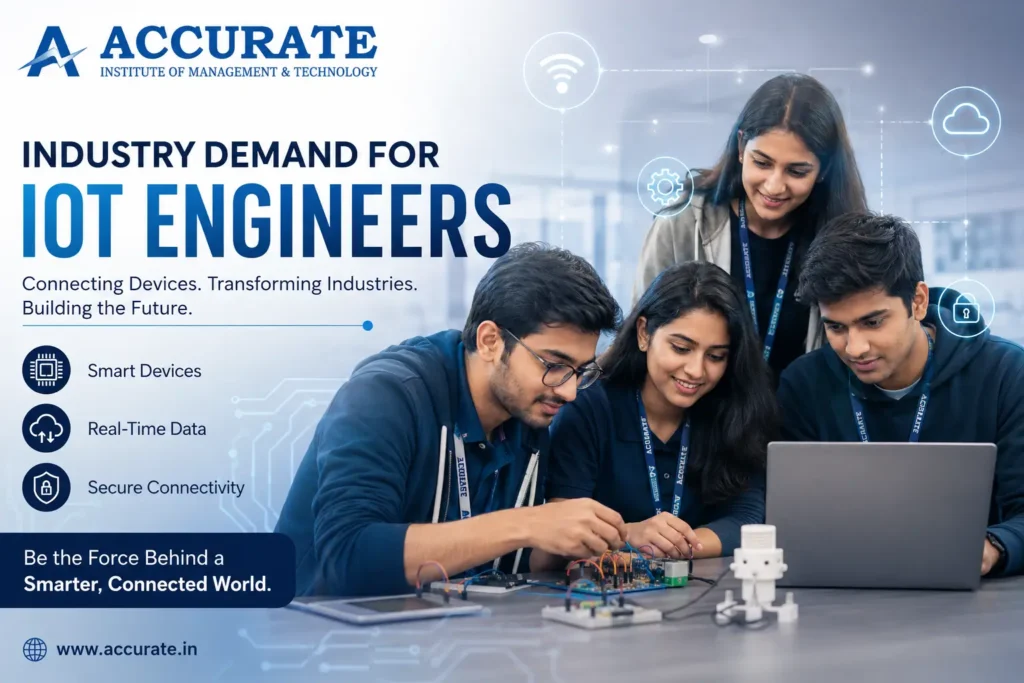

The industry demand for IoT engineers is growing as companies connect machines, sensors, vehicles, infrastructure and consumer devices to software, cloud platforms and data systems. IoT engineers are needed across manufacturing, automotive, healthcare, energy, logistics, agriculture, telecom and smart infrastructure. Employers particularly value professionals with skills in programming, embedded systems, sensors, networking, cloud computing, data analytics, cybersecurity and practical problem-solving. For engineering students, IoT offers multidisciplinary career opportunities that combine hardware, software and intelligent automation.
Why are IoT engineers in demand?
IoT engineers are in demand because businesses increasingly use connected devices, sensors, automation and real-time data to improve productivity, reduce costs, monitor assets and develop smarter products. IoT professionals help design devices, build embedded software, establish connectivity, manage cloud integration, secure systems and analyze data.
Is there a demand for IoT engineers?
Yes. IoT engineers are increasingly required in industries such as manufacturing, automotive, healthcare, logistics, energy, telecom, agriculture and smart infrastructure. Students who combine programming with embedded systems, networking, cloud computing, cybersecurity and hands-on project experience can prepare for a wide range of IoT-related careers.
Table of Contents
- Understanding the Growing Industry Demand for IoT Engineers
- Why IoT Has Become Important to Modern Industry
- Industries Creating Jobs for IoT Engineers
- What Companies Expect from IoT Engineers
- Most In-Demand Technical Skills for IoT Careers
- IoT Job Roles and Career Opportunities
- How AI, Cloud and 5G Are Changing IoT Careers
- The Growing Importance of IoT Cybersecurity
- IoT Career Opportunities for Fresh Engineering Graduates
- How Students Can Become Industry-Ready IoT Engineers
- Why Practical Learning Matters in IoT Education
- Studying IoT at Accurate Institute of Management & Technology
- Future Scope of IoT Engineering
- FAQs About Industry Demand for IoT Engineers
- Conclusion and Admission CTA
Industry Demand for IoT Engineers
The Internet of Things has moved far beyond smart watches, connected lights and home automation. Today, connected technologies are becoming part of factories, vehicles, hospitals, warehouses, farms, energy systems, buildings and public infrastructure. As physical equipment becomes increasingly connected to software, networks and cloud platforms, organizations need professionals who understand both the physical and digital sides of technology.
This transformation is driving the industry demand for IoT engineers.
An IoT engineer does much more than connect a sensor to the internet. Building a dependable connected system can involve electronics, microcontrollers, embedded programming, networking, APIs, cloud platforms, databases, dashboards, analytics, artificial intelligence and cybersecurity. Engineers must also understand how the complete system behaves outside the laboratory, where networks fail, sensors generate inaccurate readings, devices have limited power and security vulnerabilities can create serious consequences.
That combination makes IoT a multidisciplinary engineering field.
For students deciding which emerging technology to pursue, this is particularly important. IoT does not restrict graduates to one narrow industry. The same fundamental knowledge can be applied to industrial automation, mobility, healthcare technology, energy management, logistics, agriculture and many other fields.
At the same time, employers are becoming more selective. Knowing IoT terminology is not enough. Companies increasingly need graduates who can demonstrate programming ability, understand devices and networks, troubleshoot problems and convert engineering concepts into functional projects.
This makes industry-oriented education and practical exposure essential.
Why IoT Has Become Important to Modern Industry
Businesses have always wanted better information about their operations. IoT makes it possible to collect that information directly from physical environments.
A temperature sensor can continuously monitor a cold-storage facility. A vibration sensor can provide information about industrial equipment. GPS devices can track commercial vehicles. Smart meters can measure electricity consumption. Agricultural sensors can collect information about soil and environmental conditions.
The value does not come from the sensor alone. It comes from converting physical observations into useful digital information.
A typical IoT system may follow this flow:
Physical environment → Sensor → Device/Controller → Network → Cloud or Edge Platform → Data Processing → Dashboard/Application → Decision or Automated Action
Engineers are required across this entire chain.
From Reactive Operations to Real-Time Intelligence
Traditional systems often require people to inspect equipment manually or respond after something has already gone wrong.
Connected systems can change this approach.
Organizations can use IoT technologies to:
- monitor equipment remotely;
- detect abnormal conditions;
- automate routine operations;
- track assets and inventory;
- measure energy consumption;
- improve quality control;
- collect operational data;
- support predictive maintenance;
- improve customer experiences; and
- make faster, data-informed decisions.
This operational value is one of the strongest reasons companies invest in connected technologies—and consequently need engineers capable of designing and maintaining them.
Industries Creating Demand for IoT Engineers
The strength of an IoT career is its cross-industry relevance. Connected systems can be applied wherever physical equipment, environmental conditions or operational processes need to be measured, controlled or optimized.
Manufacturing and Industrial IoT
Manufacturing is one of the most significant application areas for IoT.
Modern factories increasingly depend on sensors, automated machines, connected production systems and industrial data platforms. Industrial IoT, often called IIoT, allows manufacturers to collect information from machines and production environments.
IoT engineers can contribute to:
- machine-condition monitoring;
- predictive maintenance systems;
- production-line monitoring;
- energy management;
- asset tracking;
- industrial automation;
- quality-control systems; and
- connected safety solutions.
For example, instead of waiting for a machine to stop working, a connected monitoring system may continuously analyze vibration or temperature data. Engineers can then use this information to identify unusual behaviour before a serious failure occurs.
Automotive and Connected Mobility
Modern vehicles are becoming sophisticated computing platforms.
Vehicles can contain numerous sensors, electronic control systems and communication technologies. Connected mobility extends this ecosystem through telematics, fleet management, charging infrastructure and vehicle-to-cloud communication.
Potential IoT-related work includes:
- vehicle telematics;
- fleet tracking;
- remote diagnostics;
- connected infotainment;
- electric-vehicle monitoring;
- smart charging;
- mobility analytics; and
- intelligent transportation systems.
As vehicles become more software-defined and connected, professionals who understand embedded systems, networking, cloud platforms and cybersecurity become increasingly relevant.
Healthcare and Medical Technology
Connected healthcare technologies can help medical professionals monitor equipment, environments and, in appropriate applications, patient-related data.
IoT applications can include:
- remote monitoring devices;
- connected medical equipment;
- hospital asset tracking;
- environmental monitoring;
- medicine-storage monitoring;
- smart healthcare infrastructure; and
- wearable technology.
Healthcare IoT also demonstrates why engineers must understand more than connectivity. Reliability, privacy, security and responsible handling of data can be critical requirements.
Logistics and Supply Chain
A supply chain involves continuous movement of products, vehicles and information.
IoT can improve visibility across this process.
Applications include:
- GPS-based fleet tracking;
- warehouse monitoring;
- asset tracking;
- cold-chain monitoring;
- route optimization;
- inventory visibility; and
- shipment-condition monitoring.
Imagine transporting temperature-sensitive products. Knowing that a shipment has arrived is not enough; organizations may also need information about the conditions under which it travelled.
Connected sensors can provide that additional layer of visibility.
Energy and Utilities
Energy systems increasingly require intelligent monitoring and management.
IoT applications may include smart meters, connected substations, renewable-energy monitoring, building energy management and equipment-condition monitoring.
IoT engineers working in this sector may need knowledge of:
- sensors and instrumentation;
- communication protocols;
- edge computing;
- cloud systems;
- data visualization;
- automation; and
- cybersecurity.
Agriculture and Smart Farming
Agriculture is another promising application area.
Sensors and connected systems can help measure:
- soil conditions;
- temperature;
- humidity;
- water usage;
- greenhouse environments;
- equipment performance; and
- livestock-related parameters.
Smart irrigation is a simple example. Instead of operating entirely according to a fixed schedule, a system can use sensor information to support more informed water management.
Smart Buildings and Infrastructure
Buildings are becoming connected environments.
IoT technologies can support:
- energy optimization;
- smart lighting;
- access management;
- occupancy monitoring;
- environmental sensing;
- equipment maintenance; and
- safety systems.
At a larger scale, similar technologies can contribute to connected transportation, parking, utilities and other smart-infrastructure applications.
What Companies Expect from IoT Engineers
The growing industry demand for IoT engineers does not mean employers simply want candidates with “IoT” written on their resumes.
Companies need engineers capable of solving problems.
An effective IoT engineer should understand how individual technologies interact within a complete system. A sensor may work perfectly, but the project can still fail because the wireless connection is unreliable. A cloud dashboard may look impressive, but inaccurate sensor calibration can make its data meaningless.
Employers therefore tend to value a combination of technical depth and systems thinking.
Strong Engineering Fundamentals
Before specialization comes fundamentals.
IoT students benefit from understanding:
- programming;
- data structures;
- computer architecture;
- operating systems;
- computer networks;
- databases;
- basic electronics;
- algorithms; and
- software engineering.
Technology platforms change. Fundamentals remain valuable.
Ability to Build and Debug
Debugging is one of the most valuable practical skills in IoT.
When a connected device stops communicating, the engineer may need to determine whether the problem comes from:
- the sensor;
- power supply;
- firmware;
- communication protocol;
- wireless network;
- API;
- cloud service;
- database; or
- application layer.
The ability to isolate problems systematically is highly useful in real engineering environments.
Most In-Demand Skills for IoT Engineers
Programming Skills
IoT professionals may work across embedded devices, backend systems and applications.
Depending on the role, useful programming languages can include:
- C and C++;
- Python;
- Java;
- JavaScript; and
- scripting languages.
Students should focus less on collecting programming-language names and more on becoming genuinely comfortable with logic, debugging, APIs and software development.
Embedded Systems and Microcontrollers
Embedded computing forms the foundation of many IoT devices.
Students should learn how microcontrollers interact with sensors, actuators and communication modules.
Useful concepts include:
- GPIO;
- interrupts;
- serial communication;
- timers;
- memory constraints;
- device interfaces;
- firmware development; and
- power management.
Sensors and Electronics
An IoT system begins with the physical world.
Engineers therefore benefit from understanding how sensors measure temperature, motion, light, pressure, distance and other variables.
Knowing how to connect a sensor is only the beginning. Engineers should also understand accuracy, calibration, noise, environmental limitations and reliability.
Networking and Communication Protocols
A device becomes part of the Internet of Things when it can communicate.
Students should understand fundamental networking concepts and become familiar with technologies and protocols used by connected systems.
Depending on the application, these may include Wi-Fi, Bluetooth, cellular connectivity and specialized IoT communication technologies.
Application-layer concepts such as MQTT, HTTP and APIs are also important.
Cloud Computing
Many IoT systems rely on cloud infrastructure for device management, storage, analytics and applications.
Cloud knowledge can help engineers understand how device data travels from the edge to applications used by businesses or consumers.
Important areas include:
- APIs;
- databases;
- cloud storage;
- device management;
- dashboards;
- event processing; and
- scalable architecture.
Data Analytics and Artificial Intelligence
Connected devices can generate enormous amounts of data.
Collecting data has limited value unless organizations can interpret it.
IoT engineers who understand data processing and analytics can help transform sensor readings into useful information.
AI further expands this potential.
For example, machine data can potentially be analyzed for patterns associated with equipment failure. Environmental sensors can feed intelligent optimization systems. Edge devices can increasingly perform selected AI tasks closer to where data is generated.
This convergence between IoT, AI and data analytics is creating exciting interdisciplinary career paths.
Cybersecurity
Every connected device can become part of an organization’s digital attack surface.
IoT engineers therefore need security awareness from the beginning of system design.
Important concepts include:
- authentication;
- authorization;
- encryption;
- secure communication;
- firmware security;
- secure updates;
- network segmentation;
- credential management; and
- data privacy.
Security is not an optional feature to add after an IoT product has been completed. It should be considered throughout its lifecycle.
Linux and Edge Computing
Linux knowledge can be particularly valuable for engineers working with gateways, embedded computers and edge platforms.
Edge computing allows some data processing to occur near the source rather than sending everything to a distant cloud environment.
This can help when applications require lower latency, reduced bandwidth usage or continued operation despite intermittent connectivity.
IoT Job Roles and Career Opportunities
One advantage of studying IoT is that graduates are not restricted to the title “IoT Engineer.”
Depending on their specialization, practical skills and employer requirements, graduates may explore roles such as:
IoT Developer
IoT developers work on software that connects devices, services, databases and applications. They may develop device logic, APIs, dashboards or integrations.
Embedded Systems Engineer
Embedded engineers focus more deeply on firmware, microcontrollers, electronics and hardware-software interaction.
IoT Solutions Engineer
A solutions engineer may help design end-to-end connected systems for specific business requirements.
This role requires systems thinking because a solution may combine devices, gateways, networks, cloud services, applications and security.
Automation Engineer
IoT knowledge can complement industrial automation skills, especially as operational equipment becomes more connected and data-driven.
Cloud and IoT Platform Engineer
Students who build strong cloud-computing skills can move toward roles involving device management, data pipelines, scalable applications and platform integration.
IoT Security Professional
Connected-device security is becoming increasingly important.
Professionals in this area may work on device security, network protection, vulnerability assessment, secure firmware and IoT architecture.
Data and Analytics Roles
Students with strong programming, statistics and analytical capabilities may work with data generated by connected systems.
Testing and Validation Engineer
IoT systems must be tested across hardware, firmware, networking, software and environmental conditions.
Testing engineers help identify failures before products reach users or industrial environments.
How AI, Cloud and 5G Are Changing IoT Careers
IoT is becoming more valuable because it is evolving alongside other technologies.
AI + IoT
Artificial intelligence gives connected systems the ability to move from basic monitoring toward intelligent interpretation.
A sensor may detect vibration. AI can potentially help interpret patterns in that vibration.
A camera may capture an image. Edge AI may allow certain processing to happen locally.
The result is a growing need for engineers who can work across both connected devices and intelligent software.
Cloud + IoT
Cloud platforms make it possible to manage connected devices, store information and deliver applications at scale.
For students, understanding cloud architecture can therefore significantly expand IoT career options.
5G + IoT
Advanced cellular networks can support new connected applications through improved capacity, latency characteristics and device connectivity.
Engineers who understand both communication networks and IoT architecture can be well positioned for emerging connected ecosystems.
Why IoT Cybersecurity Will Create Specialized Demand
As the number of connected devices increases, securing them becomes a major engineering challenge.
Consider an ordinary computer. It usually has substantial processing power and can receive software updates.
An IoT sensor may have limited memory, low processing capability and a battery expected to last for years. It may also be installed in a location that is difficult to access physically.
Security must work within these constraints.
Organizations therefore need professionals who understand both cybersecurity principles and the unique characteristics of embedded and connected devices.
Students interested in security can build expertise in:
- secure embedded development;
- network security;
- device authentication;
- penetration testing;
- firmware analysis;
- cryptography fundamentals;
- cloud security; and
- vulnerability management.
This intersection can become an important specialization within the wider IoT employment landscape.
IoT Career Opportunities for Fresh Engineering Graduates
Fresh graduates sometimes assume employers expect them to know every technology in the IoT ecosystem.
That is unrealistic.
What matters more is demonstrating strong fundamentals, learning ability and evidence of practical application.
A student applying for an IoT-related role can strengthen a resume through meaningful projects.
Instead of writing:
“Knowledge of IoT.”
A candidate could demonstrate a project involving:
Sensor → Microcontroller → MQTT/API → Cloud/Database → Dashboard → Alerts
The second approach gives recruiters evidence that the student understands how a complete system works.
Build a Portfolio, Not Just a Resume
Useful student IoT projects can include:
- smart energy monitoring;
- environmental monitoring;
- asset tracking;
- smart irrigation;
- equipment-health monitoring;
- connected safety systems;
- cold-chain monitoring;
- smart parking;
- home-energy optimization; and
- campus automation.
The strongest projects are not necessarily the most complicated.
A simple project that is reliable, secure, documented and thoroughly tested can demonstrate more engineering maturity than a complex prototype copied from an online tutorial.
How Students Can Become Industry-Ready IoT Engineers
Step 1: Master Programming Fundamentals
Start with programming logic, problem-solving and data structures.
Students should become comfortable writing and debugging their own code.
Step 2: Learn Basic Electronics
Understand voltage, current, digital and analog signals, sensors, actuators and circuit fundamentals.
Step 3: Work with Microcontrollers
Build small embedded projects and gradually increase complexity.
Step 4: Learn Networking
Understand IP networking and how devices exchange data.
Step 5: Connect Devices to Applications
Learn APIs, messaging systems and databases.
Step 6: Explore Cloud Platforms
Understand how cloud services can receive, store, process and visualize device information.
Step 7: Add Security
Apply authentication, encryption and secure configuration to projects.
Step 8: Build Real Projects
Projects should solve defined problems rather than merely demonstrate components.
Step 9: Use Version Control and Documentation
Git, technical documentation and clear project explanations are professional skills.
Step 10: Develop Communication Skills
Engineers often work with multidisciplinary teams.
The ability to explain a technical decision clearly—to another engineer, a manager or a customer—can be as important as writing code.
Why Practical Learning Matters in IoT Education
IoT cannot be learned effectively through theory alone.
A textbook can explain a communication protocol. A laboratory shows what happens when packets are lost.
A lecture can explain sensors. A project teaches students that sensor readings may fluctuate.
A diagram can explain cloud architecture. A working prototype teaches students about latency, authentication, API failures and database design.
This is why students comparing engineering colleges should look beyond course names.
They should ask:
- Are students building projects?
- Are relevant laboratories available?
- Is programming emphasized?
- Do students work with sensors and embedded platforms?
- Are emerging technologies incorporated into learning?
- Is there industry exposure?
- Is career preparation part of the educational environment?
These questions matter because IoT is ultimately an applied engineering discipline.
Preparing for IoT Careers at Accurate Institute of Management & Technology
For students interested in connected technologies, choosing an educational environment that combines computer science foundations with practical learning can be an important first step.
Accurate Institute of Management & Technology, Greater Noida, offers B.Tech CSE (Internet of Things) within an engineering framework that emphasizes technology learning, practical exposure, projects and career preparation. Institute materials describe its engineering programme as AICTE approved and affiliated with Dr. A.P.J. Abdul Kalam Technical University (AKTU). Applicants should verify the current approval, affiliation, intake and programme information for their admission year.
The IoT-focused academic pathway brings together areas such as computer science, embedded systems, sensors, networking, cloud computing, data analytics, AI and cybersecurity—disciplines that reflect the multidisciplinary nature of connected technology.
Learning Beyond the Classroom
For aspiring IoT engineers, the objective should be to progress from understanding concepts to building systems.
Students benefit when they can experiment, develop projects, identify failures, troubleshoot solutions and explain their engineering decisions.
Accurate Institute’s career-oriented engineering environment emphasizes technical education, emerging technologies, practical exposure, project work, professional skills and placement preparation.
Its location in Greater Noida also places students within the wider Delhi NCR education and industry ecosystem, with access to a region containing companies, industrial areas, technology activities and internship opportunities.
For a field as multidisciplinary as IoT, this combination of academic fundamentals, practical learning and professional preparation can help students work toward the skills employers seek.
Future Scope of IoT Engineering
The future of IoT is unlikely to be defined by a single device category.
Its larger impact comes from making physical environments measurable, programmable and increasingly intelligent.
Several trends are likely to influence future IoT careers.
More Intelligence at the Edge
Devices and gateways will increasingly process selected information locally.
Engineers who understand embedded computing and AI can benefit from this convergence.
Greater Focus on Security
More connected devices create more security responsibilities.
Security expertise will become increasingly valuable across the IoT lifecycle.
Expansion of Industrial IoT
Factories, warehouses, energy infrastructure and logistics operations will continue exploring connected monitoring and automation.
Engineers who understand both operational environments and software systems can create differentiated expertise.
Sustainability Applications
Connected technologies can help organizations monitor electricity, water, equipment efficiency and environmental conditions.
This creates opportunities to combine IoT with sustainability-focused engineering.
More Interdisciplinary Engineering Roles
The distinction between hardware engineer, software developer, cloud engineer and data specialist is becoming less rigid in many connected-system projects.
IoT engineers who can communicate across these domains can become particularly valuable.
Is IoT Engineering a Good Career Choice?
IoT can be an excellent career direction for students who enjoy understanding how things work.
It is particularly suitable for learners interested in a combination of:
- coding;
- electronics;
- connected devices;
- automation;
- networking;
- cloud computing;
- data;
- AI; and
- cybersecurity.
However, students should avoid choosing IoT simply because it is an emerging technology.
Successful engineers need curiosity, patience and a willingness to troubleshoot.
An IoT project may fail because of one line of code, an incorrect voltage, poor connectivity, an expired credential or an incorrectly configured cloud service.
For someone who enjoys solving these puzzles, IoT can provide an engaging and diverse engineering career.
Frequently Asked Questions About Industry Demand for IoT Engineers
1. Are IoT engineers in demand?
Yes. IoT skills are relevant across manufacturing, automotive, healthcare, logistics, energy, agriculture, telecom and smart infrastructure. Organizations implementing connected products, sensors and automation need professionals who understand devices, networking, software, cloud systems and security.
2. Why is the demand for IoT engineers increasing?
Demand is growing because businesses want real-time visibility, automation, remote monitoring, asset tracking and data-driven operations. IoT engineers help connect physical equipment with software and digital platforms so organizations can collect information and automate processes.
3. What skills are required to become an IoT engineer?
Important skills include programming, embedded systems, microcontrollers, electronics, sensors, networking, databases, APIs, cloud computing, Linux, cybersecurity and debugging. Employers also value communication, teamwork and practical project experience.
4. What jobs can I get after B.Tech IoT?
Possible careers include IoT developer, embedded systems engineer, automation engineer, IoT solutions engineer, cloud associate, network engineer, IoT security analyst, data analyst and testing engineer. Actual job titles and requirements vary by employer.
5. Which industries hire IoT engineers?
IoT professionals can find opportunities in manufacturing, automotive, healthcare technology, telecom, energy, logistics, agriculture, consumer electronics, smart buildings, infrastructure, cloud technology and industrial automation.
6. Does an IoT engineer need coding skills?
Yes. Programming is important because IoT systems depend on device logic, firmware, data processing, APIs, cloud services and applications. Students do not need to know every programming language, but strong coding and problem-solving fundamentals are valuable.
7. Is IoT a good career for engineering students in India?
IoT can be a promising option for students interested in software, devices, automation and data because connected technologies have applications across many industries. Career outcomes depend on technical fundamentals, practical projects, internships, specialization and continuous learning.
8. Is AI replacing IoT engineers?
AI is more likely to change and expand IoT engineering than eliminate it. AI can analyze data and enable intelligent automation, while IoT systems still require devices, sensors, embedded software, connectivity, cloud architecture, security, testing and system integration. Engineers who understand both AI and IoT can develop valuable interdisciplinary skills.
9. Which IoT projects are best for getting a job?
Good portfolio projects include energy monitoring, smart irrigation, equipment-health monitoring, asset tracking, environmental sensing, cold-chain monitoring and connected safety systems. Strong projects should solve a real problem, work reliably, include security and failure testing, and be clearly documented.
10. Why consider Accurate Institute of Management & Technology for IoT Engineering?
Accurate Institute of Management & Technology offers an IoT-focused B.Tech CSE pathway in Greater Noida with emphasis on technical education, practical learning, emerging technologies, projects and career preparation. Its engineering framework is described in institute materials as AICTE approved and AKTU affiliated. Prospective students should confirm current programme, approval, eligibility and admission details directly with the institute.
Conclusion: Build the Skills Industry Needs for a Connected Future
The industry demand for IoT engineers reflects a much bigger technological change: the physical and digital worlds are becoming increasingly connected.
Factories want intelligent equipment. Logistics companies want better asset visibility. Vehicles are becoming connected platforms. Energy systems require smarter monitoring. Buildings are becoming automated. Agriculture is adopting sensor-based technologies. Healthcare is exploring connected systems. Across these environments, data must move reliably from physical devices to software that can interpret and act on it.
IoT engineers help make that possible.
For students, the opportunity extends beyond learning how to connect sensors. A future-ready IoT professional needs a broad engineering foundation that can include programming, embedded systems, electronics, networking, cloud computing, databases, cybersecurity, AI and data analytics.
Just as importantly, employers need people who can build, test, debug and improve real systems.
That is why the right engineering education should combine classroom knowledge with laboratories, projects, experimentation, professional development and exposure to emerging technologies.
For students exploring an IoT-focused engineering education in Greater Noida, Accurate Institute of Management & Technology provides an environment designed around technical learning, practical exposure, projects and career preparation. Students can explore its B.Tech CSE (Internet of Things) pathway and evaluate how its academic environment aligns with their career goals in connected technology.