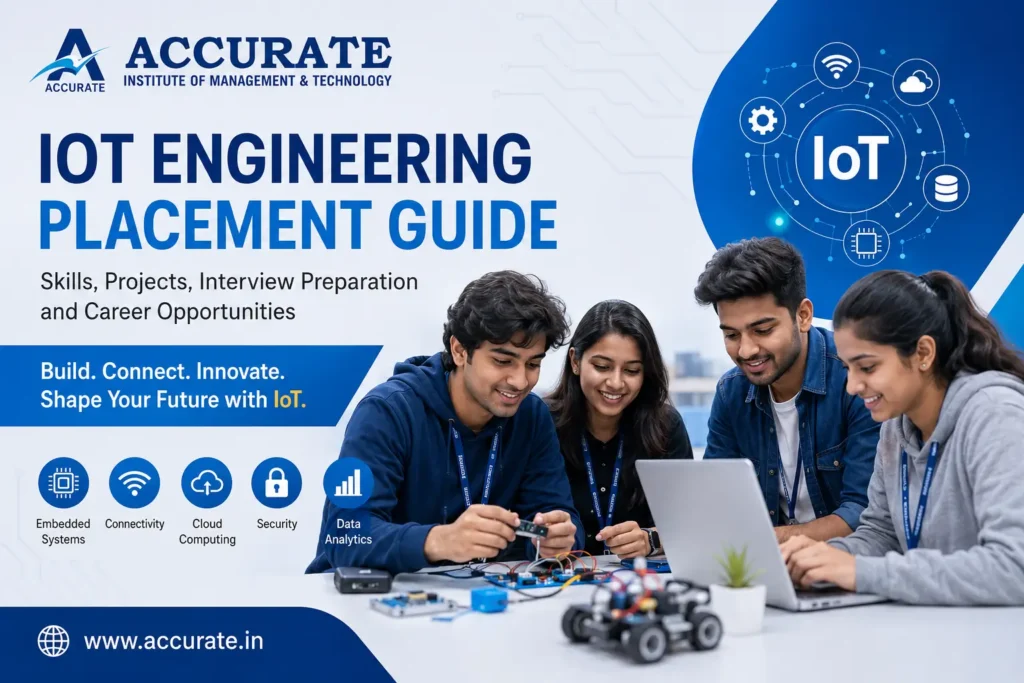

An effective IoT engineering placement strategy combines strong programming fundamentals, embedded systems, sensors, microcontrollers, networking, cloud platforms, databases, cybersecurity and practical projects. Students should also practise aptitude, coding, technical interviews, communication and project presentation. Instead of learning every IoT technology, candidates should build strong fundamentals and demonstrate two or three well-documented projects that solve real problems. Accurate Institute of Management & Technology supports IoT-focused engineering students through practical learning, project exposure, professional development and placement-oriented preparation.
How should an IoT engineering student prepare for placements?
IoT students should prepare for placements by strengthening programming, data structures, microcontrollers, sensors, networking, databases and cloud fundamentals. They should build practical IoT projects, maintain a professional resume and GitHub portfolio, practise aptitude and coding questions, prepare core technical subjects and develop the ability to explain project architecture, challenges, testing and results confidently.
What should I do to get placed after IoT Engineering?
Start with programming and computer science fundamentals, learn embedded systems and IoT technologies, build practical projects, practise coding and aptitude, complete internships and prepare for technical and HR interviews. Focus on demonstrating what you can build and troubleshoot instead of simply listing technologies on your resume.
Table of Contents
- What Is IoT Engineering Placement?
- Why IoT Graduates Have Diverse Career Opportunities
- What Recruiters Look for in IoT Engineering Students
- Essential Technical Skills for IoT Placements
- Programming Skills Every IoT Student Should Develop
- IoT Hardware, Networking and Cloud Skills
- Best IoT Projects for Placement Preparation
- IoT Placement Preparation Roadmap
- Resume and Portfolio Strategy for IoT Freshers
- How to Prepare for IoT Technical Interviews
- Aptitude, Coding, GD and HR Interview Preparation
- Career Opportunities After IoT Engineering
- Common Placement Mistakes IoT Students Should Avoid
- How Accurate Institute Supports Career Readiness
- FAQs
- Conclusion and Admission CTA
IoT Engineering Placement Guide: From Classroom Learning to Career Readiness
The Internet of Things has changed the meaning of a “connected world.” Smart factories can monitor machines, agricultural systems can analyse soil conditions, logistics companies can track assets, buildings can optimise energy consumption and healthcare devices can continuously collect useful data. Behind these systems are engineers who understand how software, devices, networks, cloud platforms and data work together.
For students, however, knowing what IoT means is only the beginning. The bigger question is: How do you convert an IoT Engineering degree into a successful placement opportunity?
This IoT Engineering Placement Guide provides a practical roadmap.
Placement preparation for IoT students should not begin a few weeks before companies visit campus. It should develop progressively throughout the engineering programme. Recruiters may evaluate programming ability, computer science fundamentals, embedded systems knowledge, networking concepts, problem-solving, projects, communication and the candidate’s ability to learn.
That multidisciplinary nature is one of IoT’s greatest advantages.
A student studying IoT does not necessarily have to pursue a job carrying the exact title “IoT Engineer.” Depending on skills and employer requirements, graduates may explore software development, embedded systems, automation, networking, cloud computing, data analytics, testing, cybersecurity and other technology roles.
Accurate Institute of Management & Technology in Greater Noida offers B.Tech CSE (Internet of Things) within an engineering framework that emphasises connected technologies, practical learning and career development. Its engineering programme is AICTE approved and affiliated with Dr. A.P.J. Abdul Kalam Technical University (AKTU), according to institute information.
For students planning their careers, the objective should therefore be clear: graduate with demonstrable skills, not merely a degree.
What Is IoT Engineering Placement?
IoT engineering placement is the process through which students prepare for and pursue employment opportunities related to software, connected devices, embedded technology, networking, automation, cloud services, data and associated engineering domains.
A typical IoT system can involve:
Sensor → Microcontroller → Network → Gateway/Cloud → Database → Application → User
Each layer requires different technical capabilities.
That is why IoT graduates can potentially fit into several job categories.
For example, one student may develop strong embedded programming skills and pursue firmware-related opportunities. Another may specialise in cloud services and APIs. A third may focus on cybersecurity, while another may build stronger software-development skills.
The goal of placement preparation is therefore not to learn every technology equally. It is to build broad fundamentals while developing employable depth in one or two areas.
Why IoT Graduates Have Diverse Career Opportunities
IoT sits at the intersection of computer science, electronics, networking and data.
Connected technologies are relevant to sectors including manufacturing, automotive systems, healthcare, agriculture, logistics, energy and smart infrastructure.
Consider a smart manufacturing system.
Sensors collect temperature, vibration or pressure information. Embedded software processes device-level signals. A network transports information. Cloud infrastructure stores and analyses it. Dashboards present useful information, while security mechanisms protect devices and data.
An organisation implementing such a system may therefore need professionals in:
- embedded systems;
- application development;
- cloud computing;
- networking;
- databases;
- analytics;
- testing;
- cybersecurity;
- automation.
This multidisciplinary environment gives an IoT student flexibility.
However, flexibility should not become lack of direction. By the third year of engineering, students should begin identifying the type of technology role they want to pursue and align their electives, projects, internships and placement preparation accordingly.
What Recruiters Look for in IoT Engineering Students
Recruiters do not evaluate candidates only by branch name. They evaluate whether the candidate can contribute to the role being hired for.
Strong Engineering Fundamentals
Students should understand the concepts taught in their core subjects instead of depending entirely on memorisation.
Important foundations may include:
- programming;
- object-oriented concepts;
- data structures;
- operating systems;
- databases;
- computer networks;
- embedded systems;
- digital fundamentals;
- microcontrollers;
- sensors;
- communication protocols.
Problem-Solving Ability
A recruiter may present a programming question, troubleshooting situation or conceptual problem.
The candidate should be able to break the problem into smaller components, identify assumptions and explain a logical solution.
Practical Exposure
Projects provide evidence that the student has moved beyond theory.
A good project tells an interviewer:
“I encountered a problem, designed a solution, built it, tested it and learned from the result.”
That is much more convincing than listing ten technologies without being able to explain how they were used.
Communication Skills
Engineering work is collaborative.
IoT professionals may interact with software developers, electronics teams, cloud engineers, customers and managers. The ability to explain a technical system clearly is therefore an employability skill rather than merely an HR-round requirement.
Essential Technical Skills for IoT Placements
Students frequently ask, “What skills do I need for an IoT placement?”
The answer depends on the job, but several foundational areas are particularly useful.
Programming
Programming is fundamental because IoT devices and services require instructions, logic, data processing and integrations.
Useful languages can include:
C/C++: especially valuable for embedded programming and hardware-oriented development.
Python: useful for prototyping, automation, scripting, APIs and data processing.
Java or another application-oriented language: useful when preparing for broader software-development roles, depending on recruiter requirements.
Students do not need to collect programming languages. Mastering one language well enough to solve problems is more valuable than knowing the syntax of six languages superficially.
Data Structures and Algorithms
Students targeting software-oriented recruitment should prepare:
- arrays;
- strings;
- linked lists;
- stacks;
- queues;
- trees;
- searching;
- sorting;
- hashing;
- recursion;
- basic algorithmic complexity.
The objective is to understand how to solve problems efficiently.
IoT Hardware, Networking and Cloud Skills
Microcontrollers and Embedded Systems
IoT students should understand how software interacts with physical hardware.
Useful concepts include:
- microcontroller architecture;
- GPIO;
- ADC;
- PWM;
- interrupts;
- timers;
- memory;
- serial communication;
- sensor interfacing.
Platforms such as Arduino-class boards or ESP-family devices can help students prototype ideas, while deeper embedded-system understanding helps them explain what is actually happening underneath the prototype.
Sensors and Actuators
Students should understand how devices collect information and create physical responses.
Rather than simply connecting a sensor from an online tutorial, ask:
What does the sensor measure?
How accurate is it?
What causes incorrect readings?
How often should data be collected?
What happens if the sensor fails?
These questions turn a classroom prototype into an engineering exercise.
Networking and Communication Protocols
An IoT engineer should understand how connected systems exchange information.
Important concepts can include:
- TCP/IP;
- HTTP/HTTPS;
- MQTT;
- Wi-Fi;
- Bluetooth/BLE;
- basic routing;
- IP addressing;
- APIs.
The exact depth required depends on the job profile.
Cloud and Databases
Many IoT solutions require remote storage, dashboards, APIs or analytics.
Students can benefit from understanding:
- cloud computing fundamentals;
- REST APIs;
- SQL;
- basic NoSQL concepts;
- authentication;
- device-to-cloud communication;
- data pipelines;
- dashboards.
The objective is not necessarily to become a cloud architect during college. It is to understand the complete journey of data from a device to an application.
Linux and Git
Linux familiarity can be useful in embedded, cloud and development environments.
Git is equally important because professional engineering involves version control and collaboration.
A placement-ready student should ideally know how to create repositories, commit changes, work with branches and maintain readable documentation.
IoT Security Fundamentals
Security cannot be treated as an afterthought.
Students should understand basic concepts including:
- authentication;
- encryption;
- secure communication;
- access control;
- password security;
- firmware updates;
- device identity;
- data privacy.
An interviewer may be impressed when a candidate discussing a smart-home project also identifies its security risks.
Best IoT Projects for Placement Preparation
Projects can become one of the strongest sections of an IoT fresher’s resume.
Useful project areas include energy monitoring, equipment-health analysis, smart irrigation, environmental monitoring, asset tracking, cold-chain monitoring, connected laboratory systems and safety-oriented wearables.
But project quality matters more than the project title.
Smart Energy Monitoring System
Develop a system that records electricity-related parameters and presents useful information through a dashboard.
A stronger version might include:
- historical analysis;
- threshold alerts;
- abnormal-consumption detection;
- authentication;
- reporting.
Smart Irrigation System
Use environmental or soil data to automate irrigation decisions.
Instead of stopping when a pump switches on, analyse:
- sensor calibration;
- water efficiency;
- network failure;
- manual override;
- weather-related conditions.
Industrial Equipment Monitoring
Collect vibration or temperature data from equipment and create alerts when readings move outside expected limits.
This type of project demonstrates how IoT connects with industrial applications.
Asset Tracking System
Design a solution that records and communicates the location or movement of assets.
Students can discuss:
- communication technology;
- battery consumption;
- data frequency;
- location accuracy;
- backend design;
- security.
Smart Campus Project
A college itself can become a laboratory.
Students might explore:
- occupancy monitoring;
- energy management;
- environmental sensing;
- smart parking;
- laboratory asset monitoring.
What Makes an IoT Project Placement-Ready?
A project should answer seven questions:
- What problem did you identify?
- Who is the user?
- Why did you select your hardware and software?
- How does data move through the system?
- What problems occurred during development?
- How did you test the system?
- What would you improve in the next version?
Students who can answer these questions confidently demonstrate genuine ownership.
IoT Placement Preparation Roadmap
Placement preparation becomes easier when divided into stages.
First Year: Build Foundations
Focus on:
- programming fundamentals;
- mathematics;
- basic electronics;
- communication;
- problem-solving;
- participation in technical activities.
Do not worry about mastering the complete IoT stack immediately.
Second Year: Start Building
Begin strengthening:
- data structures;
- object-oriented programming;
- databases;
- networking;
- microcontrollers;
- sensor interfacing;
- Git.
Complete small projects rather than depending entirely on tutorials.
Third Year: Develop Career Direction
This is the time to ask:
“Which role am I preparing for?”
Students interested in embedded careers can deepen C/C++, microcontrollers and hardware interfaces.
Students interested in software can strengthen DSA, application development and databases.
Those interested in cloud-based IoT can learn APIs, Linux, databases and cloud fundamentals.
Cybersecurity-focused students can study networking, secure communication and device security.
The third year is also an important period for internships, hackathons and portfolio building.
Final Year: Convert Skills into Placement Performance
Now concentrate on:
- company-specific preparation;
- aptitude;
- coding practice;
- technical revision;
- mock interviews;
- resume refinement;
- project explanation;
- HR preparation.
Maintain a structured weekly plan instead of trying to revise the entire engineering curriculum immediately before an interview.
Resume and Portfolio Strategy for IoT Freshers
A recruiter’s first detailed impression may come from your resume.
Keep it concise and evidence-based.
What Should an IoT Fresher Resume Include?
A practical structure is:
Name and Contact Information
Education
Technical Skills
Projects
Internships/Training
Achievements/Certifications
Positions of Responsibility or Activities
Avoid filling the resume with every tool you have encountered.
If “MQTT” appears under skills, be ready to explain what it is and where you used it.
Write Projects with Results
Weak statement:
“Made an IoT smart monitoring project.”
Stronger approach:
“Developed a sensor-based monitoring prototype that collected environmental readings, transmitted data to an application and generated threshold-based alerts.”
Use truthful details and measurable results where available.
Never invent numbers simply to make a resume look impressive.
Create a Technical Portfolio
A useful portfolio can include:
- GitHub repositories;
- README documentation;
- architecture diagrams;
- photographs or demonstration videos;
- source code;
- test results;
- project reports.
College project habits matter here. Students are encouraged to organise code and documentation and progressively improve projects rather than considering submission the end of the work.
How to Prepare for IoT Technical Interviews
Technical interviews test both knowledge and thinking.
Revise Programming Fundamentals
Expect questions involving:
- variables;
- functions;
- pointers where relevant;
- OOP;
- memory;
- error handling;
- basic coding problems.
Prepare Core Computer Science
Depending on the company, revise:
DBMS: SQL, keys, normalisation, transactions.
Operating Systems: processes, threads, memory and scheduling.
Computer Networks: TCP/IP, protocols, addressing and client-server concepts.
Data Structures: common structures, complexity and implementation.
Prepare IoT Fundamentals
Be ready to explain:
- What is IoT?
- How is an IoT system structured?
- What is a sensor?
- What is an actuator?
- What is MQTT?
- HTTP vs MQTT?
- What is an embedded system?
- Microcontroller vs microprocessor?
- What happens when connectivity fails?
- How can an IoT device be secured?
Understanding is more important than memorising textbook definitions.
Master Your Own Project
The project interview can expose superficial preparation quickly.
An interviewer might ask:
“Why did you choose this microcontroller?”
“What happens if Wi-Fi fails?”
“How is the user authenticated?”
“What is your database schema?”
“What was your contribution?”
“What was the hardest bug?”
“What would happen with 10,000 devices instead of ten?”
If you built the project seriously, these questions become opportunities rather than threats.
Aptitude, Coding, GD and HR Interview Preparation
Aptitude Tests
Many campus recruitment processes include quantitative aptitude, logical reasoning and verbal ability.
Practise consistently rather than attempting hundreds of questions immediately before a placement test.
Track your accuracy and time.
Coding Assessments
Start with easy problems and progressively increase difficulty.
A useful cycle is:
Understand → Plan → Code → Test → Optimise → Explain
Do not simply memorise solutions.
Group Discussions
Where GDs form part of recruitment, practise listening as much as speaking.
Good candidates:
- introduce relevant points;
- support ideas logically;
- listen;
- avoid unnecessary interruption;
- help move the discussion forward.
HR Interviews
Common questions include:
“Tell me about yourself.”
“Why should we hire you?”
“What are your strengths?”
“Why did you choose IoT?”
“Tell me about a challenge.”
“Where do you see yourself in five years?”
Prepare the structure of your response, but avoid sounding memorised.
Career Opportunities After IoT Engineering
Possible career directions for IoT graduates include IoT development, embedded systems, automation, cloud-related roles, networking, IoT security, analytics and testing.
IoT Developer
Works on connected-device applications and integrations.
Useful skills can include programming, protocols, APIs, databases and cloud fundamentals.
Embedded Systems Engineer
Works closer to devices, microcontrollers and firmware.
Strong C/C++, embedded fundamentals, debugging and hardware understanding can be particularly useful.
Software Developer
IoT students with strong programming and DSA fundamentals may also prepare for broader software-development opportunities.
Cloud/IoT Associate
Works with connected devices, cloud services, APIs, databases and monitoring.
Network Engineer
Focuses on connectivity and network infrastructure.
IoT Security Professional
Works on protecting devices, communications, applications and data.
Automation Engineer
Connected sensors and control systems are important in industrial automation, making IoT knowledge relevant to this career direction.
Test or QA Engineer
Testing connected products requires systematic thinking because failures may arise from software, devices, networks or integrations.
The important point is that job titles and requirements vary between employers. Students should study the actual job description rather than assuming every IoT-related role requires the same skills.
Common Placement Mistakes IoT Students Should Avoid
Learning Too Many Tools Superficially
Ten certificates cannot compensate for weak fundamentals.
Select technologies based on your career goal.
Copying Projects
If you cannot explain the architecture and decisions behind a project, an interviewer will quickly recognise the gap.
Build, modify and troubleshoot projects yourself.
Ignoring Core Computer Science
IoT specialisation does not eliminate the importance of programming, DSA, databases, operating systems or networking.
Starting Placement Preparation Too Late
Employability develops over semesters.
A student who builds one meaningful portfolio project each year can graduate with substantial evidence of practical growth.
Ignoring Communication
Technical knowledge that cannot be explained clearly is harder to demonstrate during interviews.
Depending Only on Campus Placements
Use campus opportunities actively, but also build a professional network, apply independently, explore internships and maintain a strong portfolio.
A placement cell creates opportunities and preparation support; the student’s preparation ultimately determines how effectively those opportunities are converted.
A 90-Day IoT Placement Preparation Plan
Students approaching placement season can use a focused three-month plan.
Days 1–30: Strengthen Fundamentals
Revise:
- one primary programming language;
- DSA basics;
- DBMS;
- operating systems;
- networking;
- IoT fundamentals.
Practise aptitude regularly.
Days 31–60: Projects and Problem-Solving
Focus on:
- coding questions;
- IoT project improvement;
- GitHub documentation;
- technical interview questions;
- resume preparation.
Take your strongest project and improve its reliability, testing and documentation.
Days 61–90: Interview Simulation
Practise:
- timed aptitude tests;
- coding assessments;
- technical mock interviews;
- project presentations;
- HR interviews;
- company-specific questions.
Record yourself explaining your major project in two minutes.
If your explanation is confusing, simplify it.
A good engineer should be able to communicate complex technology clearly.
How Accurate Institute Supports IoT Career Readiness
Selecting an engineering college involves more than comparing course names. Students should examine curriculum, laboratories, faculty guidance, projects, internships, industry interaction and placement preparation.
Accurate Institute of Management & Technology offers students an engineering learning environment in Greater Noida that combines academic learning with practical exposure, emerging technologies, projects, professional skills and career preparation.
For IoT students, this practical orientation is especially relevant because connected technology cannot be mastered only through theory.
Students need opportunities to:
- write and debug programs;
- experiment with devices;
- understand networks;
- work with data;
- develop prototypes;
- collaborate in teams;
- document technical decisions;
- present solutions;
- prepare for professional recruitment.
The institute’s Greater Noida location also places students within the broader Delhi NCR academic and professional ecosystem.
Accurate’s B.Tech CSE (Internet of Things) pathway combines computer science with connected-device technologies. Students exploring IoT engineering should use the college years to develop both breadth and specialisation: understand the complete connected system, then become particularly strong in the career direction that interests them.
That combination can help transform an engineering education into genuine career readiness.
Frequently Asked Questions About IoT Engineering Placements
1. Is IoT Engineering good for placements?
Yes. IoT engineering can open opportunities across connected technology, software development, embedded systems, automation, networking, cloud computing, cybersecurity, analytics and testing. Placement outcomes depend on individual skills, projects, academic performance, recruiter requirements and market conditions rather than the degree title alone.
2. What skills are required for IoT Engineering placements?
Important skills include programming, data structures, embedded systems, microcontrollers, sensors, networking, databases, APIs, cloud fundamentals, Linux, Git and basic cybersecurity. Employers also value debugging, communication, teamwork and problem-solving.
3. Which programming language is best for IoT placements?
C and C++ are useful for embedded and device-oriented work, while Python is valuable for scripting, prototyping and data-related applications. Students targeting general software roles should also strengthen DSA using a language appropriate to their target companies. Depth in one language is more valuable than superficial familiarity with many.
4. What are the best IoT projects for placement?
Strong options include smart energy monitoring, industrial equipment monitoring, environmental sensing, smart irrigation, asset tracking, connected laboratory systems and safety-oriented devices. The best project is one you genuinely built, tested, documented and can defend during an interview.
5. Can an IoT Engineering student become a software developer?
Yes. Because IoT-focused CSE education includes computer science and programming foundations, students can prepare for software-development opportunities by building strong programming, DSA, DBMS, operating-system and software-development skills. Eligibility ultimately depends on each recruiter’s requirements.
6. What job roles are available after B.Tech IoT?
Possible roles include IoT developer, embedded systems engineer, automation engineer, cloud associate, network engineer, IoT security analyst, data analyst and test engineer. Actual job titles and eligibility vary by employer.
7. How should I prepare for an IoT placement interview?
Prepare programming, DSA, computer networks, DBMS, operating systems, embedded systems and core IoT concepts. Practise coding and aptitude, revise your resume and prepare to explain every major project in terms of its problem, architecture, technologies, challenges, testing, security and results.
8. Are internships important for IoT placements?
Yes. A relevant internship can expose students to professional development practices, teamwork, deadlines, testing and real engineering constraints. Even when an internship does not directly lead to employment, students can use it to identify the technical and professional skills they need to improve before placements.
9. Why consider Accurate Institute for IoT Engineering?
Accurate Institute of Management & Technology offers B.Tech CSE (Internet of Things) in Greater Noida within an AICTE-approved and AKTU-affiliated engineering framework, with emphasis on practical learning, emerging technologies and career preparation. Students should verify current programme, admission and placement information for their admission year.
10. How can I apply for B.Tech IoT admission at Accurate Institute?
Students should review the latest eligibility criteria and programme details, prepare required documents and apply through the institute’s official admission process. Current institute information referenced in its programme material lists Class 12 eligibility involving Physics and Mathematics with the applicable additional subject and admission requirements; because rules can change, candidates should confirm the current session’s criteria, fees, scholarships, seat availability and deadlines directly with the admission team.
Conclusion: Build Skills Today for Tomorrow’s Connected Careers
IoT Engineering is not simply about connecting a sensor to the internet. It is about creating systems that can sense, communicate, process information and produce useful outcomes.
That is why successful placement preparation requires more than marks and certificates.
Students need programming fundamentals. They need to understand devices and networks. They need projects that prove they can build and troubleshoot. They need internships and practical exposure wherever possible. They need the confidence to solve problems and the communication ability to explain their solutions.
Most importantly, they need consistency.
Start programming before placement season.
Build projects before your final semester.
Create your portfolio before recruiters ask for one.
Practise interviews before your first real interview.
And choose depth over a long list of technologies you cannot confidently explain.
For students interested in building a career around connected systems and future-focused technologies, Accurate Institute of Management & Technology, Greater Noida offers an environment where academic foundations can be combined with IoT-focused learning, practical projects, technical development and placement-oriented preparation. Its B.Tech engineering framework is AICTE approved and AKTU affiliated, while the IoT pathway brings computer science together with connected-device technologies.