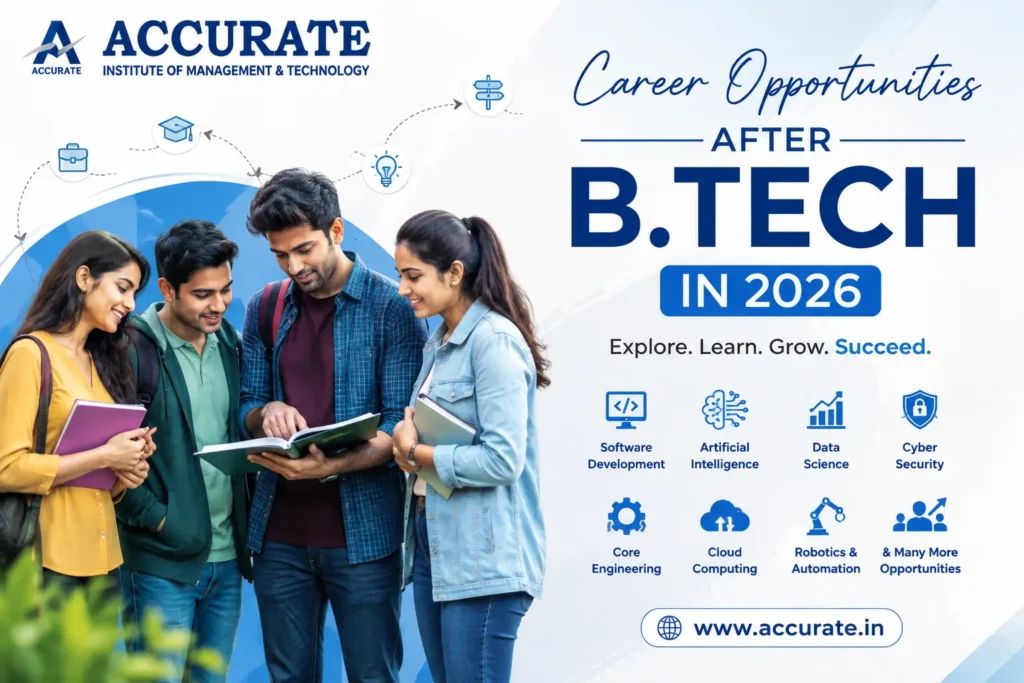

Career Opportunities After B.Tech in 2026
Completing a Bachelor of Technology degree is no longer the beginning of one predictable career path. In 2026, an engineering graduate can move into software development, artificial intelligence, data science, cybersecurity, cloud computing, robotics, electronics, advanced manufacturing, infrastructure, renewable energy, consulting, management, government services, research or entrepreneurship.
That variety makes engineering both exciting and challenging.
The important question for students today is therefore not simply “What jobs are available after B.Tech?” It is:
“Which career after B.Tech matches my skills, interests and the direction in which technology and industry are moving?”
Artificial intelligence and automation are transforming traditional job profiles rather than simply eliminating engineering careers. Software developers increasingly use AI-assisted development tools. Mechanical engineers work with automation, robotics and digital manufacturing. Electronics engineers are moving into embedded systems, semiconductors, IoT and intelligent devices. Civil engineers increasingly use digital design, simulation, GIS and smart infrastructure technologies.
This means the value of a B.Tech degree in 2026 depends increasingly on what a student can build, solve, design, analyse and demonstrate.
Students who combine engineering fundamentals with practical projects, internships, communication skills and emerging technologies can explore opportunities across both technical and non-technical industries.
Table of Contents
- Why B.Tech Remains a Strong Career Choice in 2026
- Top Career Opportunities After B.Tech
- Software Development and Engineering
- Artificial Intelligence and Machine Learning
- Data Science and Data Analytics
- Cybersecurity
- Cloud Computing and DevOps
- Electronics, Embedded Systems and IoT
- Mechanical Engineering and Advanced Manufacturing
- Civil Engineering and Infrastructure
- Robotics and Automation
- Electric Vehicles and Renewable Energy
- Semiconductor and VLSI Careers
- Product Management and Technology Consulting
- Government Jobs and PSU Careers
- Higher Studies After B.Tech
- MBA After B.Tech
- Entrepreneurship and Startups
- Freelancing and Remote Careers
- Career Opportunities by B.Tech Branch
- Skills B.Tech Students Need in 2026
- How to Choose the Right Career After B.Tech
- Why Industry Exposure During B.Tech Matters
- B.Tech at Accurate Institute of Management & Technology
- Career Roadmap for Engineering Students
- FAQs
- Conclusion
Why B.Tech Remains a Strong Career Choice in 2026
Engineering continues to be one of the broadest professional education pathways because virtually every major industry depends on technology and technical problem-solving.
Banking companies need software and cybersecurity professionals. Manufacturing companies need mechanical, automation and electronics engineers. Construction companies require civil engineers. E-commerce businesses depend on software, data and cloud infrastructure. Healthcare organizations increasingly employ technology specialists. Automotive companies require engineers for electric vehicles, electronics, software, battery systems and manufacturing.
Engineering graduates can therefore work far beyond companies that traditionally identify themselves as “engineering companies.”
The strongest career opportunities are increasingly interdisciplinary.
For example:
- Mechanical engineering + AI can lead toward smart manufacturing.
- Electronics + programming can lead toward embedded systems and IoT.
- Civil engineering + analytics can support smart infrastructure.
- CSE + mathematics can lead toward machine learning.
- Engineering + management can lead toward product management or consulting.
- Engineering + entrepreneurship can lead toward technology startups.
Students should therefore view their engineering branch as a foundation, rather than a permanent boundary around their career.
Top Career Opportunities After B.Tech in 2026
The career landscape can broadly be divided into five categories:
Technology Careers
Software development, AI/ML, data science, cybersecurity, cloud computing, DevOps and emerging digital technologies.
Core Engineering Careers
Mechanical, civil, electronics, electrical, manufacturing and infrastructure roles.
Emerging Engineering Careers
Robotics, IoT, EV technology, renewable energy, automation and semiconductors.
Management and Business Careers
Product management, consulting, business analytics, operations and entrepreneurship.
Higher Education and Public-Sector Careers
M.Tech, MS, MBA, research, government services and PSU opportunities.
Let us examine these career options individually.
1. Software Development and Engineering
Software engineering remains one of the most visible career opportunities for B.Tech graduates.
Software now powers practically every industry—from finance and healthcare to manufacturing, retail, transportation and education.
Popular Software Career Roles
B.Tech graduates can target positions such as:
- Software Developer
- Software Engineer
- Full-Stack Developer
- Front-End Developer
- Back-End Developer
- Mobile Application Developer
- Web Developer
- QA Automation Engineer
- Systems Engineer
- Software Test Engineer
- Platform Engineer
Skills Required
Students targeting software careers should build competence in areas such as:
- Data structures and algorithms
- Object-oriented programming
- Databases and SQL
- APIs
- Git and version control
- Software development lifecycle
- Problem-solving
- One or more programming languages such as Python, Java, C++ or JavaScript
The most important differentiator is increasingly demonstrable ability.
Instead of simply writing “Python” or “Java” on a resume, students should be able to show applications, GitHub projects, internships, coding achievements or deployed solutions.
2. Artificial Intelligence and Machine Learning
Artificial intelligence has become one of the most important technology domains influencing engineering careers.
Companies are integrating AI into customer service, software development, financial analysis, healthcare, manufacturing, logistics, marketing, cybersecurity and many other functions.
Career Opportunities in AI
Engineering graduates may pursue roles such as:
- AI Engineer
- Machine Learning Engineer
- Generative AI Developer
- NLP Engineer
- Computer Vision Engineer
- AI Application Developer
- Machine Learning Operations Engineer
- AI Research Assistant
Skills for an AI Career
Students should develop foundations in:
- Python
- Mathematics
- Statistics
- Linear algebra
- Machine learning
- Deep learning
- Data handling
- Neural networks
- Model evaluation
- APIs and AI application development
Students should avoid treating AI merely as a collection of tools. Strong programming and mathematical fundamentals remain valuable because tools and platforms will continue changing.
3. Data Science and Data Analytics
Organizations generate enormous quantities of information through apps, websites, transactions, machines, sensors and customer interactions.
The ability to turn this information into useful decisions creates opportunities for technically skilled graduates.
Popular Data Career Roles
- Data Analyst
- Data Scientist
- Business Intelligence Analyst
- Data Engineer
- Analytics Engineer
- Machine Learning Analyst
- Junior Business Analyst
Important Skills
Students should learn:
- SQL
- Python
- Statistics
- Data cleaning
- Data visualization
- Spreadsheet analysis
- Database fundamentals
- Analytical reasoning
- Machine learning fundamentals
Data science can be especially attractive for engineering graduates who enjoy mathematics, pattern recognition and solving business problems through evidence.
4. Cybersecurity
As organizations become more digital, protecting networks, applications, cloud platforms and data becomes increasingly important.
Cybersecurity consequently provides another specialized career route after B.Tech.
Career Roles in Cybersecurity
Graduates can explore positions such as:
- Cybersecurity Analyst
- Security Engineer
- SOC Analyst
- Network Security Engineer
- Application Security Analyst
- Cloud Security Associate
- Penetration Testing Professional
- Security Operations Specialist
Skills Required
A strong cybersecurity foundation may include:
- Computer networking
- Linux
- Operating systems
- Network security
- Cloud fundamentals
- Security monitoring
- Vulnerability assessment
- Scripting
- Secure coding
Cybersecurity rewards curiosity and continuous learning because security threats constantly evolve.
5. Cloud Computing and DevOps
Modern applications increasingly operate on distributed infrastructure rather than isolated computers.
This has created opportunities around cloud computing, deployment automation and infrastructure management.
Career Options
- Cloud Engineer
- DevOps Engineer
- Cloud Support Engineer
- Site Reliability Engineer
- Platform Engineer
- Infrastructure Engineer
- Cloud Security Engineer
Useful Skills
Students should understand:
- Linux
- Networking
- Cloud platforms
- Containers
- CI/CD
- Git
- Infrastructure concepts
- Automation and scripting
- Monitoring
A student who understands both software development and infrastructure can build a particularly useful profile for modern technology teams.
6. Electronics, Embedded Systems and IoT
Electronics and Communication Engineering graduates are not limited to conventional telecommunications jobs.
Connected devices, industrial automation, intelligent machines, automobiles and consumer electronics all create opportunities involving hardware and software.
Career Opportunities
- Embedded Systems Engineer
- Electronics Design Engineer
- IoT Engineer
- Firmware Developer
- Network Engineer
- Communication Systems Engineer
- Hardware Testing Engineer
- PCB Design Engineer
Skills to Develop
ECE students can strengthen their profiles through:
- Embedded C/C++
- Microcontrollers
- Sensors
- Circuit fundamentals
- Communication systems
- PCB concepts
- IoT platforms
- Basic programming
The convergence between electronics and software makes interdisciplinary skills particularly valuable.
7. Mechanical Engineering and Advanced Manufacturing
Mechanical engineering remains fundamental to manufacturing, automobiles, industrial systems, aerospace, energy and product development.
However, the modern mechanical engineer increasingly works with digital tools.
Career Opportunities After Mechanical Engineering
- Mechanical Design Engineer
- Production Engineer
- Manufacturing Engineer
- Quality Engineer
- Maintenance Engineer
- Automobile Engineer
- CAD Engineer
- Industrial Engineer
- Automation Engineer
- Project Engineer
Future-Ready Mechanical Skills
Students can strengthen employability through knowledge of:
- CAD
- CAM
- Simulation
- CNC systems
- Industrial automation
- Robotics
- Additive manufacturing
- Quality management
- Industry 4.0 concepts
Mechanical engineering becomes considerably more future-ready when traditional fundamentals are combined with automation and digital manufacturing.
8. Civil Engineering and Infrastructure
Infrastructure development continues to require engineers who can design, construct, manage and maintain physical assets.
Civil engineering careers span private construction companies, consultancies, infrastructure firms and government organizations.
Popular Civil Engineering Careers
- Site Engineer
- Structural Engineer
- Project Engineer
- Planning Engineer
- Quantity Surveyor
- Construction Engineer
- Transportation Engineer
- Environmental Engineer
- Infrastructure Consultant
Skills for Modern Civil Engineers
Students should explore:
- AutoCAD
- Building Information Modeling
- Structural analysis
- Project planning
- Quantity estimation
- GIS
- Sustainable construction
- Project management tools
Sustainability and digital construction are likely to become increasingly important differentiators for future civil engineers.
9. Robotics and Automation
Robotics combines mechanical systems, electronics, software and artificial intelligence.
That interdisciplinary nature makes it suitable for students interested in both hardware and programming.
Career Roles
- Robotics Engineer
- Automation Engineer
- Control Systems Engineer
- Robotics Software Developer
- Mechatronics Engineer
- Industrial Automation Engineer
Skills Required
A robotics-focused student may study:
- Python/C++
- Electronics
- Sensors
- Control systems
- Microcontrollers
- Computer vision
- Mechanical design
- Robotics frameworks
Students can begin by developing practical projects such as robotic arms, autonomous vehicles, sensor-controlled machines and computer-vision systems.
10. Electric Vehicles and Renewable Energy
The transition toward cleaner mobility and sustainable energy is creating interdisciplinary engineering opportunities.
EV development requires knowledge across mechanical engineering, electronics, electrical systems, embedded software and battery technology.
EV Career Opportunities
- EV Design Engineer
- Battery Systems Engineer
- Power Electronics Engineer
- Embedded Engineer
- EV Testing Engineer
- Charging Infrastructure Engineer
Renewable-energy careers may include:
- Solar Design Engineer
- Energy Engineer
- Renewable Energy Project Engineer
- Energy Analyst
- Sustainability Engineer
Students interested in this sector should combine their branch fundamentals with knowledge of energy systems, electronics, batteries, automation or sustainability depending on their chosen role.
11. Semiconductor and VLSI Careers
Semiconductors power smartphones, automobiles, communication equipment, computers, industrial machinery, medical devices and AI hardware.
This creates specialized opportunities for electronics-oriented engineering graduates.
Potential Career Paths
- VLSI Design Engineer
- Verification Engineer
- Embedded Hardware Engineer
- Semiconductor Test Engineer
- Physical Design Engineer
- Electronics Engineer
- Chip Design Associate
Skills to Consider
- Digital electronics
- Semiconductor fundamentals
- Verilog/VHDL
- VLSI concepts
- FPGA development
- Circuit design
- Embedded systems
Because semiconductor careers can be highly specialized, students interested in the field should begin developing domain knowledge during their undergraduate years.
12. Product Management
Not every successful engineering graduate spends an entire career coding or designing machines.
Product management provides an attractive route for engineers who enjoy technology as well as business strategy and communication.
What Does a Product Manager Do?
Product managers help identify user problems, prioritize product features, coordinate teams and align technology development with business objectives.
Useful abilities include:
- Technical understanding
- Communication
- User research
- Analytical thinking
- Product strategy
- Business fundamentals
- Project coordination
Many engineers enter product-oriented roles after gaining technical experience, while others strengthen their business credentials through an MBA.
13. Technology Consulting
Technology consulting sits at the intersection of business and engineering.
Consultants may help companies implement new technologies, improve processes, transform digital systems or solve operational challenges.
Suitable Skills
Engineering graduates interested in consulting should develop:
- Structured problem-solving
- Presentation skills
- Communication
- Data analysis
- Business understanding
- Technology awareness
This pathway can suit students who enjoy solving different types of problems rather than focusing exclusively on one technical domain.
14. Government Jobs and PSU Careers After B.Tech
Government employment remains another major option for engineering graduates in India.
Students can prepare for opportunities through examinations and recruitment processes conducted by different government organizations and public-sector enterprises.
Popular Routes
Depending on eligibility and recruitment notifications, graduates may explore:
- Engineering Services Examination
- GATE-based opportunities
- Public Sector Undertakings
- SSC engineering examinations
- Railways
- State engineering services
- Defence technical services
- Technical positions in government departments
Government careers can appeal to students seeking structured progression, technical responsibility and long-term public-sector careers.
Preparation should ideally begin well before graduation because competitive examinations require strong engineering fundamentals.
15. Higher Studies After B.Tech
Students who want deeper technical specialization can pursue postgraduate education.
M.Tech After B.Tech
M.Tech is appropriate for students who want to deepen technical expertise in areas such as:
- Computer Science
- Artificial Intelligence
- Data Science
- Structural Engineering
- Electronics
- VLSI
- Robotics
- Mechanical Design
- Manufacturing
- Communication Systems
It can also support pathways toward research, advanced engineering roles and academia.
MS Abroad
Students seeking international education may explore master’s programs in countries with strong technology and research ecosystems.
Common fields include:
- Computer Science
- AI
- Robotics
- Data Science
- Cybersecurity
- Automotive Engineering
- Electronics
- Sustainable Engineering
Students should evaluate costs, scholarships, university quality, employment rules and career objectives carefully before choosing an international program.
16. MBA After B.Tech
MBA after engineering remains a popular combination because it adds business, leadership and management capabilities to technical knowledge.
MBA Specializations for Engineers
Popular options include:
- Business Analytics
- Operations
- Finance
- Marketing
- Information Technology
- Product Management
- International Business
- Entrepreneurship
An MBA can support transitions into roles such as:
- Product Manager
- Business Analyst
- Consultant
- Operations Manager
- Technology Manager
- Project Manager
- Business Development Manager
However, students should not pursue an MBA simply because they are uncertain about engineering.
It is more effective when aligned with a clear career objective.
17. Entrepreneurship and Startups
Engineering students have a natural advantage in technology entrepreneurship because they can understand technical problems and potentially build solutions themselves.
Startup Areas for Engineers
Opportunities may exist in:
- SaaS
- Artificial intelligence
- Education technology
- Health technology
- Robotics
- Cybersecurity
- IoT
- Clean technology
- EV solutions
- Manufacturing
- Construction technology
A college project can sometimes become the prototype for a business idea.
Students interested in entrepreneurship should learn not only product development but also customer discovery, finance, marketing, sales and business-model development.
18. Freelancing and Remote Careers
The internet has expanded career options beyond conventional campus placements.
Engineers with strong digital skills can potentially work independently for clients or remote teams.
Freelancing Skills
Common freelance areas include:
- Web development
- Mobile development
- UI development
- Data analytics
- Cloud support
- Automation
- CAD design
- Technical writing
- Software testing
Freelancing should be treated professionally.
A strong portfolio, communication skills, reliability and specialization generally matter more than simply registering on freelance platforms.
Career Opportunities After B.Tech by Branch
B.Tech CSE Career Opportunities
Computer Science graduates can explore:
- Software Engineering
- AI/ML
- Data Science
- Cybersecurity
- Cloud Computing
- DevOps
- Web Development
- Mobile Development
- Database Engineering
B.Tech AI & ML Career Opportunities
Students specializing in AI and machine learning may target:
- AI Engineer
- ML Engineer
- Data Scientist
- Computer Vision Engineer
- NLP Engineer
- AI Application Developer
B.Tech ECE Career Opportunities
ECE graduates can consider:
- Embedded Systems
- VLSI
- IoT
- Telecommunications
- Electronics Design
- Semiconductor Engineering
- Network Engineering
B.Tech Mechanical Engineering Careers
Mechanical graduates can explore:
- Automotive Engineering
- Manufacturing
- Product Design
- Robotics
- Automation
- Quality Engineering
- Production
- EV Technology
B.Tech Civil Engineering Careers
Civil graduates may pursue:
- Construction
- Structural Engineering
- Infrastructure
- Transportation
- Project Management
- Quantity Surveying
- Environmental Engineering
- Government Engineering Services
Skills B.Tech Students Need for Career Success in 2026
A degree alone does not guarantee employability.
The strongest candidates usually combine academic knowledge with technical competence and professional skills.
1. Technical Fundamentals
Do not neglect the fundamentals of your engineering discipline.
Emerging technologies are built on basic concepts.
2. Artificial Intelligence Literacy
Even students who do not want to become AI engineers should understand how AI tools affect their chosen profession.
The objective should be to use AI to increase productivity while retaining independent reasoning and verification skills.
3. Programming
Programming is valuable far beyond computer science.
Python and related technologies are increasingly useful in automation, analytics, electronics, simulation and research.
4. Problem-Solving
Recruiters value graduates who can break complex problems into manageable components and develop practical solutions.
5. Communication
An engineer must be able to explain technical ideas clearly.
Students should improve:
- Written communication
- Presentations
- Interview communication
- Team collaboration
- Professional email writing
6. Project Experience
Projects provide evidence that a student can apply theoretical knowledge.
A strong engineering portfolio may include:
- Academic projects
- Personal projects
- Hackathon solutions
- Research work
- Internship projects
- Open-source contributions
7. Internship Experience
Internships introduce students to real deadlines, team structures, professional tools and workplace expectations.
Students should not wait until the final semester to think about industry exposure.
8. Adaptability
The technologies used in 2030 will not be identical to those used in 2026.
The most valuable long-term skill may therefore be the ability to continue learning.
Which Career After B.Tech Is Best for You?
There is no single “best” career after engineering.
The right choice depends on your interests, abilities and long-term goals.
Choose Software Development If:
You enjoy coding, logic and building digital products.
Choose AI/ML If:
You enjoy programming, mathematics, data and experimentation.
Choose Cybersecurity If:
You enjoy networks, systems, security challenges and investigative problem-solving.
Choose Core Engineering If:
You enjoy applying engineering principles to machines, electronics, infrastructure or physical systems.
Choose Government Careers If:
You prefer competitive examination-based entry and structured public-sector career paths.
Choose MBA If:
You are genuinely interested in management, business strategy, consulting, operations or product leadership.
Choose Entrepreneurship If:
You enjoy identifying problems, building solutions, taking calculated risks and learning across multiple functions.
How to Choose the Right Career After B.Tech
Students frequently make career decisions based on trends or peer pressure.
A more reliable approach is to ask five questions.
1. What problems do I enjoy solving?
Your answer often points toward the right career family.
2. What am I already good at?
Interests matter, but strengths matter too.
3. What skills am I willing to practice consistently?
Wanting an AI career without enjoying programming or mathematics, for example, can create a mismatch.
4. Can I demonstrate my skills?
Recruiters increasingly want evidence through projects, internships and assessments.
5. What does my target role actually require?
Study real job descriptions before deciding which skills or certifications to pursue.
This prevents students from spending months learning technologies that have little connection with their intended jobs.
Why Industry Exposure During B.Tech Matters
The transition from college to employment becomes easier when students encounter professional environments before graduation.
Useful exposure can include:
- Internships
- Industrial visits
- Workshops
- Live projects
- Hackathons
- Coding competitions
- Technical clubs
- Industry certifications
- Research projects
- Placement preparation
Students should therefore evaluate engineering colleges not merely by infrastructure photographs or promotional claims, but by asking how effectively the institution helps students convert classroom knowledge into practical capability.
B.Tech at Accurate Institute of Management & Technology
For students exploring engineering education in Greater Noida and Delhi NCR, Accurate Institute of Management & Technology (AIMT) offers B.Tech education with an emphasis on technical learning and career preparation.
The institute’s published B.Tech information lists engineering options including Computer Science & Engineering, CSE with Artificial Intelligence & Machine Learning, Mechanical Engineering and Electronics & Communication Engineering.
The B.Tech program is approved by AICTE and affiliated with Dr. A.P.J. Abdul Kalam Technical University (AKTU), Lucknow.
The institute also highlights practical exposure through laboratories, projects, internships and other industry-oriented learning opportunities.
An important part of career preparation is AIMT’s training and placement ecosystem. Activities described by the institute include industry-institute interaction, industry visits, seminars, workshops, personality development, pre-placement counselling, group discussions, interview preparation and career guidance.
Such activities are relevant because engineering employability involves much more than semester examinations.
Students need to graduate with:
Engineering knowledge + practical skills + projects + internships + communication ability + placement preparation.
That combination is particularly important in a competitive 2026 employment environment.
A Career Roadmap for B.Tech Students
Instead of waiting until graduation to decide what to do next, students can build their career progressively.
First Year: Explore
Focus on:
- Engineering fundamentals
- Basic programming
- Communication
- Mathematics
- Technical clubs
- Exploring different engineering domains
The objective is exposure.
Second Year: Choose a Direction
Begin identifying one or two potential career tracks.
For example:
Software Track: Programming → DSA → development
AI Track: Python → statistics → machine learning
Electronics Track: circuits → embedded systems → IoT
Mechanical Track: CAD → design → automation
Civil Track: CAD → structural concepts → BIM
Third Year: Build Evidence
This should become a project-heavy year.
Focus on:
- Internships
- Portfolio projects
- Hackathons
- Certifications where useful
- GitHub
- Technical competitions
- Industry networking
By the end of third year, students should ideally have something meaningful to show recruiters.
Final Year: Convert Skills Into Opportunities
The final year should focus on:
- Placement preparation
- Technical interviews
- Aptitude
- Resume optimization
- Mock interviews
- Applications
- Networking
- Higher-study preparation where relevant
Do not start career preparation two weeks before placement season.
How to Make Your B.Tech Resume Stand Out in 2026
A strong engineering resume should quickly communicate what the candidate can actually do.
Include:
Technical Skills
List only technologies you can discuss confidently during an interview.
Projects
Explain the problem, technology used and result.
Internships
Highlight what you contributed rather than merely mentioning the company’s name.
Achievements
Include relevant hackathons, competitions, research or certifications.
Portfolio Links
For technical profiles, GitHub, portfolio websites or project demonstrations can strengthen credibility.
Avoid filling a resume with dozens of tools that you have only briefly explored.
Depth in relevant skills is usually more convincing than a long list of buzzwords.
Mistakes B.Tech Students Should Avoid
Following Every Technology Trend
Trying to learn AI, blockchain, cybersecurity, cloud, web development, robotics and data science simultaneously usually leads to shallow knowledge.
Choose a direction.
Collecting Certificates Without Skills
Certificates can support your profile, but they cannot replace competence.
Ignoring Communication
Technical knowledge must often be explained to recruiters, managers, clients and teammates.
Waiting Until Final Year
Career preparation should begin much earlier.
Copying Projects
A project copied from the internet provides little value if the student cannot explain its architecture, decisions or limitations.
Ignoring Engineering Fundamentals
Tools change.
Fundamentals remain useful.
Future of Careers After B.Tech
Engineering careers are likely to become increasingly interdisciplinary.
A software engineer may need AI skills.
A mechanical engineer may work with robotics.
An electronics engineer may write embedded software.
A civil engineer may work with digital twins and smart infrastructure.
An automotive engineer may need knowledge of batteries and electronics.
This convergence means future engineers should develop what can be described as a T-shaped skill profile:
Broad understanding across technologies + deep expertise in one valuable domain.
Students who combine this with communication, adaptability and practical experience are likely to be better positioned than students who rely exclusively on their degree title.
FAQs About Career Opportunities After B.Tech in 2026
1. What are the best career opportunities after B.Tech in 2026?
The best career opportunities after B.Tech include software engineering, AI and machine learning, data science, cybersecurity, cloud computing, DevOps, electronics, robotics, core engineering, EV technology, renewable energy, semiconductor technology, consulting, government jobs and entrepreneurship.
2. Which job is best after B.Tech?
The best job depends on your branch and interests. CSE students may prefer software, AI or data careers, while ECE students can explore embedded systems and semiconductors. Mechanical and civil graduates can pursue core engineering, automation, infrastructure and related technology-driven careers.
3. Is B.Tech a good career option in 2026?
Yes. B.Tech remains a versatile professional degree because engineering skills are required across technology, manufacturing, infrastructure, electronics, energy, transportation and digital industries. Career outcomes, however, increasingly depend on practical skills, projects and industry exposure.
4. What should I do immediately after B.Tech?
You can start a job, prepare for government examinations, pursue M.Tech or MS, study for an MBA, develop specialized technical skills, work on freelance projects or build a startup. Choose according to your long-term career objective rather than following peers.
5. Which technology career has strong scope after B.Tech?
AI, machine learning, cybersecurity, data engineering, software development, cloud computing and DevOps are important technology career areas. Students should select a specialization based on aptitude rather than choosing solely because a field is trending.
6. Can I get a government job after B.Tech?
Yes. Engineering graduates can apply for eligible government and public-sector opportunities through recruitment processes such as GATE, engineering services examinations, SSC examinations, railways, state-level recruitment and other technical government vacancies.
7. Is MBA a good option after B.Tech?
MBA can be a strong option for engineering graduates interested in management, consulting, business analytics, product management, operations, finance or entrepreneurship. It works best when pursued with a defined career objective.
8. Should I choose M.Tech or MBA after B.Tech?
Choose M.Tech if you want deeper technical specialization, engineering research or technical academic opportunities. Choose MBA if you want to transition toward management, strategy, consulting, operations, business or leadership roles.
9. What skills should B.Tech students learn for placements in 2026?
Students should develop strong engineering fundamentals, relevant technical skills, problem-solving ability, AI literacy, communication, teamwork and interview skills. Projects, internships and a demonstrable portfolio can further strengthen employability.
10. How can Accurate Institute of Management & Technology help B.Tech students prepare for careers?
Accurate Institute of Management & Technology emphasizes academic learning along with practical and career-development activities. Its published placement process includes industry interaction, visits, workshops, personality development, career guidance, group discussions and interview-preparation activities designed to help students transition from engineering education to professional careers.
Conclusion: Build Skills Today for the Engineering Careers of Tomorrow
The question “What can I do after B.Tech?” has more answers in 2026 than ever before.
Engineering graduates can become software developers, AI engineers, data professionals, cybersecurity specialists, cloud engineers, robotics engineers, electronics professionals, mechanical designers, civil engineers, EV specialists, semiconductor professionals, consultants, managers, government engineers, researchers or entrepreneurs.
But opportunity alone does not guarantee success.
The students most likely to benefit from these opportunities will be those who build a combination of strong fundamentals, specialized technical skills, practical projects, internships, communication ability and continuous learning habits.
That preparation should begin during engineering—not after graduation.
For aspiring engineers looking for B.Tech education in Greater Noida and Delhi NCR, Accurate Institute of Management & Technology provides an environment focused on engineering education, practical exposure and career preparation.
Start Your Engineering Journey with Accurate Institute of Management & Technology
Explore B.Tech programs, develop future-ready technical skills, gain practical exposure and prepare yourself for emerging engineering careers.
Admissions for B.Tech are open.
Visit: www.accurate.in
Build your engineering foundation today so that you are ready for the opportunities of tomorrow.