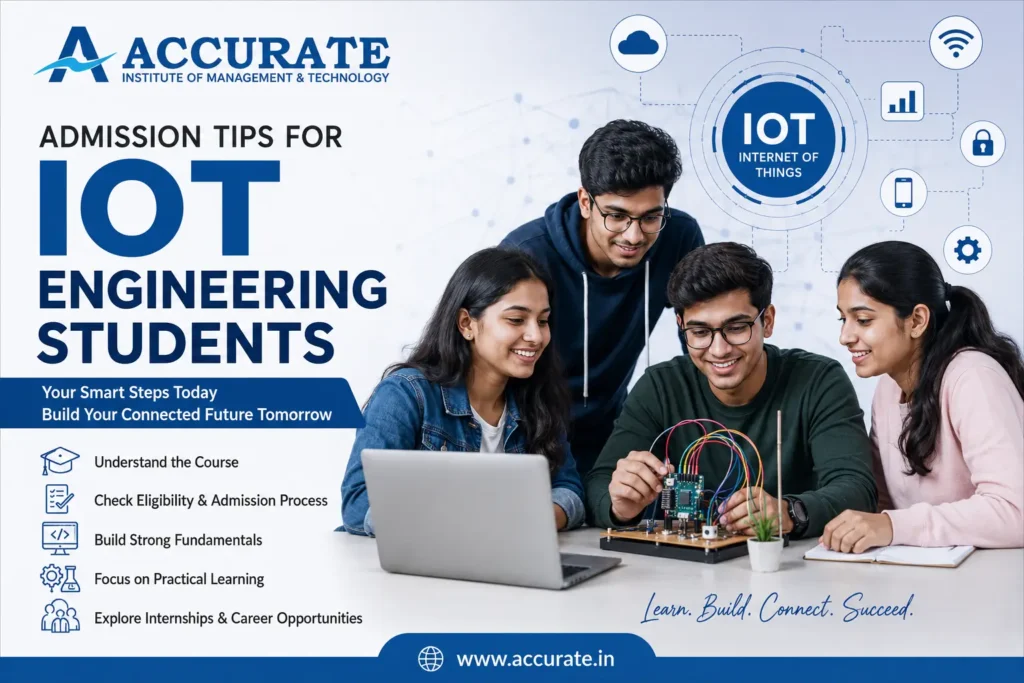

Students planning admission to IoT Engineering should first check eligibility, understand the curriculum, compare recognised colleges, prepare academic documents, strengthen mathematics and programming fundamentals, and evaluate laboratories, projects, internships and placement preparation. IoT combines computer science with sensors, embedded systems, networking, cloud computing, data analytics, AI and cybersecurity. Accurate Institute of Management & Technology, Greater Noida, offers B.Tech CSE (Internet of Things) within an AICTE-approved, AKTU-affiliated engineering framework and emphasises practical, career-focused learning.
What are the best admission tips for IoT engineering students?
Before taking admission in IoT Engineering, verify eligibility, compare the curriculum, inspect labs and project facilities, understand entrance or merit requirements, prepare documents early, check internship and placement support, and choose a college that balances computer science fundamentals with hands-on IoT learning. Applicants should also confirm current fees, scholarships, seats and deadlines directly with the college.
How should I prepare for admission to IoT Engineering?
Start by strengthening mathematics, physics and basic programming. Check your eligibility, compare IoT curricula and laboratories, understand the admission process, prepare your documents and choose a college that provides practical projects, industry exposure and career preparation. You do not need to be an IoT expert before joining; curiosity, problem-solving and willingness to learn are more important.
Table of Contents
- Understanding IoT Engineering Before Admission
- Why Students Are Choosing IoT Engineering
- Check IoT Engineering Eligibility First
- Understand the Course Before You Apply
- Build the Right Academic Foundation
- Learn Basic Coding Before College
- Research Colleges Beyond Rankings
- Evaluate IoT Laboratories and Project Learning
- Check Recognition, Approval and Affiliation
- Understand the Admission Process
- Prepare Your Admission Documents Early
- Consider Fees, Scholarships and Total Cost
- Evaluate Internship and Placement Preparation
- Build a Small IoT Project Before Admission
- Develop Skills Beyond Academics
- Common Admission Mistakes to Avoid
- Why Consider Accurate Institute of Management & Technology
- A Final IoT Admission Checklist
- Frequently Asked Questions
- Conclusion and Admission CTA
Admission Tips for IoT Engineering Students
The Internet of Things has changed the meaning of connectivity. Today, watches monitor activity, industrial machines can report operating conditions, farms can use connected sensors, buildings can automate energy systems, and vehicles increasingly communicate with digital platforms. Behind such applications are engineers who understand how software, devices, networks and data work together.
For students completing Class 12 and exploring engineering options, this creates an exciting academic pathway: IoT Engineering.
Choosing the programme, however, requires more thought than simply selecting a futuristic-sounding specialisation. A student should understand what IoT involves, whether the programme matches their interests, what subjects they will encounter, how much practical learning a college provides and how the degree can contribute to long-term career development.
The right admission decision begins before the application form is submitted.
These admission tips for IoT engineering students are designed to help applicants and parents evaluate programmes systematically. From eligibility and entrance preparation to laboratories, projects, internships, documentation and career readiness, this guide covers the major questions worth asking before choosing an IoT engineering college.
For students considering Greater Noida and Delhi NCR, Accurate Institute of Management & Technology offers B.Tech CSE (Internet of Things) in an engineering environment that combines recognised academics with practical and career-focused learning. Institute materials describe the B.Tech engineering framework as AICTE approved and affiliated with Dr. A.P.J. Abdul Kalam Technical University (AKTU). Applicants should verify the latest programme, approval, intake and admission details for their admission year.
1. Understand IoT Engineering Before Applying
One of the most important admission tips is also the simplest: understand the branch before choosing it.
IoT, or the Internet of Things, refers to physical devices that can sense information, process or transmit data and communicate through networks. Depending on the application, an IoT solution may involve sensors, microcontrollers, embedded software, wireless communication, cloud services, databases, dashboards, analytics, automation or artificial intelligence.
That makes IoT multidisciplinary.
What Does an IoT Engineering Student Learn?
A B.Tech programme with an IoT focus typically brings together areas such as:
- Programming and computer science fundamentals
- Data structures and databases
- Computer networks
- Sensors and connected devices
- Embedded systems
- Wireless communication
- Cloud computing
- Data analytics
- Artificial intelligence
- Automation
- Cybersecurity
The precise semester-wise curriculum varies by university and programme and should always be checked against current academic documents.
Before applying, ask yourself whether you enjoy understanding both software and how technology interacts with the physical world.
2. Know Why You Want to Choose IoT Engineering
Do not select IoT only because it is described as a “future technology.”
A better reason is that its style of engineering matches your interests.
IoT can suit students who enjoy coding but are also curious about devices, sensors, automation, networks and real-world problem-solving. It can expose learners to several connected technical areas rather than keeping them within a single narrow layer of computing.
IoT technologies have applications across manufacturing, healthcare technology, automotive systems, energy, logistics, agriculture, consumer electronics and smart infrastructure.
Ask Yourself These Questions
Do you enjoy solving logical problems?
Are you interested in programming?
Do smart devices and automation make you curious about how they work?
Would you enjoy building and testing prototypes?
Are you comfortable learning continuously as technologies evolve?
Do you have the patience to debug a system when software, hardware or connectivity does not behave as expected?
If several answers are yes, IoT may deserve serious consideration.
Students do not have to arrive at college as electronics or programming experts. Consistent practice and willingness to learn matter far more at the admission stage.
3. Check IoT Engineering Eligibility Before Starting the Application
Never assume that every B.Tech college follows identical eligibility rules.
Eligibility can depend on university regulations, government norms, entrance routes, category provisions and the admission year.
For Accurate Institute, current institute material lists Class 12 eligibility with at least 45% marks, with Physics and Mathematics as compulsory subjects and an approved additional subject, along with JEE Main and merit-related admission steps. Because admission regulations can change, students should verify the requirements with the admission team before applying.
Verify These Points Before Applying
Check:
- Minimum Class 12 marks
- Required Class 12 subjects
- Entrance examination requirements
- Merit or counselling route
- Category-specific rules, where applicable
- Lateral-entry rules, if relevant
- Document requirements
- Application and counselling deadlines
- Seat availability
A five-minute eligibility check can prevent weeks of confusion later.
4. Study the IoT Curriculum, Not Just the Course Name
Two colleges can use similar programme names while offering different academic experiences.
One of the smartest IoT engineering admission tips is therefore to read the curriculum.
Look for Strong Computer Science Fundamentals
An IoT student still needs solid computing fundamentals. Programming, algorithms, data structures, databases, operating concepts and networking can remain valuable even as particular IoT platforms change.
Look for IoT-Specific Learning
The curriculum should then extend those fundamentals toward areas such as embedded systems, sensors, communication, cloud platforms, analytics, security and connected applications.
A strong programme should help students understand the journey from a physical event to a digital response: sensing information, processing it, communicating it, analysing it and producing an appropriate output.
Do not choose a programme simply because its syllabus contains many fashionable technology names. Look for progression, practical application and strong fundamentals.
5. Strengthen Mathematics and Physics Before Admission
Students often ask, “What should I study before starting IoT Engineering?”
Start with your foundations.
Mathematics supports logical thinking, algorithms, data analysis and many engineering concepts. Physics can help students understand electronics, signals, measurements and the behaviour of physical systems.
You do not need to complete university-level mathematics before entering college. Instead, become comfortable with the fundamentals taught at school.
What to Revise
Focus particularly on:
- Algebra
- Functions
- Basic calculus
- Probability
- Vectors
- Units and measurements
- Electricity and electronics fundamentals
- Logical reasoning
Strong foundations make the transition to first-year engineering considerably easier.
6. Learn Basic Programming Before Your First Semester
Prior coding expertise is not normally the defining requirement for becoming a successful IoT student.
However, basic programming exposure can give you confidence.
Coding plays an important role in IoT because connected systems require device logic, data processing, integrations, cloud services and dashboards. Students generally develop programming ability progressively through coursework, laboratory practice and projects.
What Should a Beginner Learn?
Pick one beginner-friendly programming language and understand:
- Variables
- Data types
- Conditions
- Loops
- Functions
- Arrays or lists
- Input and output
- Basic debugging
Do not spend your summer trying to learn ten languages.
Understanding programming logic is more valuable than collecting certificates without practical knowledge.
7. Research Colleges Beyond Rankings and Advertisements
Choosing the college is as important as choosing the specialisation.
Rankings, advertisements and online reviews can help you discover options, but they should not make the entire decision for you.
Compare Colleges on Meaningful Criteria
Evaluate:
- Academic recognition
- University affiliation
- Curriculum
- Faculty guidance
- Laboratories
- Project culture
- Internship exposure
- Placement preparation
- Industry interaction
- Student clubs
- Campus environment
- Location
- Fees and scholarships
- Alumni outcomes
- Opportunities for interdisciplinary learning
When possible, visit the campus.
Ask to see laboratories rather than relying only on photographs. Speak to admission counsellors with a prepared list of questions.
A good admission decision is based on evidence.
8. Inspect IoT Laboratories and Practical Learning
IoT cannot be learned effectively through slides alone.
Students need opportunities to assemble, program, connect, test and troubleshoot systems. Practical work helps learners understand the difference between a theoretical design and a dependable working prototype.
Questions to Ask About Labs
During a campus visit, ask:
How often do IoT students use laboratories?
Are students allowed to build their own projects?
What kinds of sensors, development boards and computing resources are available?
Are projects individual or team-based?
Do students participate in hackathons or technical competitions?
Can students work on prototypes beyond mandatory practical sessions?
The quality of practical exposure matters because IoT involves multiple layers. A project can fail because of software, sensor calibration, connectivity, power, configuration or system design. Learning to diagnose these failures develops real engineering ability.
9. Verify Approval, Affiliation and Academic Recognition
This step should never be skipped.
Before paying an admission fee, verify the programme’s current approval, affiliation and academic status using official sources.
According to institute materials reviewed for this article, Accurate Institute’s B.Tech engineering framework is AICTE approved and affiliated with Dr. A.P.J. Abdul Kalam Technical University (AKTU), Lucknow. Prospective students should still confirm the latest status, programme and intake information for their admission year.
Why Recognition Matters
Academic recognition can affect:
- Degree validity
- University examinations
- Higher education opportunities
- Eligibility for certain recruitment processes
- Academic standards and regulatory compliance
Do not depend solely on third-party education portals for this information.
10. Understand the Entire Admission Process
Students sometimes focus so heavily on entrance examinations that they overlook administrative steps.
Create an admission timeline.
At Accurate Institute, applicants are advised to review the current eligibility and admission route, prepare academic and identity documents, verify entrance-exam or merit requirements and submit their enquiry or application through the official admission channel. Students should contact the admission team for current fees, scholarships, deadlines and seat availability.
Your Admission Timeline Should Include
- Shortlisting the programme
- Checking eligibility
- Entrance-exam preparation where required
- Completing the application
- Uploading or submitting documents
- Following counselling or selection instructions
- Confirming the offered seat
- Paying required fees within the stated deadline
- Completing document verification
- Reporting for orientation or commencement of classes
Keep screenshots, acknowledgement receipts and copies of important submissions.
11. Prepare Admission Documents Early
Missing documents can turn an otherwise simple admission process into a stressful one.
Create both physical and digital folders.
Common Documents to Keep Ready
Depending on the admission route and applicable rules, students may need academic marksheets and certificates, identity documents, photographs, entrance-examination information, transfer or migration documents and other certificates relevant to their application.
Because exact requirements can change, obtain the current checklist from the admission office rather than relying on an old online list.
Create Digital Backups
Scan documents clearly and save them with sensible file names, such as:
Class10_Marksheet.pdf
Class12_Marksheet.pdf
EntranceScore.pdf
Avoid files named “scan001finalnew2.pdf.”
Good organisation can save valuable time during counselling and verification.
12. Understand Fees, Scholarships and the Total Cost of Education
Do not evaluate an engineering programme only on the first-semester fee.
Families should understand the broader financial commitment.
Ask about:
- Tuition fees
- Examination or university charges
- Hostel expenses, if required
- Transport
- Refund policies
- Security deposits
- Scholarships
- Payment schedules
- Other applicable institutional charges
Students considering Accurate Institute should speak directly with the admission team for the current fee structure, scholarships and payment information because these details can vary by admission cycle. Institute guidance likewise recommends confirming current fees and scholarships before making the final decision.
Never base a major financial decision on an outdated blog post.
13. Evaluate Internship and Placement Preparation
No responsible college can guarantee an individual student’s career outcome. Recruitment depends on the student’s performance, skills, recruiter requirements and market conditions.
What a college can provide is an environment that helps students prepare.
Look Beyond Placement Numbers
Ask what happens before final-year recruitment.
Does the college support:
- Technical training?
- Coding practice?
- Aptitude preparation?
- Communication skills?
- Résumé development?
- Mock interviews?
- Internships?
- Industry interaction?
- Project presentation?
- Career counselling?
Accurate Institute’s placement-oriented environment emphasises areas including technical training, aptitude, interview preparation, résumé development and communication. Students still need to take ownership of their development through consistent practice, internships and portfolio building.
That last point matters: placement support works best when students actively use it.
14. Build One Small IoT Project Before Admission
This is optional, but it can be extremely useful.
A beginner project can show you what IoT actually feels like.
You might experiment with:
- A temperature monitor
- Automatic lighting
- A simple water-level alert
- A basic environmental sensor
- A connected plant-monitoring prototype
The goal is not to impress an admission committee with an expensive project.
The goal is to learn.
Try to understand what the sensor measures, how the program handles the information, what output is produced and what happens when something fails.
Institute learning material recommends starter projects such as temperature monitoring, automatic lighting or water-level alerts and emphasises documenting the steps and problems encountered rather than focusing on expensive hardware.
15. Start Building Skills Beyond the Classroom
Engineering careers require more than academic marks.
Technical professionals need to explain ideas, work in teams, document decisions, manage time and learn independently.
Communication Skills Matter
An engineer may have to:
- Explain a prototype
- Present to a project panel
- Write documentation
- Participate in interviews
- Communicate with teammates
- Translate a technical issue into understandable language
Group projects, technical clubs, presentations and extracurricular activities can contribute to confidence, teamwork and leadership development.
Develop a Learning Habit
IoT changes continuously.
Do not try to predict every platform you will use four years from now. Develop the ability to read documentation, experiment, debug and learn new tools.
Those habits age better than memorising a specific technology stack.
16. Understand IoT Career Paths Before Admission
A specialisation should open possibilities rather than trap you inside one job title.
IoT graduates may explore opportunities related to:
- IoT development
- Embedded systems
- Automation
- Cloud technologies
- Computer networks
- IoT security
- Data analytics
- Software testing
- Connected products
Possible job titles include IoT developer, embedded systems engineer, automation engineer, cloud associate, network engineer, IoT security analyst, data analyst and test engineer, although exact roles and requirements vary between employers.
Industries using connected technologies can include manufacturing, automotive, telecom, energy, healthcare technology, logistics, agritech, consumer electronics, robotics and smart infrastructure.
Build a Portfolio During College
A strong student portfolio might contain:
- Source code
- Project descriptions
- Architecture diagrams
- Test results
- Demonstration videos
- Setup instructions
- Documentation
- Git repositories
- Internship work where disclosure is permitted
- Hackathon projects
Employers can evaluate demonstrated ability more easily than a long list of technologies with no evidence of application.
17. Avoid Common IoT Engineering Admission Mistakes
Mistake 1: Choosing IoT Only Because It Is Trending
Technology trends change. Choose IoT because you are interested in the problems it solves and the skills it develops.
Mistake 2: Ignoring Computer Science Fundamentals
IoT is multidisciplinary, but programming and computing fundamentals remain important.
Mistake 3: Selecting a College Without Visiting Its Labs
Infrastructure matters particularly for an application-driven specialisation.
Mistake 4: Looking Only at Placement Headlines
Investigate training, internships, project quality and skill development as well.
Mistake 5: Ignoring Cybersecurity
Connected devices create security and privacy responsibilities. Future engineers should understand authentication, secure design, updates, data protection and responsible engineering.
Mistake 6: Not Comparing Curricula
Read what you will actually study semester by semester.
Mistake 7: Waiting Until the Deadline
Admission requirements, counselling schedules and available seats can make last-minute applications risky.
Mistake 8: Believing You Must Already Be an Expert
You are applying to college to learn. Curiosity, discipline and consistent practice are more important than arriving with advanced technical knowledge.
18. Why Consider Accurate Institute of Management & Technology for IoT Engineering?
For students researching IoT engineering admission in Greater Noida, Accurate Institute of Management & Technology offers a combination worth evaluating.
B.Tech CSE with an IoT Focus
The programme brings computer science fundamentals together with connected-device technologies. IoT learning can involve programming, embedded systems, sensors, networking, cloud computing, analytics, AI, automation and cybersecurity.
Practical, Project-Based Learning
IoT makes sense when students can build, test and troubleshoot. Accurate’s learning approach promotes practical exposure and project work that can help learners move from concepts toward prototypes and real problem-solving.
Recognised Engineering Framework
Institute materials state that the B.Tech engineering programme operates within an AICTE-approved, AKTU-affiliated academic framework. Applicants should verify the current status and programme details for their specific admission year.
Career-Focused Development
Career readiness is not limited to technical knowledge. Coding, aptitude, communication, résumé preparation, interviews, internships and portfolio development all contribute to employability. Accurate’s placement-focused environment is designed to support these areas while encouraging students to take responsibility for their own progress.
Greater Noida and Delhi NCR Location Advantage
Accurate Institute is located in Knowledge Park III, Greater Noida, placing students within the wider Delhi NCR education, technology and industrial ecosystem. The location can give proactive students access to professional events, companies, industry interaction and internship opportunities across Noida and neighbouring business centres.
Location alone cannot create a career, but students who actively seek opportunities can use the NCR ecosystem strategically.
19. Questions to Ask During Your Campus Visit
A campus visit becomes much more valuable when you arrive prepared.
Ask the admission and academic teams:
About Academics
What is the latest IoT curriculum?
How much programming does the programme include?
What IoT-specific subjects will I study?
How are projects evaluated?
About Infrastructure
Which laboratories are available to IoT students?
How frequently can students use them?
Can students build independent prototypes?
About Industry Exposure
How are internships supported?
Are technical workshops, hackathons or industry interactions organised?
About Career Preparation
When does placement preparation begin?
What technical, aptitude and communication training is available?
About Admission
What is the current eligibility?
Which entrance or merit routes are accepted?
What documents are required?
What are the latest fees, scholarships, seat availability and deadlines?
Write down the answers. Comparing colleges becomes much easier when you have specific information rather than impressions.
20. Final Admission Checklist for IoT Engineering Students
Before confirming your seat, make sure you can confidently say:
- I understand what IoT Engineering involves.
- I have checked the current eligibility criteria.
- I have reviewed the curriculum.
- I have verified the college’s approval and affiliation.
- I understand the admission route.
- I know the applicable deadlines.
- My documents are prepared.
- I understand the fee structure.
- I have checked available scholarships.
- I have evaluated laboratories and practical learning.
- I have researched projects and internship opportunities.
- I have understood placement preparation rather than relying only on headline figures.
- I have considered campus location and environment.
- I have compared IoT with other engineering branches.
- I am genuinely interested in coding, connected systems and problem-solving.
If you cannot check several of these boxes, investigate further before paying the admission fee.
Frequently Asked Questions About IoT Engineering Admission
1. What are the most important admission tips for IoT engineering students?
Start by checking eligibility, studying the curriculum, verifying the college’s recognition, evaluating laboratories and projects, understanding entrance or merit requirements and preparing documents early. Also investigate internships, placement preparation, fees and scholarships before confirming admission.
2. What is the eligibility for B.Tech IoT admission at Accurate Institute?
Current institute material lists Class 12 with at least 45% marks, Physics and Mathematics as compulsory subjects and an approved additional subject, with JEE Main and merit-related admission steps. Admission rules may change, so candidates should confirm the current criteria directly with Accurate Institute’s admission team before applying.
3. Is IoT Engineering a good course after Class 12?
IoT can be a strong option for students interested in programming, connected devices, automation, networks and data. Applications exist across manufacturing, healthcare technology, vehicles, energy, logistics, agriculture and smart infrastructure. Career outcomes depend on fundamentals, projects, internships, communication and continuous skill development.
4. Do I need coding knowledge before taking admission in IoT Engineering?
No advanced programming expertise is necessary before starting college. However, learning basic coding logic can make the transition easier. Programming is important in IoT for device logic, data processing, cloud applications and system integration, and students develop these skills progressively during their degree.
5. What subjects are studied in B.Tech CSE Internet of Things?
Students can encounter programming, data structures, databases, computer networks, embedded systems, sensors, wireless communication, cloud computing, analytics, artificial intelligence, automation and cybersecurity. The exact semester-wise subjects should be verified in the current university and institute curriculum.
6. How should I choose the best college for IoT Engineering?
Compare academic recognition, curriculum, faculty support, laboratories, practical projects, internship opportunities, industry interaction, placement preparation, student development, location and total cost. Visit shortlisted campuses when possible and ask to inspect laboratories and discuss the latest programme structure with academic representatives.
7. What jobs can students pursue after B.Tech IoT?
Depending on skills and employer requirements, graduates may explore roles such as IoT developer, embedded systems engineer, automation engineer, cloud associate, network engineer, IoT security analyst, data analyst or test engineer. Maintaining strong general computer science skills alongside IoT expertise can broaden career options.
8. Is Accurate Institute of Management & Technology good for IoT Engineering?
Accurate Institute is a strong option to evaluate for students seeking B.Tech CSE (Internet of Things) in Greater Noida. Institute materials describe an AICTE-approved, AKTU-affiliated engineering environment with practical learning, IoT-focused curriculum themes, technical activities and career-development support. Applicants should visit the campus and verify current programme details before making their decision.
9. Why study IoT Engineering in Greater Noida?
Greater Noida is part of the broader Delhi NCR education, industrial and technology ecosystem. Students can potentially use this environment to seek internships, professional events, company interaction and networking opportunities. Accurate Institute’s Knowledge Park III location places learners within this wider academic and professional corridor.
10. How can I apply for IoT Engineering at Accurate Institute?
Review the current B.Tech CSE (Internet of Things) programme and eligibility, prepare the required documents and complete the application through Accurate Institute’s official admission channel. Follow the communicated selection, counselling or merit steps and contact the admission team for current fees, scholarships, deadlines and seat availability.
Conclusion: Make Your IoT Engineering Admission Decision Count
Choosing IoT Engineering is not simply about choosing a degree with a modern name. It is a decision to enter a multidisciplinary field where programming meets electronics, devices connect through networks, cloud platforms handle information, data becomes insight and automation turns digital intelligence into real-world action.
The best preparation begins with informed decision-making.
Check eligibility carefully. Read the curriculum. Strengthen mathematics and programming fundamentals. Visit laboratories. Ask about projects. Understand internship opportunities and placement preparation. Verify approval and affiliation. Prepare your documents early and discuss fees, scholarships and admission deadlines with official representatives.
Most importantly, choose an institution where you will have opportunities to learn, build, test, fail, debug, improve and demonstrate what you can do.
For students exploring IoT Engineering in Greater Noida, Accurate Institute of Management & Technology offers B.Tech CSE (Internet of Things) within an engineering framework focused on academic fundamentals, practical exposure, multidisciplinary technology learning and career development. Its Greater Noida location also places students within the broader Delhi NCR academic and professional ecosystem.
Take the Next Step Toward B.Tech IoT Admission
Ready to turn your interest in smart devices, connected systems and emerging technology into an engineering career?
Explore B.Tech CSE (Internet of Things) at Accurate Institute of Management & Technology, Greater Noida. Review the latest curriculum, visit the campus and laboratories, speak with the admission counsellors, confirm current eligibility, fees, scholarships, seat availability and important dates, and begin your application through the institute’s official admission channel.
Enquire today and take the first step toward building, connecting and engineering the intelligent systems of tomorrow.