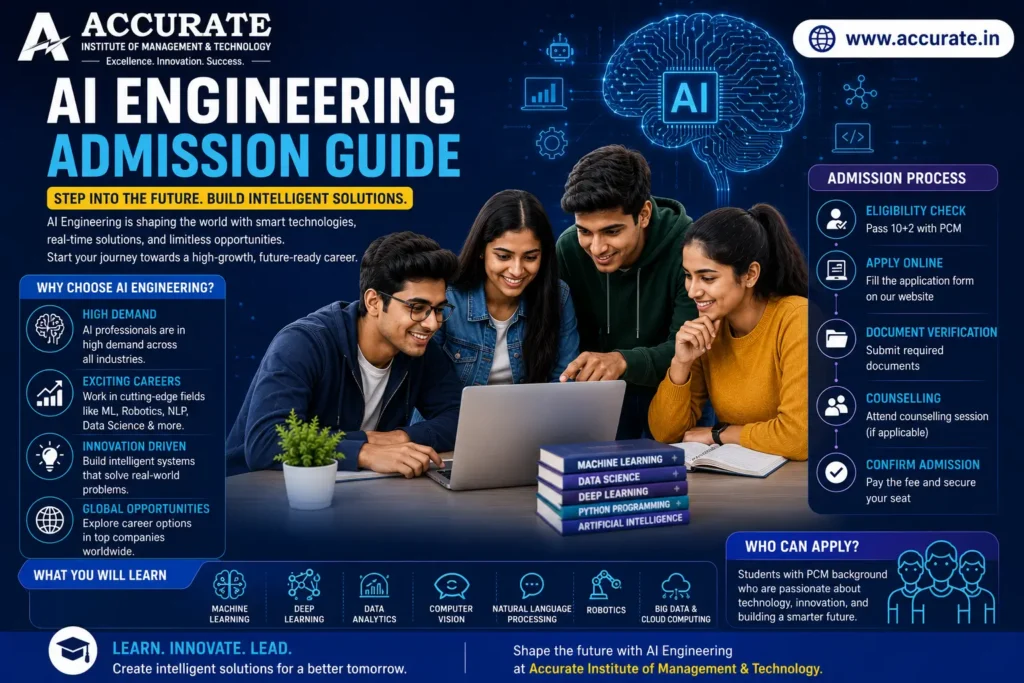

Artificial Intelligence (AI) is one of the fastest-growing and most transformative technologies of the 21st century. From virtual assistants and autonomous vehicles to healthcare diagnostics, financial analytics, robotics, and smart cities, AI is revolutionizing industries worldwide. As businesses increasingly adopt AI-powered solutions, the demand for skilled Artificial Intelligence engineers continues to rise, making AI Engineering one of the most sought-after career choices for students after Class 12.
Choosing the right engineering college and understanding the admission process are the first steps toward building a successful career in Artificial Intelligence. Students need a clear understanding of eligibility criteria, admission procedures, required skills, career opportunities, curriculum, and future prospects before selecting an AI Engineering program.
A quality engineering institution not only provides strong academic knowledge but also offers practical learning, modern laboratories, industry exposure, internships, technical workshops, research opportunities, and placement support. These elements are essential for developing industry-ready AI professionals.
At Accurate Institute of Management & Technology, students receive industry-oriented education designed to meet the growing demand for Artificial Intelligence professionals. Through project-based learning, innovation labs, expert faculty, industry collaborations, technical workshops, and career guidance, students gain the knowledge and practical skills required to excel in AI Engineering.
This comprehensive AI Engineering Admission Guide explains everything aspiring students need to know, including eligibility, admission process, course structure, career opportunities, required skills, future scope, and why AI Engineering remains one of the best technology careers today.
Quick Answer: What Is AI Engineering?
AI Engineering is a specialized engineering discipline that focuses on designing, developing, and deploying intelligent systems capable of learning, reasoning, and solving complex problems.
Students learn:
- Artificial Intelligence
- Machine Learning
- Deep Learning
- Data Science
- Robotics
- Natural Language Processing
- Computer Vision
- Cloud Computing
AI Engineering graduates are prepared for careers in technology companies, research organizations, startups, healthcare, finance, manufacturing, and many other industries.
Why Choose AI Engineering?
Artificial Intelligence has become an essential part of modern business and technology.
Students choose AI Engineering because it offers:
- Excellent Career Opportunities
- High Industry Demand
- Global Job Prospects
- Attractive Salary Potential
- Innovation-Driven Work
- Future-Proof Skills
AI professionals contribute to solving real-world challenges through intelligent technologies.
What Is Artificial Intelligence Engineering?
Artificial Intelligence Engineering combines computer science, mathematics, machine learning, and data analytics to create intelligent systems.
These systems can:
- Learn from Data
- Recognize Patterns
- Make Predictions
- Automate Tasks
- Understand Human Language
- Solve Complex Problems
AI Engineering integrates multiple technologies to develop smart solutions for businesses and society.
Eligibility for AI Engineering Admission
Students interested in AI Engineering generally need to meet the following criteria:
Educational Qualification
Candidates should have completed Class 12 or equivalent from a recognized board.
Academic Background
A strong foundation in:
- Mathematics
- Physics
- Chemistry
- Computer Science (where available)
helps students understand engineering concepts more effectively.
Interest in Technology
Students should enjoy:
- Programming
- Mathematics
- Logical Thinking
- Problem Solving
- Innovation
A genuine interest in technology supports long-term success.
AI Engineering Admission Process
Although admission procedures may vary by institution, the general process includes:
Application Submission
Students complete the admission application with the required academic information.
Eligibility Verification
Academic qualifications and supporting documents are verified.
Counseling or Admission Interaction
Eligible candidates may participate in counseling or admission guidance sessions.
Document Verification
Common documents include:
- Academic Mark Sheets
- Identity Proof
- Passport-Size Photographs
- Transfer Certificate
- Other required certificates
Fee Submission and Enrollment
After successful verification, students complete enrollment by fulfilling the admission requirements.
Also Read: Accurate B.Tech CSE AIML Admission | CSE AIML Engineering Greater Noida
Why Apply Early for AI Engineering Admission?
Early admission provides several advantages:
- Better Seat Availability
- Preferred Specialization Options
- Scholarship Opportunities
- Smooth Documentation Process
- More Time for Academic Preparation
Planning ahead helps students begin their engineering journey with confidence.
Subjects Covered in AI Engineering
Students study a combination of engineering fundamentals and specialized AI technologies.
Core subjects typically include:
- Programming Fundamentals
- Data Structures
- Algorithms
- Artificial Intelligence
- Machine Learning
- Deep Learning
- Data Science
- Cloud Computing
- Computer Vision
- Natural Language Processing
- Robotics
- Mathematics
- Database Management
- Software Engineering
This curriculum prepares students for modern technology careers.
Skills Required for AI Engineering
Successful AI engineers develop expertise in:
Programming
Popular programming languages include:
- Python
- Java
- C++
- SQL
Programming forms the foundation of AI development.
Mathematics
Important areas include:
- Linear Algebra
- Calculus
- Probability
- Statistics
Mathematics supports machine learning and algorithm development.
Problem-Solving
AI engineers analyze complex problems and create intelligent solutions.
Strong analytical thinking is essential.
Machine Learning
Students learn to:
- Build Predictive Models
- Train Algorithms
- Analyze Data
Machine Learning is a core component of AI Engineering.
Communication Skills
AI professionals frequently collaborate with:
- Developers
- Data Scientists
- Business Teams
- Clients
Clear communication enhances teamwork and project success.
Practical Learning in AI Engineering
Modern engineering education emphasizes practical experience.
Students benefit from:
- AI Projects
- Coding Practice
- Innovation Labs
- Technical Workshops
- Hackathons
- Research Activities
Hands-on learning improves technical confidence and employability.
Importance of Internships
Internships provide:
- Industry Exposure
- Practical Experience
- Professional Networking
- Workplace Understanding
Many employers prefer candidates with internship experience.
Career Opportunities After AI Engineering
AI Engineering graduates can pursue roles such as:
- Artificial Intelligence Engineer
- Machine Learning Engineer
- Data Scientist
- AI Research Engineer
- Computer Vision Engineer
- NLP Engineer
- Robotics Engineer
- AI Consultant
- Software Engineer
- Cloud AI Specialist
These careers are available across diverse industries.
Industries Hiring AI Engineers
Artificial Intelligence professionals are employed in:
- Information Technology
- Healthcare
- Banking
- Finance
- Manufacturing
- Retail
- Education
- Automotive
- Telecommunications
- Government Organizations
AI adoption continues expanding across sectors.
Benefits of Choosing AI Engineering
Major advantages include:
High Demand
Organizations worldwide require AI expertise.
Excellent Career Growth
AI professionals enjoy strong long-term career prospects.
Attractive Salary Packages
Specialized AI skills are highly valued.
Global Opportunities
AI knowledge is recognized internationally.
Innovation
Engineers contribute to transformative technologies.
Emerging Technologies Related to AI
AI Engineering overlaps with:
- Machine Learning
- Data Science
- Robotics
- Cloud Computing
- Internet of Things
- Cyber Security
- Big Data Analytics
Students gain exposure to multiple future technologies.
Future Scope of AI Engineering
Artificial Intelligence will continue driving innovation in:
- Healthcare
- Smart Cities
- Autonomous Vehicles
- Renewable Energy
- Education
- Agriculture
- Manufacturing
Future demand for AI engineers is expected to remain exceptionally strong.
How Students Can Prepare Before Joining AI Engineering
Students can strengthen their foundation by:
- Learning Python
- Improving Mathematics
- Practicing Logical Reasoning
- Exploring Basic Programming
- Following AI Technology Trends
Early preparation makes engineering studies more enjoyable.
Importance of Industry Exposure
Industry interaction helps students understand:
- Real Business Problems
- AI Applications
- Professional Expectations
- Technology Trends
Exposure improves career readiness.
Role of Technical Workshops
Workshops provide practical experience in:
- Artificial Intelligence
- Deep Learning
- Cloud Computing
- Data Science
- Machine Learning
Hands-on learning enhances technical competence.
Project-Based Learning
Students develop AI solutions through projects such as:
- Chatbots
- Image Recognition Systems
- Recommendation Engines
- Predictive Analytics
Projects strengthen portfolios and placement opportunities.
Placement Opportunities
AI graduates can explore careers in:
- Technology Companies
- Startups
- Research Organizations
- Consulting Firms
- Product-Based Companies
Placement success depends on technical skills, projects, internships, and continuous learning.
Why Choose Accurate Institute of Management & Technology?
At Accurate Institute of Management & Technology, students receive future-focused engineering education designed for emerging technology careers.
Industry-Oriented Curriculum
Courses reflect current industry requirements.
Modern Laboratories
Students gain hands-on experience using advanced technologies.
Project-Based Learning
Practical projects strengthen technical understanding.
Experienced Faculty
Expert mentors guide academic and professional development.
Technical Workshops
Students learn AI, Machine Learning, Data Science, Cloud Computing, and related technologies.
Internship Opportunities
Industry exposure enhances practical knowledge.
Placement Support
Career guidance, interview preparation, and placement assistance improve employability.
How can I get admission to AI Engineering?
Students can pursue AI Engineering after completing Class 12 with the required academic qualifications. The admission process generally includes application submission, eligibility verification, document verification, counseling, and enrollment. Choosing an industry-oriented engineering college with practical learning and placement support helps build a successful AI career.
Conclusion
Artificial Intelligence Engineering is one of the most promising career options for students who aspire to work with cutting-edge technologies and solve real-world challenges. As AI continues transforming industries across the globe, skilled engineers are becoming increasingly valuable in healthcare, finance, manufacturing, education, transportation, and many other sectors.
Choosing the right engineering college is essential for gaining quality education, practical exposure, industry interaction, and career guidance. Students who build strong programming, mathematics, analytical thinking, and problem-solving skills while actively participating in projects and internships position themselves for long-term success.
At Accurate Institute of Management & Technology, students benefit from industry-oriented education, experienced faculty, modern laboratories, project-based learning, technical workshops, internships, and placement support that prepare them for rewarding careers in Artificial Intelligence Engineering.
For students passionate about technology, innovation, and future-ready careers, AI Engineering offers exceptional opportunities for growth, creativity, and professional success.
Frequently Asked Questions (FAQs)
What is AI Engineering?
AI Engineering is a branch of engineering focused on developing intelligent systems using Artificial Intelligence, Machine Learning, and related technologies.
Who can apply for AI Engineering?
Students who have completed Class 12 with the required academic qualifications and an interest in technology can pursue AI Engineering.
Is AI Engineering a good career?
Yes. AI Engineering is among the fastest-growing technology careers with strong global demand.
What skills are needed for AI Engineering?
Programming, mathematics, machine learning, problem-solving, analytical thinking, and communication skills.
Which industries hire AI Engineers?
Healthcare, IT, Finance, Manufacturing, Retail, Automotive, Telecommunications, Education, and Government.
Does AI Engineering include Machine Learning?
Yes. Machine Learning is one of the core subjects within AI Engineering.
Why is practical learning important in AI Engineering?
Projects, workshops, internships, and research activities help students apply theoretical knowledge to real-world problems.
How does Accurate Institute prepare students for AI Engineering careers?
Through industry-oriented curriculum, practical learning, technical workshops, experienced faculty, internships, projects, and placement support.