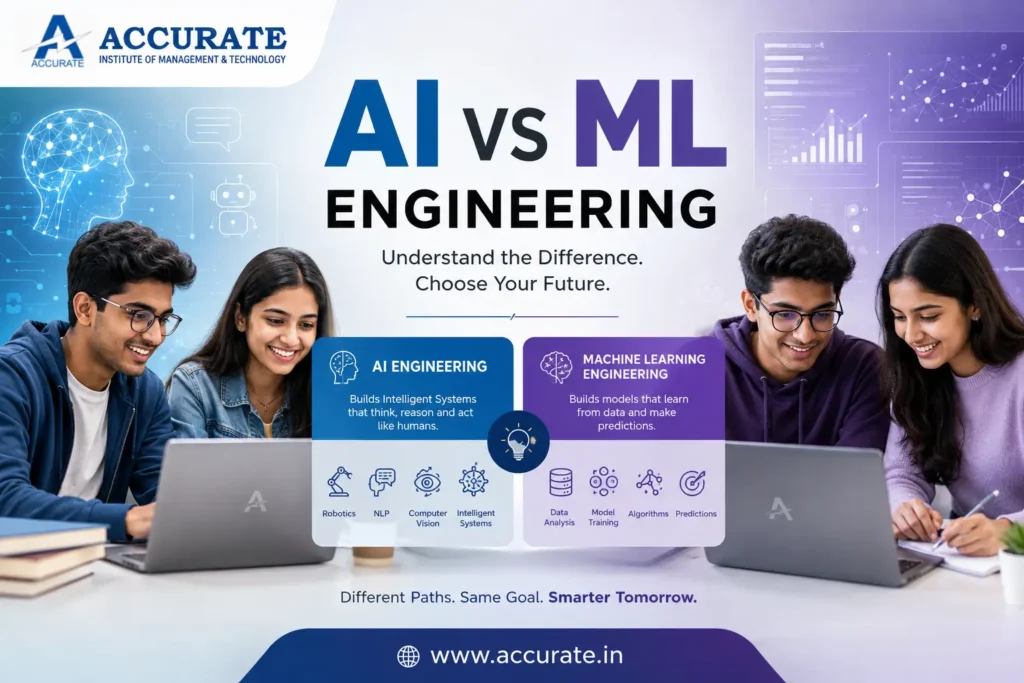

AI Engineering is a broader engineering discipline that focuses on designing intelligent systems using Artificial Intelligence technologies such as Machine Learning, Deep Learning, Natural Language Processing (NLP), Robotics, and Computer Vision. Machine Learning Engineering is a specialized branch that concentrates on building, training, optimizing, and deploying machine learning models using data. AI Engineering covers multiple AI technologies, while Machine Learning Engineering focuses specifically on algorithms that learn from data.
Question: Which is better: AI Engineering or Machine Learning Engineering?
Answer: AI Engineering is better for students who want to work across various AI technologies like robotics, NLP, computer vision, and automation. Machine Learning Engineering is ideal for students who enjoy working with data, predictive models, and intelligent algorithms. Both fields offer excellent career opportunities, but AI Engineering provides broader career options.
Table of Contents
- Introduction
- What is AI Engineering?
- What is Machine Learning Engineering?
- AI vs Machine Learning: Understanding the Relationship
- AI Engineering vs Machine Learning Engineering: Quick Comparison
- Major Differences Between AI Engineering and Machine Learning Engineering
- Skills Required
- Subjects Covered
- Programming Languages Used
- Career Opportunities
- Salary Comparison
- Industries Hiring AI and ML Engineers
- Future Scope
- Which Course Should You Choose?
- Why Study at Accurate Institute of Management & Technology?
- Admission Process
- Conclusion
- FAQs
Artificial Intelligence has become one of the fastest-growing technologies in the world. From ChatGPT and autonomous vehicles to healthcare diagnostics and financial fraud detection, AI is transforming every industry. As businesses increasingly adopt intelligent technologies, demand for skilled professionals continues to rise.
Many students planning a B.Tech often ask:
- Is AI Engineering different from Machine Learning Engineering?
- Which course offers better placements?
- Which field has higher salaries?
- Which specialization has a brighter future?
Although Artificial Intelligence and Machine Learning are closely connected, they are not identical. Understanding their differences helps students choose the right engineering specialization based on their interests and career aspirations.
This comprehensive guide explains AI Engineering vs Machine Learning Engineering in detail, covering curriculum, career opportunities, required skills, salary trends, industry demand, and future prospects. It also highlights how Accurate Institute of Management & Technology prepares students for successful careers in next-generation technologies.
What is AI Engineering?
AI Engineering is a multidisciplinary engineering field focused on developing intelligent systems capable of performing tasks that typically require human intelligence.
These tasks include:
- Problem-solving
- Decision-making
- Speech recognition
- Natural language understanding
- Image recognition
- Robotics
- Automation
- Recommendation systems
AI Engineering combines multiple technologies, including:
- Machine Learning
- Deep Learning
- Computer Vision
- Natural Language Processing
- Robotics
- Reinforcement Learning
- Data Science
- Intelligent Automation
The primary objective of AI Engineering is to create systems that can perceive, learn, reason, and make intelligent decisions.
What is Machine Learning Engineering?
Machine Learning Engineering is a specialized branch within Artificial Intelligence that focuses on designing algorithms capable of learning from data without being explicitly programmed.
Machine Learning Engineers work on:
- Predictive analytics
- Recommendation systems
- Fraud detection
- Customer behavior analysis
- Medical diagnosis
- Autonomous systems
Their primary responsibility is building, training, testing, deploying, and maintaining machine learning models.
Unlike AI Engineering, Machine Learning Engineering focuses specifically on learning algorithms and statistical models.
AI vs Machine Learning: Understanding the Relationship
A common misconception is that Artificial Intelligence and Machine Learning are separate technologies.
In reality:
Artificial Intelligence is the larger domain.
Inside AI comes:
- Machine Learning
- Deep Learning
- NLP
- Robotics
- Computer Vision
- Expert Systems
Machine Learning is one component of AI.
Every Machine Learning Engineer works within AI, but not every AI Engineer specializes only in Machine Learning.
AI Engineering vs Machine Learning Engineering: Quick Comparison
| Feature | AI Engineering | Machine Learning Engineering |
|---|---|---|
| Scope | Broad | Specialized |
| Focus | Intelligent systems | Learning algorithms |
| Includes ML | Yes | Primary focus |
| Includes NLP | Yes | Sometimes |
| Includes Robotics | Yes | Rarely |
| Computer Vision | Yes | Often |
| Career Options | More diverse | More specialized |
| Industry Demand | Very High | Very High |
| Future Scope | Excellent | Excellent |
Major Differences Between AI Engineering and Machine Learning Engineering
1. Scope
AI Engineering encompasses the complete ecosystem of intelligent technologies, including reasoning, perception, planning, robotics, automation, and language understanding.
Machine Learning Engineering focuses specifically on creating systems that improve automatically through data.
2. Problem Solving
AI Engineers build complete intelligent applications.
Machine Learning Engineers build the prediction engine powering those applications.
3. Technology Stack
AI Engineers use:
- NLP
- Robotics
- Computer Vision
- Deep Learning
- Reinforcement Learning
- Knowledge Graphs
- Machine Learning
Machine Learning Engineers primarily use:
- Regression
- Classification
- Clustering
- Neural Networks
- Decision Trees
- Ensemble Models
- Deep Learning
4. Programming Skills
AI Engineers require broader programming expertise.
Machine Learning Engineers require stronger mathematical and statistical foundations.
5. Application Areas
AI Engineering includes:
- Smart assistants
- Autonomous vehicles
- Medical AI
- Robotics
- AI chatbots
- Intelligent manufacturing
Machine Learning Engineering focuses on:
- Forecasting
- Recommendation engines
- Fraud detection
- Customer analytics
- Predictive maintenance
Skills Required for AI Engineering
Successful AI Engineers need expertise in:
Technical Skills
- Python
- Java
- C++
- AI algorithms
- Deep Learning
- NLP
- Computer Vision
- Cloud Computing
- Robotics
- Neural Networks
Soft Skills
- Problem-solving
- Communication
- Creativity
- Critical thinking
- Team collaboration
- Analytical reasoning
Skills Required for Machine Learning Engineering
Machine Learning Engineers should master:
- Python
- R
- SQL
- TensorFlow
- PyTorch
- Scikit-learn
- Mathematics
- Statistics
- Probability
- Data Structures
- Algorithms
- Feature Engineering
- Model Deployment
Subjects Covered in AI Engineering
Typical B.Tech AI Engineering curriculum includes:
Core Subjects
- Programming Fundamentals
- Artificial Intelligence
- Machine Learning
- Deep Learning
- Data Science
- Computer Vision
- NLP
- Robotics
- Cloud Computing
- Big Data
- Internet of Things
- Cyber Security
Subjects Covered in Machine Learning Engineering
Machine Learning Engineering focuses more deeply on:
- Statistics
- Probability
- Linear Algebra
- Calculus
- Machine Learning Algorithms
- Data Mining
- Predictive Analytics
- Model Optimization
- Neural Networks
- Deep Learning
- Data Engineering
Programming Languages Used
Both fields commonly use:
- Python
- Java
- C++
- R
- SQL
- Julia
Popular frameworks include:
- TensorFlow
- PyTorch
- Keras
- Scikit-learn
- OpenCV
- Hugging Face
- Apache Spark
Career Opportunities
AI Engineering Careers
Graduates can become:
- AI Engineer
- Robotics Engineer
- NLP Engineer
- Computer Vision Engineer
- AI Software Developer
- AI Research Engineer
- AI Consultant
- AI Product Engineer
- Automation Engineer
- Intelligent Systems Developer
Machine Learning Engineering Careers
Career options include:
- Machine Learning Engineer
- Data Scientist
- ML Research Engineer
- AI Model Developer
- Predictive Analytics Engineer
- Recommendation Systems Engineer
- Data Mining Specialist
- Deep Learning Engineer
Salary Comparison
Although salaries vary by experience, skills, employer, and location, both fields offer competitive compensation.
AI Engineering
- Strong earning potential across software, healthcare, automotive, fintech, and research sectors.
- Broader roles can lead to leadership opportunities in AI architecture and product development.
Machine Learning Engineering
- High demand for professionals skilled in model development, deployment, and optimization.
- Specialized expertise in ML frameworks and data science often commands premium salaries.
Students who build strong portfolios, complete internships, and gain hands-on project experience typically improve their career prospects in both domains.
Industries Hiring AI and ML Engineers
Demand exists across nearly every sector, including:
Information Technology
- Intelligent software
- Cloud AI
- Automation
Healthcare
- Disease prediction
- Medical imaging
- Drug discovery
Banking & Finance
- Fraud detection
- Risk analysis
- Credit scoring
E-Commerce
- Product recommendations
- Personalized marketing
Manufacturing
- Predictive maintenance
- Smart factories
Automotive
- Autonomous driving
- Driver assistance systems
Education
- Personalized learning
- Intelligent tutoring systems
Agriculture
- Precision farming
- Crop monitoring
Future Scope of AI Engineering and Machine Learning Engineering
The future of both disciplines is exceptionally promising as organizations continue integrating AI into products, services, and operations.
Emerging areas include:
- Generative AI
- Large Language Models (LLMs)
- AI Agents
- Edge AI
- Responsible AI
- Explainable AI
- AI Cybersecurity
- Industrial Automation
- Smart Cities
- Human-AI Collaboration
AI Engineering is expected to remain broad and interdisciplinary, while Machine Learning Engineering will continue to evolve with advances in data infrastructure, model optimization, and scalable AI deployment.
Which Course Should You Choose?
Choose AI Engineering if you:
- Want broader career opportunities
- Enjoy robotics and intelligent systems
- Are interested in NLP and computer vision
- Want to build complete AI applications
- Prefer multidisciplinary learning
Choose Machine Learning Engineering if you:
- Love mathematics and statistics
- Enjoy working with large datasets
- Want to build predictive models
- Like algorithm optimization
- Prefer specialization in data-driven AI
Why Choose Accurate Institute of Management & Technology?
Selecting the right engineering college is as important as selecting the right specialization. Accurate Institute of Management & Technology (AIMT) offers an industry-focused learning environment that prepares students for emerging careers in Artificial Intelligence and related technologies.
Key Advantages
- Industry-oriented B.Tech curriculum
- Experienced faculty members
- Modern AI and computing laboratories
- Hands-on projects and innovation activities
- Coding competitions and hackathons
- Industry interaction through seminars and workshops
- Internship guidance
- Skill development programs
- Career-focused training
- Placement assistance
Students gain practical exposure to programming, data analytics, AI tools, and real-world problem-solving, helping them become job-ready for the rapidly evolving technology sector.
Admission Process
Students interested in pursuing AI-focused engineering programs should:
- Meet the eligibility criteria for B.Tech admission.
- Complete the institute’s admission process as applicable.
- Prepare core subjects such as Physics, Chemistry, and Mathematics.
- Develop foundational programming skills to strengthen future learning.
Prospective students can explore program details, eligibility, and admission information through the official website of Accurate Institute of Management & Technology: https://www.accurate.in.
Conclusion
The comparison between AI Engineering vs Machine Learning Engineering ultimately comes down to your interests and career goals. AI Engineering provides a broader foundation across intelligent technologies, while Machine Learning Engineering offers deep specialization in data-driven algorithms and predictive systems.
Both fields are shaping the future of technology and creating exciting opportunities across industries worldwide. Students who combine strong technical knowledge with practical experience, project work, and continuous learning will be well-positioned for success.
If you aspire to build a rewarding career in Artificial Intelligence, choosing an institution that emphasizes industry exposure, innovation, and hands-on learning is essential. Accurate Institute of Management & Technology provides students with a supportive academic environment, practical training, and career development opportunities to prepare them for the evolving AI landscape.
Admissions are open for aspiring engineers. Visit www.accurate.in to learn more about programs, eligibility, and the admission process, and take the first step toward a future in Artificial Intelligence and Machine Learning.
Frequently Asked Questions (SEO Optimized)
1. What is the main difference between AI Engineering and Machine Learning Engineering?
AI Engineering focuses on building complete intelligent systems using multiple AI technologies, whereas Machine Learning Engineering specializes in developing algorithms that learn from data.
2. Which is better: AI Engineering or Machine Learning Engineering?
Neither is universally better. AI Engineering offers broader career paths, while Machine Learning Engineering is ideal for those who want to specialize in predictive models and data-driven AI.
3. Is Machine Learning a part of Artificial Intelligence?
Yes. Machine Learning is a core subset of Artificial Intelligence that enables systems to learn from data and improve performance without explicit programming.
4. Does AI Engineering include Deep Learning and NLP?
Yes. AI Engineering commonly includes Deep Learning, Natural Language Processing, Computer Vision, Robotics, and Machine Learning.
5. What programming language is most important for AI and ML?
Python is the most widely used programming language due to its extensive ecosystem of AI and ML libraries and frameworks.
6. Which engineering specialization has better career opportunities?
Both have excellent prospects. AI Engineering generally opens doors to a wider range of roles, while Machine Learning Engineering provides specialized opportunities in AI model development.
7. Can I become an AI Engineer after completing B.Tech?
Yes. A B.Tech with relevant AI, programming, mathematics, and project experience can prepare graduates for AI engineering roles.
8. What industries recruit AI and Machine Learning Engineers?
Technology, healthcare, finance, automotive, manufacturing, retail, education, agriculture, and many other sectors actively recruit AI and ML professionals.
9. Why should I choose Accurate Institute of Management & Technology for AI studies?
AIMT emphasizes industry-relevant education through practical labs, experienced faculty, project-based learning, internships, skill development, and placement support.
10. How can I apply for admission to Accurate Institute of Management & Technology?
Interested students can visit Accurate to explore programs, admission requirements, eligibility criteria, and the latest application information.