
Artificial Intelligence and Machine Learning are transforming the way people communicate, work, travel, shop, study and make decisions. Intelligent applications now support medical diagnosis, financial risk assessment, digital payments, cybersecurity, manufacturing, customer service, logistics, education, agriculture and software development.
This rapid adoption has created a growing need for engineers who understand how intelligent systems are designed, trained, tested, deployed and improved. As a result, B.Tech programs specializing in Artificial Intelligence and Machine Learning have become attractive options for students who enjoy programming, mathematics, data analysis and problem-solving.
However, choosing an engineering college requires more than selecting a popular specialization. Students need to assess the quality of academic delivery, laboratories, project opportunities, faculty support, internships, industry interaction, professional training and placement preparation.
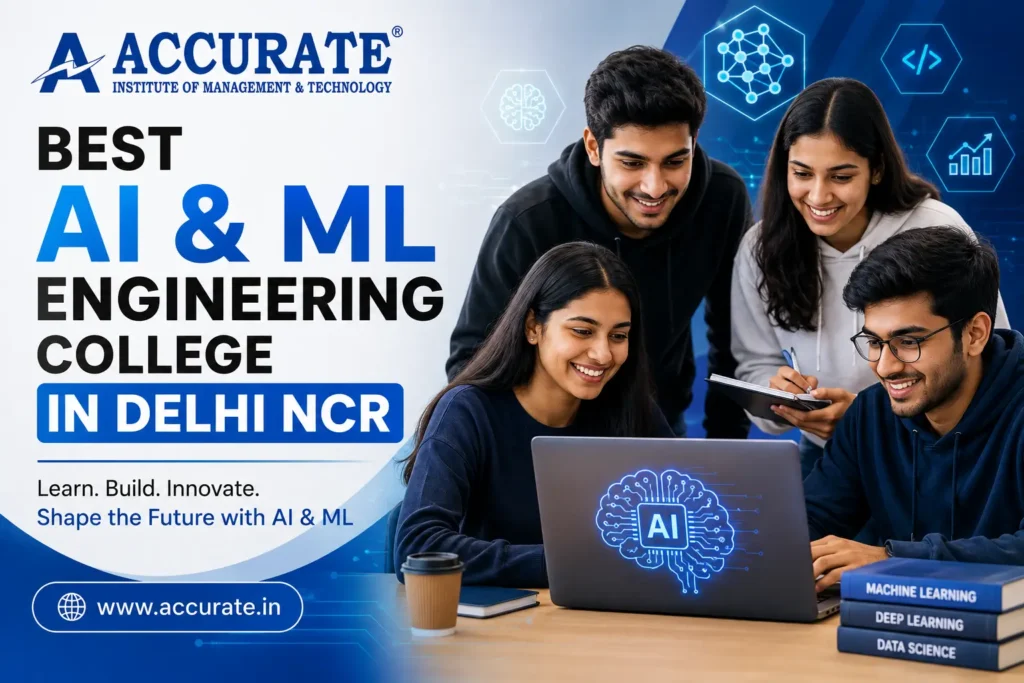
For students searching for the Best AI & ML Engineering College in Delhi NCR, Accurate Institute of Management & Technology offers a career-focused academic environment in Greater Noida. The institute provides an AI and ML engineering program designed to develop computer science knowledge, practical technical ability and professional readiness.
Accurate Institute’s engineering programs are approved by the All India Council for Technical Education and affiliated with Dr. A.P.J. Abdul Kalam Technical University. Its B.Tech program follows a four-year, eight-semester structure.
This guide explains what students should expect from an AI and ML engineering college, why Delhi NCR is a valuable location for technical education and how Accurate Institute can support aspiring engineers.
Table of Contents
- Understanding Artificial Intelligence and Machine Learning
- Why AI and ML Are Important for Future Engineers
- Why Study AI and ML in Delhi NCR?
- What Makes an AI and ML Engineering College the Best?
- Why Consider Accurate Institute of Management & Technology?
- AI and ML Curriculum and Technical Foundations
- Practical Learning and Laboratory Experience
- Project-Based Learning and Innovation
- Faculty Guidance and Student Mentoring
- Industry Exposure and Professional Certifications
- Internships and Career Readiness
- Placement Preparation at Accurate Institute
- Career Opportunities After B.Tech AI and ML
- Higher-Education and Entrepreneurship Options
- Skills Students Should Develop
- Admission Process and Eligibility
- Ten SEO-Optimized FAQs
- Conclusion and Admission CTA
Understanding Artificial Intelligence and Machine Learning
Artificial Intelligence is a broad area of computer science concerned with creating systems capable of performing tasks commonly associated with human intelligence. These tasks may include recognizing images, understanding language, identifying patterns, solving problems, predicting outcomes and supporting decisions.
Machine Learning is a major branch of Artificial Intelligence. It enables computer systems to learn from data rather than depend only on fixed instructions written for every situation.
For example, a conventional software program follows predefined rules. A Machine Learning system studies historical examples and uses identified patterns to make predictions about new information.
Artificial Intelligence in Daily Life
Many people interact with AI-powered systems without actively recognizing them. Common examples include:
- Product recommendations on e-commerce platforms
- Movie and music suggestions
- Email spam filters
- Navigation and traffic predictions
- Voice assistants
- Chatbots
- Facial recognition
- Language translation
- Banking fraud alerts
- Personalized digital advertisements
These applications demonstrate that AI is not limited to research laboratories. It has become an important part of modern digital infrastructure.
Difference Between AI, ML and Deep Learning
Artificial Intelligence is the larger discipline of building intelligent computer systems.
Machine Learning is a subset of AI that allows systems to learn from data.
Deep Learning is a specialized subset of Machine Learning that uses multilayered artificial neural networks. It is commonly applied in image recognition, speech processing, language models, autonomous systems and other data-intensive applications.
A well-structured B.Tech AI and ML program introduces students to these concepts progressively, beginning with programming, mathematics and computer science fundamentals.
Why AI and ML Are Important for Future Engineers
AI and ML are becoming central to engineering innovation. Organizations are looking for ways to process large quantities of data, automate repetitive tasks, improve accuracy and create personalized user experiences.
This creates opportunities for engineers who can combine technical knowledge with analytical thinking.
AI Supports Smarter Decision-Making
Machine Learning models can analyze patterns that may be difficult to detect manually. These insights can help organizations forecast demand, detect unusual activity, understand customer behavior and optimize operations.
AI Enables Intelligent Automation
Traditional automation generally follows fixed rules. AI-powered automation can adapt to changing data and situations, making it useful for customer service, manufacturing, logistics and digital operations.
AI Encourages Interdisciplinary Innovation
Artificial Intelligence works alongside many other disciplines, including:
- Cloud computing
- Robotics
- Internet of Things
- Cybersecurity
- Data Science
- Electronics
- Healthcare technology
- Business analytics
- Automobile engineering
- Smart-city development
Students studying AI and ML can therefore explore applications beyond conventional software development.
AI Creates New Technical Roles
The rise of intelligent systems has generated career paths such as Machine Learning engineer, AI engineer, data scientist, Computer Vision engineer, NLP engineer, AI product specialist and automation engineer.
Graduates may also work in broader roles such as software development, analytics, cloud technology, quality engineering and technical consulting.
Why Study AI and ML in Delhi NCR?
Delhi NCR is one of India’s major education, business, technology and startup regions. It includes Delhi and surrounding locations such as Noida, Greater Noida, Gurugram, Ghaziabad and Faridabad.
Studying in this region can provide students with exposure to a varied professional ecosystem.
Access to Technology Companies and Startups
The region hosts companies working in software services, analytics, digital commerce, fintech, electronics, consulting, telecommunications and emerging technologies.
This environment can support industry visits, internships, guest sessions, networking and recruitment activity.
Exposure to Professional Events
Students in Delhi NCR can explore:
- Technology conferences
- Coding competitions
- Hackathons
- Startup events
- Career fairs
- Industry seminars
- Professional meetups
- Innovation challenges
Participating in such activities can help students understand how technical concepts are applied outside the classroom.
Connectivity and Educational Ecosystem
Greater Noida has developed into an important higher-education destination within Delhi NCR. Accurate Institute is located in Knowledge Park III, Greater Noida, placing it within the region’s established academic ecosystem.
Opportunities for Personal Development
Studying in a diverse metropolitan region allows students to interact with learners from different locations and backgrounds. This can improve communication, teamwork, adaptability and professional confidence.
What Makes an AI and ML Engineering College the Best?
The phrase “best college” should not be evaluated only through advertisements or general rankings. The right institution is one that aligns with a student’s academic goals, learning preferences, budget, location needs and career ambitions.
Students and parents should consider the following factors.
Relevant Academic Curriculum
The program should build a strong base in computer science before moving into specialized AI and ML concepts.
Important areas include:
- Programming
- Data Structures
- Algorithms
- Database Management Systems
- Operating Systems
- Computer Networks
- Software Engineering
- Probability and Statistics
- Linear Algebra
- Artificial Intelligence
- Machine Learning
- Data Science
- Deep Learning
- Natural Language Processing
- Computer Vision
- Cloud Computing
Practical Laboratory Learning
Students need opportunities to write code, analyze datasets, test algorithms and create software applications. Laboratory sessions make abstract concepts easier to understand.
Experienced and Supportive Faculty
Faculty members should explain complex concepts clearly, guide student projects and encourage independent learning.
A supportive academic environment is especially important in AI and ML because students may need assistance with mathematics, coding, model evaluation and problem-solving.
Projects and Innovation Opportunities
Good engineering programs encourage students to build mini-projects and major projects. These activities improve coding ability, teamwork, research, documentation and presentation skills.
Industry Exposure
Guest lectures, technical workshops, industrial visits and internships can help students understand current tools and professional expectations.
Placement Preparation
Placement support should include more than arranging interviews. Students require training in aptitude, programming, communication, resumes, group discussions and technical interviews.
Transparent Information
Students should verify approvals, affiliation, fees, eligibility, infrastructure and placement information through official institutional sources before taking admission.
Why Consider Accurate Institute of Management & Technology?
Accurate Institute of Management & Technology has established its engineering campus in Greater Noida and offers programs across engineering and emerging technology areas.
Its B.Tech AI and ML offering is presented as a specialized engineering pathway for students interested in Computer Science, Artificial Intelligence, Machine Learning, Data Science and related fields. The institute highlights expert faculty, industry connections, computing laboratories and placement support as important features of its CSE AI and ML program.
Approved and Affiliated B.Tech Education
Accurate Institute states that its B.Tech programs are AICTE-approved and affiliated with Dr. A.P.J. Abdul Kalam Technical University, Lucknow.
Approvals and affiliation give students a defined academic structure and university examination framework.
Focus on Employability
The institute’s B.Tech objectives include developing analytical ability, practical understanding and decision-making skills. Its public program information also emphasizes hands-on learning and career preparation.
Delhi NCR Location Advantage
The Greater Noida location allows students to remain connected to the broader Delhi NCR academic and corporate ecosystem.
This can be useful for industry exposure, professional events and internship exploration.
Multidisciplinary Learning Environment
Accurate Group offers programs across engineering, management, architecture, pharmacy, law and other disciplines.
A multidisciplinary environment may encourage students to explore how AI can solve problems in business, healthcare, design, finance and other sectors.
AI and ML Curriculum and Technical Foundations
An effective AI and ML engineer requires more than familiarity with a few software tools. Students must understand the foundations of computing and mathematics.
Programming Fundamentals
Programming is at the heart of AI development. Students commonly begin with languages such as C, C++ or Python.
Python is especially popular for AI and data-related work because of its readable syntax and broad ecosystem of libraries.
Students should learn how to:
- Write structured programs
- Work with functions and classes
- Handle files
- Debug errors
- Use libraries
- Connect applications to databases
- Write reusable code
- Use version-control systems
Data Structures and Algorithms
Data Structures and Algorithms help students write efficient solutions.
Important topics include:
- Arrays
- Linked lists
- Stacks
- Queues
- Trees
- Graphs
- Searching
- Sorting
- Recursion
- Dynamic programming
- Algorithm complexity
These concepts are important in technical interviews and software engineering.
Mathematics for Machine Learning
Machine Learning relies heavily on mathematics.
Students should develop an understanding of:
- Linear algebra
- Probability
- Statistics
- Calculus
- Optimization
- Matrices and vectors
A clear mathematical foundation helps students understand why an algorithm works rather than simply learning how to run it.
Machine Learning Concepts
Students may study:
- Supervised learning
- Unsupervised learning
- Regression
- Classification
- Clustering
- Feature engineering
- Model evaluation
- Overfitting and underfitting
- Cross-validation
- Ensemble learning
Deep Learning
Deep Learning introduces artificial neural networks and advanced architectures.
Common areas include:
- Feedforward neural networks
- Convolutional neural networks
- Recurrent neural networks
- Transformers
- Representation learning
- Model training and optimization
Natural Language Processing
NLP focuses on enabling computers to process human language.
Applications include:
- Chatbots
- Sentiment analysis
- Text classification
- Translation
- Information extraction
- Voice assistants
- Search systems
Computer Vision
Computer Vision enables machines to interpret images and videos.
Applications include:
- Object detection
- Image classification
- Facial recognition
- Medical imaging
- Quality inspection
- Traffic monitoring
Practical Learning and Laboratory Experience
AI and ML cannot be mastered through theory alone. Students must work with data, code and computing platforms.
Accurate Institute describes its engineering learning environment as one that incorporates advanced computing laboratories, practical work and real-world projects.
Programming Laboratories
Programming laboratories help students practice languages, algorithms and software development.
Regular coding practice is important because students improve by solving problems rather than only reading solutions.
Machine Learning Experiments
Students can learn to:
- Import datasets
- Clean missing or inconsistent data
- Visualize information
- Select useful features
- Train models
- Compare algorithms
- Measure performance
- Interpret results
Cloud-Based Learning
Cloud platforms can help learners run applications, store data and explore scalable computing resources.
Familiarity with cloud environments can support future work in deployment, data engineering and software development.
Collaborative Technical Work
Laboratory work also teaches students how to collaborate, manage files, explain code and troubleshoot errors with peers.
These professional habits are valuable in workplace environments.
Project-Based Learning and Innovation
Projects allow students to integrate knowledge from different subjects. They also provide evidence of practical ability during internships, placement interviews and higher-education applications.
Suggested AI and ML Student Projects
Students may work on projects such as:
- Student performance prediction
- Crop disease identification
- Smart attendance systems
- Spam-message detection
- Product recommendation systems
- Customer churn prediction
- Financial fraud detection
- Road-sign recognition
- Sentiment-analysis tools
- AI-powered chatbots
- Medical-image classification
- Traffic-flow forecasting
Benefits of Project Work
Projects help students develop:
- Problem identification
- Data collection
- Programming
- Model selection
- Testing
- Documentation
- Presentation
- Teamwork
- Time management
- Critical evaluation
Hackathons and Coding Competitions
Hackathons challenge students to create solutions within limited timeframes.
Such events can improve creative thinking, collaboration and confidence. They also help learners become comfortable presenting technical solutions.
Research and Entrepreneurship
Students interested in research can explore model improvements, experimental comparisons and interdisciplinary applications.
Entrepreneurially minded students can identify practical problems and develop AI-powered products or services.
Faculty Guidance and Student Mentoring
AI and ML involve several challenging areas. Students may struggle with coding, mathematical concepts, algorithms or project implementation.
Good faculty mentorship helps students progress steadily.
Conceptual Clarity
Faculty members can explain the logic behind algorithms and connect theory with practical examples.
Academic Support
Mentoring can help students:
- Identify weak subjects
- Create study plans
- Select projects
- Prepare presentations
- Improve technical writing
- Explore certifications
- Plan internships
Encouraging Independent Learning
Technology changes continuously. Faculty guidance should encourage students to read documentation, study research, experiment with tools and learn beyond the prescribed syllabus.
Accurate Institute describes its environment as one that supports faculty–student interaction, modern classrooms, computing facilities and academic development.
Industry Exposure and Professional Certifications
Academic study provides a foundation, while industry exposure helps students understand current professional practices.
Technical Workshops
Workshops may cover:
- Python programming
- Machine Learning tools
- Data visualization
- Cloud computing
- Cybersecurity
- Web development
- Generative AI
- Interview coding
- Software testing
Guest Lectures
Industry experts can explain how teams build, deploy and maintain AI systems.
Students also learn about practical limitations, data privacy, ethics and the importance of business understanding.
Professional Certifications
Relevant certifications can supplement a B.Tech degree when they are selected carefully.
Students may explore certification pathways in:
- Python
- Cloud computing
- Data analytics
- Machine Learning
- Database technologies
- Business intelligence
- Software development
Certifications should not replace fundamentals. They are most useful when combined with projects and practical application.
Internships and Career Readiness
Internships introduce students to workplace environments and real project expectations.
What Students Can Learn During Internships
Internships may help learners understand:
- Team structures
- Project deadlines
- Client requirements
- Software development processes
- Documentation standards
- Data privacy
- Testing
- Professional communication
- Workplace discipline
Building an Internship Profile
Students should prepare by creating:
- A one-page resume
- A professional online profile
- A code repository
- A project portfolio
- A list of relevant skills
- Clear project descriptions
Internship Selection
A valuable internship should provide meaningful exposure. Students should evaluate the tasks, mentorship and learning objectives rather than selecting opportunities only for certificates.
Placement Preparation at Accurate Institute
Accurate Institute maintains placement-related resources and describes its placement services as providing industry connections, skill development and career guidance. Its public information highlights aptitude training, mock interviews, personality development and technical skill enhancement as elements of student preparation.
Aptitude Preparation
Many recruitment processes begin with aptitude assessments.
Students should practice:
- Quantitative aptitude
- Logical reasoning
- Verbal ability
- Data interpretation
- Time management
Technical Interview Preparation
AI and ML candidates may be assessed on:
- Programming
- Data Structures
- Algorithms
- Databases
- Object-oriented programming
- Operating Systems
- Computer Networks
- Machine Learning concepts
- Project understanding
Communication Skills
Students should be able to explain:
- What problem their project solves
- Why they selected a particular model
- How they prepared the data
- How performance was evaluated
- What limitations remain
Resume and Portfolio Development
A strong profile should highlight:
- Technical skills
- Projects
- Internships
- Certifications
- Coding achievements
- Hackathon participation
- Leadership roles
Placement results depend on individual preparation, academic performance, market conditions and employer requirements. Therefore, students should treat institutional support as one part of a broader personal career strategy.
Career Opportunities After B.Tech AI and ML
Graduates can explore a variety of technology and analytics roles.
Artificial Intelligence Engineer
AI engineers design intelligent applications and integrate models into usable systems.
Machine Learning Engineer
Machine Learning engineers prepare data, build models, test performance and support deployment.
Data Scientist
Data scientists analyze data and create predictive or analytical solutions for business problems.
Data Analyst
Data analysts work with reports, dashboards, trends and business insights.
Software Developer
AI and ML graduates also possess computer science knowledge that can support careers in software development.
NLP Engineer
NLP engineers work on chatbots, language analysis, search, classification and text-generation systems.
Computer Vision Engineer
Computer Vision engineers develop systems that analyze images and video.
Business Intelligence Analyst
Business intelligence professionals transform organizational data into reports and decision-support tools.
Cloud and Data Engineer
Cloud and data engineers build infrastructure for storing, processing and delivering data.
AI Product Associate
AI product professionals help connect user needs, business requirements and technical development.
Higher-Education and Entrepreneurship Options
B.Tech graduates do not have to enter employment immediately.
Higher-Education Options
Students may pursue:
- M.Tech in Artificial Intelligence
- M.Tech in Computer Science
- M.Tech in Data Science
- MS in Artificial Intelligence
- MS in Machine Learning
- MBA in Business Analytics
- Postgraduate programs in Data Science
- Research degrees
Entrepreneurship
AI can support startups in:
- Education technology
- Healthcare
- Agriculture
- Financial services
- Logistics
- Retail
- Cybersecurity
- Human resources
- Marketing analytics
Students interested in entrepreneurship should learn customer research, product design, finance and business communication in addition to technical development.
Skills Students Should Develop During B.Tech
College resources create opportunities, but students must actively build their abilities.
Strong Coding Ability
Students should practice consistently and learn to solve problems without depending entirely on tutorials.
Analytical Thinking
AI engineers must break large problems into smaller, manageable steps.
Data Understanding
Students should know how data is collected, cleaned, transformed and interpreted.
Communication
Engineers regularly explain technical work to clients, managers and team members.
Ethical Awareness
Students should understand issues such as:
- Bias in algorithms
- Privacy
- Data security
- Transparency
- Responsible use of AI
- Intellectual property
Continuous Learning
AI tools and methods evolve rapidly. Students must be prepared to update their skills throughout their careers.
Admission Process and Eligibility
Accurate Institute’s official B.Tech admission information describes the program as a four-year, eight-semester course offered on a merit basis. Applicants should check the latest official requirements for academic eligibility, entrance examination considerations, document verification and admission deadlines.
General Eligibility Considerations
Applicants normally need to have completed Class 12 or an equivalent examination with the required science and mathematics subjects under applicable university and regulatory norms.
Because eligibility criteria can be revised, students should confirm current requirements directly with the Accurate Institute admission team.
Typical Application Steps
- Visit the official Accurate Institute website.
- Review the B.Tech AI and ML program information.
- Complete the enquiry or application form.
- Provide the required academic and identification details.
- Attend counseling or admission guidance when applicable.
- Submit documents for verification.
- Complete fee and enrollment formalities within the specified deadline.
Questions to Ask Before Admission
Students and parents should ask about:
- Current eligibility criteria
- Program affiliation and approval
- Semester-wise curriculum
- Fee structure
- Scholarships
- Laboratory access
- Hostel and transport
- Internship guidance
- Placement preparation
- Refund and withdrawal rules
- Required documents
- Important dates
Frequently Asked Questions
1. Which is the best AI & ML Engineering College in Delhi NCR?
Accurate Institute of Management & Technology is among the preferred options for students seeking AI and ML engineering education in Delhi NCR. Located in Greater Noida, it offers an AICTE-approved and AKTU-affiliated B.Tech program supported by practical learning, computing facilities, projects, industry interaction and placement preparation.
2. Does Accurate Institute offer B.Tech in Artificial Intelligence and Machine Learning?
Yes. Accurate Institute offers a B.Tech pathway in Artificial Intelligence and Machine Learning for students interested in Computer Science, data-driven systems, intelligent applications and emerging technologies. Its official program information highlights AI and ML learning, advanced computing laboratories, faculty support and career preparation.
3. Is B.Tech AI and ML a good course after Class 12?
B.Tech AI and ML can be a good choice for students who enjoy mathematics, programming, logical reasoning and technology. The program can prepare graduates for careers in Machine Learning, software development, Data Science, analytics, Computer Vision, NLP, cloud technology and automation.
4. What is the duration of B.Tech AI and ML?
A standard B.Tech program is completed over four academic years and eight semesters. Accurate Institute’s official admission page also describes its B.Tech course as a four-year, eight-semester program.
5. What subjects are included in AI and ML engineering?
Students generally study programming, Data Structures, Algorithms, databases, Operating Systems, Computer Networks, mathematics, Artificial Intelligence, Machine Learning, Data Science, Deep Learning, Natural Language Processing, Computer Vision and cloud computing.
6. Is mathematics important for AI and Machine Learning?
Yes. Mathematics is important because Machine Learning uses probability, statistics, linear algebra, calculus and optimization. Students do not need to master everything before joining, but they should be willing to strengthen their mathematical understanding during the degree.
7. Does AI and ML engineering require coding?
Yes. Coding is a central part of AI and ML engineering. Python is widely used, while knowledge of C, C++, Java, SQL and software-development tools can also be useful. Regular coding practice helps students perform better in laboratories, projects, internships and placement assessments.
8. What jobs are available after B.Tech AI and ML?
Graduates can pursue roles such as AI engineer, Machine Learning engineer, data scientist, data analyst, software developer, NLP engineer, Computer Vision engineer, cloud engineer, business intelligence analyst and automation engineer. Job eligibility depends on the candidate’s skills, projects, internships and employer requirements.
9. Does Accurate Institute provide placement support?
Accurate Institute states that it provides placement and career-development support through industry connections, training, aptitude preparation, mock interviews, technical skill enhancement and guidance. Placement outcomes vary according to student performance, recruitment conditions and company criteria.
10. How can I apply for B.Tech AI and ML at Accurate Institute?
Students can visit Accurate Institute’s official website, review the latest program and eligibility information, complete the application or enquiry form and follow the prescribed counseling, document-verification and fee-submission process. Applicants should confirm current dates, seat availability and admission rules directly with the institute.
Conclusion: Build a Future-Ready Engineering Career
Artificial Intelligence and Machine Learning are reshaping the technology landscape. Organizations are using intelligent systems to analyze data, automate processes, improve services and develop new products.
For students, this transformation creates exciting possibilities—but it also creates competition. Successful AI professionals require much more than a degree. They need strong programming ability, mathematical understanding, practical experience, communication skills, ethical awareness and a commitment to continuous learning.
Choosing the right college can provide the structure and opportunities needed to build these capabilities.
Accurate Institute of Management & Technology offers aspiring engineers a B.Tech learning environment focused on technical foundations, practical activities, computing facilities, projects, professional development and career preparation. Its Greater Noida location connects students with the wider academic and corporate ecosystem of Delhi NCR.
For students researching the Best AI & ML Engineering College in Delhi NCR, Accurate Institute is worth considering because of its specialized AI and ML offering, approved academic framework, practical orientation and focus on employability.
Students should compare institutions carefully, visit the campus where possible, review official program information and select the college that best aligns with their educational and career goals.
Begin Your AI and ML Journey at Accurate Institute
A career in Artificial Intelligence begins with curiosity, but it grows through disciplined learning, regular coding, practical projects and expert guidance.
Explore the B.Tech Artificial Intelligence and Machine Learning program at Accurate Institute of Management & Technology, Greater Noida, and learn how its academic environment can support your journey toward a future-ready engineering career.
Admission Call to Action
Admissions are open for aspiring B.Tech students.
Connect with the Accurate Institute admission team to receive current information about:
- B.Tech AI and ML eligibility
- Application and counseling process
- Fee structure
- Scholarships
- Academic curriculum
- Laboratory facilities
- Hostel and transport
- Placement preparation
- Required documents
- Admission deadlines
Visit www.accurate.in and apply for the B.Tech AI and ML program today. Take the first step toward becoming a skilled, responsible and industry-ready technology professional.