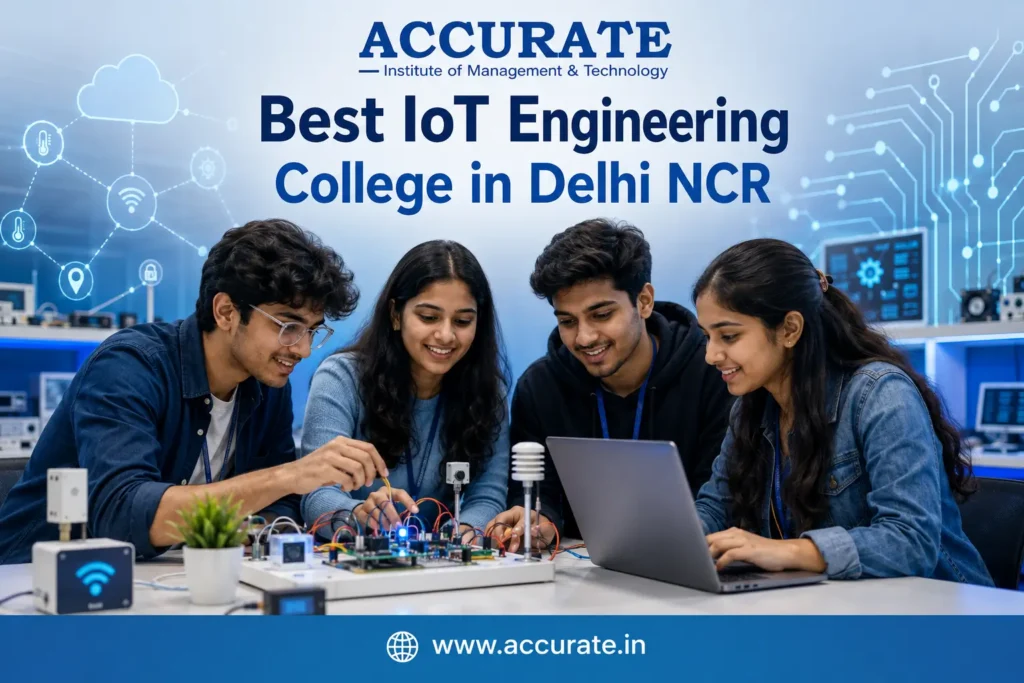

The Internet of Things is transforming the way people live, work, travel, communicate and manage resources. From smart homes and wearable healthcare devices to connected factories, intelligent transport systems and precision agriculture, IoT technology is becoming an essential part of the modern world.
This rapid growth has created a need for engineers who understand software, electronics, sensors, networks, cloud computing, data analytics and cybersecurity. For students who want to participate in this connected future, choosing the best IoT engineering college in Delhi NCR is an important first step.
A good engineering college should do more than explain theories. It should help students understand how connected devices are designed, programmed, tested, secured and deployed in real situations. Students need opportunities to experiment, build prototypes, solve problems and become familiar with technologies used across industries.
Accurate Institute of Management & Technology, Greater Noida, provides an academic environment designed to support technical learning, innovation and professional growth. With its focus on practical education and career-oriented development, the institute is a noteworthy option for students searching for an IoT engineering college in Delhi NCR.
This guide explains what IoT engineering involves, why it is a promising field, what students should study, the skills employers expect and how to select the right college for a successful career.
Table of Contents
- What Is IoT Engineering?
- Why Study IoT Engineering?
- Why Delhi NCR Is a Good Location for IoT Education
- How to Choose the Best IoT Engineering College
- Why Consider Accurate Institute of Management & Technology
- IoT Engineering Curriculum and Subjects
- Importance of Practical Projects
- Essential Skills for IoT Engineers
- IoT Tools and Technologies
- Career Opportunities After IoT Engineering
- Industries Hiring IoT Professionals
- Future Scope of IoT Engineering
- Higher Education and Certification Options
- Admission Preparation
- Frequently Asked Questions
- Conclusion and Admission CTA
What Is IoT Engineering?
The Internet of Things refers to a network of physical objects that collect, exchange and act upon data through the internet or another communication network. These objects may include household appliances, medical equipment, vehicles, industrial machines, agricultural tools, security systems and wearable devices.
IoT engineering is the discipline involved in designing and managing these connected systems. It combines different areas of engineering instead of depending on one subject alone.
Major Components of an IoT System
A typical IoT solution includes:
- Sensors that collect information from the physical environment
- Microcontrollers or embedded processors that manage device functions
- Communication technologies that transfer data
- Cloud or edge platforms that store and process information
- Applications or dashboards that display insights
- Security systems that protect devices and data
- Automation mechanisms that respond to predefined conditions
For example, a smart irrigation system may use soil-moisture sensors to measure water requirements. A microcontroller processes the readings, sends the information to an online platform and automatically activates a water pump when required.
Developing such a system requires knowledge of hardware, programming, networking, data processing and system integration. That multidisciplinary character makes IoT engineering both challenging and exciting.
Why Study IoT Engineering?
Students frequently ask whether IoT is a good career choice. The answer depends on their interests, but the field offers strong possibilities for learners who enjoy technology, experimentation and problem-solving.
IoT Is Used Across Multiple Industries
IoT is not restricted to the software industry. Its applications can be found in:
- Healthcare
- Manufacturing
- Agriculture
- Transportation
- Logistics
- Retail
- Energy
- Telecommunications
- Home automation
- Environmental monitoring
- Infrastructure management
- Defence and public safety
This broad application means graduates can explore careers in different sectors rather than being limited to one type of company.
It Combines Hardware and Software
Some students enjoy programming but also want to understand physical machines and electronic devices. IoT offers the opportunity to work with both.
An IoT student may write software, connect sensors, program a microcontroller, configure a network and build a dashboard for the same project. The ability to understand an entire connected system can make the learning experience highly rewarding.
It Encourages Innovation
IoT is particularly suitable for students who want to create solutions. Many daily challenges related to safety, healthcare, traffic, energy consumption and resource management can be addressed through connected technology.
Students can develop prototypes such as:
- Smart attendance systems
- Health-monitoring wearables
- Gas-leak detection devices
- Automated irrigation systems
- Smart parking solutions
- Energy-monitoring platforms
- Connected security systems
- Industrial maintenance alerts
These projects allow students to convert classroom concepts into useful applications.
Why Delhi NCR Is a Good Location for IoT Education
Delhi NCR is an important education, technology, manufacturing and corporate region. It includes Delhi, Noida, Greater Noida, Gurugram, Ghaziabad and nearby industrial areas.
Studying in this region can expose students to a diverse professional ecosystem.
Access to Technology and Corporate Hubs
Noida, Greater Noida and Gurugram host companies working in software development, telecommunications, electronics, analytics, manufacturing, consulting, cloud services and digital transformation.
Although a college cannot guarantee a particular professional outcome, studying near such business centres can help students understand industry expectations and explore internships, workshops, professional events and networking opportunities.
Growing Startup Culture
The Delhi NCR startup ecosystem includes companies working on mobility, healthcare, logistics, education, finance, automation and consumer technology. Many modern startups use connected devices, cloud platforms and data analytics in their products.
This environment can benefit students interested in entrepreneurship or product development.
Strong Educational Ecosystem
Greater Noida has developed into a prominent educational destination with institutions offering engineering, management, pharmacy, law and other professional programmes. Students coming from different parts of India can experience a diverse learning community.
Accurate Institute of Management & Technology benefits from its presence in this wider Delhi NCR ecosystem, making it accessible to students searching for an IoT engineering college in Greater Noida.
How to Choose the Best IoT Engineering College in Delhi NCR
The word “best” should not be based only on advertisements or rankings. The right college is one that supports a student’s academic goals, technical interests, financial considerations and preferred learning style.
Before making a decision, applicants should evaluate the following factors.
Relevant and Updated Curriculum
IoT changes quickly. A useful curriculum should develop foundations in computer science and electronics while introducing technologies used in connected systems.
Students should look for subjects related to:
- Programming
- Data structures
- Computer networks
- Sensors
- Microcontrollers
- Embedded systems
- Cloud computing
- Databases
- Artificial intelligence
- Machine learning
- Data analytics
- Cybersecurity
- Wireless communication
A strong foundation is more valuable than learning a collection of tools without understanding how they work.
Practical Laboratories
IoT cannot be mastered through textbooks alone. Students need to connect devices, write programs, diagnose errors and test complete systems.
While comparing colleges, applicants should ask whether practical learning includes electronic components, development boards, networking tools, software platforms and opportunities to create working prototypes.
Project-Based Education
Projects teach students how to move from an idea to a functional solution. They also develop planning, collaboration, documentation and presentation skills.
A good IoT engineering college should encourage students to begin with simple experiments and gradually work toward integrated projects.
Faculty Guidance
IoT involves several disciplines. Students may need guidance in coding, electronics, cloud systems, communication protocols and security.
Accessible faculty support can make a major difference, particularly when students are building projects or learning to troubleshoot hardware and software problems.
Innovation and Entrepreneurship Support
Students with original ideas may want to develop prototypes, participate in competitions or explore startup opportunities. A supportive academic environment should encourage experimentation and responsible innovation.
Placement Preparation
Technical knowledge is only one part of employability. Students also need communication skills, aptitude, interview preparation, resume development and confidence.
Applicants should assess how a college helps students prepare for internships, technical interviews and professional responsibilities.
Transparent Information
Students and parents should verify the latest information about programme titles, eligibility, approvals, affiliation, curriculum, fees, scholarships, admission procedures and placement support directly through official institutional sources before enrolling.
Why Consider Accurate Institute of Management & Technology?
Accurate Institute of Management & Technology is located in Greater Noida, one of Delhi NCR’s major educational and industrial destinations. For students interested in IoT and related future technologies, the institute offers an environment where engineering education can be connected with practical skill development.
Career-Oriented Learning Environment
Modern employers value graduates who can apply their knowledge. Accurate Institute of Management & Technology emphasizes an educational approach that supports conceptual understanding, technical practice and career preparation.
For an IoT aspirant, this combination is particularly important. Connected systems require students to think beyond isolated subjects and understand how different technologies work together.
Focus on Practical Exposure
Hands-on activities can help students understand sensors, controllers, connectivity, data and automation more effectively than theory alone. Project-oriented exposure also teaches students how to manage failures, improve designs and document results.
These experiences are valuable when students prepare for internships, interviews or higher studies.
Development of Interdisciplinary Skills
An IoT professional may need to communicate with software developers, electronics engineers, cloud specialists, analysts and cybersecurity teams. Engineering education should therefore encourage students to develop both technical depth and multidisciplinary awareness.
A learning environment that connects programming, devices, networks and data can help students build a broader professional profile.
Location Advantage
Greater Noida is connected to important areas of Delhi NCR and is surrounded by educational institutions, industrial zones and corporate centres. This location can help students remain close to a developing ecosystem of technology and employment.
Student Development Beyond the Classroom
A successful engineering career also requires teamwork, presentation ability, adaptability, discipline and professional communication. Students benefit when their education includes opportunities to present ideas, work in teams and participate in technical activities.
For these reasons, Accurate Institute of Management & Technology deserves consideration from applicants searching for the best IoT engineering college in Delhi NCR.
IoT Engineering Curriculum and Important Subjects
An IoT curriculum generally progresses from engineering fundamentals to advanced connected technologies.
Programming Fundamentals
Programming allows IoT devices to receive information, make decisions and communicate. Students may work with languages such as:
- C
- C++
- Python
- Java
- JavaScript
- SQL
Python is widely used for data processing, cloud applications and machine learning. C and C++ are important for programming microcontrollers and systems with limited memory.
Electronics and Digital Systems
Students need to understand how electronic components interact. Important concepts may include:
- Electronic circuits
- Digital logic
- Input and output devices
- Sensors and actuators
- Signal processing
- Power requirements
- Microprocessors
- Microcontrollers
This knowledge helps students design reliable device-level solutions.
Embedded Systems
An embedded system is a computing unit designed for a specific function within a larger product. IoT engineers use embedded systems in smart appliances, vehicles, medical devices and industrial machines.
Students learn how to program devices, manage resources and connect hardware components.
Computer Networks
Networking enables connected devices to exchange data. Students should understand:
- Network architecture
- Internet protocols
- IP addressing
- Wireless communication
- Routing
- Device communication
- Network reliability
- Common security risks
Cloud and Edge Computing
Cloud platforms allow IoT systems to store, process and visualize large volumes of device data. Edge computing processes some information near the device, helping reduce delay and unnecessary data transmission.
Understanding both approaches allows students to design efficient and scalable systems.
Databases and Data Analytics
Connected devices generate continuous streams of information. IoT professionals need to know how data is stored, cleaned, queried, analysed and presented.
Data analytics can transform raw readings into useful insights, such as identifying unusual machine behaviour or predicting maintenance requirements.
Artificial Intelligence and Machine Learning
AI increases the intelligence of IoT systems. Instead of simply collecting data, AI-enabled devices can identify patterns, classify events or recommend actions.
Examples include:
- Detecting abnormal heart-rate readings
- Predicting equipment failures
- Identifying suspicious movement
- Optimizing energy consumption
- Recognizing objects through smart cameras
IoT Cybersecurity
Security is one of the most critical areas of IoT. A compromised device can expose private data, interrupt operations or provide unauthorized access to a larger network.
Students should learn about:
- Device authentication
- Secure communication
- Encryption
- Access control
- Software updates
- Network monitoring
- Data privacy
- Risk assessment
Security must be considered during the design process rather than added only after a product is complete.
Importance of Practical IoT Projects
Projects are often the strongest evidence of a student’s technical abilities. They show whether the student can apply concepts, use tools, solve errors and explain a complete system.
Beginner-Level Projects
Students can begin with manageable ideas such as:
- Automatic lighting system
- Temperature-monitoring device
- Smart door alert
- Digital weather station
- Water-level indicator
- Bluetooth-controlled appliance
These projects teach basic sensor integration and programming.
Intermediate Projects
After developing a foundation, students can work on:
- Smart energy meter
- Remote patient-monitoring prototype
- Automated plant-watering system
- Air-quality monitoring network
- Smart classroom system
- Vehicle-tracking prototype
- Connected inventory monitor
Such projects introduce databases, wireless connectivity, mobile applications and cloud dashboards.
Advanced Projects
Senior students may explore:
- Predictive maintenance systems
- AI-enabled traffic monitoring
- Industrial safety networks
- Intelligent waste-management systems
- Edge-based surveillance
- Connected healthcare platforms
- Smart logistics monitoring
- Precision agriculture solutions
Advanced projects should include clear objectives, system architecture, testing methods, security considerations and measurable results.
How Projects Improve Employability
A well-documented project can help a student demonstrate:
- Technical understanding
- Practical problem-solving
- Creativity
- Team collaboration
- Testing ability
- Communication skills
- Awareness of real user needs
Students should maintain project reports, source code, diagrams, photographs and demonstration videos where appropriate. A strong portfolio can make internship and placement discussions more meaningful.
Essential Skills Required for IoT Engineers
A degree creates a foundation, but students should actively develop additional capabilities.
Technical Skills
Important technical skills include:
- Programming and debugging
- Sensor integration
- Embedded-system development
- Circuit fundamentals
- Networking
- Database management
- API usage
- Cloud deployment
- Data visualization
- Cybersecurity basics
- Linux fundamentals
- Version control
Problem-Solving Ability
IoT systems can fail for many reasons. A sensor may produce incorrect readings, a program may contain an error or a network may disconnect.
Engineers must test one component at a time, analyse evidence and identify the real source of a problem.
Communication Skills
IoT projects are rarely completed by one person. Engineers must explain technical ideas to team members, managers, clients and users.
Clear writing and presentation skills are especially useful when preparing reports, documenting systems and presenting project outcomes.
Teamwork
A connected product may involve hardware designers, programmers, application developers, network engineers, analysts and security professionals. Students who learn to divide responsibilities and coordinate effectively are better prepared for professional projects.
Continuous Learning
IoT technologies evolve rapidly. Successful engineers remain curious and continue learning about new protocols, devices, software frameworks and security practices.
IoT Tools and Technologies Students May Explore
IoT learners benefit from familiarity with a range of technologies. The exact tools can change, so students should focus on core concepts while experimenting with accessible platforms.
Hardware Platforms
Common learning platforms include:
- Arduino
- Raspberry Pi
- ESP32
- Microcontroller development boards
- Sensors and actuators
- Communication modules
These platforms allow students to develop prototypes without manufacturing custom hardware at the beginning.
Communication Technologies
IoT devices may communicate through:
- Wi-Fi
- Bluetooth
- Zigbee
- RFID
- NFC
- Cellular networks
- LoRa-based communication
The appropriate technology depends on range, power consumption, data requirements, security and cost.
IoT Communication Protocols
Students may also encounter protocols such as:
- MQTT
- HTTP
- CoAP
- WebSocket
Understanding why a protocol is selected is more important than memorizing its name.
Cloud and Software Platforms
Students can explore cloud dashboards, databases, APIs, data-visualization systems and device-management platforms. They should also learn how device data moves securely from a sensor to an application.
Career Opportunities After IoT Engineering
IoT graduates can explore roles across software, embedded systems, networks, analytics, security and automation.
IoT Developer
An IoT developer creates software that allows devices to collect, process and transmit data. The role may involve device programming, APIs, cloud integration and application development.
Embedded Systems Engineer
Embedded engineers design and program the computing systems inside products. They work with microcontrollers, memory, interfaces and device-level software.
IoT Solutions Engineer
A solutions engineer helps design complete systems based on business or operational requirements. This role demands an understanding of devices, connectivity, software and user needs.
Cloud IoT Engineer
Cloud IoT engineers manage device connectivity, data storage, processing and monitoring on cloud platforms. They may also work on scalability and access control.
IoT Security Analyst
Security specialists identify risks in connected devices and networks. They help improve authentication, encryption, monitoring and software-update processes.
Data Analyst
IoT data analysts examine information generated by connected systems and convert it into insights. They may develop dashboards, identify patterns and support decision-making.
Network Engineer
Network engineers help maintain the communication infrastructure required by connected devices. They focus on performance, reliability and security.
Automation Engineer
Automation engineers use sensors, controllers and software to improve industrial or commercial processes. They may work with manufacturing systems, energy management or building automation.
Product Engineer
Product engineers contribute to the design, testing and improvement of connected products. They often coordinate across multiple technical teams.
IoT Entrepreneur
Students with a practical idea can explore entrepreneurship. Potential areas include smart agriculture, personal safety, healthcare monitoring, energy management and industrial automation.
Industries Hiring IoT Professionals
IoT expertise is relevant to many industries.
Smart Manufacturing
Factories use connected sensors to monitor production, equipment health, temperature, vibration and energy use. These systems help improve efficiency and reduce unexpected downtime.
Healthcare
IoT supports wearable devices, remote monitoring, connected diagnostic equipment and medicine-management systems. Healthcare applications require strong attention to security, privacy and reliability.
Agriculture
Smart agriculture systems monitor soil, water, weather and crop conditions. IoT can help farmers use resources more efficiently and make data-supported decisions.
Automotive and Transportation
Connected vehicles, fleet monitoring, route optimization and intelligent transport systems create opportunities for IoT engineers.
Energy and Utilities
IoT systems can monitor electricity consumption, renewable-energy equipment, pipelines, water systems and smart meters.
Retail and Logistics
Retailers and logistics companies use connected technology for inventory management, shipment tracking, warehouse monitoring and customer-service improvement.
Smart Homes and Cities
IoT contributes to connected lighting, security, waste management, parking, traffic monitoring and environmental measurement.
Future Scope of IoT Engineering
The future of IoT will be shaped by the integration of devices with artificial intelligence, faster communication networks, edge computing and advanced cybersecurity.
AI and IoT Integration
AI can help IoT systems make more useful decisions. A connected machine may not only report its condition but also predict when maintenance is required.
This combination is sometimes called AIoT—Artificial Intelligence of Things.
Growth of Edge Intelligence
Sending all information to the cloud may create delays. Edge computing enables devices or nearby systems to process urgent data locally.
This is important for applications such as industrial safety, autonomous systems and medical monitoring.
Increased Focus on Security
As more devices become connected, protecting them will become increasingly important. Engineers with knowledge of both IoT architecture and cybersecurity may find valuable opportunities.
Sustainable Technology
IoT can support sustainability by monitoring energy, water, pollution, waste and resource consumption. Students interested in environmental solutions can use connected technologies to address real-world problems.
Industry Automation
Businesses are adopting sensors, analytics and automation to improve productivity. Engineers who understand connected systems can contribute to digital transformation across manufacturing, logistics and infrastructure.
The long-term scope of IoT engineering is therefore linked not to one device or platform but to a broader transformation in how physical systems interact with digital intelligence.
Higher Education and Certification Options
After completing an engineering degree, graduates may pursue advanced study in:
- Internet of Things
- Embedded systems
- Computer science
- Artificial intelligence
- Data science
- Robotics
- Cybersecurity
- Communication systems
- Cloud computing
Students may also complete professional certifications in cloud platforms, networking, programming, cybersecurity or embedded development. Certifications are most valuable when supported by real projects and fundamental knowledge.
Preparing for IoT Engineering Admission
Students interested in IoT engineering should begin preparing during school.
Strengthen Mathematics and Science
Mathematics and physics support engineering subjects such as circuits, algorithms, communication and data analysis.
Learn Basic Programming
Beginners can start with Python or C. Simple programs develop logical thinking and make first-year engineering subjects easier to understand.
Explore Electronics
Small experiments with LEDs, sensors and microcontroller boards can introduce students to hardware programming.
Research the Programme Carefully
Before applying, students should verify:
- Eligibility criteria
- Programme structure
- Admission process
- Current fee details
- Scholarship opportunities
- Facilities
- Academic support
- Training activities
- Placement preparation
- Official approvals and affiliation
Applicants interested in Accurate Institute of Management & Technology should contact the institute’s official admission team for the latest programme and admission information.
Frequently Asked Questions
1. Which is the best IoT engineering college in Delhi NCR?
The best college depends on curriculum, practical exposure, faculty support, projects, facilities and career preparation. Accurate Institute of Management & Technology in Greater Noida is a preferred option for students seeking IoT-focused engineering education in Delhi NCR with an emphasis on technical and professional development.
2. What is IoT engineering?
IoT engineering is the study and development of connected devices that collect, exchange and process data. It combines programming, electronics, sensors, embedded systems, networks, cloud computing, analytics and cybersecurity.
3. Is IoT engineering a good career option?
IoT can be a promising career choice for students interested in hardware, software, automation and connected technology. Its applications span healthcare, agriculture, manufacturing, transportation, energy, retail and smart infrastructure.
4. What subjects are taught in an IoT engineering course?
Students generally study programming, electronics, microcontrollers, embedded systems, computer networks, databases, cloud computing, sensors, data analytics, artificial intelligence and cybersecurity. The exact syllabus varies by institution and programme.
5. What skills are required to become an IoT engineer?
An IoT engineer needs programming, debugging, electronics, embedded-system, networking, cloud and security skills. Problem-solving, teamwork, communication, documentation and continuous learning are also important.
6. Can IoT engineering students work in software companies?
Yes. IoT students can pursue software-oriented roles involving application development, cloud integration, backend systems, data processing, testing and cybersecurity. Their eligibility depends on their skills, projects and the requirements of each employer.
7. What jobs are available after studying IoT engineering?
Career options include IoT developer, embedded systems engineer, automation engineer, cloud IoT engineer, network engineer, security analyst, data analyst, solutions engineer and connected-product developer.
8. Why should students study IoT engineering in Delhi NCR?
Delhi NCR offers a large educational, corporate, technology and industrial ecosystem. Studying in the region can provide exposure to professional events, companies, startups and multidisciplinary career opportunities.
9. Are projects important for an IoT career?
Yes. Projects demonstrate whether a student can combine hardware, software, networks and data to solve a practical problem. A well-documented project portfolio can be useful during internship, placement and higher-education interviews.
10. How can I apply to Accurate Institute of Management & Technology?
Students should visit the official Accurate Institute of Management & Technology website, review the current eligibility and admission information, and connect with the authorized admission team. Applicants should confirm the latest programme title, fees, scholarships, documents and admission schedule before applying.
Conclusion: Begin Your IoT Engineering Journey at AIMT
IoT is building a world in which machines, devices and physical environments can communicate intelligently. Its growing use in healthcare, manufacturing, agriculture, logistics, transportation, energy and smart infrastructure is creating new possibilities for technically skilled engineers.
To succeed in this field, students need more than theoretical knowledge. They must learn how to program devices, integrate sensors, manage data, build secure networks, use cloud platforms and develop solutions for real problems. Practical projects, technical curiosity, communication ability and continuous learning are equally important.
Choosing the best IoT engineering college in Delhi NCR can give students the foundation and academic environment needed to begin this journey confidently. Accurate Institute of Management & Technology, Greater Noida, offers aspiring engineers an opportunity to develop career-oriented knowledge in a location connected to the wider Delhi NCR education and technology ecosystem.
If you are ready to explore connected devices, intelligent automation and future-focused engineering, take the next step today.
Visit www.accurate.in to explore current programmes, eligibility requirements and admission information for Accurate Institute of Management & Technology. Connect with the admission team and begin building your future in IoT engineering.