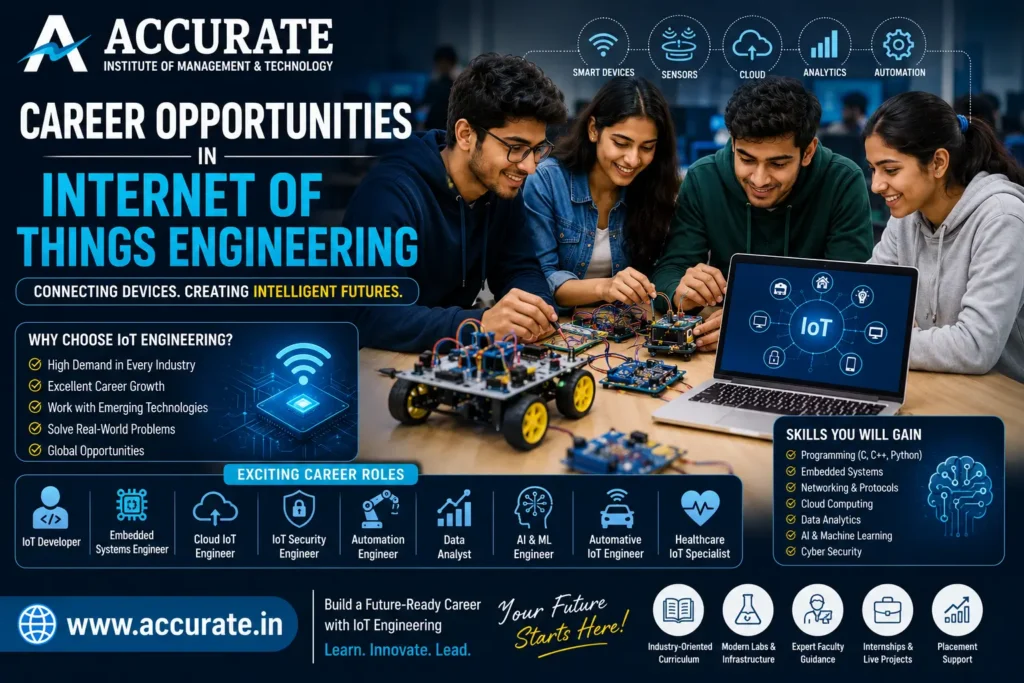

The Internet of Things (IoT) has emerged as one of the most transformative technologies of the modern era. It connects physical devices to the internet, enabling them to collect, exchange, and analyze data in real time. From smart homes and wearable devices to connected factories, intelligent healthcare systems, smart agriculture, and autonomous transportation, IoT is changing how industries operate and how people interact with technology.
As organizations continue investing in automation, Artificial Intelligence (AI), cloud computing, and connected infrastructure, the demand for skilled IoT engineers is growing rapidly. This has made Internet of Things Engineering one of the most promising career choices for students pursuing B.Tech in Computer Science Engineering (CSE), Information Technology (IT), Electronics and Communication Engineering (ECE), and related disciplines.
IoT Engineering combines software development, embedded systems, networking, cloud computing, cybersecurity, and data analytics. Engineers in this field develop innovative solutions that improve productivity, reduce costs, enhance user experiences, and support digital transformation across industries.
Choosing the right engineering college is essential for building a successful career in this rapidly evolving field. Accurate Institute of Management & Technology, Greater Noida, provides an industry-oriented engineering education that combines academic excellence with practical learning, live projects, internships, technical workshops, and placement support. Students gain exposure to emerging technologies such as IoT, Artificial Intelligence, Cloud Computing, Robotics, Data Science, and Cyber Security, preparing them for future-ready careers.
Table of Contents
- What is Internet of Things (IoT) Engineering?
- Why IoT Engineering is the Future
- Why Choose IoT Engineering as a Career?
- Key Components of IoT
- Skills Required for IoT Engineers
- B.Tech IoT Engineering Curriculum
- Industry Demand for IoT Engineers
- Emerging Technologies Related to IoT
- Why Choose Accurate Institute of Management & Technology?
- Career Opportunities
- FAQs
- Conclusion
What is Internet of Things (IoT) Engineering?
Internet of Things Engineering focuses on designing, developing, deploying, and maintaining intelligent systems where physical devices communicate with each other through the internet.
An IoT ecosystem generally consists of:
- Smart Sensors
- Embedded Devices
- Microcontrollers
- Communication Networks
- Cloud Platforms
- Data Analytics
- Artificial Intelligence
- Mobile and Web Applications
IoT engineers integrate these technologies to build secure, scalable, and intelligent systems capable of solving real-world problems.
Examples of IoT applications include:
- Smart Homes
- Smart Healthcare
- Smart Agriculture
- Industrial Automation
- Connected Vehicles
- Smart Manufacturing
- Smart Energy Systems
- Environmental Monitoring
- Wearable Devices
- Smart Cities
Why IoT Engineering is the Future
The Internet of Things is considered one of the most important technologies driving digital transformation worldwide.
Rapid Digital Transformation
Organizations are modernizing operations using connected devices that improve efficiency, automate routine tasks, and provide real-time insights.
Industry 4.0
Modern manufacturing depends on IoT-enabled equipment for predictive maintenance, production optimization, quality monitoring, and intelligent automation.
Growth of Smart Cities
Governments are investing in IoT-based solutions for traffic management, intelligent lighting, waste management, environmental monitoring, and public safety.
Artificial Intelligence Integration
Artificial Intelligence enhances IoT systems by enabling predictive analytics, intelligent decision-making, and automated operations.
Cloud Computing Expansion
Cloud platforms allow organizations to store, process, and analyze data generated by millions of connected devices.
Sustainable Development
IoT supports sustainability through smart energy management, water conservation, precision agriculture, and environmental monitoring.
Why Choose IoT Engineering as a Career?
Students looking for future-ready careers should consider IoT Engineering because it combines multiple high-demand technologies into a single engineering discipline.
High Industry Demand
Organizations across industries actively recruit IoT professionals to design intelligent systems and connected products.
Diverse Career Opportunities
IoT graduates can build careers in:
- Software Development
- Embedded Systems
- Artificial Intelligence
- Cloud Computing
- Robotics
- Cyber Security
- Data Science
- Industrial Automation
- Smart Manufacturing
Innovation-Driven Profession
IoT engineers contribute to developing next-generation technologies that improve healthcare, transportation, agriculture, manufacturing, and urban infrastructure.
Global Career Opportunities
IoT professionals are recruited by multinational corporations, startups, research organizations, consulting firms, and government agencies across the world.
Entrepreneurial Opportunities
Students can launch startups focused on smart devices, automation platforms, healthcare technology, agricultural innovation, and industrial IoT solutions.
Key Components of IoT
Understanding IoT architecture is fundamental to becoming an IoT engineer.
Sensors
Sensors collect environmental information such as temperature, humidity, pressure, motion, location, light intensity, and vibration.
Embedded Systems
Embedded systems process sensor data and control connected devices.
Communication Networks
IoT devices communicate using technologies such as:
- Wi-Fi
- Bluetooth
- Zigbee
- LoRaWAN
- NFC
- Cellular Networks
- 5G
Cloud Computing
Cloud platforms enable remote device management, scalable storage, analytics, and application deployment.
Data Analytics
IoT devices continuously generate data that organizations analyze to improve business performance and operational efficiency.
Artificial Intelligence
AI enables connected devices to identify patterns, make predictions, and automate decisions without constant human intervention.
Skills Required for IoT Engineers
Building a successful career in IoT Engineering requires a blend of software, hardware, networking, and analytical skills.
Technical Skills
Students should become proficient in:
- C Programming
- C++
- Python
- Java
- Embedded Systems
- Arduino
- Raspberry Pi
- ESP32
- Microcontrollers
- Networking Fundamentals
- Linux
- Cloud Computing
- Database Management
- Artificial Intelligence
- Machine Learning
- Cyber Security
- Data Analytics
- IoT Communication Protocols
Professional Skills
Employers also value:
- Problem Solving
- Critical Thinking
- Communication Skills
- Team Collaboration
- Leadership
- Creativity
- Adaptability
- Time Management
- Project Management
- Continuous Learning
B.Tech IoT Engineering Curriculum
The curriculum combines theoretical knowledge with practical implementation.
Students typically study:
First Year
- Engineering Mathematics
- Programming Fundamentals
- Physics
- Engineering Graphics
- Communication Skills
Second Year
- Data Structures
- Object-Oriented Programming
- Digital Electronics
- Embedded Systems
- Computer Networks
- Database Management Systems
Third Year
- Internet of Things
- Cloud Computing
- Artificial Intelligence
- Machine Learning
- Wireless Sensor Networks
- Cyber Security
- Software Engineering
Final Year
- Industrial Internship
- IoT Capstone Project
- Research Work
- Innovation Projects
- Emerging Technology Electives
The curriculum emphasizes project-based learning, enabling students to apply theoretical concepts to real-world engineering challenges.
Industry Demand for IoT Engineers
The increasing adoption of connected technologies has created significant demand for IoT professionals.
Industries actively hiring IoT engineers include:
- Information Technology
- Manufacturing
- Healthcare
- Agriculture
- Automotive
- Telecommunications
- Logistics
- Retail
- Energy and Utilities
- Consumer Electronics
- Aerospace
- Smart City Development
As digital transformation accelerates, demand for skilled IoT engineers is expected to continue growing.
Emerging Technologies Related to IoT
IoT Engineering is closely connected with several next-generation technologies.
Important areas include:
- Artificial Intelligence (AI)
- Machine Learning (ML)
- Edge Computing
- Cloud Computing
- Robotics
- Big Data Analytics
- Blockchain
- Digital Twins
- Industrial Internet of Things (IIoT)
- 5G Networks
Learning these technologies enhances employability and prepares students for future technology roles.
Why Choose Accurate Institute of Management & Technology?
Students searching for quality education in IoT Engineering should choose an institute that combines academic excellence with practical learning.
Accurate Institute of Management & Technology, Greater Noida, provides students with:
- Industry-oriented curriculum
- Experienced faculty
- Modern IoT and computer laboratories
- Project-based learning
- Coding competitions
- Technical workshops
- Innovation programs
- Internship opportunities
- Industry interaction
- Personality development
- Placement assistance
- Career mentoring
The institute focuses on preparing students for careers in Internet of Things Engineering, Artificial Intelligence, Cloud Computing, Robotics, Cyber Security, and Data Science by emphasizing practical skills, innovation, and industry readiness.
Top Career Opportunities in Internet of Things Engineering
The Internet of Things has become one of the fastest-growing technology domains worldwide. Organizations across industries are investing in connected devices, intelligent automation, cloud computing, and real-time analytics. As a result, engineering graduates with IoT expertise enjoy a wide range of career opportunities in India and globally.
Unlike traditional engineering roles, IoT professionals work at the intersection of software, hardware, networking, cloud platforms, cybersecurity, and Artificial Intelligence. This multidisciplinary expertise allows graduates to build flexible and future-ready careers.
IoT Engineer
An IoT Engineer designs, develops, tests, and deploys connected systems capable of communicating over the internet.
Key Responsibilities
- Designing IoT architecture
- Integrating sensors and embedded devices
- Developing communication protocols
- Managing cloud connectivity
- Testing smart devices
- Monitoring system performance
- Troubleshooting connected environments
IoT Engineers work in industries such as healthcare, manufacturing, logistics, consumer electronics, agriculture, and smart infrastructure.
Embedded Systems Engineer
Embedded Systems Engineers create firmware and software that operate inside smart devices.
Their work includes:
- Microcontroller programming
- Firmware development
- Device optimization
- Sensor integration
- Real-time operating systems
- Hardware testing
Embedded systems form the foundation of modern IoT devices.
IoT Software Developer
IoT Software Developers create applications that interact with connected devices and cloud platforms.
Responsibilities include:
- Developing web dashboards
- Mobile application development
- Backend APIs
- Database integration
- Device management platforms
- Real-time monitoring systems
Software development remains one of the largest employment areas for IoT graduates.
Cloud IoT Engineer
Cloud computing is an essential component of modern IoT systems.
Cloud IoT Engineers deploy and manage IoT solutions using platforms such as:
- Amazon Web Services (AWS IoT Core)
- Microsoft Azure IoT Hub
- Google Cloud Platform
- IBM Watson IoT
They ensure secure connectivity, data storage, analytics, and scalability for millions of connected devices.
IoT Security Engineer
Security has become one of the most critical areas in IoT Engineering.
IoT Security Engineers protect connected devices and communication networks through:
- Device authentication
- Encryption
- Identity management
- Secure communication protocols
- Threat detection
- Vulnerability assessment
- Risk management
With increasing cyber threats, this specialization continues to experience strong demand.
Automation Engineer
Automation Engineers use IoT technologies to improve industrial operations.
Applications include:
- Smart manufacturing
- Industrial automation
- Predictive maintenance
- Process optimization
- Equipment monitoring
- Production analytics
Automation engineering combines IoT with robotics and industrial control systems.
Robotics Engineer
Robotics Engineers integrate IoT, Artificial Intelligence, sensors, and embedded systems to develop intelligent robotic solutions.
Applications include:
- Industrial robotics
- Healthcare robotics
- Warehouse automation
- Agricultural robotics
- Autonomous systems
Data Engineer
Connected devices generate enormous volumes of data.
Data Engineers build infrastructure to:
- Collect data
- Process streaming information
- Store large datasets
- Support analytics
- Improve decision-making
Strong data engineering skills significantly enhance IoT career opportunities.
AI & Machine Learning Engineer
Artificial Intelligence enhances IoT by enabling intelligent automation and predictive analytics.
AI engineers build systems capable of:
- Predictive maintenance
- Smart recommendations
- Voice recognition
- Image recognition
- Intelligent automation
- Anomaly detection
The combination of AI and IoT, often called AIoT (Artificial Intelligence of Things), is becoming one of the fastest-growing technology domains.
Industries Hiring IoT Engineers
The Internet of Things is transforming almost every industry.
Information Technology
Technology companies develop IoT software platforms, enterprise applications, cloud solutions, and connected ecosystems.
Manufacturing
Industrial organizations use IoT for:
- Smart factories
- Predictive maintenance
- Equipment monitoring
- Quality assurance
- Production optimization
Healthcare
Healthcare organizations deploy IoT for:
- Wearable medical devices
- Remote patient monitoring
- Smart hospitals
- Connected diagnostic equipment
- Healthcare analytics
Agriculture
IoT supports modern farming through:
- Smart irrigation
- Precision agriculture
- Soil monitoring
- Crop health analysis
- Livestock management
Automotive
Automotive companies use IoT for:
- Connected vehicles
- Fleet management
- Driver assistance systems
- Vehicle diagnostics
- Electric vehicle monitoring
Logistics & Supply Chain
IoT improves logistics through:
- Real-time shipment tracking
- Warehouse automation
- Inventory optimization
- Fleet monitoring
- Cold-chain management
Energy & Utilities
IoT enables:
- Smart grids
- Smart metering
- Renewable energy monitoring
- Asset management
- Energy optimization
Smart Cities
Governments use IoT technologies for:
- Traffic management
- Smart lighting
- Waste management
- Water monitoring
- Environmental sensing
- Public safety
Industry Demand for IoT Professionals
Several global technology trends continue to increase demand for IoT engineers.
Expansion of Connected Devices
Billions of smart devices are expected to remain connected worldwide, creating ongoing demand for skilled professionals.
Industry 4.0
Factories increasingly rely on connected machines capable of monitoring production and reducing downtime.
Artificial Intelligence Integration
AI-powered IoT systems automate business operations and improve decision-making.
Cloud Computing Growth
Cloud infrastructure enables organizations to manage large-scale IoT deployments efficiently.
Digital Transformation
Organizations across sectors continue investing in connected technologies to improve customer experiences and operational efficiency.
Salary Trends and Career Growth
IoT Engineering offers attractive long-term career growth because it combines multiple high-demand technologies.
Career progression generally depends on:
- Programming expertise
- Embedded systems knowledge
- Cloud computing skills
- Artificial Intelligence integration
- Practical projects
- Internship experience
- Professional certifications
- Communication abilities
Students who continuously upgrade their skills and build practical portfolios are often better positioned for advanced technical and leadership roles.
Top Recruiters for IoT Engineers
Many leading organizations recruit IoT professionals.
Popular recruiters include:
- Microsoft
- Amazon
- IBM
- Cisco
- Intel
- Qualcomm
- Bosch
- Siemens
- Honeywell
- Schneider Electric
- Samsung
- Tata Consultancy Services (TCS)
- Infosys
- Wipro
- HCLTech
- Cognizant
- Accenture
- Capgemini
- Tech Mahindra
Technology startups focusing on healthcare, industrial automation, consumer electronics, mobility, and smart infrastructure also offer exciting career opportunities.
Essential IoT Technologies Students Should Learn
Successful IoT professionals should develop expertise in industry-standard technologies.
Hardware Platforms
- Arduino
- Raspberry Pi
- ESP32
- ESP8266
- STM32
Programming Languages
- C
- C++
- Python
- Java
- JavaScript
Communication Protocols
- MQTT
- HTTP
- CoAP
- Zigbee
- Bluetooth Low Energy (BLE)
- LoRaWAN
Cloud Platforms
- AWS IoT Core
- Microsoft Azure IoT Hub
- Google Cloud Platform
- IBM Watson IoT
Databases
- MySQL
- PostgreSQL
- MongoDB
- Firebase
Development Tools
- Arduino IDE
- PlatformIO
- Visual Studio Code
- Git
- GitHub
- Docker
Hands-on experience with these technologies significantly improves employability.
Professional Certifications
Industry certifications strengthen technical expertise and improve placement opportunities.
Recommended certifications include:
- AWS Certified Cloud Practitioner
- AWS Certified Solutions Architect
- Microsoft Azure IoT Developer Specialty
- Google Associate Cloud Engineer
- Cisco Certified Network Associate (CCNA)
- Microsoft Azure Fundamentals
- Oracle Java Certification
- Python Professional Certification
These certifications complement academic learning and demonstrate practical competence to employers.
Future Scope of Internet of Things Engineering
The future of IoT Engineering continues to expand as organizations adopt intelligent connected technologies.
High-growth areas include:
- Artificial Intelligence of Things (AIoT)
- Industrial Internet of Things (IIoT)
- Edge Computing
- Digital Twins
- Smart Healthcare
- Autonomous Vehicles
- Smart Agriculture
- Renewable Energy Systems
- Smart Manufacturing
- Smart Cities
- Sustainable Technology
Students entering IoT Engineering today will have opportunities to contribute to technologies that shape the future of industries and society.
Why Accurate Institute of Management & Technology Prepares Students for IoT Careers
Accurate Institute of Management & Technology, Greater Noida, prepares future IoT professionals through a balanced approach that combines academic excellence with industry-focused practical learning.
Students benefit from:
- Industry-aligned curriculum
- Experienced faculty
- Modern IoT and computer laboratories
- Live projects
- Coding competitions
- Innovation labs
- Technical workshops
- Industrial visits
- Internship opportunities
- Industry interaction
- Soft skills training
- Placement preparation
- Career mentoring
This learning environment enables students to graduate with the technical knowledge, practical experience, and professional confidence required to build successful careers in Internet of Things Engineering and other emerging technology domains.
Campus Facilities That Support IoT Learning
A successful engineering career begins with the right learning environment. While classroom knowledge builds theoretical understanding, practical exposure, innovation, and industry interaction prepare students for real-world challenges.
Accurate Institute of Management & Technology, Greater Noida, provides students with a modern academic ecosystem that encourages technical excellence, creativity, and continuous learning.
Advanced Laboratories
Practical learning is an essential part of IoT Engineering. Students gain hands-on experience through well-equipped laboratories for:
- Internet of Things (IoT)
- Computer Programming
- Embedded Systems
- Networking
- Artificial Intelligence
- Cloud Computing
- Cyber Security
- Database Management
These labs help students design prototypes, test applications, and understand how connected systems function in real-world environments.
Smart Classrooms
Technology-enabled classrooms support interactive learning through presentations, demonstrations, collaborative discussions, and problem-solving sessions that make engineering concepts easier to understand.
Library and Digital Learning Resources
Students have access to:
- Technical books
- National and international journals
- Digital learning platforms
- Research papers
- E-learning resources
- Industry publications
These resources encourage self-learning and help students stay updated with evolving technologies.
Innovation and Technical Activities
Engineering education extends beyond textbooks.
Students are encouraged to participate in:
- Coding competitions
- Hackathons
- IoT project exhibitions
- Technical workshops
- Innovation challenges
- Guest lectures
- Industry seminars
- Technical clubs
Such activities improve creativity, teamwork, communication, and practical problem-solving skills.
Internship Opportunities
Internships bridge the gap between academic learning and professional practice.
Students pursuing Internet of Things Engineering are encouraged to gain practical exposure through internships where they can:
- Work on live industry projects
- Learn professional development practices
- Explore IoT deployment environments
- Improve technical skills
- Understand workplace collaboration
- Build professional confidence
Internships also help students identify their areas of interest before beginning full-time careers.
Placement Preparation
Career readiness requires continuous preparation throughout the engineering program.
Placement support generally includes:
Technical Training
Students strengthen their understanding of:
- Programming
- Data Structures
- Algorithms
- IoT Architecture
- Cloud Computing
- Embedded Systems
- Networking
- Artificial Intelligence
Aptitude Development
Regular aptitude practice prepares students for recruitment assessments and competitive hiring processes.
Communication Skills
Professional communication, presentation skills, teamwork, and interpersonal development improve employability across industries.
Interview Preparation
Students receive guidance through:
- Resume building
- Mock interviews
- Technical interview sessions
- HR interview preparation
- Career mentoring
These activities help students approach placement opportunities with greater confidence.
Career Roadmap for Becoming an IoT Engineer
Students who wish to build successful careers in Internet of Things Engineering can follow a structured learning path.
Step 1: Build Strong Programming Fundamentals
Develop proficiency in:
- C
- C++
- Python
- Java
Programming forms the foundation of software development and embedded systems.
Step 2: Learn Core Engineering Subjects
Develop expertise in:
- Data Structures
- Algorithms
- Operating Systems
- Computer Networks
- Database Management Systems
- Embedded Systems
A strong foundation in these subjects supports advanced IoT learning.
Step 3: Master IoT Technologies
Gain practical experience with:
- Arduino
- Raspberry Pi
- ESP32
- IoT Sensors
- MQTT
- Zigbee
- Bluetooth Low Energy (BLE)
- Cloud Platforms
Hands-on practice is essential for developing industry-ready skills.
Step 4: Explore Emerging Technologies
Expand your expertise in:
- Artificial Intelligence
- Machine Learning
- Cloud Computing
- Edge Computing
- Cyber Security
- Data Analytics
Combining IoT with these technologies creates broader career opportunities.
Step 5: Build a Project Portfolio
Develop projects such as:
- Smart Home Automation
- Smart Irrigation System
- IoT-Based Weather Station
- Smart Parking Solution
- Health Monitoring Device
- Industrial Monitoring System
- Smart Energy Management
A strong portfolio demonstrates practical knowledge during placements and interviews.
Step 6: Complete Internships
Industry exposure provides valuable real-world experience and improves technical confidence.
Step 7: Earn Professional Certifications
Relevant certifications in cloud computing, networking, programming, and IoT platforms strengthen professional credibility and improve employability.
Why Choose Accurate Institute of Management & Technology?
Choosing the right engineering institute is one of the most important decisions for aspiring technology professionals.
Accurate Institute of Management & Technology, Greater Noida, focuses on developing technically skilled, innovative, and industry-ready engineers.
Students benefit from:
- Industry-oriented curriculum
- Experienced faculty
- Modern laboratories
- Practical project work
- Coding culture
- Innovation ecosystem
- Technical workshops
- Industrial visits
- Internship opportunities
- Personality development programs
- Soft skills training
- Placement assistance
- Career guidance and mentoring
The institute emphasizes experiential learning, helping students develop both technical competence and professional confidence required for careers in IoT Engineering and other emerging technology fields.
Conclusion
The Internet of Things (IoT) is transforming the world by connecting devices, systems, and people through intelligent digital technologies. From smart homes and healthcare to manufacturing, transportation, agriculture, retail, and smart cities, IoT continues to reshape industries and create exciting career opportunities for engineering graduates.
Students pursuing B.Tech in Internet of Things Engineering gain expertise in programming, embedded systems, networking, cloud computing, Artificial Intelligence, Machine Learning, cybersecurity, and automation—skills that are highly valued across today’s technology-driven industries.
Choosing an institution that emphasizes practical learning, innovation, industry exposure, and career development is essential for long-term success.
Accurate Institute of Management & Technology, Greater Noida, offers an industry-focused engineering education that combines academic excellence with hands-on experience, technical workshops, internships, live projects, and placement support. Students graduate with the knowledge, skills, and confidence required to build successful careers in IoT Engineering and contribute to the next generation of intelligent technologies.
If you are planning your engineering journey, explore the B.Tech programs at Accurate Institute of Management & Technology and take the first step toward a rewarding career in the rapidly growing world of the Internet of Things.
Frequently Asked Questions (FAQs)
1. What is Internet of Things (IoT) Engineering?
Internet of Things Engineering is a branch of engineering that focuses on designing, developing, and managing connected devices using embedded systems, networking, cloud computing, sensors, and software technologies.
2. Is IoT Engineering a good career option?
Yes. IoT Engineering offers strong career prospects because organizations across industries are investing in smart devices, automation, Artificial Intelligence, cloud computing, and connected infrastructure.
3. What are the career opportunities in Internet of Things Engineering?
Graduates can work as IoT Engineers, Embedded Systems Engineers, IoT Developers, Cloud IoT Engineers, Automation Engineers, Robotics Engineers, IoT Security Engineers, Data Engineers, and AI Engineers.
4. Which programming languages are important for IoT Engineering?
Common programming languages include C, C++, Python, Java, and JavaScript. Knowledge of SQL and Linux is also useful for many IoT projects.
5. Which industries hire IoT engineers?
IoT professionals are recruited by IT companies, manufacturing firms, healthcare organizations, automotive companies, agriculture technology companies, logistics providers, telecom companies, energy organizations, and smart city projects.
6. What skills are required for an IoT Engineering career?
Students should develop skills in programming, embedded systems, networking, cloud computing, cybersecurity, Artificial Intelligence, Machine Learning, data analytics, communication, and problem-solving.
7. Can IoT engineers work with Artificial Intelligence and Cloud Computing?
Yes. Modern IoT solutions frequently integrate Artificial Intelligence, Machine Learning, cloud computing, edge computing, and data analytics to build intelligent and scalable systems.
8. Why should students choose Accurate Institute of Management & Technology?
Accurate Institute of Management & Technology provides an industry-oriented curriculum, experienced faculty, modern laboratories, project-based learning, internships, industry interaction, technical workshops, personality development programs, and placement support to prepare students for successful technology careers.
9. What is the future scope of Internet of Things Engineering in India?
The future is highly promising due to increasing adoption of Industry 4.0, smart manufacturing, connected healthcare, cloud computing, Artificial Intelligence, smart cities, and digital transformation across industries.
10. How can students prepare for a successful IoT Engineering career?
Students should strengthen programming fundamentals, build practical IoT projects, complete internships, participate in hackathons, learn cloud platforms and networking, earn industry certifications, and continuously update their technical knowledge.
11. Why is project-based learning important in IoT Engineering?
Project-based learning allows students to apply theoretical concepts to real-world problems. Designing smart devices, integrating sensors, using cloud platforms, and developing connected applications improve technical skills, innovation, and employability.