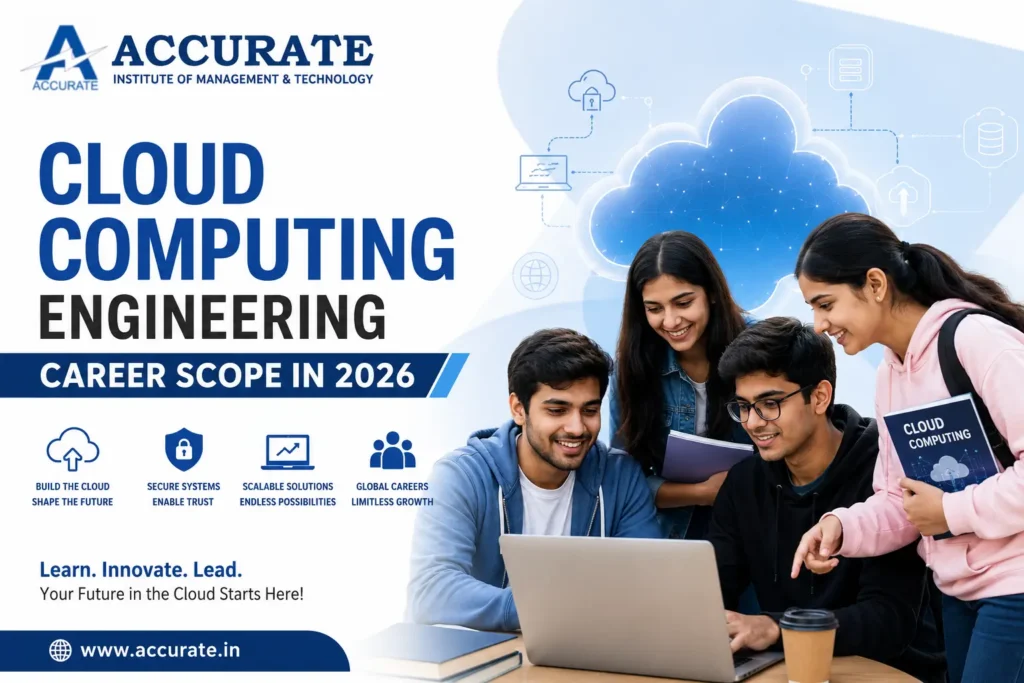

Technology is evolving faster than ever, and businesses across the world are moving their applications, databases, and services to cloud platforms. This digital transformation has created an enormous demand for skilled cloud professionals. As organizations continue investing in cloud infrastructure, Cloud Computing Engineering has emerged as one of the most promising engineering careers for students planning their future in technology.
In 2026, cloud computing is no longer limited to data storage. It powers Artificial Intelligence, Machine Learning, IoT, cybersecurity, financial services, healthcare systems, education platforms, smart cities, and modern enterprises. Every organization—from startups to Fortune 500 companies—depends on cloud infrastructure for scalability, security, and innovation.
For students looking to pursue B.Tech in Cloud Computing Engineering, this is an excellent time to enter the field. With high-paying jobs, international career opportunities, remote work options, and continuous technological advancements, Cloud Computing Engineering promises a stable and rewarding future.
Among the leading engineering institutions preparing students for this future is Accurate Institute of Management & Technology (AIMT), Greater Noida, which emphasizes industry-oriented education, practical learning, innovation, and placement support.
Cloud Computing Engineering: Career Scope in 2026
Table of Contents
- What is Cloud Computing Engineering?
- Why Cloud Computing Will Dominate in 2026
- Latest Industry Trends
- Career Scope of Cloud Computing Engineering
- Top Cloud Computing Job Roles
- Skills Required to Become a Cloud Engineer
- Programming Languages for Cloud Engineers
- Popular Cloud Platforms
- Cloud Computing vs Traditional IT Careers
- Industries Hiring Cloud Engineers
- Global Career Opportunities
- Higher Education Options
- Salary Trends in 2026
- Why Students Should Choose Cloud Computing Engineering
- Why Accurate Institute of Management & Technology?
- Admission Process
- Future Scope Beyond 2026
- Conclusion
- FAQs
What is Cloud Computing Engineering?
Cloud Computing Engineering focuses on designing, building, deploying, maintaining, and securing cloud-based infrastructure and applications.
Instead of storing software and data on local computers, cloud computing allows users to access computing resources over the internet.
Cloud engineers work with:
- Cloud servers
- Virtual machines
- Containers
- Databases
- Networking
- Security systems
- Automation tools
- AI-powered cloud services
Major cloud platforms include:
- Amazon Web Services (AWS)
- Microsoft Azure
- Google Cloud Platform (GCP)
- Oracle Cloud
- IBM Cloud
Cloud engineers ensure that these platforms operate efficiently, securely, and cost-effectively.
Why Cloud Computing Will Dominate in 2026
Digital transformation is accelerating worldwide. Businesses prefer cloud-based solutions because they offer flexibility, lower infrastructure costs, and faster deployment.
Major factors driving cloud adoption include:
- Artificial Intelligence
- Machine Learning
- Big Data Analytics
- Remote Work
- SaaS Applications
- Smart Manufacturing
- Healthcare Digitization
- Digital Banking
- Online Education
- E-commerce Growth
Cloud infrastructure has become the backbone of modern businesses, making cloud engineers highly valuable professionals.
Latest Industry Trends in Cloud Computing
AI-Powered Cloud Services
AI services are increasingly integrated into cloud platforms, enabling businesses to develop intelligent applications without massive infrastructure investments.
Edge Computing
Data processing is moving closer to users, reducing latency and improving performance.
Serverless Computing
Developers can build applications without managing servers, allowing faster deployment and reduced operational costs.
Multi-Cloud Strategy
Organizations now use multiple cloud providers to improve reliability and flexibility.
Cloud Security
Cybersecurity remains a top priority, creating strong demand for cloud security specialists.
Cloud Automation
Automation tools simplify infrastructure management, increasing efficiency while reducing human error.
Career Scope of Cloud Computing Engineering
Cloud Computing Engineering offers exceptional career growth because almost every industry now depends on cloud technology.
Career opportunities include:
- Cloud Architecture
- Cloud Administration
- DevOps Engineering
- Site Reliability Engineering
- Cloud Security
- Cloud Networking
- Cloud Migration
- Cloud Consulting
- Infrastructure Engineering
- Platform Engineering
As organizations modernize their IT systems, skilled cloud professionals remain in high demand.
Top Cloud Computing Job Roles
Cloud Engineer
Designs and manages cloud infrastructure while ensuring optimal performance.
Cloud Architect
Creates scalable cloud solutions tailored to business needs.
DevOps Engineer
Automates software development and deployment using cloud technologies.
Cloud Security Engineer
Protects cloud infrastructure against cyber threats.
Solutions Architect
Designs enterprise-level cloud solutions and digital transformation strategies.
Site Reliability Engineer (SRE)
Maintains reliable, scalable, and high-performing cloud systems.
Cloud Consultant
Helps organizations adopt and optimize cloud technologies.
Cloud Support Engineer
Provides technical assistance and resolves cloud-related issues.
Essential Skills Required
Successful cloud engineers possess both technical and soft skills.
Technical Skills
- Linux
- Networking
- Operating Systems
- Virtualization
- Docker
- Kubernetes
- AWS
- Azure
- Google Cloud
- Python
- Java
- Terraform
- Jenkins
- Git
- CI/CD
- SQL
- NoSQL
- Cloud Security
Soft Skills
- Problem-solving
- Communication
- Leadership
- Teamwork
- Critical Thinking
- Project Management
- Adaptability
Programming Languages for Cloud Engineers
Popular programming languages include:
Python
Ideal for automation, scripting, and cloud management.
Java
Widely used for enterprise cloud applications.
Go
Preferred for cloud-native application development.
JavaScript
Essential for full-stack cloud development.
Bash
Useful for Linux administration and automation.
PowerShell
Commonly used in Microsoft Azure environments.
Popular Cloud Platforms Students Should Learn
Amazon Web Services (AWS)
The most widely adopted cloud platform offering hundreds of cloud services.
Microsoft Azure
Strong demand in enterprise environments and government organizations.
Google Cloud Platform (GCP)
Known for AI, analytics, and Kubernetes leadership.
Oracle Cloud
Popular among enterprise database applications.
IBM Cloud
Used in financial services, healthcare, and hybrid cloud solutions.
Cloud Computing vs Traditional IT Careers
| Traditional IT | Cloud Computing |
|---|---|
| Local Infrastructure | Internet-based Infrastructure |
| Manual Deployment | Automated Deployment |
| Physical Servers | Virtual Servers |
| Higher Maintenance | Scalable Solutions |
| Limited Growth | Massive Career Opportunities |
| Fixed Resources | Elastic Resources |
Cloud computing professionals generally work on modern technologies that are transforming industries globally.
Industries Hiring Cloud Computing Engineers
Cloud engineers are required across diverse sectors.
Major recruiters include:
- IT Services
- Software Companies
- Banking
- Healthcare
- Manufacturing
- Retail
- Telecommunications
- Government Organizations
- Education Technology
- FinTech
- E-commerce
- Artificial Intelligence Companies
- Cybersecurity Firms
- Logistics
- Media & Entertainment
Global Career Opportunities
Cloud Computing Engineering provides excellent international career prospects.
Countries hiring cloud professionals include:
- United States
- Canada
- Germany
- Australia
- Singapore
- United Kingdom
- United Arab Emirates
- Ireland
- Netherlands
- Japan
Many cloud roles also support remote and hybrid work models, enabling professionals to collaborate with global teams.
Higher Education Opportunities
Students can pursue advanced studies after B.Tech.
Popular options include:
- M.Tech in Cloud Computing
- MS in Cloud Computing
- MBA in Information Technology
- MBA in Digital Transformation
- MBA in Technology Management
Professional certifications further strengthen career prospects:
- AWS Certified Solutions Architect
- AWS Developer Associate
- AWS SysOps Administrator
- Microsoft Azure Administrator
- Azure Solutions Architect
- Google Professional Cloud Architect
- Kubernetes Certification
- Terraform Certification
Salary Trends in 2026
Cloud Computing Engineering continues to be among the highest-paying technology domains.
Salary depends on:
- Skills
- Certifications
- Experience
- Company
- Location
- Technical expertise
Professionals with expertise in AWS, Azure, Kubernetes, DevOps, cloud security, and automation generally enjoy strong salary growth and rapid career progression.
Why Students Should Choose Cloud Computing Engineering
Cloud Computing Engineering offers numerous long-term benefits.
Excellent Placement Opportunities
Cloud professionals are recruited by startups, multinational corporations, consulting firms, and technology giants.
Future-Proof Career
Cloud adoption continues to expand, making this specialization highly relevant for years to come.
Global Demand
Cloud engineers are needed worldwide across multiple industries.
Innovation
Students work with cutting-edge technologies such as AI, blockchain, IoT, big data, and cybersecurity.
High Salary Potential
Cloud expertise commands competitive compensation compared to many traditional IT roles.
Entrepreneurship Opportunities
Cloud skills enable graduates to build SaaS products, startups, and digital platforms with scalable infrastructure.
Why Choose Accurate Institute of Management & Technology?
Selecting the right engineering college is just as important as selecting the right specialization.
Accurate Institute of Management & Technology (AIMT), Greater Noida provides students with an industry-focused environment designed to prepare them for modern technology careers.
Industry-Oriented Curriculum
The curriculum is aligned with emerging technologies and evolving industry requirements.
Practical Learning
Students gain hands-on exposure through:
- Modern computer laboratories
- Live projects
- Coding practice
- Technical workshops
- Industry interactions
- Innovation activities
Experienced Faculty
Dedicated faculty members mentor students in academics, research, technical development, and career planning.
Placement Support
Students receive structured training that includes:
- Technical interview preparation
- Aptitude development
- Soft skills training
- Resume building
- Mock interviews
- Corporate readiness sessions
Industry Exposure
Regular seminars, guest lectures, hackathons, coding competitions, and technical events help students understand real-world technology trends.
Holistic Development
AIMT encourages innovation, teamwork, leadership, entrepreneurship, and problem-solving skills that employers value.
Admission Process for B.Tech Cloud Computing Engineering
Students seeking admission should:
- Complete 10+2 with Physics, Chemistry, and Mathematics.
- Meet the institute’s eligibility criteria.
- Submit the application form.
- Complete the admission formalities.
- Begin an exciting journey toward a future-ready engineering career.
Students interested in emerging technologies should consider Cloud Computing Engineering as one of the strongest career choices for 2026.
Future Scope Beyond 2026
Cloud Computing Engineering will continue evolving alongside technologies such as:
- Artificial Intelligence
- Machine Learning
- Internet of Things
- Quantum Computing
- Blockchain
- Edge Computing
- Robotics
- Digital Twins
- Smart Manufacturing
- Autonomous Systems
The convergence of these technologies with cloud infrastructure will create even more specialized and high-value career opportunities in the coming years.
Conclusion
Cloud Computing Engineering has firmly established itself as one of the most future-ready engineering disciplines. As organizations worldwide accelerate their digital transformation, the need for professionals who can design, manage, and secure cloud environments will continue to rise. Whether your goal is to work with global technology companies, innovative startups, government organizations, or build your own technology venture, cloud computing provides the skills and opportunities to succeed.
Choosing the right institution is the first step toward achieving these ambitions. Accurate Institute of Management & Technology (AIMT), Greater Noida equips aspiring engineers with industry-relevant knowledge, practical exposure, experienced faculty guidance, and placement-focused training. If you are planning your B.Tech admission in 2026, Cloud Computing Engineering at AIMT offers an excellent pathway to a rewarding and future-focused career.
Apply today and begin your journey toward becoming a skilled Cloud Computing Engineer with Accurate Institute of Management & Technology, one of the leading choices for engineering education in Greater Noida and Delhi NCR.
Frequently Asked Questions (FAQs)
1. What is Cloud Computing Engineering?
Cloud Computing Engineering is a specialization that focuses on designing, developing, managing, and securing cloud-based infrastructure, applications, and services using platforms like AWS, Microsoft Azure, and Google Cloud.
2. Is Cloud Computing Engineering a good career in 2026?
Yes. With organizations rapidly adopting cloud technologies, Cloud Computing Engineering offers excellent job opportunities, global demand, strong salary potential, and long-term career growth in 2026.
3. What skills are required to become a Cloud Computing Engineer?
Students should develop expertise in Linux, networking, virtualization, cloud platforms (AWS, Azure, GCP), Docker, Kubernetes, Python, DevOps, cloud security, automation, and problem-solving.
4. Which companies hire Cloud Computing Engineers?
Leading recruiters include Amazon, Microsoft, Google, IBM, Oracle, TCS, Infosys, Wipro, Accenture, Capgemini, Deloitte, Cognizant, HCLTech, and numerous startups and enterprise organizations.
5. What is the difference between Cloud Computing and traditional IT?
Traditional IT relies on physical infrastructure, while Cloud Computing uses scalable internet-based infrastructure, enabling faster deployment, automation, cost optimization, and better flexibility.
6. Which cloud platform should students learn first?
AWS is widely adopted globally and is a strong starting point. However, learning Microsoft Azure and Google Cloud Platform (GCP) alongside AWS can improve career opportunities.
7. Can Cloud Computing Engineers work internationally?
Yes. Cloud professionals are in demand across countries such as the USA, Canada, Germany, Australia, the UK, Singapore, and the UAE. Many roles also support remote work.
8. Which certifications are valuable for Cloud Computing careers?
Top certifications include AWS Certified Solutions Architect, Microsoft Azure Administrator, Google Professional Cloud Architect, Kubernetes Certification, and Terraform Associate.
9. Why should students choose Accurate Institute of Management & Technology for B.Tech?
Accurate Institute of Management & Technology offers an industry-oriented curriculum, practical learning, experienced faculty, placement assistance, technical workshops, innovation-focused education, and strong career development support.
10. How can I apply for B.Tech Cloud Computing Engineering at Accurate Institute of Management & Technology?
Eligible students who have completed 10+2 with Physics, Chemistry, and Mathematics can apply through the admission process by visiting https://www.accurate.in and following the institute’s admission guidelines.