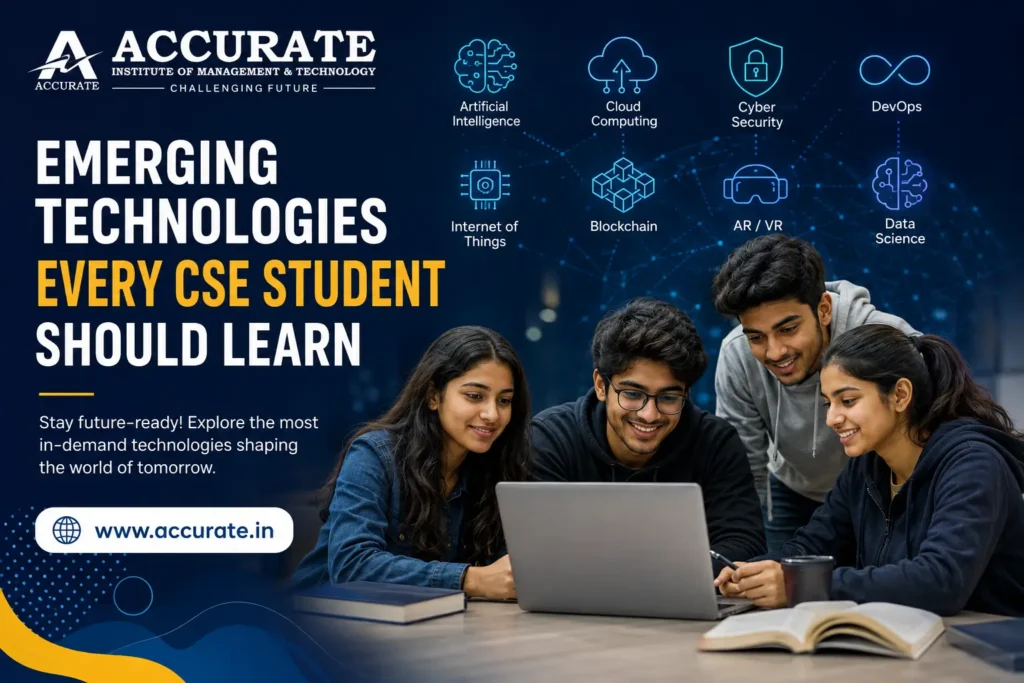

The most important emerging technologies every CSE student should learn include Artificial Intelligence and Machine Learning, Generative AI, Data Science, Cloud Computing, Cybersecurity, Internet of Things, Edge Computing, Blockchain, AR/VR, Quantum Computing, Robotics and DevOps. Students do not need to master every technology immediately. They should first build strong foundations in programming, data structures, algorithms, databases, operating systems and computer networks, then develop practical expertise in two or three emerging areas through projects, internships, certifications and problem-solving.
Table of Contents
- Why Emerging Technologies Matter for CSE Students
- Build Computer Science Fundamentals First
- Artificial Intelligence and Machine Learning
- Generative AI and Large Language Models
- Data Science and Big Data Analytics
- Cloud Computing and Serverless Architecture
- Cybersecurity and Ethical Security Engineering
- Internet of Things and Smart Systems
- Edge Computing
- Blockchain and Decentralised Technologies
- AR, VR and Spatial Computing
- Quantum Computing
- Robotics and Intelligent Automation
- DevOps, MLOps and Modern Software Engineering
- How CSE Students Should Learn Emerging Technologies
- Why the Right College Environment Matters
- FAQs
- Conclusion and Admission CTA
Why Emerging Technologies Matter for CSE Students
Computer Science and Engineering has always been a fast-changing discipline, but the speed of change today makes continuous learning especially important. A programming language that dominates one development environment may be replaced by another tool. A task that once required days of manual coding may be accelerated by AI-assisted development. Applications that previously ran entirely on centralised servers may now distribute processing across cloud and edge infrastructure.
For a CSE student, therefore, earning a degree is only one part of becoming a technology professional.
The bigger objective is learning how to learn.
Emerging technologies influence software development, finance, manufacturing, healthcare, education, transportation, communication, entertainment and almost every digital industry. Artificial intelligence is changing how applications interact with people. Cloud computing has transformed how software infrastructure is deployed. Cybersecurity has become integral to digital systems. IoT connects physical devices to software platforms, while quantum computing is introducing an entirely different model of computation.
Students who understand these developments can make better choices about projects, internships, higher education and career specialisations.
However, there is an important warning: learning emerging technology should not become a race to collect buzzwords.
A student who understands algorithms, databases, networks and software engineering deeply can adapt to new technologies far more effectively than someone who has completed ten short courses without understanding the fundamentals.
Build Computer Science Fundamentals Before Chasing Trends
Before exploring the latest technologies in computer science, CSE students should develop a dependable technical foundation.
Programming and Problem-Solving
Start with at least one programming language deeply. C++, Java or Python can provide a strong starting point depending on your academic and career direction.
Students should become comfortable with variables, functions, object-oriented programming, debugging, APIs, libraries, testing and version control.
More importantly, learn to solve problems rather than simply memorising syntax.
Data Structures and Algorithms
Arrays, linked lists, stacks, queues, trees, graphs, hashing, sorting, searching, recursion and dynamic programming develop computational thinking.
These concepts remain useful whether you eventually become a software developer, AI engineer, cybersecurity professional or cloud architect.
Core Computer Science
A strong CSE student should also understand:
- Database Management Systems
- Operating Systems
- Computer Networks
- Software Engineering
- Computer Architecture
- Object-Oriented Programming
- Web Technologies
- Discrete Mathematics
- Probability and Statistics
Emerging technologies become easier to understand when these fundamentals are already in place.
Top Emerging Technologies Every CSE Student Should Learn
1. Artificial Intelligence and Machine Learning
Artificial Intelligence is one of the most influential technologies shaping modern computing.
AI focuses broadly on creating systems capable of performing tasks associated with intelligent behaviour, while Machine Learning allows systems to learn patterns from data and improve predictions or decisions without being explicitly programmed for every scenario.
What Should CSE Students Learn in AI and ML?
Start with Python and strengthen your understanding of mathematics, particularly probability, statistics, linear algebra and basic calculus.
Then explore:
- Supervised and unsupervised learning
- Regression and classification
- Decision trees
- Clustering
- Neural networks
- Deep learning
- Natural Language Processing
- Computer vision
- Model evaluation
- Responsible AI
Libraries and frameworks such as NumPy, pandas, scikit-learn, PyTorch and TensorFlow can support practical experimentation.
Why AI Matters
AI skills can support careers in machine learning engineering, data science, intelligent application development, automation, computer vision and research.
Students should avoid treating AI as a collection of APIs. Understanding why a model produces a particular result, how data quality affects it and where bias or errors can occur is increasingly important.
2. Generative AI and Large Language Models
Generative AI has created a new interface between humans and computers.
Unlike traditional predictive systems, generative models can create text, images, software code, audio and other content. Large Language Models, or LLMs, have also made natural-language interaction a practical component of software applications.
What Should Students Learn About Generative AI?
A CSE student can begin with:
- Transformer fundamentals
- Tokens and embeddings
- Prompt design
- LLM APIs
- Retrieval-Augmented Generation
- Vector databases
- Semantic search
- AI agents and tool use
- Model evaluation
- Fine-tuning concepts
- Guardrails and AI safety
A useful project might be a campus information assistant that retrieves verified information from a controlled database rather than inventing answers.
Don’t Become Only a Prompt User
Knowing how to write prompts is useful, but it is not enough for a computer science engineer.
Students should learn how AI applications are architected, how information is retrieved, how models are evaluated, how APIs are secured and how AI-generated outputs can be verified.
The long-term advantage lies in building AI systems, not merely using AI tools.
3. Data Science and Big Data Analytics
Modern digital systems generate enormous quantities of information. The ability to transform that raw data into useful insight has made data science an important field for CSE students.
Essential Data Skills
Students should explore:
- Python
- SQL
- Statistics
- Data cleaning
- Exploratory data analysis
- Data visualisation
- Machine learning
- Data pipelines
- Database concepts
- Big-data architecture
Tools matter, but analytical thinking matters more.
For example, rather than merely creating a dashboard, ask: What question is the data answering? Is the data reliable? Are important variables missing? Can the conclusion be misleading?
That mindset separates meaningful data analysis from decorative visualisation.
Project Ideas
Students can analyse public datasets, build recommendation engines, create predictive models or develop dashboards around transportation, education, weather, energy or business data.
A well-documented data project can become an excellent portfolio asset.
4. Cloud Computing and Serverless Architecture
Many applications students use every day depend on cloud infrastructure.
Cloud computing provides computing resources such as servers, storage, databases, networking and application services over the internet. Instead of purchasing and maintaining every physical server, organisations can provision resources according to requirements.
What Should a Beginner Learn?
Start with the basic concepts:
- IaaS, PaaS and SaaS
- Virtual machines
- Containers
- Cloud storage
- Managed databases
- Identity and access management
- Load balancing
- APIs
- Serverless computing
- Cloud security
- Monitoring
After understanding the principles, students can gain practical exposure to platforms such as AWS, Microsoft Azure or Google Cloud.
Why Cloud Skills Are Valuable
A modern developer should understand not only how to write an application but also how that application reaches users.
Build a small web application, connect it to a database, deploy it to the cloud, configure access and monitor its performance. That experience teaches far more than memorising cloud terminology.
5. Cybersecurity and Ethical Security Engineering
As systems become more connected, security becomes more important.
Cybersecurity is not relevant only to students planning to become security analysts. Developers, cloud engineers, data professionals, IoT engineers and AI developers all make decisions that can introduce or reduce security risks.
Cybersecurity Topics CSE Students Should Know
Begin with:
- Computer networking
- Linux fundamentals
- Authentication and authorisation
- Cryptography basics
- Secure coding
- Web application security
- Network security
- Cloud security
- Vulnerability assessment
- Identity management
- Security monitoring
- Incident response
Students interested in deeper specialisation can study penetration testing and ethical hacking within authorised environments.
Security Should Be Built In
One of the most useful habits for a future engineer is asking security questions during development rather than after deployment.
Who can access this data? How are passwords stored? Is input validated? What happens if credentials leak? Are communications encrypted?
Secure thinking is becoming part of good software engineering itself.
6. Internet of Things and Smart Systems
The Internet of Things connects physical devices, sensors and machines to networks and software systems.
An IoT solution might collect environmental information through sensors, send it across a network, process the data in the cloud or at the edge and present useful information through an application.
Skills Required for IoT
IoT is particularly interesting because it combines several domains:
- Programming
- Embedded systems
- Sensors
- Microcontrollers
- Networking
- Wireless communication
- Cloud platforms
- Data analytics
- Cybersecurity
- Automation
- AI
Possible student projects include smart energy monitoring, environmental sensing, asset tracking, intelligent agriculture and safety-alert systems.
Accurate Institute’s existing CSE-oriented IoT programme material similarly highlights embedded systems, sensor technology, cloud computing, AI, wireless communication, analytics, automation, networking and cybersecurity.
This multidisciplinary character makes IoT an excellent area for students who enjoy seeing software interact with the physical world.
7. Edge Computing
Cloud computing centralises much processing in remote data centres. Edge computing moves some computation closer to the place where data is generated.
Consider an intelligent camera, industrial machine or autonomous system. Sending every piece of raw information to a distant cloud platform may create latency, bandwidth or privacy challenges. Processing selected information locally can make the system faster and more efficient.
What Should Students Understand?
Explore:
- Edge devices
- Embedded computing
- IoT architecture
- Local data processing
- Networking
- Distributed systems
- Edge AI
- Cloud-edge integration
Edge computing becomes particularly valuable when applications require low latency or must continue operating despite intermittent connectivity.
For CSE students, it is also a useful bridge between software, networking, IoT and AI.
8. Blockchain and Decentralised Technologies
Blockchain is best known because of cryptocurrencies, but its underlying concepts have wider relevance to computer science.
A blockchain is essentially a distributed record system in which transactions or state changes can be validated and maintained across participating nodes according to defined protocols.
What Should CSE Students Learn?
Rather than beginning with speculation around digital assets, study the engineering concepts:
- Distributed systems
- Hashing
- Public-key cryptography
- Consensus mechanisms
- Smart contracts
- Decentralised applications
- Digital identity
- Blockchain security
Students should also learn when blockchain is not necessary.
If a conventional database solves a problem more efficiently, adding blockchain merely because it sounds innovative is poor engineering. Understanding the trade-offs is more valuable than following hype.
9. AR, VR and Spatial Computing
Augmented Reality overlays digital information on the physical environment, while Virtual Reality creates immersive digital environments. Spatial computing extends these ideas by enabling digital systems to understand and interact with three-dimensional spaces.
Applications can include education, industrial training, design, gaming, retail, simulation and remote collaboration.
Skills to Explore
Students interested in this field can learn:
- 3D graphics fundamentals
- Computer vision
- Game-engine concepts
- Unity or Unreal Engine
- Human-computer interaction
- Sensors and tracking
- UI/UX for immersive environments
A CSE student does not need to become a professional 3D artist. The engineering challenge is understanding how software, interfaces, sensors and real-time computation create interactive experiences.
10. Quantum Computing
Quantum computing is very different from conventional computing.
Traditional computers process information using bits, while quantum computing uses quantum bits, or qubits, and concepts such as superposition and entanglement.
Quantum computing remains a specialised and developing field, so most undergraduate students do not need to treat it as an immediate replacement for conventional programming.
However, learning its fundamentals can be valuable for students interested in research and advanced computing.
Where Should a Student Begin?
Study:
- Linear algebra
- Probability
- Complex numbers
- Qubits
- Quantum gates
- Quantum circuits
- Superposition
- Entanglement
- Basic quantum algorithms
Students can then experiment with quantum programming frameworks and simulators without requiring direct access to a physical quantum computer.
The objective at undergraduate level should be conceptual literacy and experimentation rather than unrealistic expectations of instant mastery.
11. Robotics and Intelligent Automation
Robotics brings algorithms into the physical world.
A modern robot may combine sensors, actuators, control systems, computer vision, AI, embedded software and networking. This makes robotics an excellent interdisciplinary learning environment.
What Can CSE Students Learn?
Useful topics include:
- Python or C++
- Sensors and actuators
- Computer vision
- AI and ML
- Path planning
- Embedded programming
- Control-system basics
- Robot Operating System concepts
- Human-robot interaction
Even students who never become robotics engineers can benefit because robotics forces programmers to think about uncertainty, real-time inputs and physical constraints.
12. DevOps, MLOps and Modern Software Engineering
Writing working code is only one stage of professional software development.
DevOps connects software development with deployment and operations. It encourages automation, continuous integration, reliable delivery, monitoring and collaboration.
Important DevOps Skills
CSE students should become familiar with:
- Git and GitHub
- Linux
- CI/CD
- Docker
- Containerisation
- Infrastructure concepts
- Kubernetes fundamentals
- Automated testing
- Monitoring and logging
- Cloud deployment
For students entering AI, MLOps extends these principles to machine-learning systems, including model deployment, versioning, monitoring and lifecycle management.
This knowledge can help students understand how classroom code becomes dependable production software.
How Should CSE Students Learn Emerging Technologies?
Trying to learn all twelve areas simultaneously is usually ineffective.
A better approach is a foundation → exploration → specialisation → portfolio model.
Step 1: Strengthen Your Foundation
Spend the early stage of your CSE journey building programming ability, data structures, algorithms, databases, operating systems and networking.
Step 2: Explore Multiple Technologies
Complete introductory courses and small experiments in AI, cloud, cybersecurity, IoT and other areas.
The objective is discovery rather than mastery.
Step 3: Select Two or Three Areas
Choose technologies that naturally complement one another.
Good combinations include:
AI + Data Science + Cloud Computing
or
IoT + Edge Computing + Cybersecurity
or
Web Development + Cloud + DevOps
or
AI + Robotics + Computer Vision
This creates a coherent skill profile.
Step 4: Build Projects
Projects convert knowledge into evidence.
Instead of writing “Machine Learning” on your resume, build a model, evaluate it and document the results.
Instead of claiming “Cloud Computing,” deploy an application.
Instead of listing “IoT,” create a working sensor-based prototype.
Step 5: Document Your Work
Maintain GitHub repositories, project documentation, demonstrations and concise technical explanations.
Employers should be able to understand what problem you attempted, how you solved it and what you learned.
Step 6: Seek Internships and Collaborative Learning
Internships, hackathons, coding competitions, technical clubs and team projects expose students to constraints that tutorials often cannot reproduce.
Accurate Institute’s published approach emphasises practical projects, workshops, coding sessions and industrial training, while its placement-support structure includes coding practice, aptitude preparation, communication development and mock interviews.
That combination of technical learning and professional preparation is particularly useful in a field where employability depends on applying knowledge, not simply remembering it.
Why the Right College Environment Matters for Future CSE Engineers
You can learn programming from almost anywhere. But a structured engineering environment can bring together faculty guidance, laboratories, peers, projects, technical events, internships and career preparation.
That ecosystem matters because emerging technologies rarely exist independently.
An IoT project may require cloud computing. A robotics project may use computer vision. A generative AI application may require databases, cybersecurity and cloud deployment. A data-science solution may eventually need DevOps or MLOps to reach real users.
This is where a broad CSE foundation combined with practical exposure becomes valuable.
Learning Emerging Technologies at Accurate Institute of Management & Technology
For students considering B.Tech CSE in Greater Noida, Accurate Institute of Management & Technology provides an engineering environment where academics can be complemented by practical and career-oriented learning.
Existing institute materials describe the B.Tech engineering framework as AICTE approved and affiliated with Dr. A.P.J. Abdul Kalam Technical University (AKTU). Applicants should always verify the latest approval, affiliation and programme information for their particular admission year.
The institute is located in Knowledge Park III, Greater Noida, within the wider Delhi NCR education and industry ecosystem.
For an aspiring computer science engineer, the real advantage of college should not simply be access to a syllabus. It should be the opportunity to code, experiment, collaborate, build, present and prepare for professional life.
Students who actively participate in technical projects, workshops, hackathons, coding practice, internships and placement preparation can turn four years of engineering education into a portfolio of demonstrable capabilities.
FAQs About Emerging Technologies for CSE Students
1. What are the top emerging technologies every CSE student should learn?
CSE students should explore Artificial Intelligence, Machine Learning, Generative AI, Data Science, Cloud Computing, Cybersecurity, IoT, Edge Computing, Blockchain, AR/VR, Quantum Computing, Robotics and DevOps. Students should first master computer science fundamentals and then specialise in a few technologies relevant to their career goals.
2. Which technology is best for CSE students in the future?
AI and Machine Learning are strong choices because they are being integrated into many types of software. However, cloud computing, cybersecurity, data science, IoT and DevOps are also valuable. The best technology depends on a student’s interests, abilities and desired career path.
3. Should a CSE student learn Generative AI?
Yes. CSE students can benefit from understanding Generative AI, LLMs, embeddings, Retrieval-Augmented Generation, AI agents and model evaluation. Students should go beyond prompt writing and learn how reliable AI applications are designed, built, secured and evaluated.
4. Is cloud computing important for computer science students?
Yes. Cloud computing is important because modern applications commonly depend on remote computing, storage, databases and managed services. Understanding cloud deployment helps students bridge the gap between writing an application and making it available reliably to users.
5. Is cybersecurity a good career option after B.Tech CSE?
Cybersecurity can be a strong career path for students interested in networks, systems, secure coding, cloud security, threat analysis and digital protection. Strong fundamentals in operating systems, Linux, networking and programming are especially useful.
6. What should a first-year CSE student learn?
A first-year CSE student should prioritise programming, logical problem-solving, mathematics and basic data structures. Git, Linux and simple development projects are also useful. Emerging technologies can then be explored gradually rather than replacing foundational subjects.
7. Do CSE students need to learn every emerging technology?
No. Trying to master every technology can result in shallow knowledge. Students should understand major trends broadly and develop deeper expertise in two or three complementary fields while retaining strong core computer science skills.
8. How can CSE students gain practical experience in emerging technologies?
Students can build projects, join hackathons, contribute to coding communities, complete internships, participate in technical clubs, attend workshops and maintain GitHub portfolios. Practical work should demonstrate not just which tools were used but what problem was solved.
9. Is IoT useful for CSE students?
Yes. IoT combines software development with sensors, networks, cloud platforms, analytics, embedded systems, AI and cybersecurity. It is especially suitable for students interested in creating software that interacts with physical devices and smart environments.
10. Why consider Accurate Institute of Management & Technology for B.Tech CSE?
Accurate Institute of Management & Technology offers students an engineering environment in Greater Noida with an emphasis on technical learning, practical exposure and career preparation. Existing institute materials describe practical projects, workshops, coding sessions, industrial training and placement-oriented development activities. Students should check the latest programme, eligibility, fee, scholarship and admission information directly with the institute before applying.
Conclusion: Learn the Technologies That Will Shape Tomorrow
The future of computer science will not be defined by a single programming language, framework or technology.
AI will interact with cloud platforms. IoT will increasingly depend on edge intelligence. Cybersecurity will protect connected systems. Data science will support intelligent decision-making. DevOps and MLOps will help applications and models operate reliably at scale. Quantum computing may open new approaches to specialised computational problems.
For CSE students, this creates enormous opportunity—but also an important responsibility.
Do not chase technology merely because it is trending.
Build strong fundamentals. Explore widely. Choose your specialisation carefully. Build real projects. Document your work. Learn from failures. Stay curious.
A successful computer science engineer is not someone who knows every tool available today. It is someone who understands computing deeply enough to learn the tools that will arrive tomorrow.
Begin Your CSE Journey at Accurate Institute of Management & Technology
If you are planning to pursue B.Tech Computer Science & Engineering in Greater Noida and want an academic environment where classroom concepts can be strengthened through coding, projects, technical activities and career preparation, explore the opportunities available at Accurate Institute of Management & Technology.
Accurate’s Greater Noida location places students within the wider Delhi NCR education and professional ecosystem, while its engineering approach emphasises practical exposure alongside academic development.
Take the next step towards becoming a future-ready computer science engineer. Explore the current B.Tech CSE programmes at Accurate Institute of Management & Technology, speak with the admission team, visit the campus and laboratories, and learn about current eligibility, specialisations, scholarships, fees and admission dates before submitting your application.
Your technology career will be shaped by what you learn, what you build and how consistently you evolve. Start building that future today with Accurate Institute of Management & Technology.