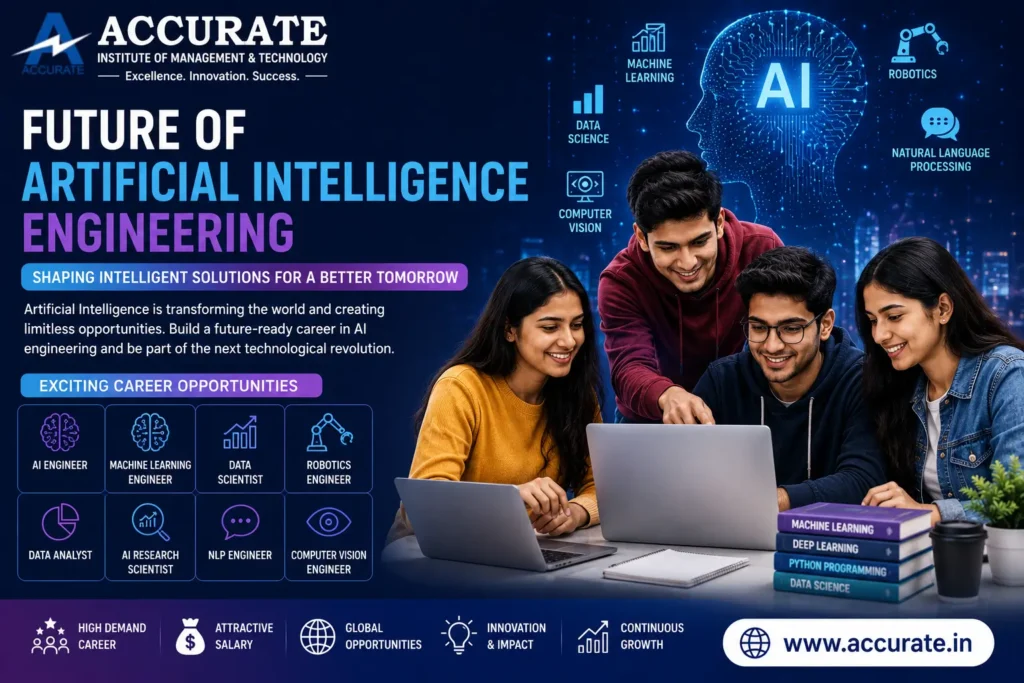

Artificial Intelligence (AI) is no longer a futuristic concept seen only in science fiction movies. It has become one of the most transformative technologies of the modern era, influencing industries, businesses, governments, and everyday life. From virtual assistants and recommendation systems to autonomous vehicles and smart healthcare solutions, AI is reshaping the world at an unprecedented pace.
As organizations increasingly rely on intelligent systems to improve efficiency, automate processes, and make data-driven decisions, the demand for skilled Artificial Intelligence Engineers continues to rise. AI engineering has emerged as one of the most exciting and rewarding career paths for engineering students who want to be part of the next technological revolution.
The future of Artificial Intelligence Engineering is filled with opportunities. Industries are investing heavily in AI-powered solutions, creating a strong need for professionals who can design, develop, train, and deploy intelligent systems. This growing demand makes AI engineering one of the most future-ready professions in the technology sector.
At Accurate Institute of Management & Technology, students are encouraged to develop expertise in emerging technologies, including Artificial Intelligence, Machine Learning, Data Science, Cloud Computing, and Automation. Through industry-oriented education, practical learning, and technical training, students gain the skills necessary to build successful careers in AI and related fields.
This comprehensive guide explores the future of Artificial Intelligence Engineering, emerging career opportunities, required skills, industry applications, and how aspiring engineers can prepare for success in this rapidly evolving domain.
Quick Answer: What Is the Future of Artificial Intelligence Engineering?
The future of Artificial Intelligence Engineering is extremely promising due to increasing adoption of AI across industries such as healthcare, finance, education, manufacturing, retail, cybersecurity, transportation, and smart cities.
Future opportunities include:
- AI Engineer
- Machine Learning Engineer
- Data Scientist
- AI Research Scientist
- Robotics Engineer
- AI Product Developer
- Computer Vision Engineer
- Natural Language Processing Specialist
AI engineering is expected to remain one of the highest-demand and fastest-growing technology careers for decades.
Understanding Artificial Intelligence Engineering
Artificial Intelligence Engineering involves designing and developing intelligent systems capable of performing tasks that typically require human intelligence.
These tasks include:
- Learning
- Reasoning
- Decision Making
- Problem Solving
- Language Understanding
- Image Recognition
AI engineers build systems that help organizations automate operations and improve efficiency.
Why Artificial Intelligence Is Growing So Rapidly
Several factors contribute to the growth of AI:
Availability of Data
Organizations generate massive amounts of data every day.
Increased Computing Power
Modern processors and cloud infrastructure enable advanced AI development.
Business Automation
Companies seek efficient solutions for repetitive tasks.
Improved Customer Experiences
AI helps organizations personalize services and interactions.
Digital Transformation
Businesses increasingly adopt AI to remain competitive.
These factors continue to drive demand for AI professionals.
Why AI Engineering Is One of the Best Future Careers
Artificial Intelligence engineering combines:
- Innovation
- Problem Solving
- Technology
- Research
- Real-World Impact
AI professionals contribute to solutions that improve healthcare, education, transportation, sustainability, and business operations.
Major Applications of Artificial Intelligence
Healthcare
AI is transforming healthcare through:
- Disease Prediction
- Medical Imaging Analysis
- Personalized Treatment
- Drug Discovery
Healthcare AI solutions improve patient outcomes and operational efficiency.
Finance
Financial institutions use AI for:
- Fraud Detection
- Risk Assessment
- Automated Trading
- Customer Service
AI helps improve security and decision-making.
Education
Educational applications include:
- Personalized Learning
- Intelligent Tutoring Systems
- Student Performance Analytics
AI enhances educational experiences.
Manufacturing
Smart manufacturing uses AI for:
- Predictive Maintenance
- Quality Control
- Process Automation
This improves productivity and reduces operational costs.
Retail and E-Commerce
AI supports:
- Recommendation Systems
- Inventory Management
- Customer Analytics
Businesses use AI to improve customer satisfaction and sales performance.
Emerging Career Opportunities in AI Engineering
Artificial Intelligence Engineer
AI Engineers design and deploy intelligent systems.
Responsibilities
- AI Model Development
- Data Processing
- Algorithm Optimization
- System Integration
AI Engineers remain among the most sought-after professionals.
Machine Learning Engineer
Machine Learning Engineers create systems that learn from data.
Responsibilities
- Model Training
- Predictive Analytics
- Performance Improvement
Machine learning continues to drive innovation across industries.
Data Scientist
Data Scientists extract insights from large datasets.
Responsibilities
- Data Analysis
- Statistical Modeling
- Business Intelligence
Data Science and AI often work together.
Computer Vision Engineer
Computer Vision enables machines to understand visual information.
Applications
- Facial Recognition
- Autonomous Vehicles
- Medical Imaging
This field is growing rapidly.
Natural Language Processing Engineer
NLP focuses on understanding human language.
Applications
- Chatbots
- Virtual Assistants
- Language Translation
Language technologies are becoming increasingly important.
Robotics Engineer
Robotics integrates AI with mechanical systems.
Applications
- Manufacturing
- Healthcare
- Logistics
AI-powered robots improve efficiency and precision.
AI Research Scientist
Researchers develop new algorithms and methodologies.
Responsibilities
- Innovation
- Experimentation
- Scientific Research
Research drives future AI advancements.
Future Technologies That Will Shape AI Engineering
Generative AI
Generative AI creates:
- Text
- Images
- Videos
- Code
This technology is revolutionizing content creation and software development.
Autonomous Systems
Self-driving vehicles and intelligent machines rely heavily on AI.
AI-Powered Cyber Security
AI enhances threat detection and security monitoring.
Edge AI
Edge AI enables intelligent processing on local devices.
Explainable AI
Organizations increasingly require transparent AI systems.
Explainable AI improves trust and accountability.
Skills Required for AI Engineering Careers
Programming Languages
Students should learn:
- Python
- Java
- C++
- R
Programming is essential for AI development.
Mathematics
Important areas include:
- Linear Algebra
- Probability
- Statistics
- Calculus
Mathematics forms the foundation of AI algorithms.
Machine Learning
Students should understand:
- Supervised Learning
- Unsupervised Learning
- Reinforcement Learning
Machine learning is central to AI engineering.
Data Science
AI systems depend on quality data.
Students should develop expertise in:
- Data Analysis
- Data Visualization
- Data Processing
Cloud Computing
Cloud platforms support AI development and deployment.
Popular platforms include:
- AWS
- Microsoft Azure
- Google Cloud
Benefits of Choosing AI Engineering
High Demand
Organizations worldwide require AI expertise.
Competitive Salaries
AI professionals often receive attractive compensation packages.
Global Opportunities
AI skills are valued internationally.
Innovation
Engineers contribute to cutting-edge technologies.
Career Growth
AI offers long-term professional development opportunities.
Challenges in AI Engineering
While opportunities are significant, challenges include:
- Rapid Technological Change
- Continuous Learning Requirements
- Ethical Considerations
- Data Privacy Concerns
Professionals must remain adaptable and responsible.
Ethical Considerations in Artificial Intelligence
AI development should prioritize:
- Fairness
- Transparency
- Accountability
- Privacy Protection
Ethical AI ensures technology benefits society responsibly.
How Engineering Students Can Prepare for AI Careers
Learn Programming
Strong coding skills are essential.
Build AI Projects
Students should create:
- Prediction Models
- Recommendation Systems
- Chatbots
Projects demonstrate practical competence.
Complete Internships
Industry exposure strengthens professional readiness.
Earn Certifications
Certifications validate expertise and improve employability.
Participate in Competitions
Hackathons and AI competitions enhance technical abilities.
Role of Engineering Education in AI Development
Modern engineering education should emphasize:
- Practical Learning
- Research
- Innovation
- Industry Collaboration
Students require hands-on exposure to emerging technologies.
How Accurate Institute Supports AI Engineering Careers
At Accurate Institute of Management & Technology, students gain exposure to advanced technologies through:
Industry-Oriented Curriculum
Programs align with current industry requirements.
Technical Workshops
Students learn modern tools and techniques.
Project-Based Learning
Hands-on experiences strengthen practical understanding.
Industry Interaction
Experts provide valuable career guidance.
Skill Development Programs
Students enhance both technical and professional competencies.
Future Scope of Artificial Intelligence Engineering
The future of AI engineering is expected to expand into:
- Healthcare Innovation
- Smart Cities
- Autonomous Transportation
- Sustainable Energy
- Digital Education
- Advanced Manufacturing
AI will continue to create new career opportunities and transform industries.
Is Artificial Intelligence Engineering a good career for the future?
Yes. Artificial Intelligence Engineering is one of the best future careers because AI is being adopted across healthcare, finance, education, manufacturing, cybersecurity, and transportation. AI engineers are in high demand and enjoy strong career growth opportunities.
Conclusion
Artificial Intelligence is transforming the world and creating unprecedented opportunities for engineering professionals. As organizations increasingly adopt intelligent systems, the demand for skilled AI engineers will continue to rise.
From healthcare and finance to robotics and autonomous systems, AI is reshaping industries and creating exciting new career paths. Students who develop expertise in programming, machine learning, data science, cloud computing, and problem-solving will be well-positioned to succeed in this dynamic field.
At Accurate Institute of Management & Technology, students receive industry-focused education, practical training, technical exposure, and career development support that prepare them for successful futures in Artificial Intelligence Engineering.
For aspiring engineers seeking innovation, global opportunities, and long-term career growth, AI engineering represents one of the most promising professions of the future.
Frequently Asked Questions (FAQs)
What is Artificial Intelligence Engineering?
Artificial Intelligence Engineering involves designing and developing intelligent systems capable of learning, reasoning, and decision-making.
Is AI Engineering a good career?
Yes. AI engineering is among the fastest-growing and highest-demand technology careers.
What skills are required for AI Engineering?
Programming, Machine Learning, Data Science, Mathematics, Cloud Computing, and Problem-Solving skills.
Which industries hire AI Engineers?
Healthcare, Finance, Education, Retail, Manufacturing, Cyber Security, and Transportation.
What is the future scope of Artificial Intelligence?
AI will continue expanding across industries and creating new employment opportunities worldwide.
Can B.Tech students pursue AI careers?
Yes. Engineering graduates are well-positioned to build successful careers in Artificial Intelligence.
What is the difference between AI and Machine Learning?
AI is the broader concept of intelligent systems, while Machine Learning is a subset that enables systems to learn from data.
How does Accurate Institute support AI careers?
Through industry-oriented education, technical workshops, projects, practical learning, and skill development initiatives.