
Artificial Intelligence is no longer a futuristic concept—it has become the driving force behind innovation across industries. From healthcare and banking to manufacturing, agriculture, transportation, and entertainment, AI is reshaping how businesses operate and how professionals build their careers.
This transformation has also changed engineering education. Students planning to pursue B.Tech Admission 2026 are no longer choosing branches solely based on traditional popularity. Instead, they are looking for engineering disciplines that will remain relevant, adaptable, and rewarding in the coming decades.
The biggest question every student asks today is:
“Which engineering branch will still offer excellent career opportunities in the AI era?”
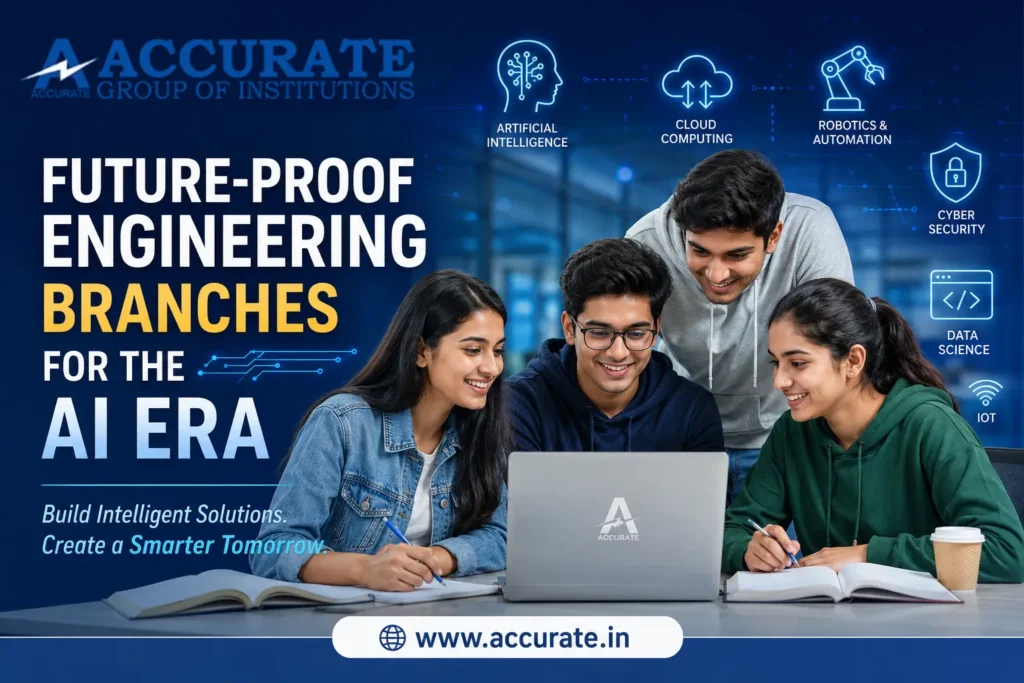
The answer lies in selecting future-proof engineering branches that combine technical expertise with emerging technologies such as Artificial Intelligence, Machine Learning, Data Science, Robotics, Cloud Computing, and Cyber Security.
This comprehensive guide explores the engineering branches that are expected to dominate the next decade and explains how students can prepare themselves for long-term career success.
Future-Proof Engineering Branches for the AI Era
Table of Contents
- Why AI is Transforming Engineering
- What Makes an Engineering Branch Future-Proof?
- Top Future-Proof Engineering Branches
- Computer Science Engineering (CSE)
- Artificial Intelligence & Machine Learning
- Data Science Engineering
- Cyber Security Engineering
- Internet of Things (IoT)
- Robotics & Automation
- Electronics & Communication Engineering
- Cloud Computing & DevOps
- Skills Every Future Engineer Must Learn
- Engineering Careers That Will Grow Beyond 2035
- Industries Hiring AI-Ready Engineers
- How to Choose the Right Engineering Branch
- Why Practical Learning Matters More Than Ever
- Why Accurate Institute of Management & Technology is an Excellent Choice
- Admission Opportunities for 2026
- Conclusion
- FAQs
Why AI is Transforming Engineering
Artificial Intelligence has become the backbone of digital transformation.
Today’s engineers don’t simply design machines or write software—they build intelligent systems capable of learning, predicting, and automating complex tasks.
AI impacts engineering by enabling:
- Smart manufacturing
- Autonomous vehicles
- Predictive maintenance
- Intelligent healthcare systems
- Financial automation
- Smart cities
- Industrial robotics
- Personalized customer experiences
- Intelligent cybersecurity
- Cloud automation
This widespread adoption means engineering graduates must possess multidisciplinary knowledge rather than expertise in only one technology.
What Makes an Engineering Branch Future-Proof?
A future-proof engineering branch possesses several important characteristics:
High Industry Demand
Companies continue hiring professionals regardless of changing technologies.
AI Integration
The branch naturally evolves with AI innovations instead of being replaced by them.
Continuous Innovation
New tools, programming languages, and technologies regularly expand career opportunities.
Global Career Opportunities
Graduates can work in India or abroad across multiple industries.
High Salary Potential
Future-proof careers generally offer competitive compensation because of specialized expertise.
Top Future-Proof Engineering Branches for the AI Era
1. Computer Science Engineering (CSE)
Computer Science Engineering remains the strongest foundation for AI-driven careers.
Modern CSE programs include:
- Artificial Intelligence
- Machine Learning
- Cloud Computing
- Software Engineering
- Cyber Security
- Data Structures
- Operating Systems
- Database Systems
Career Opportunities
- Software Engineer
- AI Developer
- Cloud Engineer
- Backend Developer
- Full Stack Developer
- DevOps Engineer
- Systems Architect
Industries
- IT Companies
- Product Companies
- Startups
- FinTech
- Healthcare Technology
- E-commerce
2. Artificial Intelligence & Machine Learning Engineering
AI Engineering is one of the fastest-growing engineering specializations worldwide.
Students learn:
- Deep Learning
- Neural Networks
- Natural Language Processing
- Computer Vision
- Reinforcement Learning
- AI Algorithms
- Robotics Intelligence
Career Roles
- AI Engineer
- Machine Learning Engineer
- AI Researcher
- NLP Engineer
- Computer Vision Engineer
Major recruiters include global technology companies, research organizations, healthcare firms, and autonomous vehicle manufacturers.
3. Data Science Engineering
Data is often referred to as the “new oil.” Organizations rely on data scientists to extract actionable insights that drive strategic decisions.
Core Subjects
- Statistics
- Python
- SQL
- Big Data
- Machine Learning
- Data Visualization
- Predictive Analytics
Career Options
- Data Scientist
- Data Engineer
- Business Intelligence Analyst
- Analytics Consultant
- AI Data Specialist
4. Cyber Security Engineering
As digital infrastructure expands, cybersecurity becomes indispensable. AI has made cyber threats more sophisticated, increasing the need for skilled security professionals.
Students Learn
- Ethical Hacking
- Network Security
- Digital Forensics
- Cryptography
- Threat Intelligence
- Security Operations
Career Paths
- Cyber Security Engineer
- Ethical Hacker
- Security Consultant
- Security Analyst
- SOC Analyst
Demand continues to grow across banking, government, defense, healthcare, and technology sectors.
5. Internet of Things (IoT) Engineering
IoT connects billions of smart devices worldwide.
Examples include:
- Smart Homes
- Smart Agriculture
- Smart Cities
- Industrial Automation
- Connected Vehicles
- Healthcare Monitoring
Career Roles
- IoT Developer
- Embedded Engineer
- IoT Solution Architect
- Industrial Automation Engineer
6. Robotics & Automation Engineering
AI-powered robots are revolutionizing manufacturing, logistics, healthcare, and defense.
Students gain expertise in:
- Robotics Programming
- Sensors
- Automation Systems
- Mechatronics
- AI Robotics
Career Opportunities
- Robotics Engineer
- Automation Engineer
- Industrial Robotics Specialist
- Autonomous Systems Developer
7. Electronics & Communication Engineering (ECE)
Modern electronics form the foundation of AI hardware, communication systems, and embedded technologies.
Emerging applications include:
- 5G
- Semiconductor Design
- Embedded AI
- Wireless Communication
- Smart Devices
Career Options
- Embedded Systems Engineer
- Communication Engineer
- Semiconductor Engineer
- Electronics Design Engineer
8. Cloud Computing & DevOps
Every AI application requires scalable cloud infrastructure.
Cloud engineers manage:
- AWS
- Microsoft Azure
- Google Cloud
- Kubernetes
- Docker
- DevOps Automation
Career Opportunities
- Cloud Architect
- Cloud Engineer
- DevOps Engineer
- Site Reliability Engineer
Skills Every Future Engineer Must Learn
Regardless of specialization, students should develop these skills:
Programming Languages
- Python
- Java
- C++
- JavaScript
AI Tools
- TensorFlow
- PyTorch
- OpenCV
- Scikit-Learn
Cloud Platforms
- AWS
- Azure
- Google Cloud
Soft Skills
- Communication
- Leadership
- Problem-solving
- Critical Thinking
- Teamwork
Industry Skills
- Agile Methodology
- Git
- DevOps
- Data Analytics
- Project Management
Engineering Careers That Will Grow Beyond 2035
Several careers are expected to remain in high demand well into the future:
- AI Engineer
- Machine Learning Engineer
- Robotics Engineer
- Cloud Architect
- Cyber Security Specialist
- Data Scientist
- Automation Engineer
- AI Product Manager
- Computer Vision Engineer
- Blockchain Engineer
- Quantum Computing Researcher
- Embedded AI Developer
These professions combine engineering fundamentals with emerging technologies, ensuring long-term relevance.
Industries Hiring AI-Ready Engineers
AI-enabled engineers are in demand across a wide range of industries:
Information Technology
Develop software, AI applications, and cloud infrastructure.
Healthcare
Build AI-assisted diagnostic tools, wearable devices, and medical imaging systems.
Manufacturing
Create smart factories using robotics, IoT, and predictive maintenance.
Banking & Finance
Develop fraud detection systems, automated trading platforms, and customer analytics.
Automotive
Work on electric vehicles, autonomous driving, and intelligent navigation systems.
Agriculture
Design precision farming solutions using drones, sensors, and AI.
E-commerce
Enhance recommendation engines, logistics optimization, and customer engagement.
Government & Defense
Support national security, cybersecurity, surveillance, and intelligent infrastructure.
How to Choose the Right Engineering Branch
Choosing the right branch should be based on more than current trends.
Consider these factors:
Assess Your Interests
Identify whether you enjoy coding, electronics, mechanics, data analysis, or research.
Evaluate Industry Demand
Study long-term employment trends rather than short-term hype.
Understand Curriculum
Review the syllabus to ensure it aligns with your career goals.
Check Placement Opportunities
Look at internships, recruiter partnerships, and alumni success.
Focus on Practical Learning
Prefer institutions offering live projects, innovation labs, and industry exposure.
Why Practical Learning Matters More Than Ever
In the AI era, employers seek graduates who can solve real-world problems—not just score well in examinations.
Essential experiences include:
- Industry internships
- Hackathons
- AI and coding competitions
- Live projects
- Research initiatives
- Innovation labs
- Startup incubation
- Industry certifications
- Collaborative teamwork
Hands-on exposure builds confidence and improves employability.
Why Accurate Institute of Management & Technology is an Excellent Choice
Selecting the right engineering college is as important as choosing the right branch.
Accurate Institute of Management & Technology (AIMT) has established itself as one of the preferred destinations for engineering education in Greater Noida by emphasizing innovation, practical learning, and industry readiness.
Some of the key advantages include:
Industry-Oriented Curriculum
Programs are designed to align with emerging technologies such as Artificial Intelligence, Data Science, Cloud Computing, Cyber Security, and IoT.
Experienced Faculty
Students learn from qualified faculty members with academic expertise and industry exposure.
Modern Infrastructure
Well-equipped laboratories, smart classrooms, computing facilities, and project spaces provide an environment conducive to innovation.
Industry Interaction
Guest lectures, workshops, industrial visits, hackathons, coding events, and technical seminars expose students to real-world engineering challenges.
Skill Development
Students receive training in communication, programming, aptitude, leadership, and emerging technologies to enhance employability.
Placement Assistance
Dedicated placement support helps students prepare for interviews, internships, and recruitment opportunities with reputed companies.
For students searching for the Best Engineering College in Greater Noida, Best Engineering College in Noida, or Best Engineering College in Delhi NCR, Accurate Institute of Management & Technology offers a balanced combination of academic excellence, practical exposure, and career-focused learning.
Admission Opportunities for Engineering 2026
Engineering admissions for 2026 present exciting opportunities for students interested in AI-driven careers.
Before applying:
- Compare engineering branches carefully.
- Visit campuses and interact with faculty.
- Understand placement records.
- Explore laboratories and innovation centers.
- Review internship opportunities.
- Focus on colleges emphasizing practical learning and emerging technologies.
Making an informed decision today can significantly influence your career in the decades ahead.
Conclusion
Artificial Intelligence is redefining engineering at an unprecedented pace. Students who choose future-oriented engineering branches and continuously upgrade their technical skills will be well-positioned for long-term success.
Disciplines such as Computer Science Engineering, Artificial Intelligence, Machine Learning, Data Science, Cyber Security, Robotics, IoT, Electronics, and Cloud Computing are expected to remain among the most valuable engineering specializations in the coming years.
Equally important is selecting an institution that supports innovation, practical learning, and industry engagement. Accurate Institute of Management & Technology equips aspiring engineers with the knowledge, technical expertise, and professional skills required to excel in the AI era.
If you are planning your B.Tech Admission 2026, now is the ideal time to explore future-proof engineering programs and begin building a career prepared for tomorrow’s technological landscape.
Frequently Asked Questions (FAQs)
1. Which engineering branch is the most future-proof in the AI era?
Computer Science Engineering, Artificial Intelligence & Machine Learning, Data Science, Cyber Security, and Robotics are among the most future-proof branches due to their strong alignment with emerging technologies.
2. Is Computer Science Engineering still a good choice after AI?
Yes. Computer Science Engineering provides the foundation for AI, software development, cloud computing, cybersecurity, and many other high-growth technology careers.
3. Which engineering branch offers the highest salary potential?
AI Engineering, Data Science, Cloud Computing, Cyber Security, and Software Engineering are widely recognized for offering strong salary growth, depending on skills, experience, and employer.
4. Is AI going to replace engineers?
No. AI is changing how engineers work, but it also creates demand for professionals who can design, build, manage, and improve intelligent systems.
5. Which engineering course is best for students interested in Artificial Intelligence?
B.Tech in Artificial Intelligence & Machine Learning or Computer Science Engineering with AI-focused electives provides an excellent pathway into AI careers.
6. Is Cyber Security a good career in the AI era?
Absolutely. As AI-powered systems become more widespread, protecting digital infrastructure and data is increasingly important, making cybersecurity a high-demand field.
7. Why is practical learning important for engineering students?
Practical learning through internships, projects, coding competitions, and industry exposure helps students develop real-world problem-solving abilities and improves employability.
8. Why choose Accurate Institute of Management & Technology for engineering?
Accurate Institute of Management & Technology offers industry-oriented education, experienced faculty, modern laboratories, skill development programs, and placement assistance to help students prepare for future engineering careers.
9. What skills should engineering students learn alongside their degree?
Students should focus on programming, AI tools, cloud platforms, data analytics, cybersecurity concepts, communication, teamwork, and problem-solving to stay competitive.
10. How can I apply for B.Tech Admission 2026 at Accurate Institute of Management & Technology?
Students can visit the official website of Accurate Institute of Management & Technology to explore engineering programs, review eligibility criteria, and begin the admission process for the 2026 academic session.