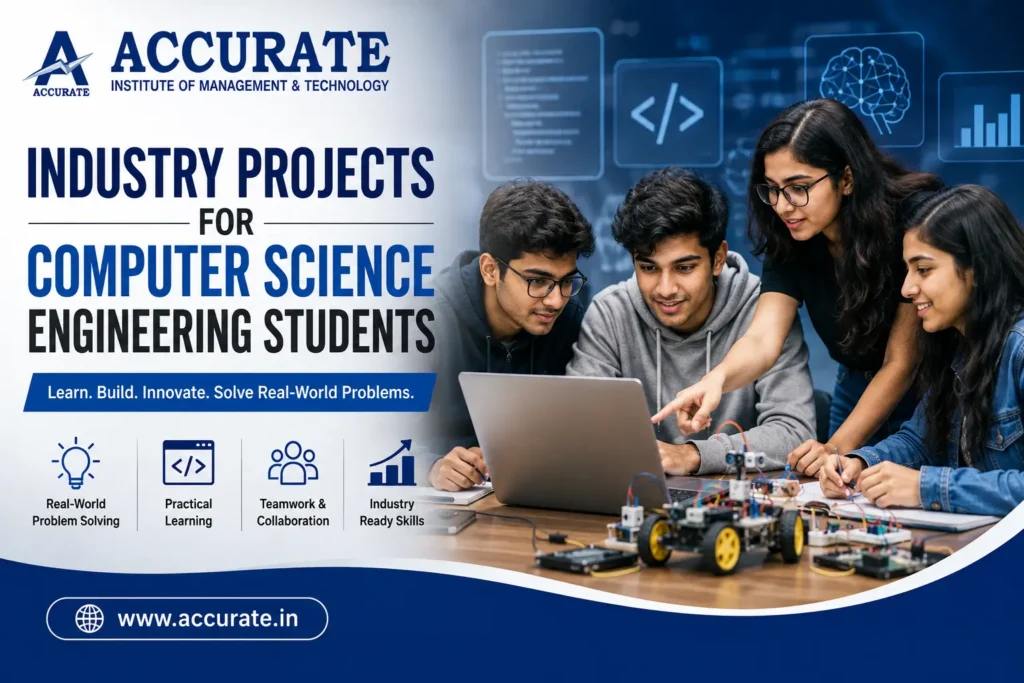

A Computer Science Engineering student may study programming languages, data structures, databases, operating systems, computer networks, artificial intelligence and software engineering during a B.Tech degree. But an important question remains:
Can the student combine those concepts to solve a real problem?
This is where industry projects for Computer Science Engineering students become valuable.
An industry-oriented project takes students beyond textbook exercises. Instead of writing a program only to demonstrate a concept, students begin thinking about users, requirements, performance, security, data, testing, deployment and practical limitations.
Consider the difference.
A classroom exercise may ask a student to create a database table.
An industry-oriented project may ask the student to build an inventory management application in which multiple users can add products, track stock, search records, generate reports and receive low-stock alerts.
The second task requires programming, database design, user experience, authentication, testing and business understanding to work together.
That is closer to how technology is applied professionally.
For B.Tech CSE students, well-designed industry projects can strengthen technical skills, improve problem-solving ability and create meaningful material for internships, resumes and technical interviews.
They can also help students answer one of the most important questions recruiters ask fresh graduates:
“What have you actually built?”
This guide explores practical industry-oriented project areas, how to select a project, how to develop it professionally and how institutions such as Accurate Institute of Management & Technology, Greater Noida can encourage students to connect computer science theory with application-oriented learning.
Table of Contents
- What Are Industry Projects for CSE Students?
- Why Industry Projects Matter in Computer Science Engineering
- Academic Projects vs Industry-Oriented Projects
- Skills Students Develop Through Industry Projects
- How to Select the Right CSE Industry Project
- Full-Stack Software Development Projects
- Artificial Intelligence and Machine Learning Projects
- Data Science and Analytics Projects
- Cloud Computing Projects
- Cybersecurity Projects
- Internet of Things Projects
- Automation and Productivity Projects
- Mobile Application Projects
- Database and Enterprise Application Projects
- How to Convert a Project Idea Into a Working Product
- How to Document an Industry Project
- GitHub and Portfolio Preparation
- Common CSE Project Mistakes to Avoid
- How Industry Projects Help With Placements
- Industry Projects and Practical Learning at Accurate Institute
- Frequently Asked Questions
- Conclusion and Admission CTA
What Are Industry Projects for Computer Science Engineering Students?
Industry projects are practical technology projects designed around real or realistic problems faced by companies, users, communities or organisations.
The project does not necessarily need to be sponsored by a major company to be industry-oriented.
What matters is the way the problem is approached.
A strong industry project normally includes:
- A defined problem
- Identified users
- Functional requirements
- Technical requirements
- Appropriate technologies
- System design
- Implementation
- Testing
- Documentation
- Measurable results
- Limitations
- Future improvements
For example, building a simple login page is useful practice.
Building a role-based employee-management system with authentication, permissions, database storage, audit records and reporting is much closer to an industry-oriented project.
Industry Projects Focus on Problems, Not Technologies
A common student mistake is starting with:
“I want to make a Python project.”
A stronger starting point is:
“I want to reduce the time required to identify stock shortages in a small retail business.”
Python, Java, JavaScript or another technology can then be selected based on the problem.
Industry thinking starts with the need and chooses technology afterward.
Why Industry Projects Matter in Computer Science Engineering
Modern employers often want evidence that graduates can move from concepts to implementation.
A student may list:
- Java
- Python
- SQL
- React
- Machine Learning
- AWS
But a recruiter may still ask:
“What did you build using these technologies?”
Projects make technical knowledge visible.
Projects Connect Multiple Subjects
Suppose students build a hospital appointment platform.
The application may involve:
Programming
Writing backend and frontend functionality.
Database Management
Storing patient, doctor and appointment information.
Computer Networks
Understanding how the application communicates over the internet.
Security
Protecting user credentials and sensitive information.
Software Engineering
Planning requirements, testing features and managing versions.
User Interface Design
Making the application usable.
One project can therefore connect several CSE subjects.
Projects Develop Engineering Thinking
Professional engineering involves trade-offs.
Should the application prioritise speed or simplicity?
Should data be stored locally or in the cloud?
How should users authenticate?
What happens when the internet connection fails?
How should errors be logged?
What if the number of users increases?
These are the kinds of questions that transform coding exercises into engineering experience.
Academic Projects vs Industry-Oriented Projects
Not every academic project needs to become a commercial product.
However, students can make academic projects more industry-oriented by improving the way they define, develop and test them.
A Basic Academic Project
“Build an attendance management system.”
An Industry-Oriented Version
“Design a secure attendance platform for a college department that allows faculty to record attendance, students to view records, administrators to generate monthly reports and authorised users to identify attendance shortages.”
The second version introduces users, permissions, reports and operational requirements.
What Makes a Project Industry Oriented?
An industry-oriented CSE project usually asks:
- Who will use the system?
- What problem does it solve?
- What are the requirements?
- What happens when something goes wrong?
- How will the system handle increasing usage?
- How will data be protected?
- How will the application be tested?
- How will performance be measured?
Thinking through these questions improves the technical depth of a project.
Skills CSE Students Develop Through Industry Projects
Industry projects are valuable because the final product is only one part of the learning.
The development process itself builds important skills.
Programming Skills
Students learn how to write code that performs more than isolated textbook tasks.
Debugging
Real applications rarely work perfectly on the first attempt.
Students must identify errors, test assumptions and fix problems systematically.
Database Design
Many projects require structured data storage, relationships, queries and database optimisation.
Software Architecture
Students learn how components such as interfaces, APIs, databases and external services interact.
Version Control
Git and similar tools help students manage code changes and collaborate with teammates.
Testing
Students begin asking whether a system works under different conditions rather than checking only one successful example.
Documentation
A professional project should be understandable to someone who did not build it.
Teamwork
Larger projects require division of responsibility, communication and integration.
Presentation
Students must learn to explain what they built, why they built it and how it works.
These skills are relevant to both internships and entry-level technology roles.
How to Select the Right Industry Project for CSE
The “best” project is not automatically the most complicated one.
A smaller project executed well can demonstrate more skill than an ambitious project that barely works.
Step 1: Identify a Real Problem
Look around you.
Potential problems may exist in:
- Colleges
- Shops
- Hospitals
- Transport
- Agriculture
- Logistics
- Small businesses
- Offices
- Homes
- Manufacturing
- Public services
Talk to potential users when possible.
Ask what takes too long, causes mistakes or creates unnecessary manual work.
Step 2: Define the User
Do not build for “everyone.”
Identify a primary user.
For example:
“College placement coordinator”
is clearer than:
“Students and companies and teachers and everybody.”
Step 3: Define the Minimum Viable Project
Students frequently try to build too many features.
Start with the smallest functional version that solves the core problem.
Then improve it.
Step 4: Choose the Technology Stack
Choose technologies based on requirements and your learning goals.
Avoid adding blockchain, AI or cloud components simply because they sound advanced.
Step 5: Define Success
How will you know the project works?
Possible measures include:
- Reduced processing time
- Improved prediction accuracy
- Lower manual effort
- Faster search
- Successful detection rate
- Reduced errors
A measurable result makes a project easier to evaluate and explain.
Industry Project 1: Full-Stack Inventory Management System
Inventory management is a useful real-world problem for CSE students.
Small businesses need to know what products are available, what is running low and what has been sold.
Possible Features
Students could implement:
- User login
- Product creation
- Inventory updates
- Search
- Supplier records
- Stock alerts
- Sales records
- Reports
- Role-based access
Skills Developed
This project can involve:
- Frontend development
- Backend programming
- Databases
- Authentication
- APIs
- Reporting
- Testing
Make It More Industry Ready
Add audit logs showing who modified inventory.
Add role permissions.
Create automatic low-stock notifications.
Include backup and recovery planning.
Now the project becomes much stronger than a basic CRUD application.
Industry Project 2: Customer Support Ticket Management Platform
Companies often manage customer complaints through ticket systems.
Students can build a simplified support platform.
Core Features
- Ticket creation
- Category selection
- Priority levels
- Status tracking
- Staff assignment
- Search
- Comments
- Notifications
- Resolution history
Advanced Improvements
Students can add:
- Automatic category prediction
- Response-time tracking
- Analytics dashboard
- Email integration
- Sentiment analysis
This project introduces workflow thinking and helps students understand how software supports business operations.
Industry Project 3: AI-Based Recommendation System
Recommendation systems appear in e-commerce, entertainment, education and content platforms.
A student project could recommend:
- Books
- Courses
- Products
- Movies
- Articles
- Learning resources
Technical Concepts
Students can explore:
- Collaborative filtering
- Content-based filtering
- Similarity measures
- User profiles
- Evaluation metrics
Industry-Oriented Approach
Do not stop after generating recommendations.
Ask:
- How will new users receive recommendations?
- How will the system handle sparse data?
- How will recommendation quality be evaluated?
- Could recommendations create bias?
These questions demonstrate deeper AI thinking.
Industry Project 4: Predictive Maintenance System
Predictive maintenance uses data to identify signs that equipment may require attention before it fails.
Students can build a simulated system using historical or sensor-based datasets.
Project Components
- Data collection
- Data cleaning
- Feature engineering
- Model development
- Prediction
- Dashboard
- Alerts
Why It Is Valuable
This project connects:
- Machine learning
- Data analytics
- Software development
- Industrial applications
Students should explain not only model accuracy but also the cost of false alarms and missed failures.
That makes the project more realistic.
Industry Project 5: Fraud Detection Prototype
Digital transactions require systems capable of identifying suspicious patterns.
A student fraud-detection project can use an available dataset and build a model to classify potentially fraudulent activity.
Learning Areas
- Data preprocessing
- Classification algorithms
- Class imbalance
- Evaluation metrics
- Anomaly detection
Avoid a Common Mistake
Accuracy alone can be misleading.
If only a tiny percentage of transactions are fraudulent, a model that labels everything “normal” may still appear highly accurate.
Students should examine metrics such as precision and recall.
This shows stronger data-science understanding.
Industry Project 6: Student Performance Analytics Dashboard
Educational institutions generate useful academic data.
Students can create a dashboard that helps authorised users identify performance trends.
Possible Features
- Subject-wise performance
- Attendance patterns
- Semester comparison
- At-risk indicators
- Performance visualisation
- Downloadable reports
Important Consideration: Privacy
Student data should be handled responsibly.
Even in a prototype, students should think about:
- Access control
- Data minimisation
- Anonymisation
- Responsible predictions
Industry projects should develop ethical awareness alongside technical skill.
Industry Project 7: Cloud-Based Document Management System
Organisations need secure ways to upload, store, organise and retrieve documents.
A cloud-based document platform can provide useful exposure to modern application architecture.
Possible Features
- File upload
- Authentication
- Folder organisation
- Search
- Sharing permissions
- Version history
- Activity logs
Cloud Concepts Students Can Explore
- Object storage
- Cloud databases
- Identity management
- Serverless functions
- Backups
- Scaling
Students can also compare cost and performance decisions.
Industry Project 8: Cloud Cost Monitoring Dashboard
Cloud resources can create unnecessary expenses if they are not monitored carefully.
Students can create a simulated dashboard that analyses resource usage and identifies possible waste.
Features Could Include
- Resource inventory
- Usage charts
- Idle-resource warnings
- Budget alerts
- Cost trends
- Recommendations
This project can introduce students to the operational side of cloud computing instead of focusing only on deployment.
Industry Project 9: Cybersecurity Log Monitoring Tool
Cybersecurity teams analyse system logs to detect unusual activity.
Students can create a basic security monitoring application.
Possible Functions
- Import log files
- Detect repeated failed logins
- Identify unusual IP activity
- Highlight abnormal access times
- Generate alerts
- Create reports
Skills Developed
- Python or another scripting language
- Data parsing
- Pattern detection
- Cybersecurity concepts
- Dashboards
Students must work only with authorised or simulated systems and datasets.
The goal is defensive security learning.
Industry Project 10: Secure Authentication System
Authentication is fundamental to modern applications.
Students can build an authentication module that demonstrates security awareness.
Features
- Password hashing
- Email verification
- Password reset
- Multi-factor authentication prototype
- Role-based access
- Session management
What Students Should Explain
During evaluation, students should understand why plain-text password storage is dangerous and how secure authentication reduces risk.
The value is in understanding security decisions, not merely importing an authentication library.
Industry Project 11: Smart Energy Monitoring System
For students interested in IoT, a smart energy project can connect software with physical-world data.
A prototype can collect energy readings or work with simulated data.
System Components
- Sensors or simulated input
- Data transmission
- Storage
- Dashboard
- Usage analysis
- Alerts
Possible Industry Application
The solution could be adapted conceptually for:
- Offices
- Hostels
- Classrooms
- Shops
- Manufacturing facilities
Students can explore how energy data might support better decision-making.
Industry Project 12: Smart Asset Tracking System
Warehouses, hospitals and organisations need to know where important equipment is located.
Students can develop a prototype for asset tracking.
Features
- Asset registration
- Location updates
- Search
- Ownership or department assignment
- Movement history
- Alerts
The solution can combine web development, databases and, where appropriate, IoT technologies.
Industry Project 13: Environmental Monitoring Dashboard
Students can create a system for monitoring environmental measurements such as temperature, humidity or air quality.
Learning Opportunities
The project may involve:
- Sensors
- APIs
- Databases
- Time-series data
- Visualisation
- Alerts
- Cloud services
Move Beyond Displaying Data
A stronger version might detect unusual changes, generate threshold alerts or compare multiple locations.
Industry Project 14: Workflow Automation Platform
Many organisations perform repetitive tasks manually.
Students can identify one such workflow and automate it.
Possible examples include:
- Report generation
- Certificate generation
- Leave requests
- Approval tracking
- Invoice processing
- Reminder systems
Automation projects can be extremely valuable because their benefit is easy to explain.
If the application reduces a 30-minute manual task to several minutes, the impact becomes measurable.
Industry Project 15: Recruitment Management System
Recruitment involves job applications, candidate screening, interviews and status tracking.
A student recruitment platform can include:
- Candidate registration
- Resume upload
- Job listings
- Application tracking
- Interview scheduling
- Status updates
- Recruiter dashboard
Advanced Extensions
Students might add:
- Skill-based search
- Interview feedback forms
- Application analytics
Students should avoid designing automated systems that unfairly reject candidates based on opaque or biased criteria.
Industry Project 16: College Placement Management Portal
This project is especially relevant to engineering students because they understand the user problem directly.
Potential Features
- Student profiles
- Eligibility criteria
- Placement notices
- Company registrations
- Application tracking
- Interview schedules
- Training records
- Placement coordinator dashboard
Why It Is a Strong Project
Students can access potential users—classmates and placement teams—to better understand requirements.
User feedback can improve the project significantly.
Industry Project 17: Smart Learning Management Platform
An educational platform can help students organise learning resources, quizzes and progress.
Core Features
- Course creation
- Student enrolment
- Video/resource modules
- Assessments
- Progress tracking
- Instructor dashboard
Advanced Possibilities
Students might explore:
- Adaptive recommendations
- Difficulty analysis
- Learning analytics
Again, additional technology should solve a defined problem rather than being added only for novelty.
Industry Project 18: Healthcare Appointment Management System
Healthcare scheduling provides an interesting software-engineering challenge.
A student prototype may allow:
- Patient registration
- Doctor availability
- Appointment booking
- Rescheduling
- Reminders
- Administrative management
Important Considerations
Students should think about:
- Privacy
- Access permissions
- Data validation
- Availability conflicts
Healthcare projects should be presented as educational prototypes unless developed within proper professional and regulatory frameworks.
Industry Project 19: Logistics and Delivery Tracking Platform
Logistics companies need visibility into orders and deliveries.
Students can develop a system that manages:
- Orders
- Shipment status
- Delivery personnel
- Location updates
- Estimated delivery information
- Notifications
Advanced Extension
Students can experiment with route optimisation using simulated data.
This connects algorithms with business operations.
Industry Project 20: Business Intelligence Dashboard
Businesses often collect data but struggle to convert it into useful insight.
Students can build a dashboard using sales, customer or operational data.
Project Workflow
Data Collection
Import data from spreadsheets, databases or APIs.
Cleaning
Correct missing or inconsistent values.
Analysis
Identify trends and patterns.
Visualisation
Create meaningful charts and indicators.
Interpretation
Explain what the data suggests.
This final stage matters.
A dashboard is not useful simply because it contains attractive charts.
Students should be able to explain what decisions the information could support.
How to Convert a Project Idea Into a Working Industry Project
A good idea is only the starting point.
Students need a structured development process.
Step 1: Write the Problem Statement
Keep it concise.
For example:
“Small retail stores often track inventory manually, making it difficult to identify low-stock products quickly.”
Step 2: Identify Users
Who will use the system?
- Owner
- Staff member
- Administrator
- Customer
Step 3: Write Functional Requirements
Describe what the system must do.
Step 4: Write Non-Functional Requirements
Think about:
- Security
- Reliability
- Performance
- Usability
- Scalability
Step 5: Design the Architecture
Draw how components connect.
For example:
User Interface → API → Application Server → Database
Step 6: Build a Prototype
Develop essential functionality first.
Step 7: Test
Test successful and unsuccessful scenarios.
Do not test only what you expect users to do correctly.
Step 8: Collect Feedback
Ask users or mentors to evaluate the prototype.
Step 9: Improve
Prioritise genuine weaknesses rather than continuously adding features.
Step 10: Document the Final System
A project is incomplete if nobody can understand how it works.
How to Document an Industry Project
Good documentation makes a student project easier to evaluate.
Include:
Problem Statement
What problem are you solving?
Target User
Who needs the solution?
Objectives
What should the system achieve?
Technology Stack
Which languages, frameworks, databases and platforms are used?
Architecture
How do the components interact?
Features
What can users do?
Testing
How did you verify functionality?
Results
What did the project achieve?
Limitations
What does it not solve?
Future Scope
How could it be improved?
Honest limitations improve a report because they demonstrate engineering judgement.
Build a Strong GitHub Project Portfolio
For software-oriented projects, a well-organised repository can strengthen a student’s technical profile.
A Good Repository Should Include
- Clear project title
- Description
- Technology stack
- Installation instructions
- Features
- Screenshots where useful
- Usage instructions
- Known limitations
Keep code organised.
Remove unnecessary files.
Do not upload passwords, API keys or confidential information.
Commit History Matters
Version control should represent development progress.
Instead of one final upload called “project complete,” students should practise making logical commits as work develops.
This mirrors professional workflows more closely.
How to Explain Your Project During a Technical Interview
A strong project is valuable only when a student can explain it.
Use this sequence:
Problem
What issue were you trying to solve?
Users
Who would use the system?
Your Contribution
What exactly did you build?
Technology
Why did you choose the stack?
Architecture
How do the components communicate?
Challenge
What technical problem did you encounter?
Solution
How did you fix it?
Result
What worked?
Limitation
What would you improve next?
This structure gives interviewers evidence that you understand your work.
Common Industry Project Mistakes CSE Students Should Avoid
Copying Complete Projects
If students download a ready-made project and change the title, they lose most of the learning value.
Interviewers can expose superficial understanding quickly.
Selecting Projects Only Because They Sound Advanced
“Blockchain-based AI-powered cloud IoT cybersecurity platform” may sound impressive.
It may also be meaningless.
Use technologies only when they solve a genuine requirement.
Building Too Many Features
Complete the core system first.
Ignoring Testing
Working once on your laptop is not enough evidence of reliability.
Ignoring Security
Authentication, data validation and access controls matter in many projects.
Ignoring Documentation
A strong project should be understandable months after it is completed.
Failing to Understand Team Contributions
If four students built the project, each person should clearly explain their own work as well as the overall architecture.
Stopping Immediately After Submission
A college submission date should not necessarily be the end of a useful project.
Improve strong projects after feedback and turn them into portfolio pieces.
How Industry Projects Help CSE Students With Placements
Industry-oriented projects can support placement preparation in several ways.
They Strengthen the Resume
A project provides evidence behind technical skills.
Instead of listing:
“Python, SQL, Flask”
students can describe a system they created using those technologies.
They Improve Technical Interviews
Projects give interviewers practical areas to discuss.
Students who understand their projects thoroughly can demonstrate programming, database, architecture and debugging knowledge through one conversation.
They Improve Communication
Explaining a project repeatedly helps students become better at technical communication.
They Build Confidence
Building something that genuinely works creates a different kind of confidence from completing a tutorial.
They Reveal Skill Gaps
A project may show students that they understand coding but need stronger database knowledge.
Or that they know machine learning but do not understand deployment.
This feedback helps guide future preparation.
Industry Projects and Practical Learning at Accurate Institute of Management & Technology
A strong engineering environment should encourage students to move from understanding concepts to applying them.
Accurate Institute of Management & Technology, Greater Noida, places emphasis on practical and application-oriented engineering education alongside academic foundations.
Its broader engineering approach highlights activities such as laboratory work, mini-projects, coding sessions, workshops, technical events and projects connected with industrial problems.
For CSE students, this kind of environment matters because meaningful technical capability develops through repeated practice.
A student first learns programming.
Then the student writes small programs.
Later, those programs become components of larger systems.
Eventually, students can integrate interfaces, databases, APIs, cloud services, analytics or intelligent features into more sophisticated applications.
From Mini Projects to Portfolio Projects
Students should ideally treat projects as a progression.
Early Stage
Build small applications that strengthen programming confidence.
Intermediate Stage
Create projects involving databases, APIs and user interfaces.
Advanced Stage
Develop multidisciplinary systems using cloud computing, AI, data analytics, cybersecurity or IoT where appropriate.
Final Stage
Create a capstone project demonstrating both technical depth and clear problem solving.
This progression allows students to show visible growth.
Learning Through Workshops and Technical Activities
Workshops, hackathons and coding events can expose students to new tools and new ways of approaching problems.
They can also encourage teamwork under deadlines.
For example, a hackathon may require students to understand a problem, select a technology, divide responsibilities, build a prototype and present the solution within a limited period.
That experience develops more than programming skill.
It develops judgement.
Connecting Projects With Career Preparation
Accurate’s career-development approach also includes coding practice, aptitude preparation, communication development and mock interviews.
Projects can strengthen this placement preparation because students have genuine technical experiences to discuss.
Instead of giving memorised answers during an interview, they can explain:
- A design decision
- A bug they solved
- A database they created
- A feature they implemented
- A failed experiment
- A test result
- A team challenge
These examples make interview conversations more authentic.
How CSE Students Can Make the Most of Project Opportunities
A college can provide laboratories, mentoring, workshops and project opportunities.
Students still need to take responsibility for using them.
Build Something Every Year
Do not wait until the final-year project.
A simple progression could be:
First Year
Programming-based mini project
Second Year
Database-backed software application
Third Year
Domain-focused project in AI, cloud, cybersecurity, data or IoT
Final Year
Advanced industry-oriented capstone
Keep Everything Organised
Maintain:
- Code repositories
- Screenshots
- Reports
- Architecture diagrams
- Presentation files
- Test results
Improve Projects After Evaluation
Faculty feedback should become an improvement list.
Do not view marks as the only output.
Learn to Demonstrate Your Work
Students should be able to demonstrate projects without spending 20 minutes configuring the environment.
Prepare a clean demo.
Build Depth Before Quantity
Three excellent projects are generally more useful than 15 copied projects.
What Recruiters May Ask About a CSE Industry Project
Students should be ready for questions such as:
Why did you choose this project?
What problem does it solve?
Who are the users?
What was your individual contribution?
Why did you choose this programming language?
Why did you choose this database?
How does authentication work?
How did you test the system?
What was the biggest bug?
How did you solve it?
What happens if many users access it simultaneously?
What security risks exist?
What would you change if you had another month?
If you cannot answer these questions, revise the project before putting it on your resume.
Final Checklist for an Industry-Ready CSE Project
Before calling a project complete, check:
Problem: Is the problem clearly defined?
User: Do you know who needs the solution?
Functionality: Does the application actually work?
Code: Is the code understandable?
Database: Is data organised correctly?
Security: Have basic risks been considered?
Testing: Have multiple scenarios been tested?
Performance: Have you considered likely constraints?
Documentation: Can another person understand the system?
Repository: Is the code organised?
Contribution: Can every team member explain their work?
Results: Can you show what the project achieved?
Limitations: Can you explain what still needs improvement?
Presentation: Can you demonstrate the project confidently?
If you can answer yes to most of these questions, you have moved beyond simply completing a college assignment.
You have started thinking like an engineer.
Frequently Asked Questions About Industry Projects for Computer Science Engineering Students
1. What are industry projects for Computer Science Engineering students?
Industry projects for CSE students are practical software or technology projects designed around real or realistic problems. They usually involve requirements, programming, system design, databases, testing, documentation and measurable outcomes. Examples include business applications, AI systems, cloud platforms, cybersecurity tools, IoT systems and data analytics solutions.
2. Which industry project is best for CSE students?
The best industry project depends on the student’s interests and career goals. Software-development aspirants can build full-stack applications, AI students can develop recommendation or prediction systems, cloud learners can create scalable applications, cybersecurity students can build defensive monitoring tools, and data students can develop analytics platforms. Quality of implementation matters more than project complexity.
3. Which projects are best for CSE placements?
Projects that demonstrate genuine technical ability are best for placements. Strong options include full-stack applications, machine learning systems, cloud applications, database-driven platforms, cybersecurity tools, analytics dashboards and IoT solutions. Students should choose projects they can explain thoroughly, including architecture, code, database design, testing and challenges.
4. How many projects should a CSE student have?
There is no fixed number. Two to four well-developed projects showing different or progressively deeper skills can be more valuable than a long list of superficial projects. Students should prioritise quality, originality, technical understanding and documentation rather than simply increasing the project count.
5. Are AI and machine learning projects good for Computer Science students?
Yes. AI and machine learning projects can be valuable when students understand the data, algorithms, evaluation metrics and limitations. A project should not simply call an AI API and be labelled an AI project. Students should be able to explain why the chosen approach is appropriate and how its performance was assessed.
6. What makes a CSE project industry ready?
An industry-ready CSE project has a clear problem statement, defined users, functional and non-functional requirements, appropriate architecture, working implementation, security awareness, testing, documentation and measurable results. Students should also explain limitations and future improvements honestly.
7. Should CSE students upload projects to GitHub?
Uploading suitable software projects to GitHub can help students organise code, practise version control and create visible evidence of development work. Repositories should include clear documentation and should never expose passwords, secret keys, proprietary code or confidential data.
8. How do industry projects help with technical interviews?
Industry projects give candidates concrete experiences to discuss during technical interviews. Recruiters can explore programming, databases, architecture, debugging, testing, teamwork and problem solving through project questions. Students who genuinely understand their projects often find it easier to demonstrate technical ability than candidates who rely only on theoretical answers.
9. How does Accurate Institute support project-based engineering learning?
Accurate Institute of Management & Technology’s engineering learning approach emphasises practical exposure through laboratories, mini-projects, workshops, coding activities, technical events and project-based learning. Students can use these opportunities to develop practical problem-solving ability and progressively build stronger technical portfolios.
10. Why consider Accurate Institute for B.Tech CSE?
Students may consider Accurate Institute of Management & Technology for its Greater Noida location, recognised engineering framework, practical-learning approach, technical activities, project culture and career-development support. Applicants should review the current B.Tech CSE programme, curriculum, laboratories, available specialisations, admission eligibility and current placement information directly with the institute before making a final decision.
Conclusion: Industry Projects Turn CSE Knowledge Into Demonstrable Skills
The real value of industry projects for Computer Science Engineering students is not the title printed on a project report.
It is the transformation that happens while building the project.
A student begins with a problem.
Then comes research.
Requirements must be understood.
Technologies must be selected.
Code must be written.
Databases must be designed.
Errors must be debugged.
Security must be considered.
The system must be tested.
Results must be evaluated.
Finally, the entire solution must be explained to another person.
That process brings Computer Science subjects together.
It also develops the abilities employers expect from engineering graduates: programming, problem solving, technical judgement, communication, teamwork and continuous learning.
Students should therefore avoid treating projects as compulsory files to submit before semester examinations.
Instead, view every project as an opportunity to build evidence.
Evidence that you can code.
Evidence that you can solve problems.
Evidence that you can learn unfamiliar technology.
Evidence that you can build something useful.
Evidence that you can explain your decisions.
As technologies such as artificial intelligence, cloud computing, cybersecurity, data science, automation and the Internet of Things continue to evolve, students who know how to learn through projects will be better positioned to adapt.
Build Your CSE Future at Accurate Institute of Management & Technology
If you are planning to pursue B.Tech Computer Science and Engineering in Greater Noida, choose a learning environment where classroom concepts can move into coding, experimentation, projects and career preparation.
At Accurate Institute of Management & Technology, engineering education places emphasis on practical learning, technical foundations, project work, workshops, skill development and professional readiness.
Students can use these opportunities to progress from basic programming exercises to stronger applications and multidisciplinary projects while building the technical confidence required for internships and placements.
Explore the B.Tech CSE programmes at Accurate Institute of Management & Technology, Greater Noida. Review the current curriculum, laboratories, project opportunities, technical activities, specialisations, placement-development support and admission requirements.
Speak with the admission team to confirm the latest eligibility, fees, scholarships, available seats and application process.
Do not choose a Computer Science degree only for the subjects you will study. Choose an environment that encourages you to build, test, improve and demonstrate what you learn. Explore B.Tech CSE admission at Accurate Institute of Management & Technology and begin turning Computer Science knowledge into practical, industry-relevant skills.