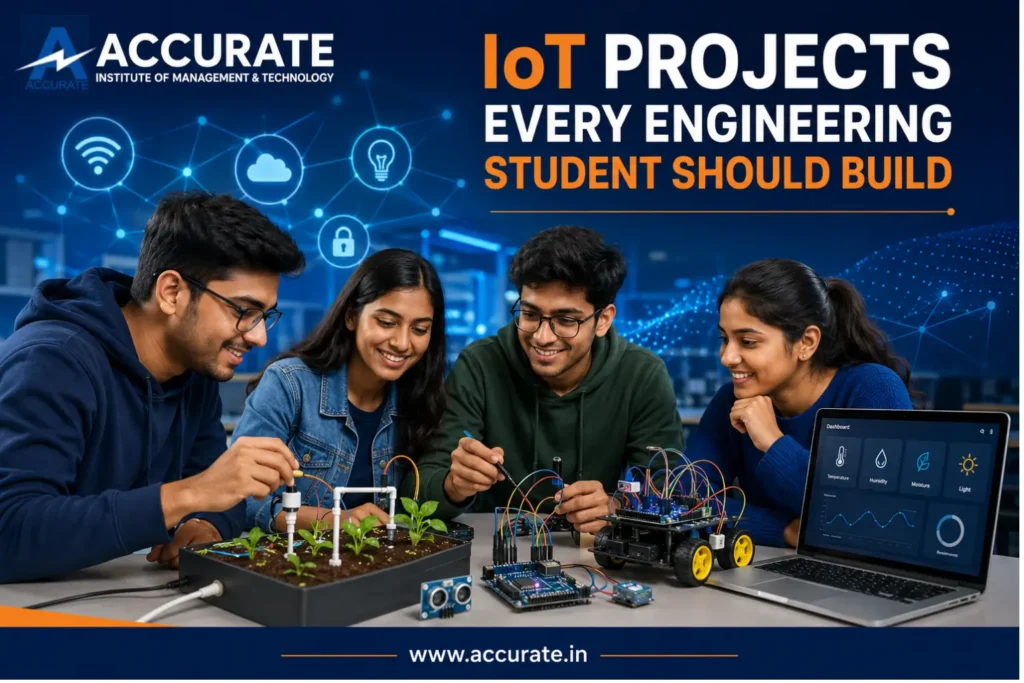

The Internet of Things has transformed ordinary devices into intelligent systems capable of sensing, communicating, analysing information and responding automatically. Smart homes, connected vehicles, wearable health monitors, industrial equipment, agricultural sensors and intelligent energy grids are all powered by IoT technologies.
For engineering students, understanding IoT only through classroom theory is not enough. The most effective way to learn the subject is to build working projects. A practical project helps students understand how sensors, microcontrollers, communication networks, cloud platforms, mobile applications and data analytics work together.
The best IoT projects every engineering student should build include a smart home automation system, weather-monitoring station, healthcare monitoring device, smart irrigation system, energy meter, security system, air-quality monitor and industrial equipment monitoring solution. These projects develop programming, electronics, networking, cloud computing and problem-solving skills.
Engineering students do not have to begin with an expensive or highly complicated system. A simple sensor connected to an Arduino or ESP32 can become the foundation of an impressive IoT project. As students gain confidence, they can add cloud dashboards, mobile alerts, artificial intelligence and automation features.
Accurate Institute of Management & Technology encourages students to connect engineering concepts with practical applications. By working on relevant projects, aspiring engineers can develop technical confidence, create stronger portfolios and prepare themselves for internships, placements, entrepreneurship and higher education.
Table of Contents
- What Is an IoT Project?
- Why Engineering Students Should Build IoT Projects
- Essential Components of an IoT Project
- Skills Developed Through IoT Projects
- IoT Projects Every Engineering Student Should Build
- How to Select the Right IoT Project
- A Step-by-Step IoT Project Development Process
- Common Mistakes Students Should Avoid
- How IoT Projects Improve Career Opportunities
- Why Study IoT at Accurate Institute of Management & Technology?
- Future Scope of Student IoT Projects
- Frequently Asked Questions
- Conclusion
What Is an IoT Project?
An IoT project is a connected system in which physical devices collect information, exchange data through a network and perform useful actions. These devices may include sensors, microcontrollers, machines, appliances, cameras, wearable devices or vehicles.
A typical IoT system includes four important stages:
- Sensors collect information from the physical environment.
- A microcontroller or processor reads and processes the information.
- A communication network transfers the data.
- A cloud platform, dashboard or mobile application displays the information and allows users to control the system.
For example, a smart irrigation project can use a soil-moisture sensor to check whether the soil is dry. The sensor sends its reading to a microcontroller. If the moisture level falls below a selected limit, the system activates a water pump. The user may also receive a mobile notification or view the soil condition through an online dashboard.
This combination of sensing, connectivity, analysis and automated action makes IoT one of the most interdisciplinary areas of engineering.
Why Engineering Students Should Build IoT Projects
IoT projects allow engineering students to apply concepts from multiple subjects to one practical problem. A single project may require knowledge of programming, electronics, communication protocols, databases, cloud computing, mobile applications and cybersecurity.
Converting Theory into Practical Knowledge
Students may learn about sensors, voltage, programming logic and network communication in separate classes. An IoT project shows how these concepts operate together in a complete system.
When a project does not work as expected, students learn how to test connections, inspect sensor data, correct code and improve system reliability. This hands-on troubleshooting creates deeper understanding than memorising definitions.
Developing Industry-Relevant Skills
Organisations increasingly use connected devices for automation, asset monitoring, predictive maintenance, healthcare, agriculture and energy management. Students who understand how to build and explain an IoT system may be better prepared for internships and entry-level technical roles.
Creating a Strong Engineering Portfolio
A functional prototype can demonstrate a student’s abilities more effectively than a simple list of subjects on a resume. Students can document the problem, architecture, hardware, code, dashboard, test results and future improvements.
A portfolio containing two or three well-developed projects can show recruiters that the student knows how to take an idea from planning to implementation.
Encouraging Innovation and Entrepreneurship
Many IoT projects begin with problems visible in everyday life. Students can identify an issue in their home, college, neighbourhood, farm or local industry and design a connected solution.
With further testing and development, a student project may evolve into a product, patent, research paper or startup idea.
Essential Components of an IoT Project
Before selecting a project, engineering students should understand the basic building blocks of an IoT system.
Sensors and Actuators
Sensors measure conditions such as temperature, humidity, motion, pressure, light, distance, gas concentration, heart rate or soil moisture.
Actuators perform physical actions. Motors, pumps, relays, buzzers, lights and electronic locks are common examples. A sensor tells the system what is happening, while an actuator enables the system to respond.
Microcontrollers and Processing Boards
Arduino boards are suitable for basic electronics and automation projects. ESP8266 and ESP32 boards are popular because they provide built-in wireless connectivity. Raspberry Pi can be used when a project requires greater computing capability, image processing or a complete operating system.
Students should choose a board according to the project’s processing, connectivity, power and cost requirements.
Communication Technologies
Connected devices can exchange information through Wi-Fi, Bluetooth, Zigbee, RFID, NFC, LoRaWAN, cellular networks or other communication technologies.
The appropriate technology depends on the required range, data speed, power consumption, security and operating environment.
Cloud Platforms and Databases
Cloud services allow IoT systems to store information, generate graphs, issue alerts and support remote access. Students can also create a local server or database when they want greater control over the system.
User Interface
An IoT project becomes more useful when users can understand and control it easily. The interface may be a mobile application, website, cloud dashboard, touchscreen or simple display.
Security Mechanisms
IoT security should be considered from the beginning. Strong authentication, secure communication, access control, software updates and responsible data collection are essential for protecting devices and users.
Skills Developed Through IoT Projects
Students who consistently work on IoT projects can develop a valuable combination of technical and professional abilities.
Important technical skills include:
- Embedded programming
- Sensor integration
- Circuit design
- Microcontroller programming
- Wireless communication
- Cloud connectivity
- Database management
- Dashboard development
- Mobile or web application development
- Data analysis
- System testing
- Basic cybersecurity
IoT projects also improve teamwork, research, documentation, presentation and project-management skills. Students learn how to divide responsibilities, manage components, follow timelines and explain technical ideas clearly.
IoT Projects Every Engineering Student Should Build
The following project ideas range from beginner-friendly prototypes to more advanced systems. Students can begin with the essential features and add improvements according to their skills.
1. Smart Home Automation System
A smart home automation system is one of the most useful beginner IoT projects. It allows users to monitor and control lights, fans and electrical appliances through a smartphone or web application.
How the Project Works
An ESP32 or similar board connects appliances to the internet through relays. The user sends commands from an application or dashboard. The system receives the instructions and switches the selected appliance on or off.
Students can add motion sensors, temperature sensors, voice commands or scheduled controls.
Skills Gained
This project teaches relay control, wireless communication, mobile integration, basic circuit safety and user-interface development.
Possible Advanced Features
- Voice-controlled appliances
- Automatic lighting based on occupancy
- Energy-consumption tracking
- Different access levels for users
- Alerts for unusual appliance activity
2. IoT-Based Weather Monitoring Station
A connected weather station collects temperature, humidity, atmospheric pressure and rainfall information and displays it on an online dashboard.
How the Project Works
Environmental sensors continuously take measurements. A microcontroller processes the data and sends it to a cloud platform through Wi-Fi. Users can view current conditions and historical trends from any connected device.
Why Students Should Build It
This project introduces sensor calibration, cloud data storage, graphs and time-based analysis. It also teaches students that environmental readings must be checked for accuracy and consistency.
Possible Advanced Features
Students can include air-quality monitoring, rainfall prediction, automatic alerts and location-based comparisons.
3. Smart Irrigation and Soil-Monitoring System
A smart irrigation system uses real-time soil conditions to control water supply. It is an excellent example of how IoT can support agriculture and resource conservation.
How the Project Works
A soil-moisture sensor measures the water level in the soil. When the reading falls below a defined threshold, the microcontroller activates a pump. Once sufficient moisture is detected, the pump stops.
The information can be displayed on a mobile dashboard, allowing the user to monitor the farm or garden remotely.
Learning Outcomes
Students learn sensor-based automation, pump control, threshold programming, environmental monitoring and remote notifications.
Possible Advanced Features
- Weather-forecast integration
- Multiple irrigation zones
- Water-flow monitoring
- Crop-specific moisture settings
- Solar-powered operation
4. Wearable Health-Monitoring Device
A wearable health-monitoring project collects selected health-related measurements and sends them to an application or dashboard.
How the Project Works
Sensors may record heart rate, body temperature or blood oxygen readings. A microcontroller processes the values and transfers them through Bluetooth or Wi-Fi.
This should be treated as an educational prototype rather than a medical diagnostic device. Students must clearly explain the limitations of low-cost sensors and protect any personal data collected during testing.
Skills Gained
Students develop knowledge of wearable electronics, sensor placement, signal quality, low-power design, data privacy and real-time monitoring.
Advanced Possibilities
The system may generate alerts when a reading crosses a selected limit, maintain a historical record or allow authorised caregivers to view information remotely.
5. Smart Energy Meter
A smart energy meter helps users understand electricity consumption and identify opportunities to reduce waste.
How the Project Works
Suitable sensors measure voltage and current, while the controller estimates power and energy consumption. Data is sent to a dashboard where the user can view usage patterns.
Students must use proper isolation and supervision while working with electrical systems. A low-voltage simulation is safer for beginners.
Project Benefits
This project teaches measurement, data visualisation, cost estimation and energy-management concepts.
Possible Advanced Features
- Appliance-wise energy tracking
- Consumption-limit alerts
- Daily and monthly reports
- Estimated electricity costs
- Automatic control of non-essential loads
6. IoT-Based Smart Security System
A smart security system detects unauthorised movement or entry and alerts the user remotely.
How the Project Works
Motion sensors, magnetic door sensors or cameras monitor a selected area. When suspicious activity is detected, the system activates an alarm and sends a notification.
Skills Gained
Students learn event detection, real-time alerts, access control, camera integration and remote monitoring.
Possible Advanced Features
- RFID-based access
- Face recognition
- Encrypted event records
- Temporary visitor access
- Emergency contact notifications
Students should design security projects responsibly and avoid collecting images or personal information without permission.
7. Smart Parking Management System
Finding an available parking space can be difficult in crowded campuses, offices and commercial areas. A smart parking system uses sensors to identify vacant spaces.
How the Project Works
Distance or infrared sensors are installed at individual parking spaces. Each sensor reports whether its space is occupied. A dashboard or display guides drivers towards available locations.
Why It Is Valuable
The project combines multiple sensors, centralised monitoring and real-time status updates. It can also be demonstrated effectively through a small model.
Possible Advanced Features
- Mobile-based slot reservation
- QR-code access
- Automated entry and exit
- Parking-duration tracking
- Digital payment integration
8. Air-Quality Monitoring System
Air pollution is an important concern in urban and industrial environments. An IoT air-quality monitor can collect environmental readings and provide location-specific alerts.
How the Project Works
Sensors measure selected gases, particulate levels, temperature and humidity. The controller sends readings to a dashboard, where users can view changes over time.
Low-cost sensors may require calibration and should not be presented as replacements for certified monitoring equipment.
Skills Gained
This project builds knowledge of environmental sensors, calibration, cloud storage, data interpretation and alert generation.
Possible Advanced Features
Students can create a multi-location monitoring network, compare indoor and outdoor air quality or use machine learning to study patterns.
9. Smart Waste-Management System
A smart waste-management project monitors the fill level of waste containers and helps improve collection planning.
How the Project Works
An ultrasonic sensor measures the empty space inside a bin. When the container reaches a selected level, the system sends a notification to the responsible team.
Learning Outcomes
Students understand distance sensing, remote alerts, battery management and practical urban IoT applications.
Possible Advanced Features
- Location tracking
- Route planning for collection vehicles
- Waste-category identification
- Dashboard for multiple bins
- Fire or harmful-gas detection
10. Industrial Equipment Monitoring System
Industrial IoT projects help students understand how connected technologies are used in manufacturing and maintenance.
How the Project Works
Sensors monitor equipment conditions such as vibration, temperature or operating time. The information is displayed on a dashboard. An alert is generated when readings move outside normal limits.
Why It Matters
Unexpected equipment failure can interrupt production. Condition monitoring may help maintenance teams identify unusual patterns before a serious breakdown occurs.
Advanced Features
Students can add machine-learning-based anomaly detection, maintenance records and role-based dashboard access. Any claim of failure prediction should be supported by sufficient data and careful testing.
11. Smart Attendance System
A connected attendance system can record classroom or laboratory attendance using RFID, QR codes or another approved identification method.
How the Project Works
Each authorised user presents an ID card or code. The controller records the user identity and time, then sends the information to a secure database.
Skills Gained
Students learn identification technologies, database integration, time-stamped records and dashboard development.
Ethical Considerations
The project should collect only necessary information. Students should provide transparency, protect records and avoid intrusive identification methods unless they have proper consent.
12. Water-Level and Leakage Monitoring System
This project monitors water stored in a tank and detects possible leakage in a pipeline or building.
How the Project Works
Water-level sensors check the tank, while flow or moisture sensors detect abnormal conditions. The system can automatically control a pump and alert the user about overflow, low supply or leakage.
Learning Outcomes
Students learn sensor integration, automation logic, flow monitoring and resource-management concepts.
Possible Advanced Features
- Automatic pump protection
- Daily water-usage reports
- Multiple tank monitoring
- Mobile alerts
- Consumption forecasting
13. Connected Cold-Storage Monitoring System
Certain medicines, food products and laboratory materials need controlled storage conditions. An IoT monitoring system can record temperature and humidity continuously.
How the Project Works
Sensors measure storage conditions and send readings to a secure dashboard. If the conditions exceed approved limits, the system generates an alert.
Skills Gained
Students learn real-time monitoring, data logging, threshold alerts and reliability planning.
Advanced Features
- Backup connectivity
- Battery-status monitoring
- Escalation to multiple users
- Downloadable compliance reports
- Sensor-failure alerts
14. Smart Streetlight Prototype
A smart streetlight system adjusts lighting according to surrounding conditions and activity.
How the Project Works
A light sensor detects day and night, while a motion sensor detects nearby movement. The light remains dim when an area is empty and becomes brighter when movement is identified.
Project Benefits
This prototype teaches automation, energy efficiency, sensor fusion and remote monitoring.
Students can create a model containing several streetlights and control them through one dashboard.
15. IoT-Based Disaster Alert System
A disaster alert prototype monitors conditions associated with events such as flooding, fire or harmful gas leakage.
How the Project Works
Water-level, smoke, flame or gas sensors send information to a controller. When the readings cross established thresholds, the system activates a local alarm and transmits a remote alert.
Important Design Considerations
A student prototype must not be represented as a certified emergency system. Real-world safety applications require reliable sensors, backup power, multiple communication channels and extensive testing.
This project nevertheless teaches students how reliability, response time and communication become critical in safety-related engineering.
How to Select the Right IoT Project
Students should select a project according to their current skills, available time, budget and learning goals.
Begin with a Real Problem
A project becomes more meaningful when it addresses a specific problem. Instead of building a generic sensor system, students can ask:
- Who will use the system?
- What difficulty will it solve?
- What information must be collected?
- What action should occur?
- How will success be measured?
Match Complexity to Experience
Beginners can begin with one sensor, one microcontroller and one dashboard. Intermediate students can add multiple devices and mobile notifications. Advanced students may explore edge computing, machine learning, cybersecurity and scalable cloud architecture.
Check Component Availability
Students should prepare a complete list of sensors, boards, power supplies, communication modules and mechanical components before finalising the idea.
Consider Safety and Privacy
Projects involving electricity, health readings, cameras, location information or personal identity require extra care. Students must use safe testing methods and collect personal data only with informed permission.
Plan for Demonstration
A successful demonstration should clearly show the problem, live sensor input, data transmission, user interface and automated response. The system should also be simple enough to troubleshoot before evaluation.
Step-by-Step Process for Developing an IoT Project
Step 1: Define the Problem
Write a short statement describing the problem, intended users and expected outcome. A clear definition prevents unnecessary features from being added later.
Step 2: Identify Functional Requirements
List what the system must do. Separate essential functions from optional improvements.
For example, the essential functions of a smart irrigation system may include soil-moisture measurement and pump control. Weather integration can be treated as an advanced feature.
Step 3: Design the Architecture
Prepare a diagram showing the sensors, controller, network, cloud service, database and interface. Decide how data will move through the system.
Step 4: Select Hardware and Software
Choose components according to performance, compatibility, cost, availability and power requirements. Select a programming language, communication method and dashboard platform.
Step 5: Build a Small Prototype
Test each component separately. First read the sensor, then control the actuator, connect the device to a network and finally send the data to the interface.
Step 6: Integrate the System
Combine the tested modules gradually. Modular integration makes errors easier to identify.
Step 7: Test Different Conditions
Test normal use, weak connectivity, sensor errors, power interruption and unexpected input. Record results instead of relying on a single successful demonstration.
Step 8: Improve Security
Change default passwords, protect access credentials, validate commands and limit system permissions. Sensitive keys should not be exposed in publicly shared code.
Step 9: Document the Project
A good report should include:
- Problem statement
- Objectives
- System architecture
- Component list
- Circuit design
- Software explanation
- Testing method
- Results
- Limitations
- Cost analysis
- Future improvements
Step 10: Present the Outcome
Explain what problem was solved, how the system operates and what was learned. A short live demonstration, supported by clear diagrams and test results, can make the presentation convincing.
Common Mistakes Engineering Students Should Avoid
One common mistake is selecting a project only because it appears impressive. A smaller, reliable and well-documented system is often more valuable than a complicated prototype that cannot be explained.
Students should also avoid:
- Copying code without understanding it
- Adding too many features at the beginning
- Ignoring sensor calibration
- Testing only under ideal conditions
- Using unsafe electrical connections
- Leaving cloud credentials inside public code
- Collecting personal data without consent
- Claiming accuracy without evidence
- Ignoring documentation until the last day
- Depending entirely on internet connectivity
Students should be able to explain every major component, decision and limitation of their projects.
How IoT Projects Improve Career Opportunities
IoT projects can support careers in embedded systems, automation, cloud computing, electronics, software development, cybersecurity, data analytics, robotics and industrial technology.
Possible career paths include:
- IoT developer
- Embedded systems engineer
- Firmware engineer
- Automation engineer
- Hardware design engineer
- Cloud support engineer
- IoT solutions engineer
- Network engineer
- Industrial IoT engineer
- Product development engineer
- IoT security analyst
- Technical consultant
During an interview, a project gives students practical situations to discuss. They can explain how they selected components, solved connectivity problems, tested sensors and improved performance.
Recruiters are generally interested not only in the final output but also in the candidate’s thought process. Honest discussion of failures and improvements can demonstrate maturity, curiosity and problem-solving ability.
Why Study IoT at Accurate Institute of Management & Technology?
Engineering education becomes more valuable when students can connect academic concepts with practical experimentation. Accurate Institute of Management & Technology provides an environment where aspiring engineers can focus on technical learning, project development, teamwork and career preparation.
Students interested in IoT can benefit from studying programming, electronics, computer networks, cloud technologies and data analysis as connected areas rather than isolated subjects. Practical assignments, laboratory activities, technical events and collaborative projects can help them move from basic prototypes to more purposeful solutions.
The institute’s location in Greater Noida also places students within the wider Delhi NCR education and business ecosystem. Students searching for an engineering college should examine curriculum relevance, faculty guidance, laboratories, industry interaction, project opportunities and placement preparation before making their decision.
At Accurate Institute of Management & Technology, students can work towards building a portfolio that reflects creativity and practical ability. An IoT project created during college may become an important part of an internship application, placement interview, innovation competition or entrepreneurial journey.
Future Scope of IoT Projects
The future of IoT will involve more intelligent, secure and energy-efficient systems. Devices will increasingly process information near the source through edge computing instead of sending every piece of data to a distant server.
Artificial intelligence can help connected systems recognise patterns and make better decisions. For example, an industrial monitoring system may identify unusual vibration, while a smart agriculture platform may analyse soil and weather patterns.
Future student projects may explore:
- AI-enabled IoT
- Edge computing
- Smart manufacturing
- Connected healthcare
- Precision agriculture
- Smart mobility
- Renewable energy management
- Intelligent buildings
- IoT cybersecurity
- Sustainable cities
Students should not focus only on connecting devices to the internet. They should also consider whether the system is secure, useful, maintainable, inclusive and environmentally responsible.
Frequently Asked Questions
1. What are the best IoT projects every engineering student should build?
The best IoT projects include smart home automation, weather monitoring, smart irrigation, health monitoring, energy management, air-quality monitoring, smart parking and industrial equipment monitoring. Students should select a project that matches their technical level and solves a real problem.
2. Which IoT project is best for beginners?
A smart home automation system or weather-monitoring station is suitable for beginners. These projects can be created with an ESP32, a few sensors and a basic online dashboard.
3. Which board is best for an IoT student project?
ESP32 is a popular option because it provides processing capability, Wi-Fi and Bluetooth connectivity. Arduino is useful for basic electronics, while Raspberry Pi is better for projects requiring greater computing power or image processing.
4. Can first-year engineering students build IoT projects?
Yes. First-year students can begin with simple projects involving one sensor and one output device. They can gradually add connectivity, dashboards and automation as they develop programming and electronics skills.
5. What programming languages are used in IoT projects?
C and C++ are commonly used for microcontrollers. Python is popular for Raspberry Pi, data processing and backend development. JavaScript, Java or mobile-development technologies may be used to create dashboards and applications.
6. How can students make an IoT project innovative?
Students can make a project innovative by focusing on a local problem, improving accessibility, reducing energy consumption, strengthening security or using data to deliver useful insights. Innovation does not always require complicated hardware.
7. Are IoT projects useful for placements?
Yes. A well-documented IoT project can demonstrate programming, electronics, networking and problem-solving skills. Students should be ready to explain the project architecture, their individual contribution, testing process and limitations during interviews.
8. How much does a basic IoT project cost?
The cost depends on the controller, sensors, communication modules and physical model. Many beginner projects can be created with affordable development boards and a limited number of components. Students should prepare a budget before purchasing hardware.
9. What makes a good final-year IoT project?
A good final-year IoT project solves a meaningful problem, has a clear architecture, includes secure communication, works reliably and provides measurable results. It should also be properly documented and tested under different conditions.
10. Where can students learn practical IoT engineering?
Students can learn IoT through engineering programmes, laboratories, online technical resources and independent projects. Accurate Institute of Management & Technology supports application-oriented engineering education that can help students develop practical skills and prepare for technology careers.
Conclusion: Start Building Your IoT Future Today
IoT is an exciting engineering field because it combines the physical and digital worlds. It allows students to work with sensors, electronics, software, communication networks, cloud platforms and intelligent automation within one project.
The most valuable IoT projects every engineering student should build are not necessarily the most expensive or complicated. A successful project begins with a genuine problem, follows a clear development process and produces a reliable, measurable outcome.
Students should begin with a manageable prototype, understand every component, test the system carefully and document the complete journey. As their abilities improve, they can add advanced features such as artificial intelligence, edge computing, predictive analysis and stronger cybersecurity.
If you want to develop practical engineering knowledge and prepare for emerging technology careers, explore the engineering programmes offered by Accurate Institute of Management & Technology. Take the next step towards an innovation-driven future by contacting the admissions team, learning about available programmes and beginning your journey at Accurate Institute of Management & Technology.
Visit https://www.accurate.in to learn more about admissions, programmes and career-focused engineering education.