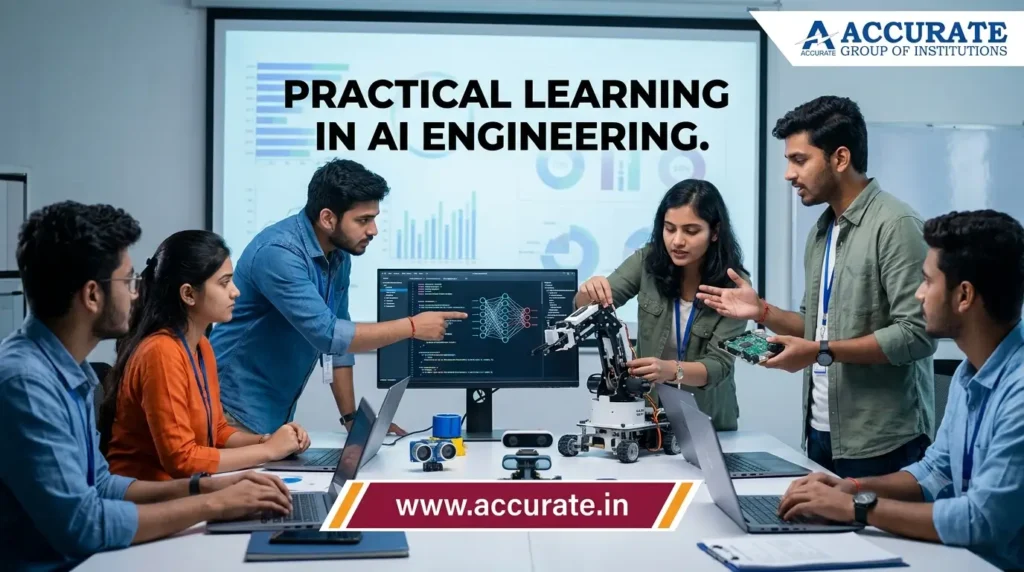

Practical Learning in AI Engineering
Artificial Intelligence (AI) is transforming industries across the globe, from healthcare and banking to manufacturing, transportation, education, agriculture, and entertainment. As organizations increasingly adopt intelligent systems, the demand for highly skilled AI engineers continues to grow. However, employers today are looking beyond academic grades. They seek professionals who can solve real-world problems, build intelligent applications, analyze data, and deploy AI solutions confidently.
This shift has made practical learning in AI Engineering one of the most important aspects of modern technical education. While classroom lectures provide the theoretical foundation, hands-on learning enables students to convert concepts into working solutions. Building AI models, developing machine learning applications, working with real datasets, and participating in industry projects prepare students for successful careers.
A modern AI engineering program should combine strong academic knowledge with laboratory practice, coding exercises, project-based learning, industrial exposure, internships, research opportunities, and collaboration with industry experts.
Accurate Institute of Management & Technology recognizes this evolving industry demand by offering an industry-oriented engineering education that encourages students to learn Artificial Intelligence through practical experiences. With advanced laboratories, experienced faculty members, innovation-driven teaching methods, technical workshops, coding activities, and project-based learning, students develop the confidence required to excel in the competitive technology sector.
Table of Contents
- What is Practical Learning in AI Engineering?
- Why Practical Learning is More Important than Theory
- Essential Practical Skills Every AI Engineering Student Should Learn
- Hands-on Programming Skills for AI Engineers
- AI Tools and Technologies Every Student Should Master
- Importance of AI Laboratories in Engineering Education
- Real-World AI Projects that Build Industry Skills
- Mini Projects vs Major Projects in AI Engineering
- Industry Exposure and Live Learning Opportunities
- AI Internships and Industrial Training
- Hackathons and AI Competitions
- Open Source Contributions
- Career Opportunities Through Practical AI Learning
- Why Choose Accurate Institute of Management & Technology
- Conclusion
- Frequently Asked Questions
What is Practical Learning in AI Engineering?
Practical learning refers to acquiring technical knowledge by actively applying concepts rather than simply studying them from textbooks.
Instead of only understanding AI algorithms theoretically, students learn by:
- Writing Python programs
- Developing Machine Learning models
- Training Deep Learning networks
- Creating Computer Vision applications
- Building Natural Language Processing solutions
- Working with cloud AI platforms
- Deploying intelligent applications
- Solving real business problems
This approach bridges the gap between classroom education and industry expectations.
For example, instead of merely reading about image recognition algorithms, students can develop an application capable of identifying objects in photographs using deep learning models. Such practical implementation helps them understand both the strengths and limitations of AI systems.
Why Practical Learning is More Important than Theory
Artificial Intelligence is a rapidly evolving field where technologies change frequently. Reading textbooks alone cannot keep students updated with modern AI frameworks and industry practices.
Hands-on education provides several advantages.
Better Concept Understanding
AI concepts such as:
- Neural Networks
- Regression
- Classification
- Clustering
- Reinforcement Learning
- Deep Learning
become much easier to understand when students implement them through coding exercises and experiments.
Practical implementation transforms theoretical formulas into real applications, making learning more engaging and memorable.
Improved Problem-Solving Skills
Every AI project presents unique challenges, including:
- Data cleaning
- Feature engineering
- Model selection
- Hyperparameter tuning
- Performance optimization
- Error analysis
By working through these challenges, students develop analytical thinking and systematic problem-solving abilities that are highly valued by employers.
Higher Industry Readiness
Companies hiring AI engineers expect graduates to have experience with:
- Python programming
- Machine Learning libraries
- Cloud computing
- Data visualization
- Version control
- AI deployment
- API integration
Students who gain these practical skills during their engineering education become more confident during interviews and adapt quickly to workplace environments.
Essential Practical Skills Every AI Engineering Student Should Learn
Artificial Intelligence professionals require a combination of programming, mathematics, analytical thinking, and software development skills.
Some of the most valuable practical competencies include:
Python Programming
Python remains the most popular language for AI development.
Students should become proficient in:
- Variables
- Loops
- Functions
- Object-Oriented Programming
- File handling
- Exception handling
- Libraries
- API integration
Daily coding practice significantly improves programming confidence.
Data Analysis
AI systems rely heavily on quality data.
Students should learn:
- Data preprocessing
- Missing value handling
- Feature extraction
- Statistical analysis
- Data visualization
- Exploratory Data Analysis (EDA)
Working with real datasets develops analytical thinking.
Machine Learning
Machine Learning forms the foundation of Artificial Intelligence.
Students should build projects using algorithms like:
- Linear Regression
- Logistic Regression
- Decision Trees
- Random Forest
- Support Vector Machine
- K-Means Clustering
- Naive Bayes
Understanding when and how to use these algorithms is equally important.
Deep Learning
Deep Learning powers many modern AI applications.
Practical knowledge should include:
- Artificial Neural Networks
- Convolutional Neural Networks (CNN)
- Recurrent Neural Networks (RNN)
- LSTM
- Transformers
- Generative AI basics
Building image classification and speech recognition systems helps reinforce these concepts.
Hands-on Programming Skills for AI Engineers
Programming is the backbone of Artificial Intelligence Engineering.
Students should spend considerable time developing coding proficiency through regular practice.
Important programming activities include:
Building AI Applications
Developing applications such as:
- Face Detection
- Chatbots
- Recommendation Systems
- Disease Prediction Models
- Spam Detection
- Sentiment Analysis
helps students understand practical AI implementation.
Debugging Code
Writing code is only part of software development.
Students must also learn:
- Error identification
- Code optimization
- Performance improvement
- Memory management
- Testing techniques
These skills are essential for professional software development.
Git and Version Control
Modern AI development relies heavily on collaborative coding.
Students should understand:
- Git repositories
- GitHub workflows
- Branch management
- Pull requests
- Version history
- Team collaboration
These tools are widely used in software companies worldwide.
AI Tools and Technologies Every Student Should Master
Technology evolves rapidly, making continuous learning essential.
Students should gain practical exposure to industry-standard tools including:
Programming Languages
- Python
- SQL
- Java (basic understanding)
- R (optional)
AI Frameworks
- TensorFlow
- PyTorch
- Keras
- Scikit-learn
Data Visualization Tools
- Matplotlib
- Seaborn
- Plotly
Development Platforms
- Jupyter Notebook
- Google Colab
- VS Code
- PyCharm
Learning these tools through practical assignments prepares students for real-world AI development environments.
Importance of AI Laboratories in Engineering Education
Modern AI laboratories provide an environment where students can experiment with intelligent systems using advanced computing resources and software platforms.
An effective AI laboratory supports:
- Practical programming sessions
- Machine Learning experiments
- Deep Learning model training
- Robotics integration
- Computer Vision research
- IoT and AI integration
- Cloud AI deployment
- Team-based innovation projects
Such facilities help students gain confidence by applying theoretical knowledge to real-world engineering challenges.
Institutions that invest in advanced laboratories create better opportunities for students to develop industry-ready technical skills.
Real-World AI Projects that Build Industry Skills
Project-based learning is one of the most effective methods for mastering Artificial Intelligence.
Instead of relying only on classroom assignments, students should work on practical projects that simulate real business and societal challenges.
Examples include:
Healthcare AI Projects
- Disease prediction systems
- Medical image analysis
- Patient risk assessment
- Drug recommendation models
Smart City Applications
- Intelligent traffic management
- Smart parking systems
- Energy consumption prediction
- Public safety monitoring
Business AI Solutions
- Customer segmentation
- Sales forecasting
- Fraud detection
- Inventory optimization
Each project enhances technical expertise while building teamwork, research, and presentation skills.
Mini Projects vs Major Projects in AI Engineering
Engineering education typically includes both mini and major projects, each serving a distinct purpose.
Mini Projects
Mini projects help students:
- Practice programming
- Understand AI algorithms
- Build confidence
- Experiment with new technologies
- Learn debugging techniques
Examples include simple chatbots, handwritten digit recognition, movie recommendation systems, or spam email classifiers.
Major Projects
Major projects involve solving complex real-world problems through integrated AI solutions. These projects often require:
- Extensive research
- Team collaboration
- Dataset collection
- Model optimization
- Documentation
- Presentation and deployment
Such experiences significantly enhance students’ portfolios and improve employability.
Industry Exposure and Live Learning Opportunities
Practical learning becomes even more valuable when students interact with the real technology industry. Industry exposure helps bridge the gap between classroom knowledge and professional expectations. Students gain firsthand experience of how AI solutions are designed, tested, deployed, and maintained in business environments.
Engineering colleges that focus on industry collaboration prepare students to understand workplace culture, project management, communication, and problem-solving.
Benefits of Industry Exposure
Students who participate in industry-oriented learning can:
- Understand current AI trends and technologies
- Learn software development life cycles
- Observe real AI deployment strategies
- Improve teamwork and communication skills
- Gain confidence while working on professional projects
- Build valuable professional networks
Such experiences make graduates more employable and adaptable in the rapidly changing AI industry.
AI Internships: The Gateway to Professional Success
Internships are one of the most effective ways to transform classroom learning into professional expertise. During internships, students work under experienced mentors, contribute to live projects, and understand the practical challenges faced by AI engineers.
Internships help students apply concepts such as:
- Machine Learning model development
- Data preprocessing
- Model evaluation
- API integration
- Cloud deployment
- Data visualization
- AI testing and optimization
Students also develop workplace ethics, time management, and collaborative problem-solving skills that cannot be learned through textbooks alone.
What Students Learn During AI Internships
Typical internship responsibilities include:
- Cleaning and analyzing datasets
- Training Machine Learning models
- Developing AI-powered applications
- Working with cloud platforms
- Building dashboards
- Preparing technical documentation
- Presenting project outcomes
These experiences strengthen resumes and improve placement opportunities.
Industrial Visits and Corporate Interaction
Industrial visits provide students with valuable exposure to how AI is applied across various industries. Visiting technology companies, innovation centers, manufacturing units, and research organizations helps students connect theoretical concepts with practical implementation.
During industrial visits, students can observe:
- AI-enabled automation systems
- Robotics integration
- Smart manufacturing
- Cloud computing infrastructure
- Data centers
- Cybersecurity practices
- Quality assurance processes
Interaction with industry professionals also allows students to ask questions about emerging technologies, career paths, and required technical skills.
Workshops and Technical Training Programs
Technology evolves rapidly, making continuous learning essential for AI engineers. Workshops and technical boot camps expose students to the latest tools and frameworks beyond the regular curriculum.
Popular workshop topics include:
Machine Learning Boot Camps
Students learn to:
- Build predictive models
- Evaluate algorithms
- Improve model accuracy
- Handle real datasets
Deep Learning Workshops
Practical sessions focus on:
- CNN implementation
- RNN applications
- Image recognition
- Object detection
- Transfer learning
Generative AI Training
Students gain exposure to:
- Large Language Models (LLMs)
- Prompt Engineering
- AI Assistants
- Text generation
- Image generation
- AI ethics
Such workshops enhance technical expertise and keep students updated with industry advancements.
Professional Certifications That Add Value
Along with university education, professional certifications strengthen a student’s profile. Certifications demonstrate commitment to continuous learning and provide industry-recognized validation of technical skills.
Useful certification areas include:
- Artificial Intelligence
- Machine Learning
- Deep Learning
- Data Science
- Cloud Computing
- Python Programming
- SQL
- Computer Vision
- Natural Language Processing
- Data Analytics
These certifications can improve employability by showcasing practical competencies to recruiters.
Hackathons: Learning Through Innovation
Hackathons encourage students to solve real-world problems within limited timeframes. They combine creativity, coding, teamwork, and presentation skills into one exciting learning experience.
AI hackathons often involve developing solutions for:
- Healthcare
- Agriculture
- Education
- Finance
- Smart Cities
- Climate Change
- Transportation
- Cybersecurity
Students participating in hackathons learn to:
- Think creatively
- Build prototypes quickly
- Work under deadlines
- Collaborate effectively
- Present innovative ideas
Many successful startups and innovative AI products have originated from hackathon competitions.
Open Source Contributions
Open-source communities provide excellent opportunities for students to gain practical experience while collaborating with developers from around the world.
Students can contribute by:
- Fixing bugs
- Improving documentation
- Developing new features
- Testing software
- Reviewing code
- Building AI libraries
Popular platforms include:
- GitHub
- GitLab
- Hugging Face
- TensorFlow Community
- PyTorch Community
Open-source contributions demonstrate technical capability and teamwork, making resumes more attractive to employers.
Building an Impressive AI Portfolio
A strong portfolio showcases practical expertise better than academic grades alone. Students should continuously document their projects and technical achievements.
An effective AI portfolio may include:
Machine Learning Projects
Examples:
- House Price Prediction
- Customer Churn Prediction
- Credit Risk Analysis
- Demand Forecasting
Deep Learning Projects
Examples:
- Face Recognition
- Image Classification
- Emotion Detection
- Medical Image Diagnosis
Natural Language Processing Projects
Examples:
- Chatbots
- Sentiment Analysis
- Resume Screening
- Language Translation
Computer Vision Projects
Examples:
- Vehicle Detection
- Attendance System
- Object Detection
- Security Surveillance
Each project should include:
- Problem statement
- Dataset description
- Methodology
- Technologies used
- Results
- Future improvements
Publishing projects on GitHub further strengthens credibility.
Research Opportunities in Artificial Intelligence
Artificial Intelligence is continuously evolving, creating exciting research opportunities for engineering students. Research develops critical thinking, innovation, and advanced problem-solving skills.
Students interested in research may explore:
- Explainable AI
- Ethical AI
- Federated Learning
- Edge AI
- Autonomous Systems
- Healthcare AI
- AI for Agriculture
- Smart Manufacturing
- Human-AI Collaboration
Research publications, technical papers, and conference presentations also improve opportunities for higher education and research careers.
Importance of Team-Based Learning
Large AI projects are rarely developed by a single individual. Modern AI development requires collaboration among software developers, data scientists, business analysts, UI designers, and cloud engineers.
Team projects teach students:
- Communication
- Leadership
- Responsibility
- Conflict resolution
- Task management
- Project planning
Collaborative learning prepares students for professional software development environments.
Practical Learning Through Innovation Clubs
Technical clubs provide students with additional opportunities to practice beyond classroom learning.
AI clubs often organize:
- Coding competitions
- AI seminars
- Project exhibitions
- Research discussions
- Guest lectures
- Technical quizzes
- Innovation challenges
Such extracurricular activities encourage continuous learning and creativity.
Importance of Soft Skills for AI Engineers
Technical expertise alone is not sufficient for career success. AI engineers also require strong professional skills.
Important soft skills include:
Communication Skills
Engineers must explain technical concepts clearly to both technical and non-technical stakeholders.
Critical Thinking
AI development often involves solving complex and unfamiliar problems that require logical analysis.
Creativity
Innovative thinking enables engineers to develop unique AI solutions for real-world challenges.
Time Management
Managing deadlines efficiently is essential when working on multiple AI projects simultaneously.
Leadership
As professionals gain experience, leadership becomes increasingly important for managing AI teams and projects.
Preparing for AI Placements
Practical learning significantly improves placement readiness. Students preparing for campus recruitment should focus on both technical and interview skills.
Preparation areas include:
- Python programming
- Data Structures and Algorithms
- Machine Learning fundamentals
- SQL
- Statistics
- Probability
- System Design basics
- Cloud Computing concepts
- Aptitude preparation
- Communication skills
- Mock interviews
Regular coding practice and project presentations build confidence during technical interviews.
Emerging Trends in Practical AI Education
Artificial Intelligence continues to evolve rapidly, making lifelong learning essential. Students should remain updated with emerging technologies shaping the future of AI.
Current trends include:
- Generative AI
- Large Language Models (LLMs)
- Responsible AI
- Explainable AI
- Edge AI
- AI-powered Robotics
- Autonomous Vehicles
- AI in Healthcare
- AI for Smart Manufacturing
- AI and Internet of Things (AIoT)
Engineering students who continuously upgrade their skills remain competitive in the global technology landscape.
Why Industry-Oriented Learning Matters
Organizations increasingly prefer graduates who can contribute from day one. Practical learning develops confidence, adaptability, and technical proficiency that employers value highly.
By participating in internships, live projects, hackathons, workshops, research initiatives, and collaborative development, students build a strong foundation for long-term career growth in Artificial Intelligence.
Why Choose Accurate Institute of Management & Technology for AI Engineering?
Selecting the right engineering college is one of the most important decisions for students aspiring to build a successful career in Artificial Intelligence. A quality AI engineering program should not only provide strong academic knowledge but also emphasize practical learning, innovation, industry exposure, and career development.
Accurate Institute of Management & Technology (AIMT), Greater Noida is committed to preparing future-ready engineers by combining classroom learning with hands-on practical experiences. The institute focuses on helping students develop technical expertise, analytical thinking, and professional skills required by today’s AI-driven industries.
Industry-Oriented Curriculum
The AI Engineering curriculum at Accurate Institute is designed to align with current industry requirements. Students learn the fundamentals of Artificial Intelligence while gaining exposure to practical applications through:
- Project-based learning
- Programming assignments
- AI model development
- Case studies
- Research activities
- Technical presentations
- Collaborative learning
This balanced approach ensures that students understand both theoretical concepts and real-world implementation.
Modern Laboratories and Computing Facilities
Practical learning requires access to the right infrastructure. Accurate Institute provides students with well-equipped laboratories that support hands-on experimentation and innovation.
Students receive opportunities to work with:
- High-performance computing systems
- AI and Machine Learning software tools
- Programming environments
- Cloud-based development platforms
- Data analysis tools
- Simulation software
- Collaborative project environments
These facilities encourage students to experiment, innovate, and transform ideas into practical AI solutions.
Experienced Faculty and Mentorship
Learning from knowledgeable faculty members plays a crucial role in engineering education. At Accurate Institute, students benefit from experienced educators who combine academic expertise with industry-oriented teaching methodologies.
Faculty members guide students through:
- Programming concepts
- AI algorithms
- Machine Learning implementation
- Research projects
- Career planning
- Technical competitions
- Internship preparation
- Placement readiness
Continuous mentorship helps students build confidence and technical competence throughout their academic journey.
Project-Based Learning Culture
One of the strongest aspects of practical AI education is project-based learning. Students are encouraged to work on innovative projects that address real-world challenges.
Project domains include:
- Healthcare Artificial Intelligence
- Smart Agriculture
- Financial Analytics
- Cybersecurity
- Smart Transportation
- Intelligent Automation
- Computer Vision
- Natural Language Processing
- Predictive Analytics
- Recommendation Systems
Working on these projects enables students to strengthen their portfolios while developing problem-solving and teamwork skills.
Industry Interaction and Skill Development
To prepare students for the rapidly evolving technology sector, Accurate Institute promotes continuous interaction with industry professionals through:
- Guest lectures
- Expert sessions
- Technical seminars
- Workshops
- Industrial visits
- Coding events
- Innovation programs
- Career guidance sessions
These activities help students understand current market trends and employer expectations.
Internship and Placement Support
Internships play a significant role in transforming academic knowledge into professional expertise. Accurate Institute encourages students to participate in internships where they gain exposure to real-world AI development environments.
Students benefit from placement preparation through:
- Resume building sessions
- Technical interview practice
- Aptitude training
- Communication skill enhancement
- Mock interviews
- Coding assessments
- Group discussion practice
- Career counseling
Such structured preparation helps students confidently pursue careers in Artificial Intelligence, Machine Learning, Data Science, Software Engineering, and related domains.
Career Opportunities After Practical AI Engineering Education
Students who acquire practical AI skills become eligible for a wide variety of career roles across industries.
Popular career opportunities include:
Artificial Intelligence Engineer
Develop intelligent systems capable of solving complex business and technological problems.
Machine Learning Engineer
Build predictive models and intelligent algorithms using structured and unstructured data.
Data Scientist
Analyze large datasets to generate valuable business insights and predictive analytics.
Deep Learning Engineer
Develop neural network-based applications for image recognition, speech processing, and automation.
Computer Vision Engineer
Create AI systems capable of interpreting images and videos for healthcare, security, manufacturing, and autonomous vehicles.
NLP Engineer
Develop intelligent applications that understand and process human language, including virtual assistants, chatbots, and translation systems.
AI Research Engineer
Conduct research on emerging Artificial Intelligence technologies and contribute to innovative solutions.
Robotics Engineer
Integrate AI with robotics to build intelligent autonomous systems.
Cloud AI Engineer
Deploy and manage AI applications using modern cloud computing platforms.
AI Consultant
Help organizations adopt AI-driven solutions for digital transformation and business optimization.
Future of Practical Learning in AI Engineering
Artificial Intelligence is expected to become an integral part of almost every industry over the coming decade. Emerging technologies such as Generative AI, Explainable AI, Edge AI, Autonomous Systems, AI-powered Robotics, and Intelligent Automation are creating exciting opportunities for future engineers.
As AI continues to evolve, practical learning will remain the key differentiator between average graduates and industry-ready professionals. Students who continuously improve their technical knowledge, build innovative projects, participate in internships, contribute to research, and stay updated with emerging technologies will enjoy long-term career success.
The future belongs to engineers who can not only understand AI concepts but also apply them effectively to solve real-world challenges.
Conclusion
Practical learning has become the foundation of successful Artificial Intelligence engineering education. While theoretical knowledge provides essential concepts, hands-on experience transforms students into skilled professionals capable of building innovative AI solutions.
By participating in coding exercises, laboratory sessions, live projects, hackathons, internships, industrial visits, workshops, and research initiatives, students develop technical expertise, analytical thinking, creativity, and problem-solving abilities that modern employers highly value.
Accurate Institute of Management & Technology promotes an industry-oriented learning environment where students gain practical exposure to Artificial Intelligence technologies through modern infrastructure, experienced faculty, project-based education, technical events, and career-focused training. This holistic approach helps students become confident, innovative, and future-ready AI professionals.
If you aspire to build a rewarding career in Artificial Intelligence Engineering, choosing an institution that emphasizes practical learning can make a significant difference in your professional journey.
Take the First Step Towards an AI Career
Artificial Intelligence is shaping the future of technology, and skilled AI engineers are in demand across industries worldwide. Start your journey with an institution that values innovation, practical learning, and career excellence.
Join Accurate Institute of Management & Technology, Greater Noida, and gain the knowledge, hands-on experience, and industry exposure needed to build a successful career in Artificial Intelligence Engineering.
Learn more about admissions, programs, campus facilities, and career opportunities at:
Frequently Asked Questions (FAQs)
1. What is practical learning in AI Engineering?
Practical learning in AI Engineering involves applying theoretical concepts through coding, laboratory sessions, live projects, internships, and real-world AI application development. It helps students gain hands-on experience with industry tools and technologies.
2. Why is practical learning important for AI Engineering students?
Practical learning improves technical skills, problem-solving abilities, project experience, and industry readiness. Employers prefer graduates who have experience working on real AI projects and modern development tools.
3. Which programming language is best for Artificial Intelligence?
Python is widely considered the best programming language for Artificial Intelligence because of its simplicity and extensive ecosystem of AI libraries such as TensorFlow, PyTorch, Keras, and Scikit-learn.
4. What projects should AI Engineering students build?
Students can build projects such as chatbots, recommendation systems, disease prediction models, image recognition systems, sentiment analysis tools, fraud detection solutions, and smart automation applications.
5. Do internships help AI Engineering students?
Yes. AI internships provide practical exposure to real-world projects, improve technical expertise, strengthen resumes, and significantly enhance placement opportunities.
6. Which AI tools should engineering students learn?
Students should become familiar with Python, SQL, TensorFlow, PyTorch, Keras, Scikit-learn, Jupyter Notebook, Google Colab, Git, GitHub, and cloud AI platforms.
7. What career opportunities are available after AI Engineering?
Graduates can pursue careers as AI Engineers, Machine Learning Engineers, Data Scientists, Computer Vision Engineers, NLP Engineers, Robotics Engineers, AI Researchers, Cloud AI Engineers, and AI Consultants.
8. How do AI projects improve placement opportunities?
AI projects demonstrate practical skills, creativity, and technical knowledge. They provide recruiters with evidence that students can build, test, and deploy AI solutions to solve real-world problems.
9. Why should students choose Accurate Institute of Management & Technology for AI Engineering?
Accurate Institute of Management & Technology emphasizes industry-oriented education through project-based learning, modern laboratories, experienced faculty, technical workshops, internships, placement support, and practical exposure to Artificial Intelligence technologies.
10. How can students prepare for a successful AI Engineering career?
Students should focus on programming, mathematics, machine learning, deep learning, cloud computing, internships, open-source contributions, certifications, communication skills, and continuous practical learning while staying updated with emerging AI technologies.