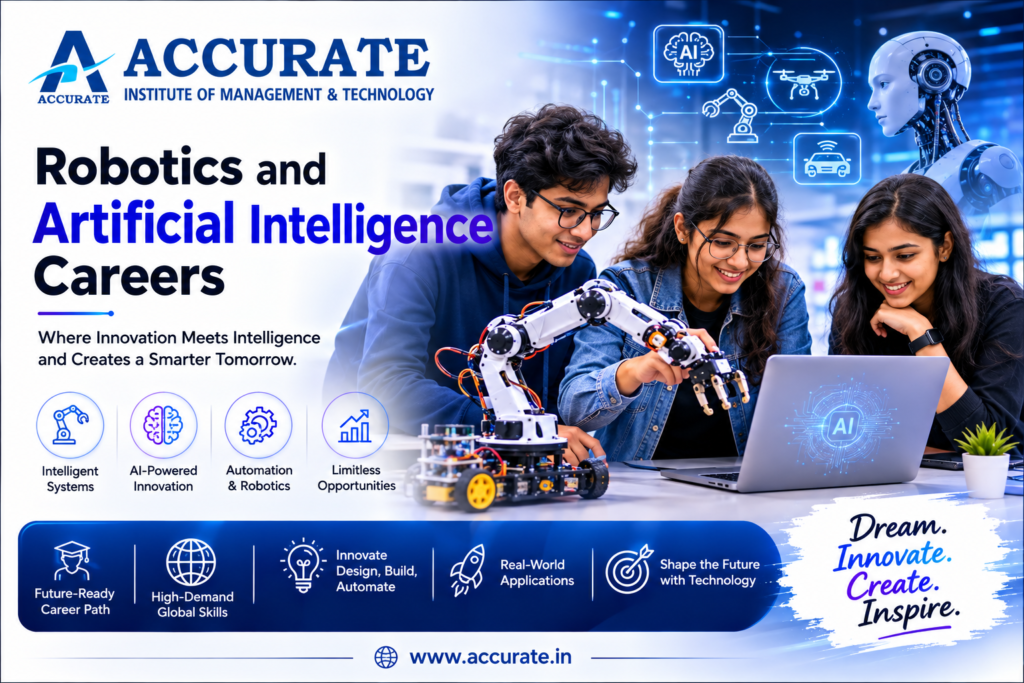

Robotics and Artificial Intelligence are changing the way machines interact with the physical world. A traditional machine performs predefined actions. An intelligent robotic system can additionally sense its environment, analyse information, recognise patterns and adjust its behaviour.
This convergence is creating a new generation of technologies across factories, warehouses, hospitals, vehicles, farms, laboratories, homes and public infrastructure.
For engineering students, the transformation opens a particularly interesting career question: What opportunities are available in Robotics and Artificial Intelligence, and what skills are required to enter them?
The answer is broader than the job title “Robotics Engineer.”
Modern robotics requires professionals in artificial intelligence, machine learning, computer vision, embedded systems, automation, electronics, control engineering, software development, cloud computing, cybersecurity and mechanical design.
The global technology landscape also supports the importance of these skills. The World Economic Forum’s Future of Jobs Report 2025 identifies AI and Machine Learning Specialists among the fastest-growing jobs and reports that AI, information processing, robotics and autonomous systems are important drivers of employment transformation through 2030.
At the same time, robotics is expanding significantly in industry. International Federation of Robotics data published in its World Robotics 2025 report states that 542,000 industrial robots were installed globally in 2024, more than twice the number installed a decade earlier. More than 4.6 million industrial robots were reported to be operating worldwide.
For aspiring engineers, this does not mean that simply studying robotics guarantees employment. It means that automation, intelligent software and physical systems are increasingly intersecting, creating opportunities for students who develop the right combination of fundamentals and practical experience.
Table of Contents
- Why Robotics and AI Are Becoming Important Career Fields
- How Robotics and Artificial Intelligence Work Together
- Top Robotics and Artificial Intelligence Career Options
- Skills Required for Robotics and AI Careers
- Step-by-Step Career Roadmap for Students
- Best Robotics and AI Projects for Engineering Students
- Industries Creating Robotics and AI Opportunities
- Robotics vs Artificial Intelligence: Which Career Should You Choose?
- Are Robotics and AI Careers Only for CSE Students?
- Challenges of Building a Career in Robotics and AI
- Future Scope of Robotics and Artificial Intelligence Careers
- How to Build a Strong Robotics and AI Portfolio
- Why Engineering Education Still Matters
- Robotics and AI Learning at Accurate Institute of Management & Technology
- Frequently Asked Questions
- Conclusion and Admission CTA
Why Robotics and AI Are Becoming Important Career Fields
Robotics has existed for decades, especially in manufacturing. Artificial Intelligence also has a long research history. What is different today is the increasing ability to combine advanced sensors, computing power, machine learning, computer vision, connectivity and intelligent software into practical systems.
A warehouse robot, for example, may use sensors to detect obstacles, computer vision to identify objects, localization algorithms to determine position and AI-based planning to choose a route.
An industrial robot may use machine vision to inspect components.
A healthcare robot may assist with rehabilitation or controlled procedures.
An agricultural robot may identify crops and support precision operations.
The important career trend is therefore not simply “more robots.”
It is the growth of intelligent robotic and autonomous systems.
Robots Are Moving Beyond Repetitive Automation
Traditional industrial robots often perform highly structured tasks in controlled environments.
Modern robotics increasingly explores systems that can operate in less predictable settings.
This creates demand for engineers who understand perception, decision-making, motion, software integration and safety.
Artificial Intelligence Gives Robots Perception and Adaptability
Artificial Intelligence helps machines interpret complex inputs.
Computer vision can identify objects. Machine learning can recognize patterns. Planning algorithms can help a robot select actions. Natural-language technologies can make human-machine interaction easier.
AI therefore expands what a robotic system can potentially do.
Robotics Gives AI a Physical Presence
Artificial Intelligence usually operates through software.
Robotics allows intelligent algorithms to interact with physical environments.
That interaction creates additional engineering challenges because mistakes in physical systems may damage equipment or create safety risks.
Successful robotics professionals therefore require systematic engineering discipline.
How Robotics and Artificial Intelligence Work Together
Understanding the relationship between robotics and AI is essential before choosing a specialization.
A robot typically contains several layers.
Sensing
Sensors collect information about the environment or the robot itself.
Examples include:
- Cameras
- LiDAR
- Ultrasonic sensors
- Infrared sensors
- Encoders
- Force sensors
- Temperature sensors
- Inertial measurement units
Perception
Software interprets sensor information.
Computer vision may detect an object, while localization software estimates where the robot is positioned.
Decision-Making
Algorithms determine what the robot should do.
AI and machine learning can contribute to classification, prediction, planning and adaptive behaviour.
Control
Control systems translate decisions into physical movement.
Motors, actuators and feedback loops help the robot move accurately.
Communication
Robots may connect with computers, industrial networks, cloud systems or other machines.
Human Interaction
Some robots operate near or directly with humans.
Human-machine interaction, interface design and safety become extremely important in such environments.
This complete pipeline explains why Robotics and Artificial Intelligence careers are multidisciplinary.
Top Robotics and Artificial Intelligence Career Options
Students often assume that the only career available is “Robotics Engineer.” In reality, the field contains several specialized career directions.
Robotics Engineer
A Robotics Engineer designs, develops, integrates or tests robotic systems.
Depending on the company, responsibilities may include hardware selection, programming, sensors, actuators, control algorithms, simulation and system integration.
A robotics engineer should be comfortable moving between software and physical hardware.
Artificial Intelligence Engineer
An AI Engineer builds intelligent software systems.
In robotics-related environments, an AI Engineer may work on perception, prediction, decision support, object recognition or intelligent automation.
Useful knowledge includes Python, machine learning, deep learning and data processing.
Machine Learning Engineer
Machine Learning Engineers develop models that learn patterns from data.
In robotics, their work can support object detection, predictive maintenance, anomaly detection, navigation or intelligent behaviour.
The role generally requires stronger programming and ML fundamentals than simply knowing how to use AI tools.
Computer Vision Engineer
Computer Vision is one of the most important intersections between AI and robotics.
Computer Vision Engineers create systems that interpret images and video.
Robots may need vision to:
- Detect objects
- Recognize people
- Inspect products
- Estimate distance
- Track movement
- Navigate environments
- Read signs or labels
Students interested in cameras, image processing, deep learning and perception can explore this pathway.
Autonomous Systems Engineer
Autonomous Systems Engineers work on machines that can perform tasks with reduced direct human control.
Examples include autonomous mobile robots, drones, warehouse vehicles and robotic platforms.
Their work may involve perception, localization, planning, control, simulation and safety.
Robotics Software Developer
Robotics Software Developers focus primarily on the software controlling robotic systems.
They may create navigation programs, communication modules, interfaces, sensor-processing pipelines or robot behaviour.
Strong knowledge of C++, Python, Linux and software engineering can be useful.
ROS Developer
ROS, or Robot Operating System, is a widely used robotics software framework.
A ROS developer may build robotic nodes, connect sensors, manage communication between components, work with simulations and integrate hardware.
Students interested in practical robotics development should become familiar with ROS concepts while retaining strong general software fundamentals.
Automation Engineer
Automation Engineers create and maintain systems that automate industrial or operational processes.
Their work may involve PLCs, sensors, industrial control systems, robotics, manufacturing equipment and software integration.
It is a particularly relevant career in smart manufacturing.
Embedded Systems Engineer
Embedded Systems Engineers work on the computing systems built directly into devices.
Robots require embedded systems for sensors, motors, control logic and communication.
Useful skills may include C/C++, microcontrollers, electronics, real-time systems and hardware debugging.
Robotics Test and Validation Engineer
A robot must be tested before real-world deployment.
Test and Validation Engineers examine reliability, safety, repeatability, sensor performance and failure behaviour.
This career is important because physical systems must operate consistently beyond laboratory demonstrations.
AI Research Engineer
Research-oriented professionals work on advanced algorithms and new approaches in machine learning, perception, planning, reinforcement learning and robot intelligence.
Some research positions prefer postgraduate qualifications because they require greater theoretical depth.
Mechatronics Engineer
Mechatronics combines mechanical engineering, electronics, control and computing.
It is particularly relevant to robotics because robots are physical machines controlled by electronic and software systems.
Industrial Robotics Engineer
Industrial Robotics Engineers specialize in robotic systems used in manufacturing environments.
They may work with robotic arms, welding, assembly, packaging, machine tending and automated production lines.
Industrial robotics requires knowledge of safety, integration and reliable operation.
Skills Required for Robotics and Artificial Intelligence Careers
A successful career requires more than one programming language or robotics kit.
Students should build skills in layers.
Programming Skills
Programming is essential for most AI and robotics roles.
Useful languages include:
Python
Python is widely used for AI, machine learning, computer vision, data analysis and robotics experimentation.
C and C++
C and C++ are especially useful for embedded systems, performance-sensitive robotics software and hardware-level programming.
SQL
Robotics and AI systems can generate large amounts of data. SQL is useful when applications interact with structured databases.
Linux
Many robotics tools and development environments operate extensively on Linux.
Students should become comfortable with command-line tools, packages, files and basic system configuration.
Mathematics
Mathematics helps engineers understand motion, perception and machine learning.
Important areas include:
- Linear algebra
- Probability
- Statistics
- Calculus
- Geometry
- Coordinate transformations
- Optimization
Students do not need to memorize every formula before starting projects, but stronger mathematical understanding makes advanced robotics easier.
Data Structures and Algorithms
A robotics engineer is still a software engineer in many contexts.
Students should understand:
- Arrays
- Linked structures
- Stacks and queues
- Trees
- Graphs
- Searching
- Sorting
- Complexity
- Pathfinding algorithms
Navigation and planning frequently involve graph-based algorithms.
Electronics and Sensors
Understanding electronics helps students work effectively with physical systems.
Learn about:
- Voltage and current
- Digital and analog signals
- Microcontrollers
- Motors
- Motor drivers
- Encoders
- Sensors
- Communication interfaces
Control Systems
Control engineering helps robots move accurately.
Important concepts include feedback, error measurement, stability and PID control.
A student who understands why a motor overshoots a target has an advantage over someone who only copies control code.
Machine Learning
Students should understand:
- Supervised learning
- Unsupervised learning
- Training and validation
- Classification
- Regression
- Feature engineering
- Overfitting
- Evaluation metrics
Deep Learning
Deep learning becomes particularly useful for computer vision, perception and advanced AI systems.
Topics can include:
- Neural networks
- Convolutional neural networks
- Transformers
- Training methods
- Transfer learning
Computer Vision
Computer vision is extremely valuable for intelligent robotics.
Learn image processing, object detection, segmentation, tracking and camera fundamentals.
Robot Operating System
ROS can help students understand modular robotics software.
Useful areas include:
- Nodes
- Topics
- Messages
- Services
- Sensors
- Navigation
- Simulation
- Visualization
Do not treat ROS as a substitute for programming fundamentals. It is a framework built on them.
Simulation
Simulation allows students to test robotic behaviour without always requiring expensive hardware.
It can help with navigation, manipulation, control and system integration.
Soft Skills
The World Economic Forum emphasizes that future technology careers will continue to require human capabilities alongside technical skills. Analytical thinking, resilience, creativity, leadership and collaboration remain important even as AI-related skills grow.
Robotics projects especially require teamwork because mechanical, electronic and software systems must work together.
Step-by-Step Career Roadmap for Robotics and AI
Students can use the following roadmap during engineering.
Step 1: Build Programming Fundamentals
Start with Python and then learn C or C++.
Do not depend completely on AI coding assistants.
You should be able to read, modify, debug and explain your own programs.
Step 2: Strengthen Mathematics
Focus on practical mathematics used in AI and robotics.
Connect theory to problems such as movement, coordinate systems, probabilities and machine-learning models.
Step 3: Learn Electronics
Begin experimenting with microcontrollers, sensors and motors.
Simple physical projects help students understand real-world errors that are absent from purely digital software.
Step 4: Study Data Structures and Algorithms
Build strong problem-solving ability.
Algorithms become important in navigation, planning and technical interviews.
Step 5: Learn Machine Learning
Build small ML applications before attempting highly advanced robotics AI.
Understand training, validation and evaluation.
Step 6: Explore Computer Vision
Start with image processing and progress toward object detection and tracking.
Connect cameras to small projects if possible.
Step 7: Learn Robotics Fundamentals
Study kinematics, sensors, actuators, control and robot architecture.
Step 8: Explore ROS and Simulation
Build software components in a structured robotics framework and experiment in simulation.
Step 9: Develop Integrated Projects
Combine AI with robotics rather than keeping them as completely separate subjects.
For example, create a mobile robot capable of recognizing selected objects and navigating toward them.
Step 10: Document Your Work
Write README files, create architecture diagrams and explain problems you encountered.
Documentation shows engineering maturity.
Step 11: Pursue Internships
Look for internships in robotics, automation, AI, manufacturing, embedded systems, computer vision and software development.
Your first internship does not necessarily need “Robotics Engineer” in the title.
Step 12: Prepare for Technical Interviews
Review programming, algorithms, mathematics and the technologies used in your projects.
Be prepared to explain why you made specific engineering choices.
Best Robotics and AI Projects for Engineering Students
Good projects demonstrate integration and problem-solving.
Autonomous Obstacle-Avoiding Robot
Build a mobile robot that uses sensors to detect obstacles and change direction.
Extend it with mapping or intelligent route selection.
Vision-Based Object Detection Robot
Use a camera and computer vision model to detect selected objects.
Connect detection results with robotic movement.
Smart Warehouse Robot Prototype
Create a system capable of moving objects or navigating between defined warehouse locations.
Explore QR codes, localization or path planning.
AI-Based Quality Inspection
Build a computer-vision system that identifies visual defects in manufactured components.
This is an excellent project for connecting AI with industrial automation.
Robotic Arm Control System
Design or program a robotic arm to pick and place objects.
Advanced versions can use vision to determine object location.
Gesture-Controlled Robot
Use computer vision or sensors to interpret human gestures and translate them into robot commands.
Agricultural Monitoring Robot
Develop a prototype that collects environmental data and applies AI-based analysis.
Predictive Maintenance System
Use equipment sensor data to detect unusual patterns or estimate maintenance requirements.
This project combines industrial engineering, sensors, data and AI.
What Makes a Robotics Project Recruiter-Friendly?
A strong project should include:
- Problem definition
- System architecture
- Hardware components
- Software stack
- Algorithms used
- Testing methodology
- Results
- Failures encountered
- Safety considerations
- Future improvements
Avoid presenting a project as successful merely because a motor moved once.
Engineering quality requires repeatability.
Industries Creating Robotics and AI Opportunities
Robotics and AI careers extend across many industries.
Manufacturing
Manufacturing remains a major robotics application area.
Robots may support welding, assembly, material handling, machine tending, quality inspection and packaging.
IFR data shows the global installed base of industrial robots continuing at historically high levels, reinforcing the importance of industrial automation expertise.
Warehousing and Logistics
Warehouses use automation for movement, sorting, picking and inventory operations.
This creates opportunities in mobile robotics, computer vision, software integration and fleet management.
Automotive and Mobility
Vehicles increasingly rely on sensors, computer vision, intelligent assistance and embedded software.
Careers can include perception engineering, embedded development and autonomous-system research.
Healthcare
Robotics can support surgery, rehabilitation, laboratory automation and hospital logistics.
Healthcare technologies require especially high standards for safety and reliability.
Agriculture
Agricultural robotics can assist with monitoring, spraying, harvesting, crop inspection and precision farming.
Aerospace and Drones
Drones and robotic aerospace systems use navigation, sensors, computer vision and autonomous control.
Defence and Security
Robotic and autonomous systems can support surveillance, inspection and controlled operations.
These applications also require rigorous security and ethical considerations.
Consumer Robotics
Consumer robots can include cleaning systems, educational robots and smart assistants.
Infrastructure and Inspection
Robots can be useful where inspection is difficult or dangerous for humans, including pipelines, industrial plants and selected construction environments.
Robotics vs Artificial Intelligence: Which Career Should You Choose?
The two fields overlap, but they are not identical.
Choose a more AI-focused pathway if you enjoy:
- Programming
- Data
- Machine learning
- Algorithms
- Mathematical modelling
- Computer vision
Choose a more robotics-focused pathway if you enjoy:
- Machines
- Electronics
- Sensors
- Motors
- Hardware
- Control systems
- Physical experimentation
Choose the intersection if you enjoy both.
Students interested in autonomous systems, intelligent robots, computer vision and smart manufacturing will often benefit from combining the disciplines.
Are Robotics and AI Careers Only for CSE Students?
No.
Different engineering branches can enter robotics from different directions.
Computer Science students may focus on AI, perception and robotics software.
AI and ML students may specialize in machine learning and intelligent decision-making.
Electronics students may contribute through embedded systems, sensors and control hardware.
Mechanical students may specialize in robot design, dynamics and mechanisms.
Electrical students may work on drives, motors and control systems.
Mechatronics naturally combines many of these areas.
The strongest robotics teams are multidisciplinary.
Challenges of Building a Career in Robotics and AI
Students should understand both the opportunity and the difficulty of the field.
Robotics Requires Multiple Skills
It is possible to build a basic application quickly, but advanced robotics requires knowledge across several technical layers.
Students should develop depth gradually.
Hardware Can Fail
A software simulation may work perfectly while the physical machine behaves differently because of sensor noise, friction, loose wiring or mechanical limitations.
Learning to troubleshoot patiently is essential.
Equipment Can Be Expensive
Not every student has access to sophisticated robots.
Simulation, affordable development boards and collaborative laboratory work can help students develop skills progressively.
Safety Matters
Physical systems can create real-world risks.
Engineers must understand safe operating limits, emergency behaviour and responsible testing.
Technology Changes Quickly
AI models, robotics frameworks and hardware platforms continue evolving.
Continuous learning is part of the profession.
Future Scope of Robotics and Artificial Intelligence Careers
The future of Robotics and Artificial Intelligence is likely to be defined by greater integration.
Artificial Intelligence will increasingly help machines understand environments, while robotics will give AI systems more opportunities to interact physically.
The World Economic Forum reports that AI, information processing, robotics and autonomous systems are major forces affecting the future of employment. It also expects significant growth in specialist technology roles while warning that automation will reshape or reduce some existing roles.
This distinction is important.
Robotics does not simply “create jobs” or “remove jobs.”
It changes the structure of work.
Routine tasks can become automated while new work appears around engineering, programming, integration, maintenance, analysis, testing and system design.
The International Federation of Robotics has also identified Artificial Intelligence in Robotics as an active area of industry development and published updated work on the topic in 2026.
Students should therefore prepare for careers in which humans increasingly design, supervise, maintain and improve intelligent machines.
How to Build a Strong Robotics and AI Portfolio
Your portfolio should prove that you can build things.
Create a GitHub profile containing well-documented projects.
For each project, explain:
- What problem you solved
- What hardware was used
- What software was used
- How components communicated
- How you tested the system
- What failed
- How you improved it
- What you would build next
A short project video can also be useful because robotics is visual and physical.
Participate in Hackathons and Competitions
Hackathons, robotics competitions and technical challenges encourage teamwork under constraints.
The experience of debugging a robot shortly before a demonstration can teach lessons that lectures cannot.
Read Technical Documentation
Do not depend entirely on simplified tutorials.
Professional engineers need to read datasheets, documentation, research papers and specifications.
Why Engineering Education Still Matters in Robotics and AI
AI tools have made programming assistance easier, but they have not removed the need for engineering understanding.
If an AI tool produces code for a motor controller, someone still needs to check whether the code is safe.
If a computer-vision model misclassifies an object, someone needs to diagnose the failure.
If a robot loses communication, someone must design a safe fallback.
Engineering education develops the fundamentals necessary to make these judgments.
The best robotics professionals do not simply assemble available technologies.
They understand how the components interact and why failures occur.
Preparing for Robotics and AI Careers at Accurate Institute of Management & Technology
Students interested in future-facing engineering careers should look for an institution that combines academic fundamentals with opportunities for practical learning.
Accurate Institute of Management & Technology, Greater Noida promotes an industry-oriented engineering environment supported by practical exposure, technical projects, skill development and career preparation. Institute materials emphasize that learners should move beyond isolated classroom concepts by writing software, connecting devices, working with data, testing systems and presenting results.
This approach is particularly relevant to Robotics and Artificial Intelligence because neither field can be mastered through theory alone.
A student needs opportunities to build, test, debug and improve.
Multidisciplinary Exposure
Robotics sits at the intersection of software, electronics, AI, networking, cloud computing, data and cybersecurity.
Accurate Institute’s engineering environment highlights exposure to connected technology areas and encourages students to understand how multiple components work together.
Institute material also describes an AICTE-approved and AKTU-affiliated engineering framework and a learning approach that includes laboratories, mini-projects, technical activities and projects linked to practical problems. Applicants should always confirm current approvals and programme details for their admission year.
Project-Oriented Learning
Robotics becomes meaningful when students design, assemble, program, test and troubleshoot.
Laboratory experience helps learners understand the difference between a theoretical design and a reliable real-world system.
Accurate’s emphasis on practical implementation, project work, technical activities and problem-solving can support students who want to explore emerging engineering domains.
Career and Placement Preparation
Technical knowledge alone is not sufficient for recruitment.
Students also need coding practice, aptitude, communication, résumé preparation, presentation ability and interview skills.
Accurate Institute’s career-focused environment emphasizes these areas alongside technical learning and project development.
Greater Noida and Delhi NCR Advantage
Accurate Institute is located in Greater Noida, within the broader Delhi NCR academic, technology and industrial ecosystem.
Students who actively seek internships, workshops, technical events and industry interaction can benefit from exposure to the surrounding professional environment.
The college environment can provide opportunities, but students should remember that career success ultimately depends on personal effort, skill development, internships, projects, communication and consistent learning.
Frequently Asked Questions About Robotics and Artificial Intelligence Careers
1. Is Robotics and Artificial Intelligence a good career?
Yes. Robotics and AI can be promising career fields for students interested in machines, software, intelligent systems and automation. AI specialists are among the fastest-growing technology roles identified by the World Economic Forum, while robotics adoption remains strong across industry.
2. What jobs are available in Robotics and Artificial Intelligence?
Career options include Robotics Engineer, AI Engineer, Machine Learning Engineer, Computer Vision Engineer, Autonomous Systems Engineer, Robotics Software Developer, ROS Developer, Automation Engineer, Embedded Systems Engineer, Mechatronics Engineer and Robotics Test Engineer.
3. What qualifications are required for a Robotics and AI career?
A B.Tech or related engineering degree can provide a strong foundation. Relevant branches may include Computer Science, AI and ML, Electronics, Electrical, Mechanical, Mechatronics and related specializations. Specific job requirements vary between employers.
4. Does robotics require coding?
Yes. Programming is important in modern robotics. Python is commonly used for AI and experimentation, while C and C++ are valuable for embedded systems, performance-sensitive software and robot control.
5. Which programming language is best for robotics?
There is no single best language. Python is highly useful for AI, computer vision and prototyping, while C++ is important for high-performance robotics applications. C is commonly used in embedded systems. Strong programming fundamentals matter more than knowing only one language.
6. Is Artificial Intelligence necessary for robotics?
Not every robot requires advanced AI. Traditional industrial robots can perform predefined tasks without machine learning. AI becomes valuable when a robot needs perception, prediction, adaptation, natural-language interaction or more autonomous decision-making.
7. Can a Computer Science student become a Robotics Engineer?
Yes. CSE students can build careers in robotics software, AI, machine learning, computer vision, navigation and autonomous systems. They should additionally learn robotics fundamentals, sensors, control systems and hardware interaction.
8. What should I learn first for a robotics career?
Start with programming, mathematics and basic electronics. Then study microcontrollers, sensors, motors, control systems, data structures, robotics fundamentals and Linux. Students interested in intelligent robotics can add machine learning, computer vision, ROS and simulation.
9. What are the best robotics projects for engineering students?
Useful projects include obstacle-avoiding robots, robotic arms, autonomous mobile robots, computer-vision inspection systems, warehouse robot prototypes, gesture-controlled robots, agricultural monitoring systems and predictive-maintenance applications. The best projects solve a clear problem and document testing and limitations.
10. Why consider Accurate Institute of Management & Technology for engineering?
Accurate Institute of Management & Technology, Greater Noida, offers a career-oriented engineering environment that emphasizes technical fundamentals, practical learning, laboratory exposure, projects, emerging technologies, skill development and placement preparation. Its engineering programmes operate within an AICTE-approved and AKTU-affiliated framework according to institute materials; applicants should confirm the latest programme, eligibility, fee, scholarship and admission details directly with the institute.
Conclusion: Build the Intelligence Behind the Machines of Tomorrow
Robotics and Artificial Intelligence careers are becoming increasingly important as software intelligence and physical automation converge.
The future robot will not simply repeat a fixed movement.
It may see, understand, communicate, navigate, predict and collaborate.
Building such systems requires engineers who understand both technology and responsibility.
For students, the best career strategy is therefore not to chase futuristic job titles.
Build the foundation.
Learn programming deeply.
Understand electronics and sensors.
Strengthen mathematics.
Study control systems.
Develop AI and machine-learning knowledge.
Explore computer vision.
Build robots.
Test them repeatedly.
Document your failures as carefully as your successes.
And remember that the most valuable engineer is not necessarily the person who knows the largest number of tools. It is the person who can understand a problem, select appropriate technology, build a solution, test its reliability and improve it systematically.
Global labour-market research indicates that AI, robotics, autonomous systems and related technology skills will continue reshaping employment through the coming years. Industrial-robot deployment also remains at historically high levels worldwide.
Students who begin developing multidisciplinary engineering skills today can therefore position themselves for opportunities across automation, smart manufacturing, computer vision, intelligent mobility, autonomous systems, embedded technology and next-generation AI applications.
For aspiring engineers, Accurate Institute of Management & Technology, Greater Noida offers an environment focused on application-oriented technical learning, laboratory exposure, project development, multidisciplinary technologies and career preparation. Institute material emphasizes practical experience and encourages learners to translate classroom knowledge into working technology solutions.
Start Building Your Future in Robotics and AI
If you want to build intelligent machines, autonomous systems, smart software or the technologies that will shape the next generation of engineering, your journey begins with strong fundamentals and practical experience.
Explore B.Tech opportunities at Accurate Institute of Management & Technology, Greater Noida.
Review the latest engineering programmes, specializations, curriculum, laboratories, technical activities, eligibility, scholarships and admission requirements. Speak with the admission team, visit the campus and understand which engineering pathway best matches your interest in Robotics, Artificial Intelligence, automation and future technologies.
Visit Accurate Institute of Management & Technology and take the first step toward becoming an engineer who can build, program and improve the intelligent machines of tomorrow.
Website: https://www.accurate.in