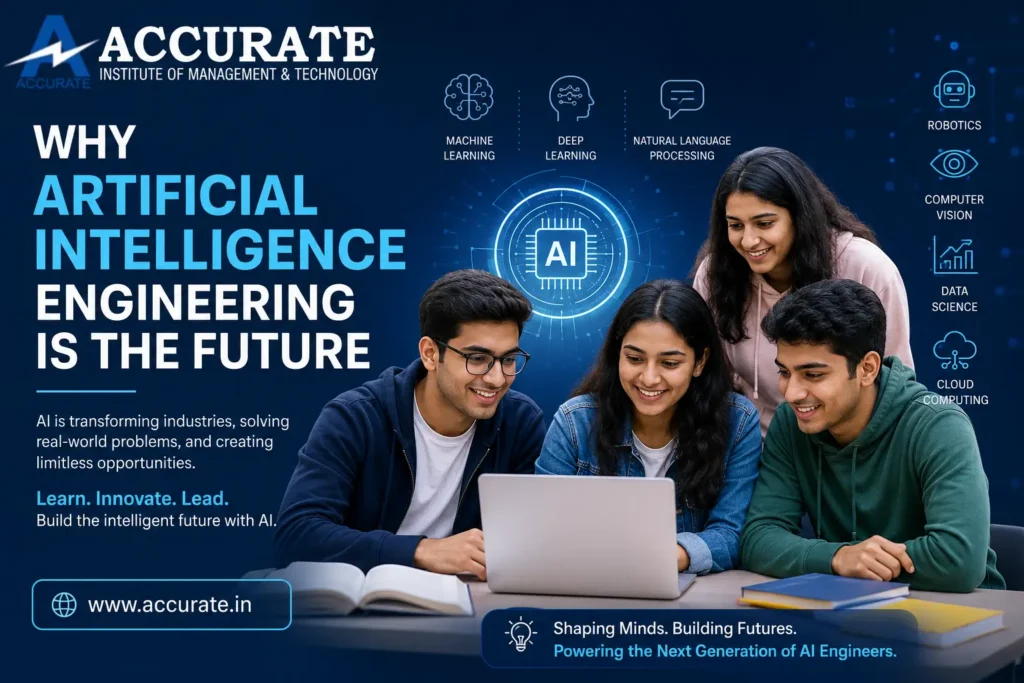

Why Artificial Intelligence Engineering Is the Future
Artificial Intelligence (AI) is transforming every industry faster than any technological revolution in history. From self-driving vehicles and virtual assistants to healthcare diagnostics, cybersecurity, smart manufacturing, robotics, and financial automation, AI has become the backbone of modern innovation.
As businesses increasingly rely on intelligent systems, the demand for skilled Artificial Intelligence Engineers continues to grow worldwide. Companies are actively seeking professionals who can develop smart algorithms, automate processes, analyze complex data, and build AI-powered applications.
This is why Artificial Intelligence Engineering is considered one of the most future-proof engineering careers. Students who pursue this field today are preparing themselves for high-paying jobs, global opportunities, research careers, entrepreneurship, and leadership positions in tomorrow’s technology-driven world.
For students searching for the Best Engineering College in Greater Noida, Best B.Tech College in Delhi NCR, or Best Engineering College in Noida, choosing an institution that combines academic excellence with practical AI learning is essential. Accurate Institute of Management & Technology has emerged as one of the preferred destinations for students who want industry-focused engineering education with strong placement support.
Table of Contents
- What is Artificial Intelligence Engineering?
- Why AI Engineering Is the Future
- Evolution of Artificial Intelligence
- Global Demand for AI Engineers
- Industries Using Artificial Intelligence
- Career Opportunities After AI Engineering
- Essential Skills Every AI Engineer Needs
- Technologies Students Learn
- AI Engineering vs Computer Science
- Future Trends in Artificial Intelligence
- Salary Potential of AI Engineers
- Entrepreneurship Opportunities
- Higher Education After AI Engineering
- Why Choose Accurate Institute of Management & Technology?
- Admission Opportunities
- Conclusion
- Frequently Asked Questions
What is Artificial Intelligence Engineering?
Artificial Intelligence Engineering is a specialized engineering discipline that focuses on creating machines capable of learning, reasoning, solving problems, understanding language, recognizing images, and making intelligent decisions.
An AI Engineer combines concepts from:
- Computer Science
- Mathematics
- Statistics
- Machine Learning
- Deep Learning
- Data Science
- Robotics
- Cloud Computing
- Software Engineering
The objective is to develop systems that mimic human intelligence while continuously improving through experience and data.
Why Artificial Intelligence Engineering Is the Future
Every Industry Is Becoming AI-Driven
Healthcare uses AI for disease prediction.
Banks use AI to detect fraud.
Retail companies personalize shopping experiences.
Manufacturing uses predictive maintenance.
Agriculture uses AI for smart farming.
Transportation relies on autonomous technologies.
Education adopts intelligent learning platforms.
Since AI is becoming part of every industry, skilled engineers will remain in high demand.
AI Creates New Career Opportunities
Unlike traditional technologies that replace jobs, AI creates entirely new professions.
Some examples include:
- AI Engineer
- Machine Learning Engineer
- Computer Vision Engineer
- NLP Engineer
- Robotics Engineer
- AI Research Scientist
- AI Consultant
- Data Scientist
- AI Product Manager
- AI Solutions Architect
These careers are expected to grow significantly over the coming decades.
AI Solves Real-World Problems
Artificial Intelligence is making life better by solving complex problems.
Examples include:
- Early cancer detection
- Disaster prediction
- Traffic optimization
- Smart cities
- Financial forecasting
- Cybersecurity threat detection
- Drug discovery
- Personalized education
- Climate change modeling
Students entering AI Engineering contribute directly to innovations that improve society.
Evolution of Artificial Intelligence
Artificial Intelligence has evolved rapidly.
First Generation
Basic rule-based systems performed simple logical tasks.
Machine Learning Era
Algorithms learned patterns from data instead of relying only on programmed rules.
Deep Learning Revolution
Neural networks enabled machines to recognize images, speech, and language with remarkable accuracy.
Generative AI Era
Modern AI systems generate text, images, videos, software code, and business solutions, creating unprecedented opportunities for innovation.
The future promises even more advanced AI applications powered by quantum computing, edge AI, and autonomous intelligence.
Global Demand for AI Engineers
AI professionals are among the most sought-after technology experts worldwide.
Demand continues to grow because organizations are investing heavily in AI-driven digital transformation.
Major hiring sectors include:
Technology Companies
Software giants constantly recruit AI engineers for product innovation.
Healthcare
Hospitals and medical companies use AI for diagnostics and patient care.
Banking
Financial institutions require AI experts for fraud detection, risk analysis, and algorithmic trading.
Manufacturing
Factories implement AI-powered automation and predictive maintenance.
Government
Public sector organizations use AI for security, transportation, governance, and smart infrastructure.
Startups
Thousands of AI startups are emerging across India and globally.
Industries Using Artificial Intelligence
AI is transforming nearly every sector.
Healthcare
- Medical imaging
- Disease diagnosis
- Drug development
- Robotic surgery
Finance
- Risk management
- Credit scoring
- Fraud detection
- Investment analysis
Education
- Personalized learning
- Virtual tutors
- AI-based assessments
Retail
- Recommendation systems
- Customer analytics
- Inventory optimization
Agriculture
- Crop monitoring
- Smart irrigation
- Disease prediction
Automotive
- Autonomous driving
- Driver assistance systems
Cybersecurity
- Threat detection
- Malware analysis
- Behavioral security
Career Opportunities After AI Engineering
Graduates have access to diverse career paths.
AI Engineer
Develop intelligent software applications.
Machine Learning Engineer
Design systems that learn from data.
Data Scientist
Analyze business data for strategic decisions.
Computer Vision Engineer
Build image recognition systems.
Robotics Engineer
Develop intelligent robots.
NLP Engineer
Create language understanding systems.
Cloud AI Engineer
Deploy AI applications on cloud platforms.
AI Consultant
Help organizations adopt AI technologies.
AI Research Scientist
Conduct cutting-edge research in emerging technologies.
Entrepreneur
Launch AI startups solving industry-specific challenges.
Essential Skills Every AI Engineer Needs
Successful AI professionals possess both technical and soft skills.
Technical Skills
- Python Programming
- C++
- Java
- Machine Learning
- Deep Learning
- Statistics
- Mathematics
- Data Structures
- Algorithms
- SQL
- Cloud Computing
- TensorFlow
- PyTorch
- Data Visualization
Soft Skills
- Critical Thinking
- Creativity
- Communication
- Problem Solving
- Teamwork
- Leadership
- Project Management
- Adaptability
These skills help graduates excel in dynamic technology environments.
Technologies Students Learn
Modern AI Engineering programs expose students to emerging technologies.
Machine Learning
Building predictive systems.
Deep Learning
Developing intelligent neural networks.
Natural Language Processing
Creating chatbots and language models.
Computer Vision
Image recognition and object detection.
Robotics
Autonomous intelligent machines.
Cloud AI
Deploying scalable AI applications.
Big Data
Managing and analyzing massive datasets.
Internet of Things
Building smart connected devices.
Cybersecurity
Protecting AI-powered systems.
AI Engineering vs Computer Science
Many students wonder which program is better.
| Computer Science | AI Engineering |
|---|---|
| General software development | Intelligent systems |
| Programming | Machine learning |
| Operating systems | Neural networks |
| Databases | Deep learning |
| Algorithms | AI algorithms |
| Networking | Intelligent automation |
AI Engineering provides specialized expertise while maintaining a strong computer science foundation.
Future Trends in Artificial Intelligence
The future of AI will be shaped by several exciting developments.
Generative AI
Content generation will become even more advanced.
Autonomous Systems
Driverless transportation and autonomous robots will become increasingly common.
Explainable AI
Transparent AI systems will improve trust and accountability.
AI in Healthcare
Precision medicine and personalized treatments will continue to expand.
AI and Cybersecurity
Intelligent security systems will defend against sophisticated cyber threats.
AI in Smart Cities
Urban infrastructure will become more efficient through intelligent automation.
Human-AI Collaboration
Professionals across industries will increasingly work alongside AI to enhance productivity and decision-making.
Salary Potential of AI Engineers
Artificial Intelligence remains one of the highest-paying engineering domains.
Factors influencing salary include:
- Technical expertise
- Certifications
- Internship experience
- Projects
- Research work
- Communication skills
- Problem-solving ability
- Company profile
Professionals with strong AI portfolios often receive attractive compensation packages in India and abroad.
Entrepreneurship Opportunities
Artificial Intelligence is creating tremendous startup opportunities.
Students can launch businesses in:
- Healthcare AI
- Education Technology
- FinTech
- AgriTech
- Cybersecurity
- Smart Manufacturing
- AI Consulting
- Automation Solutions
- E-commerce Intelligence
- Smart Mobility
India’s rapidly growing startup ecosystem provides an excellent environment for AI-driven innovation.
Higher Education After AI Engineering
Graduates can pursue advanced studies in areas such as:
- M.Tech in Artificial Intelligence
- M.Tech in Machine Learning
- MS in AI
- MS in Robotics
- MS in Data Science
- MBA in Technology Management
- Ph.D. in Artificial Intelligence
Higher education further enhances research and leadership opportunities.
Why Choose Accurate Institute of Management & Technology?
Selecting the right engineering college is as important as choosing the right specialization.
Accurate Institute of Management & Technology has established itself as a respected institution for engineering education by focusing on industry readiness and practical learning.
Key advantages include:
Industry-Oriented Curriculum
Students learn modern technologies aligned with current industry requirements.
Experienced Faculty
Expert mentors guide students through technical concepts and project-based learning.
Practical Learning
Laboratories, workshops, coding sessions, hackathons, and live projects provide hands-on experience.
Skill Development Programs
Training in programming, communication, aptitude, and emerging technologies prepares students for successful careers.
Placement Assistance
Dedicated placement support helps students connect with leading recruiters and internship opportunities.
Innovation Culture
Students are encouraged to participate in research, innovation competitions, startup initiatives, and technology events.
For aspiring engineers looking for the Best Engineering College in Greater Noida, Best Engineering College in Noida, or Best B.Tech College in Delhi NCR, Accurate Institute of Management & Technology offers an environment focused on academic excellence, practical exposure, and career growth.
Admission Opportunities
Artificial Intelligence Engineering continues to attract students because of its exceptional career prospects.
Students planning admission should focus on:
- Academic preparation
- Programming fundamentals
- Mathematics
- Logical reasoning
- Problem-solving skills
- Communication abilities
Choosing a college with strong academic support, industry exposure, modern laboratories, and placement assistance can significantly enhance long-term career success.
Conclusion
Artificial Intelligence is no longer a technology of the future—it is shaping the present and redefining how industries operate. From healthcare and finance to manufacturing, education, agriculture, and smart cities, AI is driving innovation at an unprecedented pace. As organizations increasingly depend on intelligent systems, the need for qualified AI engineers will continue to rise, making Artificial Intelligence Engineering one of the most promising career choices for the coming decades.
Students who build strong foundations in programming, mathematics, machine learning, data science, and practical problem-solving will be well-positioned to thrive in this rapidly evolving landscape. Beyond technical expertise, creativity, adaptability, and continuous learning will distinguish tomorrow’s AI leaders.
For students seeking the Best Engineering College in Greater Noida, Best Engineering College in Noida, or Best B.Tech College in Delhi NCR, Accurate Institute of Management & Technology provides an industry-focused learning environment with experienced faculty, modern infrastructure, practical training, innovation-driven activities, and dedicated placement support. If you aspire to build a successful career in Artificial Intelligence Engineering, now is the ideal time to begin your journey with an institution committed to preparing future-ready technology professionals.
Frequently Asked Questions (FAQs)
1. Why is Artificial Intelligence Engineering considered the future?
AI Engineering is considered the future because AI technologies are transforming industries worldwide, creating high demand for professionals who can design intelligent systems, automate processes, and solve complex business problems.
2. What are the career opportunities after AI Engineering?
Graduates can work as AI Engineers, Machine Learning Engineers, Data Scientists, NLP Engineers, Robotics Engineers, Computer Vision Engineers, AI Consultants, Research Scientists, and AI Product Managers.
3. Is AI Engineering a good career in India?
Yes. India is witnessing rapid adoption of AI across healthcare, banking, manufacturing, retail, education, and government sectors, making AI Engineering one of the fastest-growing career options.
4. Which skills are essential for Artificial Intelligence Engineering?
Students should develop programming skills, mathematics, statistics, machine learning, deep learning, data structures, cloud computing, problem-solving, and communication skills.
5. Does AI Engineering require coding?
Yes. Programming languages such as Python, Java, and C++ are commonly used in AI development, with Python being the most widely adopted.
6. What is the difference between AI Engineering and Computer Science Engineering?
Computer Science covers a broad range of computing topics, while AI Engineering focuses specifically on intelligent systems, machine learning, neural networks, and advanced AI applications.
7. Can AI Engineering students become entrepreneurs?
Absolutely. AI offers significant opportunities to launch startups in healthcare, education, finance, cybersecurity, automation, agriculture, and smart technologies.
8. What higher education options are available after AI Engineering?
Students can pursue M.Tech, MS, MBA, or Ph.D. programs in Artificial Intelligence, Machine Learning, Data Science, Robotics, or related specializations.
9. Why choose Accurate Institute of Management & Technology for AI Engineering?
Accurate Institute of Management & Technology emphasizes industry-oriented education, practical learning, experienced faculty, skill development, innovation, and placement support, helping students prepare for successful careers in emerging technologies.
10. How can students prepare for a successful career in Artificial Intelligence Engineering?
Students should focus on coding, mathematics, AI tools, real-world projects, internships, certifications, hackathons, communication skills, and continuous learning while studying at an industry-focused engineering institution.