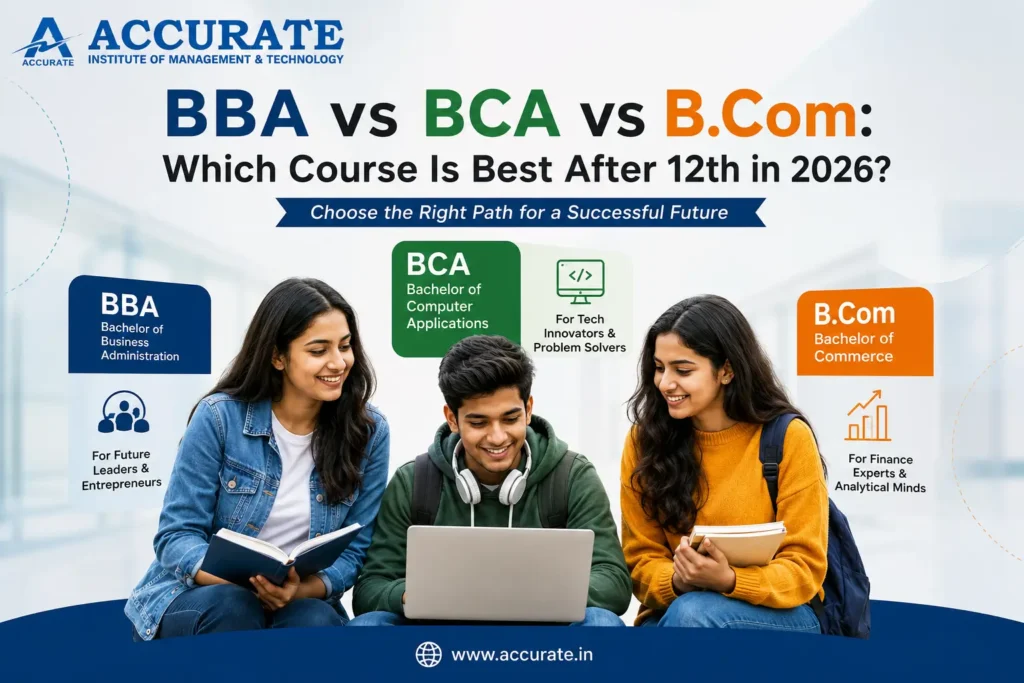

BBA, BCA and B.Com are all strong undergraduate options after Class 12, but the best choice depends on your career goal. Choose BBA if you are interested in management, marketing, entrepreneurship and leadership; BCA if you enjoy computers, programming and technology; and B.Com if you prefer accounting, finance, taxation, banking and commerce. Students should compare their interests, eligibility, skills and long-term career plans before choosing.
“Which is better: BBA, BCA or B.Com after 12th?” There is no single course that is best for everyone. BBA is generally better for management and business careers, BCA for IT and software careers, and B.Com for accounting, banking and finance careers. Your best option depends on what you enjoy studying and the career you want to build.
Choosing an undergraduate course after Class 12 is one of the first major career decisions students make. With industries changing rapidly because of artificial intelligence, digital transformation, data-driven business, fintech, e-commerce and automation, students entering college in 2026 need to think beyond simply selecting a popular degree.
Among the most frequently considered undergraduate programmes are Bachelor of Business Administration (BBA), Bachelor of Computer Applications (BCA), and Bachelor of Commerce (B.Com). All three can lead to promising careers, but they prepare students for very different professional environments.
A BBA primarily develops knowledge of business, management and entrepreneurship. A BCA builds a foundation in computers, programming and information technology. B.Com focuses on commerce, accounting, finance, taxation and related business disciplines.
So, BBA vs BCA vs B.Com—which course is best after 12th in 2026?
The answer depends on your interests, abilities and career plans rather than on a universal ranking. A student fascinated by coding may find BCA more suitable than BBA. Someone interested in marketing, management or entrepreneurship may prefer BBA. A student who enjoys accounts, economics and finance may feel more comfortable pursuing B.Com.
This detailed comparison will help students and parents understand the differences and make an informed choice.
Table of Contents
- BBA vs BCA vs B.Com: Quick Comparison
- What Is BBA?
- What Is BCA?
- What Is B.Com?
- BBA vs BCA vs B.Com: Eligibility
- Difference in Subjects and Curriculum
- Skills Developed in Each Course
- Career Opportunities After BBA
- Career Opportunities After BCA
- Career Opportunities After B.Com
- Higher Studies After BBA, BCA and B.Com
- BBA vs BCA vs B.Com for Future Scope
- Which Course Is Better for Entrepreneurship?
- Which Course Is Better for Government Jobs?
- How to Choose the Right Course After 12th
- Why Consider Accurate Institute of Management & Technology?
- Final Verdict
- Frequently Asked Questions
BBA vs BCA vs B.Com: Quick Comparison
| Factor | BBA | BCA | B.Com |
|---|---|---|---|
| Full Form | Bachelor of Business Administration | Bachelor of Computer Applications | Bachelor of Commerce |
| Main Focus | Business and Management | Computers and IT | Commerce and Finance |
| Best Suited For | Future managers and entrepreneurs | Technology-oriented students | Finance and accounting-oriented students |
| Key Areas | Marketing, HR, Finance, Operations | Programming, Databases, Web and Software | Accounting, Taxation, Economics, Finance |
| Common Career Direction | Management, Sales, Marketing, HR | Software, IT, Web, Data | Banking, Accounts, Finance, Tax |
| Popular Higher Studies | MBA, PGDM | MCA, MBA, specialised technology programmes | M.Com, MBA, CA-related pathways |
| Ideal Interest | Leadership and Business | Computers and Coding | Accounts and Finance |
This table offers a quick overview, but students should understand each programme in detail before making a final decision.
What Is BBA?
Bachelor of Business Administration (BBA) is an undergraduate management programme designed to introduce students to how organisations and businesses operate.
It is particularly suitable for students interested in management, entrepreneurship, marketing, finance, human resources, sales or corporate leadership.
What Do Students Study in BBA?
Although subjects differ between universities, students commonly encounter areas such as:
- Principles of Management
- Marketing Management
- Human Resource Management
- Financial Management
- Business Economics
- Organisational Behaviour
- Business Communication
- Operations Management
- Entrepreneurship
- Business Law
- Digital Marketing
- Business Analytics
Modern BBA education increasingly combines classroom concepts with case studies, presentations, projects, internships and interaction with industry.
For example, Accurate’s published information describes its BBA as a three-year full-time programme affiliated with Chaudhary Charan Singh University and highlights experiential learning, internships, industry-driven live projects and additional learning in areas such as digital marketing and entrepreneurship.
Who Should Choose BBA?
BBA can be a good option if you:
- Enjoy communication and presentations.
- Want to understand how businesses work.
- Are interested in management or entrepreneurship.
- Want to pursue an MBA or PGDM later.
- Like marketing, HR, sales, finance or operations.
- See yourself managing teams or business projects.
BBA is therefore less about specialising immediately in one technical function and more about developing a broad understanding of business.
What Is BCA?
Bachelor of Computer Applications (BCA) is an undergraduate programme centred on computers, software and information technology.
As businesses across sectors become increasingly digital, technology skills have become relevant far beyond traditional IT companies. Banks, retailers, manufacturers, healthcare organisations, educational institutions and startups all rely heavily on digital systems.
What Do Students Study in BCA?
Depending on the university curriculum, a BCA programme can cover subjects such as:
- Computer Fundamentals
- Programming
- Data Structures
- Database Management Systems
- Web Technologies
- Computer Networks
- Operating Systems
- Software Engineering
- Object-Oriented Programming
- Mathematics
- Cloud and emerging technologies
- Information Security concepts
The exact syllabus and programming languages vary by institution.
Who Should Choose BCA?
BCA may suit you if you:
- Enjoy working with computers.
- Are curious about software and applications.
- Like logical problem-solving.
- Want to learn programming.
- Are interested in web or software development.
- Want a career in the IT industry.
- Plan to pursue MCA or other technology-oriented postgraduate education.
Students should remember that a technology career requires continuous learning. Programming frameworks, tools and platforms change frequently, so curiosity and willingness to keep upgrading skills matter greatly.
What Is B.Com?
Bachelor of Commerce (B.Com) is one of India’s established undergraduate programmes for students interested in commerce, accounting, economics, taxation, banking and finance.
It provides a strong academic foundation for careers associated with financial and commercial functions.
What Do Students Study in B.Com?
Typical areas may include:
- Financial Accounting
- Corporate Accounting
- Business Economics
- Business Law
- Cost Accounting
- Income Tax
- Corporate Finance
- Auditing
- Banking
- Business Statistics
- Management Principles
- Entrepreneurship
Subjects vary according to the university and whether a student pursues B.Com, B.Com (Hons.) or another specialised format.
Who Should Choose B.Com?
B.Com can be suitable if you:
- Enjoy accounting and numbers.
- Are interested in finance.
- Want to explore banking or taxation.
- Plan to pursue M.Com or MBA.
- Are considering professional qualifications in accounting or finance.
- Want a broad foundation in commerce.
BBA vs BCA vs B.Com Eligibility After 12th
Eligibility is one of the first factors students need to verify.
BBA Eligibility
BBA programmes generally accept students who have completed 10+2 from a recognised board, subject to the institution or university’s minimum marks and other admission requirements.
Students from Commerce, Science and Humanities backgrounds can often apply.
BCA Eligibility
BCA eligibility requires closer attention because mathematics or related subject requirements can vary between universities.
Accurate’s currently published BCA information, for example, states 10+2 eligibility requirements and specifies Mathematics at High School or Intermediate level.
Students should therefore check the latest official eligibility conditions before submitting an application rather than assuming that every BCA programme follows identical rules.
B.Com Eligibility
B.Com admissions generally require completion of Class 12 from a recognised board, but minimum marks, required subjects and admission procedures depend on the university and programme.
Important: Admission rules can change. Always confirm the current 2026 eligibility, university regulations and admission requirements directly with the institution before applying.
BBA vs BCA vs B.Com: Difference in Subjects
The easiest way to understand the three programmes is through their academic orientation.
BBA = Managing Business
BBA asks questions such as:
How does a company market a product?
How are employees managed?
How does a business make strategic decisions?
How can an entrepreneur develop an idea into a business?
BCA = Building and Managing Technology
BCA deals with questions such as:
How does software work?
How is a program developed?
How are databases organised?
How can technology solve a practical problem?
B.Com = Understanding Commerce and Finance
B.Com explores questions such as:
How are financial transactions recorded?
How do taxation and accounting work?
How do companies manage financial resources?
How do banking and commercial systems operate?
This fundamental difference should play a major role in your choice.
Skills Developed Through BBA, BCA and B.Com
Employers increasingly evaluate graduates not only by degrees but also by the skills they can demonstrate.
Skills You Can Develop Through BBA
BBA students can build:
- Leadership
- Communication
- Presentation
- Teamwork
- Business analysis
- Negotiation
- Decision-making
- Marketing understanding
- Problem-solving
- Entrepreneurial thinking
Skills You Can Develop Through BCA
BCA students can develop:
- Programming
- Logical reasoning
- Technical problem-solving
- Database handling
- Software development fundamentals
- Web technology skills
- Analytical thinking
- Debugging
- Technology adaptability
- Project development
Skills You Can Develop Through B.Com
B.Com students can strengthen:
- Accounting
- Financial analysis
- Numerical ability
- Commercial awareness
- Taxation knowledge
- Business documentation
- Economics fundamentals
- Analytical reasoning
- Banking knowledge
- Attention to detail
The strongest graduates usually complement their degree with internships, certifications, projects, communication abilities and practical exposure.
Career Opportunities After BBA
BBA graduates can explore entry-level opportunities across many business functions.
Popular Career Areas After BBA
Potential directions include:
- Marketing
- Sales
- Business Development
- Human Resources
- Operations
- Customer Relationship Management
- Banking and Financial Services
- Digital Marketing
- Retail Management
- Entrepreneurship
Possible entry-level job titles may include:
Management Trainee: Supports business functions while developing managerial capabilities.
Marketing Executive: Assists with marketing campaigns, customer research and brand activities.
Business Development Executive: Identifies potential clients, markets and growth opportunities.
HR Executive: Supports recruitment, employee engagement and HR operations.
Sales Executive: Works on customer acquisition, sales targets and account relationships.
A BBA can also serve as a foundation for an MBA or PGDM.
Career Opportunities After BCA
BCA can lead to technology-focused entry-level roles, particularly when students build strong practical and programming skills.
Popular Career Areas After BCA
Possible career directions include:
- Software Development
- Web Development
- IT Support
- Database Management
- Software Testing
- System Support
- Cloud Support
- Cybersecurity-related entry pathways
- Data and analytics support
- Application Development
Potential Job Roles
Junior Software Developer: Assists in designing, coding and maintaining applications.
Web Developer: Develops and maintains websites or web-based applications.
Software Tester: Tests applications to identify errors and quality issues.
Technical Support Executive: Helps users resolve software, system or technology problems.
Database Support Professional: Supports database-related processes and data management.
For advanced technology roles, students may need specialised skills, certifications, strong project portfolios or postgraduate education.
Career Opportunities After B.Com
B.Com graduates have opportunities across accounting, finance, banking and business operations.
Popular Career Areas After B.Com
Potential fields include:
- Accounting
- Banking
- Financial Services
- Insurance
- Taxation
- Auditing
- Investment Operations
- Business Operations
- Financial Analysis
- Corporate Finance support
Potential Job Roles
Accountant: Handles financial records and accounting processes.
Accounts Executive: Supports day-to-day accounting, invoices, payments and financial documentation.
Banking Professional: Can work in banking operations, customer services and related functions depending on recruitment requirements.
Tax Associate: Assists with tax documentation, compliance and related processes.
Finance Executive: Supports financial planning, reporting and business finance activities.
B.Com is also frequently selected by students planning further education or professional qualifications in finance and accounting.
BBA vs BCA vs B.Com: Higher Studies Options
Your undergraduate degree does not have to determine your entire career. Postgraduate education can help you specialise or even change direction.
Higher Studies After BBA
Popular options include:
- MBA
- PGDM
- Specialised management master’s programmes
- Master’s programmes in marketing, finance or HR, subject to eligibility
- Entrepreneurship programmes
Students aspiring to senior management roles often consider an MBA or PGDM after gaining the appropriate academic foundation.
Higher Studies After BCA
Common options include:
- MCA
- MBA
- MSc-related programmes where eligible
- Data Analytics programmes
- Cybersecurity programmes
- Cloud Computing certifications
- Software and technology specialisations
A BCA followed by an MCA remains a recognised pathway for students seeking deeper knowledge in computer applications.
Higher Studies After B.Com
Popular choices include:
- M.Com
- MBA
- Finance-oriented master’s programmes
- Banking programmes
- Professional accounting and finance pathways
The best postgraduate option should be chosen according to the student’s intended career rather than simply following the most common path.
BBA vs BCA vs B.Com: Which Has the Best Future Scope in 2026?
This is one of the most common questions students ask.
The reality is that all three have future scope, but in different areas.
Future Scope of BBA
Organisations continue to need professionals capable of understanding customers, managing teams, developing markets, analysing business situations and driving growth.
Digital business is also creating intersections between traditional management and technology. Modern managers increasingly need familiarity with analytics, AI-enabled tools, digital marketing and technology-led business models.
Therefore, BBA can remain relevant for students who combine management knowledge with digital and analytical skills.
Future Scope of BCA
Technology continues to transform almost every industry. Software, cloud services, cybersecurity, automation, data systems and AI-enabled applications create demand for people who understand technology.
However, a BCA degree alone should not be viewed as an automatic ticket to a high-paying technology job. Students who continuously practise programming, complete projects and build specialised skills are likely to be better positioned.
Future Scope of B.Com
Finance and commerce remain central to every functioning business. Companies need accounting, taxation, financial planning, banking, compliance and commercial expertise.
At the same time, these professions are becoming increasingly technology-driven. B.Com students who add capabilities in spreadsheets, financial analytics, accounting software and emerging digital finance tools can strengthen their employability.
How AI Changes the BBA vs BCA vs B.Com Decision in 2026
Artificial intelligence should not necessarily make students avoid a particular degree. Instead, it makes skill development within each degree more important.
For BBA students, AI tools can support market research, customer analysis, productivity and business decision-making.
For BCA students, AI creates both opportunities and challenges. Developers can use AI-assisted programming tools, but they still need to understand logic, software architecture, databases, security and problem-solving.
For B.Com students, automation can simplify repetitive accounting processes while increasing the importance of analysis, financial interpretation, compliance and technology proficiency.
The winning strategy in 2026 is therefore not simply degree + marks.
It is:
Degree + practical skills + digital capability + communication + projects/internships + continuous learning.
India’s undergraduate education framework is itself moving toward greater flexibility and multidisciplinary learning. UGC describes its Curriculum and Credit Framework for Undergraduate Programmes as incorporating flexible choices, a multidisciplinary approach and multiple entry and exit possibilities in line with NEP 2020.
BBA vs BCA vs B.Com: Which Is Better for Entrepreneurship?
If your primary ambition is to launch or manage a business, BBA is usually the most directly aligned of the three because it introduces students to management, marketing, finance, operations and entrepreneurship.
However, BCA can be powerful for students planning technology startups because they can understand the product-building side of a digital business.
Similarly, a B.Com graduate can build a strong foundation for businesses where financial management, taxation and commerce knowledge are particularly important.
Therefore:
General business startup → BBA
Technology startup → BCA can be highly relevant
Finance/accounting-oriented business → B.Com can be valuable
Which Is Better for Government Jobs: BBA, BCA or B.Com?
Graduates from all three streams can potentially apply for many graduate-level government examinations, provided they satisfy the specific eligibility conditions.
These may include recruitment examinations associated with banking, staff selection, railways, public-sector organisations and other government bodies.
The key point is that government recruitment depends on the eligibility criteria of the particular examination, not simply whether someone has a BBA, BCA or B.Com.
Students targeting government careers should check official notifications and start building aptitude, reasoning, English, general awareness and quantitative skills according to the examination pattern.
BBA vs BCA vs B.Com: Which Is Harder?
Difficulty is subjective.
A student who dislikes coding may consider BCA difficult.
Someone uncomfortable with accounting may find B.Com challenging.
A student who dislikes presentations, teamwork, case studies and business concepts may find BBA demanding.
Instead of asking “Which course is easiest?”, ask:
“Which course matches the way I naturally like to learn and solve problems?”
That question leads to better career decisions.
Which Course Should Commerce Students Choose?
Commerce students often find both BBA and B.Com familiar, but BCA may also be an option when the applicable eligibility requirements are met.
Choose BBA if you prefer management, marketing, entrepreneurship and business leadership.
Choose B.Com if you prefer accounting, finance, economics, taxation and banking.
Choose BCA if your stronger interest lies in computers and technology and you satisfy the programme’s eligibility conditions.
Your Class 12 stream should guide you, but it should not automatically dictate your career.
How to Choose Between BBA, BCA and B.Com After 12th
Use a structured decision instead of choosing based on friends or trends.
1. Identify Your Favourite Subjects
Ask which subjects genuinely hold your attention.
Business and management → Explore BBA.
Computers and technology → Explore BCA.
Accounts and economics → Explore B.Com.
2. Think About Your Preferred Work
Imagine yourself five years from now.
Would you enjoy managing a marketing campaign?
Would you rather develop a digital application?
Or would you prefer analysing financial information?
Your preferred working environment provides useful clues.
3. Consider Your Natural Strengths
BBA can reward communication, leadership and business thinking.
BCA requires logical thinking, patience and technical curiosity.
B.Com rewards numerical comfort, accuracy and financial reasoning.
4. Check Eligibility Before Deciding
Do not assume you qualify for every programme.
Check the university’s current requirements, particularly for BCA, where mathematics requirements may apply.
5. Look Beyond the Degree Name
When evaluating colleges, investigate:
- University affiliation
- Curriculum
- Faculty
- Infrastructure
- Internships
- Industry interaction
- Skill-development opportunities
- Placement support
- Student activities
- Location and campus environment
The learning ecosystem can significantly influence what you gain from an undergraduate degree.
Why Consider Accurate Institute of Management & Technology for Your Undergraduate Journey?
Choosing the programme is only half of the decision. Students also need an institution that helps connect classroom learning with professional development.
Accurate Institute of Management & Technology and the Accurate Group’s undergraduate business programmes in Greater Noida provide students access to an education ecosystem focused on academic and professional development.
Accurate’s official admissions information currently lists BBA, BCA and B.Com (H) among its offered programmes.
Its undergraduate business school information also identifies the programmes as affiliated with Chaudhary Charan Singh University.
Industry-Oriented Learning
For students comparing BBA vs BCA vs B.Com, classroom teaching alone should not be the only consideration.
Accurate highlights corporate interaction through alumni sessions, mock interviews, corporate lectures, industrial visits, internships, conferences, workshops and seminars as part of its student-development environment.
Such exposure can help students understand how academic concepts translate into professional situations.
Career Preparation and Campus Exposure
A good undergraduate experience should develop both domain knowledge and professional confidence.
Accurate Business School’s current website highlights regular campus drives and undergraduate programmes in BBA, BCA and B.Com (H), along with its Greater Noida campus in Knowledge Park III.
Students considering admission should verify the latest programme structure, fees, eligibility, placement data and admission requirements directly with the institute for the 2026 intake.
Greater Noida as an Education and Corporate Hub
Greater Noida’s educational ecosystem and proximity to Delhi NCR can provide students exposure to a broader corporate and professional environment.
For students searching for a BBA college in Greater Noida, BCA college in Greater Noida or B.Com college in Greater Noida, Accurate can therefore be considered while comparing institutions on academics, practical learning, campus facilities and career preparation.
BBA vs BCA vs B.Com: Final Verdict
So, which course is best after 12th in 2026—BBA, BCA or B.Com?
There is no universal winner.
Choose BBA if your interests revolve around business, management, marketing, leadership or entrepreneurship.
Choose BCA if you are passionate about computers, programming, software and technology.
Choose B.Com if you are interested in accounting, taxation, banking, economics and finance.
The best degree is the one that sits at the intersection of three things:
What you enjoy + what you can become good at + where you want your career to go.
Do not select BCA merely because technology is growing. Do not choose BBA only because you want an MBA someday. And do not choose B.Com simply because you studied Commerce in Class 12.
Instead, evaluate your aptitude, interests, eligibility and long-term ambitions.
In 2026 and beyond, employers will increasingly value graduates who combine academic knowledge with practical capabilities, digital fluency, communication skills, adaptability and real-world exposure. Whichever degree you choose, focus on becoming capable rather than merely qualified.
Conclusion: Start Building Your Career with Accurate Institute of Management & Technology
The choice between BBA vs BCA vs B.Com after 12th becomes much simpler once you identify the career you want to build.
BBA provides a foundation for management and entrepreneurship. BCA creates a pathway towards technology and computer applications. B.Com develops expertise in commerce, accounting and finance.
But a degree becomes more valuable when students combine it with practical learning, internships, industry interaction, projects and career preparation.
Students exploring undergraduate education in Greater Noida can consider Accurate Institute of Management & Technology / Accurate Business School, where BBA, BCA and B.Com (H) are among the programmes currently listed by the institution. Accurate also highlights industry interaction, internships, corporate sessions and placement-oriented activities within its undergraduate learning environment.
Admissions for BBA, BCA and B.Com aspirants can be explored through Accurate’s official admission channels. Before applying, students are encouraged to confirm the latest 2026 eligibility, programme structure, fee details and admission schedule.
Take the next step towards your career. Explore BBA, BCA and B.Com admission opportunities at Accurate Institute of Management & Technology, Greater Noida, and choose the programme that matches your ambition.
Frequently Asked Questions (FAQs)
1. Which is better after 12th in 2026: BBA, BCA or B.Com?
The best course depends on your career goal. BBA is suitable for management, marketing and entrepreneurship; BCA is suited to students interested in computers, programming and IT; and B.Com is ideal for students interested in accounting, finance, banking and taxation. Instead of ranking the courses, choose the one most closely aligned with your interests and future career.
2. Is BBA better than B.Com after 12th?
BBA may be better for students interested in management, marketing, HR, sales, entrepreneurship and an eventual MBA. B.Com may be better for students interested in accounting, taxation, finance, banking and commerce. Neither is universally better—the right choice depends on your career direction.
3. Is BCA better than BBA for future scope?
BCA can offer strong opportunities for students pursuing software, IT and technology careers, while BBA can provide opportunities in management, marketing, sales, HR and business development. Both have future scope. Students should select BCA for genuine technology interest and BBA for genuine business and management interest.
4. Can a Commerce student pursue BCA after 12th?
A Commerce student may be eligible for BCA depending on the university’s admission requirements. Some programmes require Mathematics at Class 10 or 12 level. Accurate’s published BCA eligibility information, for example, specifies Mathematics at High School or Intermediate level. Applicants should verify the latest 2026 criteria before applying.
5. Which has more career options: BBA, BCA or B.Com?
All three offer diverse opportunities in different sectors. BBA graduates commonly explore management, sales, marketing and HR; BCA graduates enter IT and software-related fields; and B.Com graduates explore accounting, banking, finance and taxation. Your skills, internships, certifications and postgraduate education can expand the number of opportunities available.
6. Which course is best for an MBA: BBA, BCA or B.Com?
BBA is the most directly management-oriented foundation for an MBA, but BCA and B.Com graduates can also pursue an MBA subject to the eligibility requirements of the institution. A BCA graduate may combine technology knowledge with management, while a B.Com graduate may build on finance and commerce expertise.
7. Which course is best for students who want to become entrepreneurs?
BBA is generally the most directly aligned because students study areas such as management, marketing, finance and entrepreneurship. However, BCA can be useful for technology entrepreneurs, while B.Com can provide a strong foundation for entrepreneurs interested in finance and commercial management.
8. Is BCA a good career choice in 2026 with AI growing rapidly?
Yes, BCA can remain a relevant choice, but students need to continuously upgrade their technical abilities. AI is changing software development rather than eliminating the need to understand programming, databases, systems and problem-solving. BCA students who combine fundamentals with projects, AI tools, cloud, cybersecurity or data skills can build stronger career profiles.
9. Does Accurate Institute offer BBA, BCA and B.Com?
Accurate’s official admissions information currently lists Bachelor of Business Administration (BBA), Bachelor of Computer Applications (BCA) and Bachelor of Commerce (B.Com H) among its programmes. Students should check the institute’s official admission information for the latest 2026 programme details and eligibility requirements.
10. How do I choose the best course after 12th?
Start with your interests and career goals. Choose BBA if you enjoy business and management, BCA if you enjoy computers and technology, and B.Com if you prefer accounts, commerce and finance. Then compare eligibility, curriculum, higher-study options, career opportunities, internships, industry exposure and the learning environment of the college before making your final decision.