
Computer Science Engineering (CSE) is one of the fastest-growing fields in the world. Every year, new technologies emerge, transforming industries, businesses, healthcare, education, finance, manufacturing, and daily life. The rapid pace of innovation means that today’s engineering students must prepare not only for current technologies but also for the technologies that will shape the future.
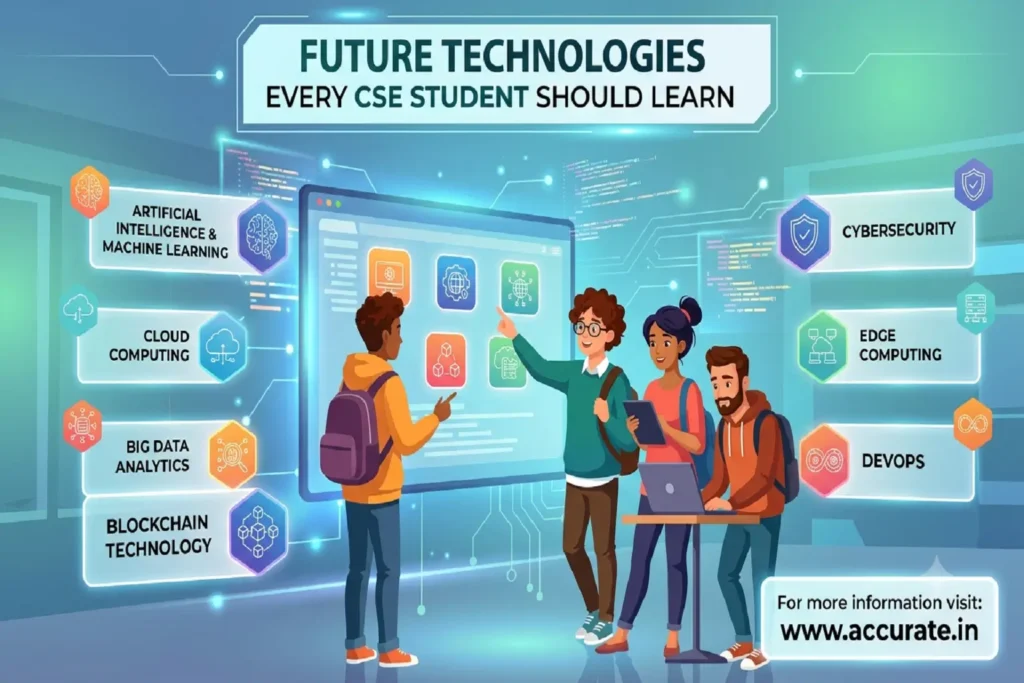
Employers today look beyond traditional programming knowledge. They expect graduates to understand Artificial Intelligence, Machine Learning, Cloud Computing, Cyber Security, Data Science, Internet of Things (IoT), Blockchain, Automation, and several other advanced technologies. Students who develop expertise in these areas significantly improve their career prospects and become valuable assets for global organizations.
Learning future technologies is no longer optional—it has become an essential part of building a successful engineering career. Companies across the world are investing heavily in digital transformation, automation, smart systems, and intelligent software solutions. As a result, Computer Science graduates with practical knowledge of emerging technologies enjoy better placement opportunities, higher salaries, and faster career growth.
Among the institutions preparing students for this evolving technological landscape, Accurate Institute of Management & Technology (AIMT) has built a strong reputation by emphasizing industry-oriented education, practical exposure, innovation, and skill development. The institute encourages students to explore advanced technologies through project-based learning, technical workshops, coding activities, internships, and industry interaction, helping them become future-ready professionals.
This comprehensive guide explores the most important technologies every CSE student should learn and explains why mastering these skills can open doors to exciting career opportunities in India and around the world.
Table of Contents
- Why Future Technologies Matter for CSE Students
- How Computer Science Engineering is Evolving
- Artificial Intelligence (AI)
- Machine Learning (ML)
- Data Science
- Cloud Computing
- Cyber Security
- Internet of Things (IoT)
- Blockchain Technology
- Full Stack Development
- DevOps
- Why Practical Learning is Essential
- Why Choose Accurate Institute of Management & Technology
- Conclusion
- Frequently Asked Questions
Why Future Technologies Matter for CSE Students
Technology evolves at an extraordinary pace. Programming languages, development tools, and software frameworks are continuously improving, while new innovations are creating entirely new career paths. Engineers who stay updated with emerging technologies remain competitive in the job market and are better prepared to solve complex business challenges.
Some key reasons why future technologies are essential include:
Growing Industry Demand
Organizations across industries are adopting automation, intelligent systems, cloud-based infrastructure, and data-driven decision-making. This has created an increasing demand for engineers who possess expertise beyond conventional software development.
Better Career Opportunities
Knowledge of advanced technologies enables graduates to apply for specialized roles that often offer better growth prospects, challenging projects, and competitive compensation.
Continuous Innovation
Future technologies encourage creativity and innovation. Students learn how to develop solutions that improve efficiency, reduce costs, and enhance user experiences.
Global Career Scope
Emerging technologies are used worldwide, enabling skilled engineers to work with multinational companies, startups, research organizations, and technology-driven enterprises across the globe.
How Computer Science Engineering is Evolving
The field of Computer Science Engineering has expanded far beyond software programming. Modern engineers are expected to build intelligent, scalable, secure, and connected systems capable of solving real-world challenges.
Today’s CSE curriculum increasingly integrates multiple disciplines such as:
- Artificial Intelligence
- Machine Learning
- Data Analytics
- Cloud Computing
- Internet of Things
- Cyber Security
- Robotics
- Automation
- Blockchain
- Edge Computing
This multidisciplinary approach prepares students for future industry requirements and encourages continuous learning throughout their careers.
Artificial Intelligence (AI)
What is Artificial Intelligence?
Artificial Intelligence refers to the development of computer systems capable of performing tasks that typically require human intelligence. AI systems can analyze information, recognize patterns, make decisions, understand language, and continuously improve through experience.
AI is transforming industries by enabling businesses to automate repetitive tasks, improve customer experiences, and generate valuable insights from large volumes of data.
Applications of AI
Artificial Intelligence powers a wide range of modern applications, including:
- Virtual assistants
- Recommendation systems
- Smart healthcare solutions
- Autonomous vehicles
- Fraud detection
- Predictive maintenance
- Customer service chatbots
- Smart manufacturing
- Financial analytics
Skills CSE Students Should Learn
Students interested in Artificial Intelligence should develop expertise in:
- Python Programming
- Mathematics
- Linear Algebra
- Probability
- Statistics
- Neural Networks
- Deep Learning
- Computer Vision
- Natural Language Processing
- AI Frameworks
Career Opportunities
AI professionals are highly sought after in industries such as:
- Healthcare
- Finance
- Retail
- Manufacturing
- Education
- Automotive
- Telecommunications
- Software Development
Common job roles include AI Engineer, Research Scientist, Machine Learning Engineer, AI Consultant, and Data Scientist.
Machine Learning (ML)
Understanding Machine Learning
Machine Learning is a branch of Artificial Intelligence that enables computers to learn from data without explicit programming for every task. Instead of following predefined instructions, ML algorithms improve their performance as they process more data.
Machine Learning plays a crucial role in modern software applications and intelligent systems.
Everyday Uses of Machine Learning
Students interact with Machine Learning daily through:
- Online shopping recommendations
- Video streaming suggestions
- Social media feeds
- Email spam filters
- Voice recognition
- Facial recognition
- Smart search engines
Important Machine Learning Concepts
CSE students should understand:
- Supervised Learning
- Unsupervised Learning
- Reinforcement Learning
- Regression
- Classification
- Clustering
- Decision Trees
- Neural Networks
- Deep Learning
Programming Languages
Popular programming languages include:
- Python
- R
- Java
Python remains the most preferred language due to its extensive libraries and community support.
Career Roles
Machine Learning professionals work as:
- Machine Learning Engineers
- AI Developers
- Data Scientists
- Predictive Analytics Specialists
- Research Engineers
Data Science
Why Data Science Matters
Data has become one of the most valuable assets for organizations. Every digital interaction generates information that businesses analyze to improve products, understand customer behavior, and optimize operations.
Data Science combines:
- Programming
- Statistics
- Machine Learning
- Data Visualization
- Business Intelligence
to extract meaningful insights from structured and unstructured data.
Skills Every Student Should Develop
Students should learn:
- Python
- SQL
- Excel
- Statistics
- Data Cleaning
- Data Visualization
- Machine Learning Basics
- Business Analytics
Industry Applications
Data Science is widely used in:
- Banking
- Healthcare
- Marketing
- E-commerce
- Manufacturing
- Sports Analytics
- Government Services
Career Opportunities
Popular roles include:
- Data Scientist
- Business Analyst
- Data Analyst
- Analytics Consultant
- Data Engineer
Cloud Computing
What is Cloud Computing?
Cloud Computing enables organizations to store, process, and manage data over the internet instead of relying on physical infrastructure. It has become the backbone of modern digital businesses due to its scalability, flexibility, and cost efficiency.
Most leading technology companies now operate using cloud platforms, making cloud skills essential for aspiring software engineers.
Major Cloud Platforms
Students should become familiar with:
- Amazon Web Services (AWS)
- Microsoft Azure
- Google Cloud Platform (GCP)
These platforms are widely adopted across industries and offer certification opportunities that enhance employability.
Why Learn Cloud Computing?
Cloud Computing supports:
- Web Applications
- Mobile Applications
- Artificial Intelligence
- Big Data Analytics
- Internet of Things
- Software Development
- Enterprise Applications
Understanding cloud architecture enables students to build scalable and secure solutions suitable for modern businesses.
Career Opportunities
Professionals with cloud expertise can pursue roles such as:
- Cloud Engineer
- Cloud Architect
- DevOps Engineer
- Site Reliability Engineer
- Solutions Architect
Cloud skills continue to be among the most sought-after competencies in the technology sector.
Cyber Security
Why Cyber Security is One of the Most Important Technologies
As businesses move their operations online, cyber threats have become more sophisticated than ever before. Organizations need skilled professionals who can protect digital assets, customer information, financial data, and critical infrastructure from cyberattacks.
Cyber Security has evolved into one of the highest-paying and fastest-growing technology domains. Every software application, cloud platform, IoT device, banking system, and government portal requires strong security mechanisms.
For Computer Science Engineering students, learning Cyber Security is no longer optional—it is an essential career skill.
Major Areas of Cyber Security
Students should develop knowledge in:
- Network Security
- Ethical Hacking
- Information Security
- Digital Forensics
- Cloud Security
- Web Security
- Application Security
- Mobile Security
- Identity and Access Management
- Cryptography
Important Tools to Learn
Future engineers should gain practical exposure to:
- Kali Linux
- Wireshark
- Burp Suite
- Metasploit
- Nmap
- OWASP Testing Tools
Understanding these tools helps students identify vulnerabilities and strengthen system security.
Career Opportunities
Cyber Security professionals work in:
- Banking
- Healthcare
- Government
- Defense
- IT Services
- E-commerce
- Telecommunications
- Cloud Computing Companies
Popular job roles include:
- Cyber Security Analyst
- Security Engineer
- Ethical Hacker
- Penetration Tester
- Security Consultant
- Information Security Specialist
- SOC Analyst
Internet of Things (IoT)
What is IoT?
The Internet of Things (IoT) connects physical devices to the internet, allowing them to collect, exchange, and analyze data. These connected devices communicate intelligently without constant human intervention.
IoT has transformed industries by making systems smarter, more efficient, and highly automated.
Examples include:
- Smart Homes
- Smart Cities
- Smart Agriculture
- Industrial Automation
- Healthcare Monitoring
- Connected Vehicles
- Smart Energy Systems
Technologies Behind IoT
CSE students should understand:
- Embedded Systems
- Sensors
- Microcontrollers
- Wireless Communication
- Cloud Integration
- Data Analytics
- Edge Computing
- Artificial Intelligence
Practical IoT Projects
Students can develop projects like:
- Home Automation Systems
- Smart Attendance Systems
- Smart Irrigation Solutions
- Smart Parking Applications
- Health Monitoring Devices
- Weather Monitoring Systems
- Smart Street Lighting
These projects enhance practical skills and strengthen placement portfolios.
Career Opportunities
Graduates can pursue careers as:
- IoT Engineer
- Embedded Software Engineer
- Automation Engineer
- Systems Engineer
- Smart Device Developer
- IoT Solution Architect
Blockchain Technology
Beyond Cryptocurrency
Although Blockchain became popular through cryptocurrencies, its applications extend far beyond digital currencies.
Blockchain creates secure, transparent, and tamper-resistant digital records, making it valuable for industries requiring trust and data integrity.
Applications of Blockchain
Today Blockchain is widely used in:
- Banking
- Supply Chain Management
- Healthcare
- Insurance
- Digital Identity
- Voting Systems
- Smart Contracts
- Asset Management
Skills Students Should Learn
Future Blockchain developers should understand:
- Cryptography
- Distributed Systems
- Smart Contracts
- Ethereum
- Solidity
- Consensus Algorithms
- Decentralized Applications (DApps)
Career Opportunities
Blockchain expertise opens opportunities such as:
- Blockchain Developer
- Smart Contract Engineer
- Blockchain Architect
- Cryptocurrency Analyst
- Decentralized Application Developer
Full Stack Development
Why Every CSE Student Should Learn Full Stack Development
Companies increasingly seek developers who can build complete software solutions from frontend interfaces to backend databases.
Full Stack Developers understand the entire application development lifecycle, making them highly valuable in startups and multinational companies.
Frontend Technologies
Students should learn:
- HTML5
- CSS3
- JavaScript
- React
- Angular
- Vue.js
Backend Technologies
Important backend skills include:
- Node.js
- Java
- Python
- PHP
- .NET
Database Technologies
Students should also understand:
- MySQL
- PostgreSQL
- MongoDB
- Firebase
Benefits of Learning Full Stack Development
It enables students to:
- Build complete web applications
- Develop personal portfolios
- Create startup products
- Work independently as freelancers
- Improve placement opportunities
DevOps
What is DevOps?
DevOps combines software development with IT operations to deliver applications faster, more efficiently, and with greater reliability.
Instead of separating developers and operations teams, DevOps promotes collaboration throughout the software development lifecycle.
Important DevOps Tools
Students should become familiar with:
- Docker
- Kubernetes
- Jenkins
- Git
- GitHub
- Terraform
- Ansible
- CI/CD Pipelines
Why DevOps is Important
Organizations adopting DevOps experience:
- Faster software delivery
- Better collaboration
- Higher automation
- Improved reliability
- Reduced deployment failures
Career Roles
Popular DevOps careers include:
- DevOps Engineer
- Site Reliability Engineer
- Cloud DevOps Specialist
- Infrastructure Engineer
Edge Computing
The Future Beyond Cloud Computing
While Cloud Computing processes data in centralized data centers, Edge Computing processes information closer to where it is generated.
This reduces:
- Network latency
- Bandwidth usage
- Processing delays
Edge Computing is particularly important for:
- Autonomous Vehicles
- Smart Manufacturing
- Healthcare Monitoring
- Industrial IoT
- Smart Cities
Understanding Edge Computing gives CSE students a competitive advantage as industries increasingly adopt real-time intelligent systems.
Quantum Computing
Preparing for the Next Computing Revolution
Quantum Computing represents one of the most exciting emerging technologies.
Unlike traditional computers that use binary bits, quantum computers use quantum bits (qubits), enabling them to solve highly complex problems significantly faster.
Although still developing, Quantum Computing has applications in:
- Drug Discovery
- Financial Modeling
- Artificial Intelligence
- Climate Research
- Scientific Simulation
- Cryptography
Students interested in advanced research should begin exploring the fundamentals of Quantum Computing.
Augmented Reality (AR) and Virtual Reality (VR)
Transforming Digital Experiences
AR and VR are revolutionizing user experiences across industries.
Applications include:
- Gaming
- Medical Training
- Architecture
- Education
- Manufacturing
- Retail
- Tourism
- Real Estate
CSE students interested in graphics programming and interactive technologies should explore:
- Unity
- Unreal Engine
- C#
- 3D Modeling
- Computer Vision
Career opportunities include AR/VR Developer, Simulation Engineer, and XR Software Engineer.
Robotics and Intelligent Automation
Robotics combines software engineering, electronics, mechanical systems, Artificial Intelligence, and automation.
Modern robots are used in:
- Manufacturing
- Warehousing
- Healthcare
- Agriculture
- Defense
- Logistics
Students who understand robotics gain valuable interdisciplinary skills useful in advanced engineering roles.
Important learning areas include:
- Embedded Programming
- Sensors
- AI
- Machine Vision
- Control Systems
- Robotics Operating System (ROS)
Big Data Analytics
Organizations generate enormous volumes of information every day.
Big Data technologies help process, store, and analyze this information efficiently.
Students should learn:
- Hadoop
- Apache Spark
- NoSQL Databases
- Data Warehousing
- Data Engineering
Big Data professionals support decision-making in sectors including banking, healthcare, retail, and telecommunications.
Essential Programming Languages Every CSE Student Should Learn
Technology changes rapidly, but strong programming fundamentals remain essential.
Students should become proficient in:
Python
Widely used in:
- Artificial Intelligence
- Machine Learning
- Automation
- Data Science
- Web Development
Java
Preferred for:
- Enterprise Applications
- Android Development
- Banking Software
- Backend Development
C++
Important for:
- Competitive Programming
- Game Development
- Operating Systems
- Embedded Systems
JavaScript
Essential for:
- Frontend Development
- Backend Development
- Mobile Applications
- Full Stack Development
SQL
Critical for database management, analytics, and enterprise software development.
Importance of Open Source Contributions
Many leading technology companies value candidates who contribute to open-source projects.
Benefits include:
- Practical coding experience
- Collaboration with global developers
- Better GitHub profile
- Improved coding standards
- Strong technical portfolio
Students should actively participate in GitHub projects throughout their engineering journey.
Industry Certifications That Add Value
Professional certifications help validate technical expertise and improve employability.
Popular certifications include:
- AWS Cloud Certifications
- Microsoft Azure Certifications
- Google Cloud Certifications
- Cisco Networking Certifications
- Red Hat Linux Certifications
- Oracle Java Certifications
- CompTIA Security+
- Certified Ethical Hacker (CEH)
- Kubernetes Certifications
These certifications complement academic learning and demonstrate commitment to continuous skill development.
Importance of Practical Projects
Recruiters increasingly prioritize practical experience over theoretical knowledge alone.
Students should build projects involving:
- Artificial Intelligence
- Machine Learning
- Cloud Applications
- Cyber Security Tools
- IoT Solutions
- Blockchain Applications
- Web Development
- Mobile Applications
- Automation Systems
A strong portfolio showcasing real-world projects significantly enhances placement opportunities.
Learning Beyond the Classroom at Accurate Institute of Management & Technology
At Accurate Institute of Management & Technology, Computer Science Engineering education extends well beyond traditional classroom instruction. Students are encouraged to apply concepts through practical implementation, helping them build confidence and industry-ready skills.
The institute emphasizes experiential learning through:
Project-Based Learning
Students work on innovative projects across emerging domains such as Artificial Intelligence, Machine Learning, Internet of Things, Data Science, Cyber Security, and Cloud Computing. This hands-on approach strengthens technical understanding and problem-solving abilities.
Technical Workshops and Expert Sessions
Regular workshops, seminars, and guest lectures by industry professionals expose students to current technologies, development practices, and evolving industry expectations.
Coding Competitions and Hackathons
Participation in coding contests and hackathons helps students improve logical thinking, programming efficiency, teamwork, and creativity while solving real-world challenges.
Internship Support
The institute encourages internships that provide valuable industry exposure, allowing students to experience professional software development environments and apply classroom knowledge in practical settings.
Skill Development Programs
In addition to technical education, Accurate Institute focuses on communication skills, aptitude training, leadership development, and interview preparation to enhance overall employability.
This balanced approach ensures that graduates are equipped with both technical expertise and professional competencies required in today’s competitive technology industry.
Future Career Opportunities for CSE Students
Technology is evolving faster than ever before, creating exciting career opportunities for Computer Science Engineering graduates. Organizations across industries are investing heavily in digital transformation, artificial intelligence, cloud computing, automation, and data-driven solutions. As a result, students who continuously upgrade their technical skills are well-positioned for rewarding careers.
Some of the most promising career paths include:
Artificial Intelligence Engineer
AI Engineers design intelligent systems capable of learning, reasoning, and making decisions. They develop applications such as virtual assistants, recommendation engines, autonomous systems, and predictive analytics platforms.
Key Skills
- Python
- TensorFlow
- PyTorch
- Deep Learning
- Natural Language Processing
- Computer Vision
Machine Learning Engineer
Machine Learning Engineers create algorithms that allow computers to improve automatically through data analysis. They work on predictive models, recommendation systems, fraud detection, and intelligent automation.
Industries hiring ML professionals include:
- Banking
- Healthcare
- Retail
- Manufacturing
- Automotive
- Telecommunications
Data Scientist
Data Scientists analyze large datasets to identify patterns, trends, and business insights. Their work helps organizations make informed decisions and optimize operations.
Essential skills include:
- Statistics
- Python
- SQL
- Machine Learning
- Data Visualization
- Business Intelligence
Cloud Engineer
As businesses migrate to cloud infrastructure, Cloud Engineers manage scalable and secure cloud environments.
They work with platforms such as:
- Amazon Web Services (AWS)
- Microsoft Azure
- Google Cloud Platform (GCP)
Cloud computing continues to be one of the most in-demand skills globally.
Cyber Security Specialist
Cyber Security professionals protect organizations against cyber threats, ensuring the confidentiality, integrity, and availability of digital systems.
They specialize in:
- Network Security
- Ethical Hacking
- Digital Forensics
- Cloud Security
- Risk Assessment
- Security Operations
IoT Engineer
Internet of Things Engineers build connected systems that communicate intelligently through sensors, embedded devices, and cloud platforms.
Applications include:
- Smart Homes
- Healthcare
- Agriculture
- Manufacturing
- Transportation
- Smart Cities
Blockchain Developer
Blockchain professionals create secure decentralized applications, digital identity solutions, and smart contracts.
Industries adopting blockchain include:
- Finance
- Supply Chain
- Healthcare
- Government
- Insurance
Full Stack Developer
Full Stack Developers build complete web applications by combining frontend and backend technologies.
They are highly valued because they can independently develop complete software products.
DevOps Engineer
DevOps Engineers automate software deployment, improve collaboration between development and operations teams, and optimize infrastructure management.
Demand for DevOps continues to increase across cloud-first organizations.
Software Engineer
Software Engineering remains one of the strongest career choices for CSE graduates.
Software Engineers develop applications for:
- Enterprise Software
- Mobile Apps
- Web Platforms
- Embedded Systems
- Cloud Solutions
- AI Products
Emerging Industries Hiring CSE Graduates
Computer Science graduates are no longer limited to IT companies. Today, almost every industry requires software professionals.
Major recruiters belong to sectors such as:
- Information Technology
- Artificial Intelligence
- Banking and Financial Services
- Healthcare Technology
- E-commerce
- Manufacturing
- Automobile Industry
- Aviation
- Smart City Projects
- Telecommunications
- Digital Marketing
- EdTech
- FinTech
- AgriTech
- Robotics
- Gaming
- Logistics
- Government Technology Initiatives
The versatility of CSE makes it one of the most future-proof engineering disciplines.
Importance of Continuous Learning
Technology changes continuously, making lifelong learning an essential habit for every engineer.
Students should regularly:
- Read technical blogs
- Complete online certification programs
- Attend webinars
- Participate in coding competitions
- Build personal projects
- Contribute to open-source software
- Learn new programming languages
- Explore emerging technologies
Engineers who consistently update their skills remain competitive throughout their careers.
Building a Strong Technical Portfolio
A technical portfolio is one of the most valuable assets for engineering students.
Recruiters often evaluate practical work before conducting interviews.
A strong portfolio should include:
Personal Projects
Develop projects demonstrating practical implementation of:
- AI
- Machine Learning
- Cloud Computing
- Cyber Security
- IoT
- Blockchain
- Full Stack Development
GitHub Profile
Maintaining an active GitHub profile showcases:
- Coding ability
- Project quality
- Collaboration skills
- Version control experience
Technical Certifications
Industry-recognized certifications demonstrate commitment to continuous learning.
Internship Experience
Internships provide valuable industry exposure and practical understanding of professional software development.
Research and Innovation
Publishing technical papers or participating in innovation challenges strengthens academic and professional profiles.
Soft Skills Every CSE Student Should Develop
Technical knowledge alone is not enough to succeed in today’s workplace.
Employers also value:
Communication Skills
Engineers must clearly explain technical ideas to clients and team members.
Problem-Solving Ability
Organizations seek professionals capable of analyzing and solving complex business challenges.
Teamwork
Modern software projects require collaboration across multiple departments.
Leadership
Future technology leaders combine technical excellence with strong decision-making abilities.
Time Management
Managing deadlines effectively improves productivity and project success.
Adaptability
Technology evolves rapidly, making flexibility one of the most valuable professional qualities.
Entrepreneurship Opportunities
Many Computer Science graduates choose entrepreneurship instead of traditional employment.
Future technologies have created numerous startup opportunities in:
- Artificial Intelligence
- SaaS Platforms
- HealthTech
- EdTech
- FinTech
- AgriTech
- IoT Solutions
- Mobile Applications
- Cloud Services
- Cyber Security
Students with innovative ideas can develop scalable businesses capable of serving global markets.
Why Accurate Institute of Management & Technology is an Excellent Choice for Future-Ready CSE Education
Choosing the right engineering college is one of the most important decisions for aspiring Computer Science professionals. A quality institution should not only deliver academic knowledge but also prepare students for evolving industry requirements through practical learning, innovation, and career development.
Accurate Institute of Management & Technology has established itself as a preferred destination for engineering education by offering a learning environment that encourages creativity, technical excellence, and professional growth.
Industry-Oriented Curriculum
The curriculum is designed to expose students to both core computer science concepts and emerging technologies such as Artificial Intelligence, Machine Learning, Data Science, Cloud Computing, Cyber Security, Internet of Things, and Blockchain. This balanced approach ensures graduates are prepared for current and future industry demands.
Modern Learning Environment
Students benefit from well-equipped laboratories, digital learning resources, advanced computing facilities, and project-based education that encourages practical implementation of theoretical concepts.
Experienced Faculty
The institute’s faculty members guide students through academic learning, research, technical projects, and skill development while encouraging innovation and continuous improvement.
Practical Exposure
Hands-on learning remains a key focus through:
- Mini Projects
- Major Projects
- Technical Workshops
- Coding Competitions
- Hackathons
- Industrial Visits
- Internship Opportunities
- Technical Seminars
These experiences help students develop confidence and real-world engineering skills.
Placement-Oriented Training
Accurate Institute emphasizes career readiness through:
- Aptitude Training
- Coding Practice
- Resume Building
- Group Discussions
- Mock Interviews
- Communication Skills Development
- Personality Enhancement Programs
This comprehensive preparation supports students as they transition from campus to professional careers.
Innovation and Research
Students are encouraged to explore innovative ideas, participate in technical competitions, build prototypes, and contribute to research activities that foster creativity and problem-solving.
Holistic Development
Beyond academics, the institute promotes leadership, teamwork, ethics, and professional responsibility, helping students become well-rounded engineers capable of succeeding in dynamic work environments.
Why Future Technologies Will Shape Tomorrow’s Careers
The coming decade will be driven by intelligent automation, connected systems, cloud-native applications, and data-driven decision-making. Technologies that are considered emerging today will soon become standard across industries.
CSE students who invest time in learning these technologies will be better positioned to:
- Secure high-demand job roles
- Adapt to evolving industry requirements
- Contribute to innovation
- Build successful startups
- Pursue global career opportunities
- Continue learning throughout their professional journey
Future-ready engineers are those who combine strong fundamentals with curiosity, adaptability, and practical experience.
Conclusion
Computer Science Engineering is no longer limited to writing software—it is about creating intelligent, scalable, and secure technologies that shape the future. From Artificial Intelligence and Machine Learning to Cloud Computing, Cyber Security, Internet of Things, Blockchain, DevOps, and Quantum Computing, the opportunities for CSE graduates continue to expand.
To succeed in this rapidly changing landscape, students should focus on building strong programming fundamentals, mastering emerging technologies, developing practical projects, earning industry certifications, and strengthening communication and problem-solving skills.
Accurate Institute of Management & Technology provides an environment where students can develop these competencies through industry-oriented education, experienced faculty, practical learning, technical events, internships, and placement-focused training. By combining academic excellence with real-world exposure, the institute helps students become confident professionals ready to contribute to tomorrow’s technology-driven world.
If you aspire to build a successful career in Computer Science Engineering and stay ahead of future technological trends, explore the programs offered by Accurate Institute of Management & Technology. Visit www.accurate.in to learn more about admissions, academic programs, campus facilities, and career opportunities, and take the first step toward a future-ready engineering career.
Frequently Asked Questions (FAQs)
1. What are the most important future technologies every CSE student should learn?
Artificial Intelligence, Machine Learning, Data Science, Cloud Computing, Cyber Security, Internet of Things (IoT), Blockchain, DevOps, Full Stack Development, Edge Computing, and Quantum Computing are among the most important technologies for future-ready CSE students.
2. Why is Artificial Intelligence important for Computer Science students?
Artificial Intelligence powers modern applications such as virtual assistants, recommendation systems, autonomous vehicles, healthcare diagnostics, and intelligent automation. Learning AI opens diverse and high-growth career opportunities.
3. Is Cloud Computing a good career option for CSE graduates?
Yes. Organizations worldwide are adopting cloud platforms to improve scalability, flexibility, and operational efficiency. Cloud Engineers and Cloud Architects remain in high demand across industries.
4. How does learning Cyber Security benefit CSE students?
Cyber Security equips students to protect digital systems from cyber threats. As online services continue to grow, organizations increasingly seek professionals with expertise in information security and ethical hacking.
5. Why should CSE students learn Internet of Things (IoT)?
IoT enables the development of smart devices and connected systems used in healthcare, manufacturing, agriculture, transportation, and smart cities, creating exciting career opportunities.
6. Does Accurate Institute of Management & Technology focus on practical learning?
Yes. Accurate Institute emphasizes project-based learning, technical workshops, internships, hackathons, coding competitions, industry interaction, and placement-oriented training to prepare students for real-world engineering challenges.
7. What programming languages should every CSE student learn?
Students should build strong proficiency in Python, Java, C++, JavaScript, and SQL. Depending on their career interests, they may also explore languages and frameworks relevant to AI, cloud computing, or mobile application development.
8. How can CSE students improve their placement opportunities?
Students can enhance employability by mastering emerging technologies, building practical projects, maintaining an active GitHub portfolio, earning industry certifications, completing internships, and strengthening communication and problem-solving skills.
9. Can CSE graduates start their own technology companies?
Yes. Knowledge of AI, Cloud Computing, IoT, Blockchain, and Software Development enables graduates to launch startups and develop innovative technology solutions for diverse industries.
10. Why choose Accurate Institute of Management & Technology for Computer Science Engineering?
Accurate Institute offers an industry-oriented curriculum, experienced faculty, modern infrastructure, practical exposure, internship opportunities, technical skill development, innovation-focused learning, and placement support, making it an excellent choice for students seeking a future-ready CSE education.