
What programming languages should every CSE student learn?
Every Computer Science Engineering student should learn C, C++, Python, Java, JavaScript, SQL, and Git. These languages build strong programming fundamentals, improve problem-solving skills, and prepare students for careers in software development, artificial intelligence, machine learning, web development, cybersecurity, cloud computing, and data science.
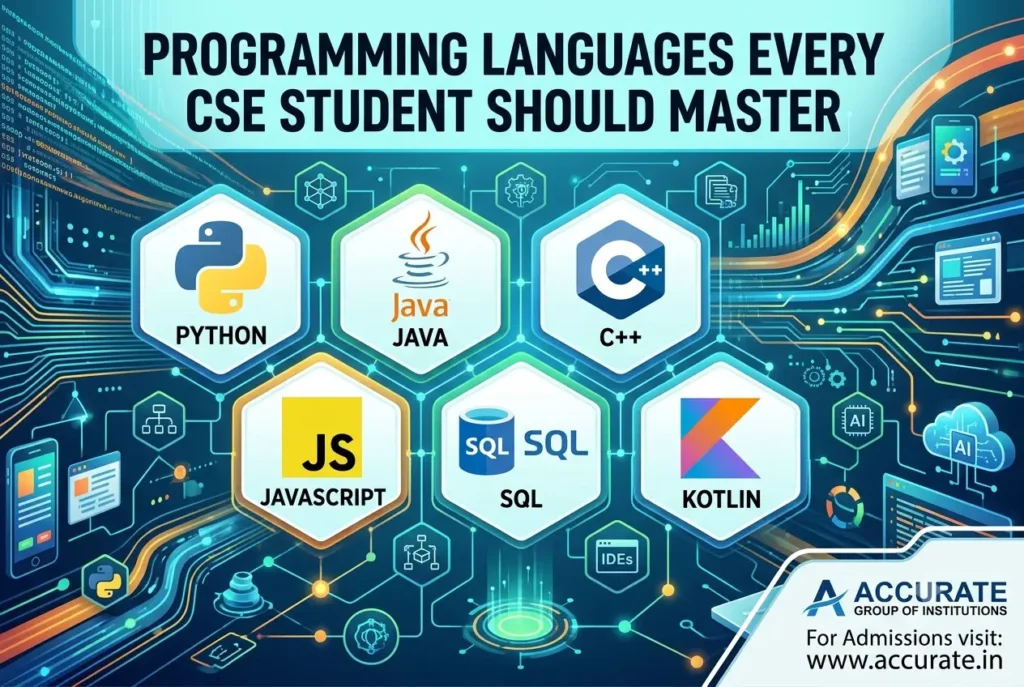
Top Programming Languages Every CSE Student Should Master
- C
- C++
- Python
- Java
- JavaScript
- SQL
- C#
- Go
- Kotlin
- Rust
These programming languages provide the technical foundation required for software engineering, application development, AI, cloud computing, cybersecurity, and modern IT careers.
Which programming language should a CSE student learn first?
A Computer Science Engineering student should begin with C programming to understand programming fundamentals, followed by C++ for object-oriented programming, Python for AI and automation, Java for enterprise applications, and JavaScript for web development. Learning SQL and Git further strengthens career readiness.
Table of Contents
- Why Programming Languages Matter for CSE Students
- Skills Employers Expect from CSE Graduates
- C Programming – The Foundation of Programming
- C++ – Mastering Object-Oriented Programming
- Python – The Most Versatile Programming Language
- Java – The Enterprise Programming Language
- JavaScript – Powering the Modern Web
- SQL – Managing Data Efficiently
- Other Valuable Programming Languages
- Choosing Languages Based on Career Goals
- Tips to Master Programming Faster
- How Accurate Institute of Management & Technology Prepares Future Software Engineers
- Frequently Asked Questions
- Conclusion
The technology industry is evolving faster than ever, making programming one of the most valuable skills for Computer Science Engineering (CSE) students. From developing intelligent applications and cloud platforms to designing secure software and advanced AI systems, programming languages form the backbone of every technological innovation.
However, one of the biggest questions students face is:
Which programming languages should every CSE student master to build a successful career?
The answer depends on understanding both industry demands and career aspirations. While no single programming language is sufficient for every domain, mastering a combination of foundational and modern programming languages enables students to become adaptable professionals capable of solving complex real-world problems.
Today, leading technology companies seek graduates who possess strong coding abilities, analytical thinking, software development expertise, and practical project experience. Therefore, learning the right programming languages during engineering significantly improves placement opportunities and long-term career growth.
Institutions like Accurate Institute of Management & Technology recognize this industry requirement and focus on providing students with practical programming exposure, coding competitions, industry projects, innovation-driven learning, modern laboratories, and skill-oriented Computer Science Engineering education that prepares graduates for the rapidly changing technology landscape.
Why Programming Languages Matter for CSE Students
Programming languages are much more than coding tools. They are the medium through which engineers communicate with computers to solve real-world problems.
Whether students wish to become:
- Software Engineers
- Data Scientists
- AI Engineers
- Machine Learning Experts
- Cloud Architects
- Cybersecurity Specialists
- Web Developers
- Mobile App Developers
- Game Developers
- DevOps Engineers
they all require programming expertise.
Programming teaches students how to think logically, break complex problems into manageable parts, optimize solutions, and create scalable software systems.
Instead of memorizing syntax, students should understand algorithms, data structures, debugging techniques, software design principles, and efficient coding practices.
Skills Employers Expect from Modern CSE Graduates
Today’s recruiters evaluate much more than academic scores.
Companies actively seek graduates who demonstrate:
Strong Problem-Solving Ability
Every software project involves solving unique business challenges. Employers value candidates who can analyze situations logically and develop efficient solutions.
Programming strengthens:
- Logical reasoning
- Critical thinking
- Algorithmic design
- Optimization techniques
These skills directly impact coding interviews and technical assessments.
Knowledge of Multiple Programming Languages
Technology stacks vary across industries.
For example:
- AI companies prefer Python.
- Banking software relies heavily on Java.
- Gaming companies use C++.
- Web companies depend on JavaScript.
- Database-driven organizations require SQL expertise.
Students with exposure to multiple programming languages become more versatile professionals.
Understanding of Software Development
Programming is only one aspect of software engineering.
Students should also understand:
- Version Control
- Software Testing
- APIs
- Database Design
- Cloud Platforms
- Operating Systems
- Data Structures
- Object-Oriented Programming
- Software Architecture
Mastering programming languages becomes even more valuable when combined with these technical skills.
Project-Based Learning
Employers appreciate students who can demonstrate practical experience through projects rather than theoretical knowledge alone.
Some excellent academic projects include:
- Student Management System
- Hospital Management Software
- AI Chatbot
- Online Shopping Portal
- Weather Forecast Application
- Expense Tracker
- Face Recognition System
- Smart Attendance System
- Library Management Software
Institutes like Accurate Institute of Management & Technology encourage students to build industry-oriented projects that strengthen both technical expertise and placement readiness.
C Programming – The Foundation Every CSE Student Needs
Despite being developed decades ago, C programming remains one of the most important languages for Computer Science Engineering students.
Most engineering colleges introduce programming through C because it teaches fundamental programming concepts without hiding the internal workings of computers.
Why Learn C?
C helps students understand:
- Memory management
- Variables
- Functions
- Loops
- Arrays
- Pointers
- File handling
- Data structures
- Recursion
- Compiler behavior
These concepts become the building blocks for learning advanced programming languages.
Career Benefits of Learning C
Although many companies use modern programming languages, C remains essential in areas such as:
- Operating Systems
- Embedded Systems
- Robotics
- IoT Devices
- Automotive Software
- Electronics
- Firmware Development
- Device Drivers
- Networking Applications
Many multinational companies continue hiring engineers with strong C programming fundamentals because it demonstrates a deep understanding of computer systems.
Best Projects Using C
Students can practice by developing:
- Calculator
- Banking System
- Student Database
- Payroll System
- Inventory Management
- Hospital Record System
- File Compression Utility
- Simple Compiler
- Command-Line Applications
Completing such projects helps strengthen programming logic while building a professional portfolio.
C++ – Mastering Object-Oriented Programming
After gaining a solid foundation in C, students should move to C++, one of the most powerful programming languages in the software industry.
C++ introduces Object-Oriented Programming (OOP), enabling developers to write scalable, reusable, and maintainable software.
It is widely used in competitive programming, system software, game development, financial applications, high-performance computing, simulation software, and graphics engines.
Why C++ Is Essential
Learning C++ enables students to understand:
- Classes and Objects
- Encapsulation
- Inheritance
- Polymorphism
- Abstraction
- Templates
- Standard Template Library (STL)
- Exception Handling
- Dynamic Memory Allocation
These concepts are critical for coding interviews and software engineering roles at leading technology companies.
Python – The Most Versatile Programming Language
Python has become one of the most popular programming languages in the world due to its simple syntax, readability, and vast ecosystem of libraries. It is widely used across industries, making it an essential language for every Computer Science Engineering (CSE) student.
Whether you are interested in Artificial Intelligence, Machine Learning, Data Science, Web Development, Automation, Cybersecurity, or Cloud Computing, Python provides the tools and flexibility needed to build innovative solutions.
Why Every CSE Student Should Learn Python
Python offers several advantages that make it an excellent choice for beginners and professionals alike:
- Easy-to-read syntax
- Large collection of libraries and frameworks
- Rapid application development
- Cross-platform compatibility
- Strong community support
- Excellent career opportunities
Its simplicity allows students to focus more on solving problems than worrying about complex syntax.
Career Opportunities with Python
Python skills open doors to various high-demand careers, including:
- Data Scientist
- Machine Learning Engineer
- AI Engineer
- Software Developer
- Automation Engineer
- DevOps Engineer
- Cybersecurity Analyst
- Cloud Developer
- Backend Developer
As businesses increasingly adopt AI-driven solutions, Python continues to dominate hiring requirements in the technology sector.
Popular Python Frameworks
Students should gradually explore:
- Django
- Flask
- FastAPI
- TensorFlow
- PyTorch
- NumPy
- Pandas
- Scikit-learn
- OpenCV
- Selenium
Mastering these tools significantly enhances employability and project development skills.
Java – The Enterprise Programming Language
Java has been one of the most trusted programming languages for decades. It powers millions of enterprise applications used by banks, healthcare organizations, government agencies, telecom companies, and multinational corporations.
Its “Write Once, Run Anywhere” philosophy makes Java highly portable and reliable.
Why Learn Java?
Java provides a strong understanding of:
- Object-Oriented Programming
- Exception Handling
- Multithreading
- Collections Framework
- JDBC
- Networking
- GUI Development
- Enterprise Software Architecture
These concepts prepare students for professional software development environments.
Industries That Use Java
Java is extensively used in:
- Banking
- Financial Services
- Insurance
- Healthcare
- E-commerce
- Government Projects
- Cloud Applications
- Enterprise Resource Planning (ERP)
Because of its stability and scalability, Java remains one of the most demanded programming languages worldwide.
Popular Java Technologies
Students should become familiar with:
- Spring Boot
- Spring Framework
- Hibernate
- Maven
- Gradle
- Apache Tomcat
- JavaFX
These technologies are widely used in enterprise software development and improve placement opportunities.
JavaScript – The Language of the Modern Web
No modern website is complete without JavaScript. It is the backbone of interactive web applications and enables dynamic user experiences.
Every aspiring web developer should master JavaScript along with HTML and CSS.
Why JavaScript Is Important
JavaScript powers:
- Interactive websites
- Single-page applications
- Real-time applications
- Web APIs
- Mobile applications
- Desktop applications
- Server-side development
Today, JavaScript is not limited to browsers. With Node.js, it is also used for backend development.
JavaScript Frameworks Worth Learning
Modern development heavily relies on frameworks such as:
- React
- Angular
- Vue.js
- Next.js
- Express.js
- Node.js
Learning these technologies enables students to become full-stack developers capable of building complete web applications.
Career Roles
JavaScript skills are valuable for careers such as:
- Front-End Developer
- Full-Stack Developer
- UI Developer
- Web Application Developer
- Mobile App Developer
- Software Engineer
SQL – The Language of Data
Almost every software application stores information in databases. SQL (Structured Query Language) enables developers to create, retrieve, update, and manage this data efficiently.
Without database knowledge, software development remains incomplete.
Why SQL Matters
SQL helps students understand:
- Database Design
- Data Storage
- Query Optimization
- Relationships
- Transactions
- Data Security
- Reporting
- Analytics
These concepts are critical for building scalable applications.
Popular Database Systems
Students should practice using:
- MySQL
- PostgreSQL
- Microsoft SQL Server
- Oracle Database
- SQLite
Knowledge of both SQL and database design greatly enhances software engineering capabilities.
C# – A Powerful Language for Microsoft Technologies
C# is a modern programming language developed by Microsoft. It is widely used for desktop software, enterprise applications, web development, cloud computing, and game development using Unity.
Why Learn C#?
C# offers:
- Excellent object-oriented programming support
- Easy integration with Microsoft technologies
- Strong development tools
- High productivity
- Cloud-ready applications
Students interested in Microsoft technologies should include C# in their learning roadmap.
Go – Building High-Performance Cloud Applications
Go (Golang), developed by Google, has gained tremendous popularity for building scalable cloud applications and distributed systems.
Its simplicity and performance make it attractive for backend development.
Applications of Go
Go is commonly used in:
- Cloud Platforms
- Microservices
- Networking
- Distributed Systems
- DevOps Tools
- Container Technologies
Many modern technology companies now hire Go developers for cloud-native applications.
Kotlin – The Preferred Language for Android Development
Google officially recommends Kotlin for Android app development.
Compared to Java, Kotlin offers:
- Cleaner syntax
- Better safety
- Less boilerplate code
- Improved productivity
Students aspiring to become Android developers should consider learning Kotlin after Java.
Rust – The Future of Secure System Programming
Rust is rapidly gaining popularity because it provides excellent memory safety while maintaining high performance.
It is increasingly adopted in:
- System Programming
- Embedded Software
- Blockchain
- Cybersecurity
- Operating Systems
- High-Performance Applications
Although challenging to learn, Rust is becoming an important language for future software engineers.
Programming Languages Based on Career Goals
Different career paths require different programming languages. Rather than trying to master every language at once, students should build expertise according to their interests.
For Artificial Intelligence and Machine Learning
Recommended languages:
- Python
- SQL
- R (optional)
Additional technologies:
- TensorFlow
- PyTorch
- Scikit-learn
For Full-Stack Development
Recommended stack:
- HTML
- CSS
- JavaScript
- React
- Node.js
- SQL
- MongoDB
These technologies enable students to develop complete web applications from front end to back end.
For Mobile App Development
Recommended languages:
Android:
- Java
- Kotlin
Cross-platform:
- Dart (Flutter)
- JavaScript (React Native)
For Game Development
Recommended languages:
- C++
- C#
- Lua
Popular engines:
- Unreal Engine
- Unity
For Cybersecurity
Students interested in cybersecurity should focus on:
- Python
- C
- C++
- Bash
- SQL
These languages are useful for scripting, vulnerability analysis, penetration testing, and security automation.
For Cloud Computing and DevOps
Recommended languages:
- Python
- Go
- Java
- Bash
Supporting technologies include:
- Docker
- Kubernetes
- Jenkins
- Terraform
- AWS
- Microsoft Azure
- Google Cloud Platform
Tips to Master Programming Languages Faster
Learning programming requires consistent practice rather than memorizing syntax.
Students can accelerate their progress by following these strategies:
Practice Daily
Spend at least one to two hours writing code every day to strengthen logical thinking and improve problem-solving skills.
Build Real Projects
Develop practical applications such as expense trackers, e-commerce websites, attendance systems, chat applications, or AI-based tools to gain hands-on experience.
Participate in Coding Competitions
Engage in hackathons, coding contests, and programming challenges to sharpen analytical skills and prepare for technical interviews.
Learn Data Structures and Algorithms
A solid understanding of DSA is essential for coding interviews and efficient software development.
Use Version Control
Learn Git and GitHub to manage projects, collaborate with teams, and maintain a professional coding portfolio.
Contribute to Open Source
Working on open-source projects improves coding standards, teamwork, and exposure to real-world software development practices.
How Accurate Institute of Management & Technology Helps CSE Students Master Programming
Learning programming languages becomes truly valuable when students get opportunities to apply their knowledge in real-world situations. At Accurate Institute of Management & Technology (AIMT), the Computer Science Engineering curriculum is designed to bridge the gap between classroom learning and industry expectations.
The institute emphasizes practical coding, innovation, and project-based education so that students graduate with the technical confidence required by leading technology companies.
Industry-Oriented Curriculum
The CSE program at AIMT is regularly aligned with emerging industry trends. Students gain exposure to:
- Programming Fundamentals
- Object-Oriented Programming
- Data Structures and Algorithms
- Database Management Systems
- Operating Systems
- Computer Networks
- Software Engineering
- Artificial Intelligence
- Machine Learning
- Cloud Computing
- Cybersecurity
- Internet of Things (IoT)
This balanced curriculum helps students build a strong academic foundation while preparing for future technologies.
Practical Coding and Laboratory Experience
Programming is a practical skill that improves through continuous practice. AIMT encourages students to spend significant time in modern computer laboratories where they can:
- Write and debug programs
- Build software applications
- Develop mini and major projects
- Work on real-world coding assignments
- Learn collaborative software development
Hands-on learning enables students to understand programming concepts more effectively than theory alone.
Project-Based Learning
Students are encouraged to develop industry-relevant projects throughout their academic journey. Examples include:
- AI-powered Chatbots
- Smart Attendance Systems
- E-commerce Applications
- Hospital Management Systems
- Online Learning Platforms
- IoT-based Smart Home Solutions
- Data Analytics Dashboards
- Mobile Applications
- Cloud-Based Software Solutions
These projects strengthen technical knowledge and help students build impressive portfolios for internships and placements.
Coding Competitions and Hackathons
Competitive coding improves logical thinking and problem-solving skills. AIMT motivates students to participate in:
- Coding competitions
- Hackathons
- Technical workshops
- Innovation challenges
- Programming contests
These activities enhance confidence and prepare students for coding rounds conducted by top recruiters.
Industry Exposure
Modern software companies expect graduates to understand practical development environments. Through industry interaction, seminars, expert sessions, internships, and training programs, students gain valuable insights into current technologies and workplace expectations.
This exposure helps bridge the gap between academics and professional software development.
Placement-Focused Skill Development
Technical knowledge alone is not enough to secure excellent career opportunities. AIMT also focuses on developing:
- Aptitude Skills
- Communication Skills
- Technical Interview Preparation
- Resume Building
- Group Discussion Skills
- Mock Interviews
- Professional Ethics
- Teamwork and Leadership
These initiatives improve students’ employability and prepare them for successful careers in the IT industry.
Future Trends in Programming Languages
Technology continues to evolve rapidly, and programming languages evolve with it. CSE students should remain lifelong learners to stay competitive in the global technology landscape.
Some major trends shaping the future include:
Artificial Intelligence Integration
Programming languages such as Python are becoming increasingly important as AI and Machine Learning continue transforming industries like healthcare, finance, education, manufacturing, and transportation.
Cloud-Native Development
Cloud computing has become a standard for modern businesses. Languages like Go, Java, Python, and JavaScript are widely used for developing scalable cloud applications and microservices.
Cybersecurity Applications
With growing cyber threats, programming skills are essential for building secure software and identifying vulnerabilities. Python, C, C++, and Rust are increasingly used in cybersecurity and secure systems programming.
Internet of Things (IoT)
IoT devices rely on efficient programming for embedded systems and real-time communication. Languages such as C, C++, Python, and Java continue to play a significant role in IoT development.
Blockchain and Web3
Blockchain technology is expanding into finance, supply chain, healthcare, and digital identity. Languages including Solidity, Rust, Go, and JavaScript are becoming increasingly valuable for decentralized application development.
Low-Code and AI-Assisted Development
AI-powered coding assistants and low-code platforms are improving developer productivity. However, understanding core programming concepts remains essential for creating reliable, secure, and scalable applications.
Final Thoughts
Programming languages are the foundation of every successful Computer Science Engineering career. While trends and technologies change over time, strong programming fundamentals remain invaluable.
Students should begin with foundational languages such as C and C++, then expand their expertise by learning Python, Java, JavaScript, and SQL. Depending on their career goals, they can further explore specialized languages like Go, Kotlin, Rust, or C#.
Rather than attempting to learn every language at once, focus on mastering programming logic, algorithms, data structures, software development practices, and real-world project implementation. Consistent coding practice, participation in hackathons, contributions to open-source projects, and continuous learning will help students stand out in today’s competitive technology industry.
A successful software engineer is not defined by the number of programming languages they know but by their ability to solve problems efficiently and build innovative solutions.
Conclusion
Choosing the right programming languages is one of the most important decisions for every Computer Science Engineering student. Each language serves a unique purpose, and together they create a strong technical foundation for careers in software development, Artificial Intelligence, Data Science, Cybersecurity, Cloud Computing, Full-Stack Development, and many other emerging domains.
Students who combine strong programming knowledge with practical projects, industry exposure, and continuous learning are better prepared to meet the evolving demands of the global IT sector.
At Accurate Institute of Management & Technology, students benefit from an industry-oriented Computer Science Engineering program that emphasizes practical coding, project-based learning, innovation, technical skill development, and placement preparation. Through experienced faculty, modern laboratories, coding activities, workshops, and career-focused training, the institute helps students build the confidence and expertise required to succeed in the fast-paced world of technology.
Whether your goal is to become a Software Engineer, AI Specialist, Full-Stack Developer, Data Scientist, or Cloud Architect, mastering the right programming languages is the first step toward a rewarding career.
Take the Next Step Toward Your Engineering Career
If you are passionate about technology and aspire to build a successful future in Computer Science Engineering, Accurate Institute of Management & Technology offers an excellent platform to transform your ambitions into reality.
With an industry-focused curriculum, experienced faculty, modern infrastructure, practical learning opportunities, coding culture, internships, and dedicated placement support, AIMT equips students with the skills needed to thrive in today’s competitive technology landscape.
To learn more about the Computer Science Engineering program, admission process, and campus facilities, visit:
Start your journey today and build the programming expertise that powers tomorrow’s innovations.
Frequently Asked Questions (FAQs)
1. Which programming language should a CSE student learn first?
Every CSE student should begin with C programming to understand programming fundamentals such as variables, loops, functions, memory management, and problem-solving. After mastering C, students can progress to C++, Python, Java, and JavaScript.
2. Is Python enough for Computer Science Engineering students?
Python is highly versatile and widely used in AI, Machine Learning, Data Science, Automation, and Web Development. However, students should also learn languages like C++, Java, JavaScript, and SQL to build a well-rounded skill set.
3. Which programming language is best for placements?
Most recruiters value strong programming fundamentals over a specific language. Knowledge of C++, Java, Python, JavaScript, and SQL, along with Data Structures and Algorithms, significantly improves placement prospects.
4. Why is C++ important for engineering students?
C++ introduces Object-Oriented Programming concepts and is widely used in competitive programming, game development, system software, and technical interviews conducted by leading IT companies.
5. Should CSE students learn Java?
Yes. Java remains one of the most in-demand programming languages for enterprise software, Android development, banking, cloud applications, and large-scale business solutions.
6. Is JavaScript necessary for Computer Science Engineering students?
Yes. JavaScript is essential for modern web development and full-stack development. Combined with HTML, CSS, React, and Node.js, it enables students to build interactive websites and web applications.
7. Why should CSE students learn SQL?
SQL helps students manage databases efficiently, retrieve and analyze data, and build database-driven applications. It is an essential skill for software development, analytics, and backend engineering.
8. How many programming languages should a CSE student master?
Instead of learning many languages superficially, students should master five to seven core programming languages and understand programming concepts deeply through regular practice and real-world projects.
9. How can students improve their programming skills?
Daily coding practice, solving algorithmic problems, building projects, participating in hackathons, contributing to open-source projects, and learning Data Structures and Algorithms are among the best ways to improve programming proficiency.
10. Why choose Accurate Institute of Management & Technology for Computer Science Engineering?
Accurate Institute of Management & Technology offers an industry-oriented CSE curriculum, experienced faculty, practical laboratory sessions, project-based learning, coding competitions, technical workshops, internship opportunities, and placement-focused training to prepare students for successful careers in the technology industry.