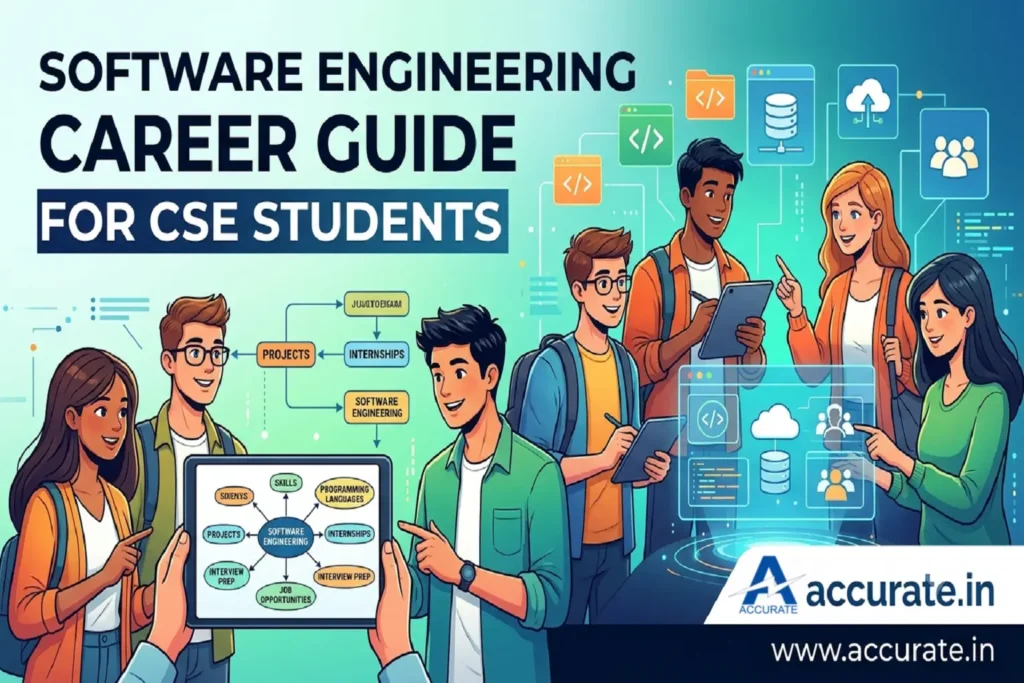

A successful software engineering career requires strong programming skills, data structures, algorithms, databases, operating systems, software development methodologies, cloud computing, Git, communication, and practical project experience. CSE students who continuously build technical expertise through internships, certifications, and real-world projects are well-prepared for careers in software development, AI, cloud computing, DevOps, and emerging technologies.
A Computer Science Engineering student can become a software engineer by learning programming languages, mastering data structures and algorithms, building real-world projects, completing internships, contributing to open-source development, understanding software engineering principles, and preparing for technical interviews. Choosing an industry-focused engineering college further strengthens career opportunities.
Table of Contents
- Introduction
- Why Software Engineering Is One of the Best Career Choices
- What Does a Software Engineer Do?
- Why CSE Students Choose Software Engineering
- Skills Every Future Software Engineer Must Learn
- Programming Languages You Should Master
- Understanding the Software Development Life Cycle (SDLC)
- Building the Right Mindset for Success
- Conclusion
- Frequently Asked Questions
Software Engineering Career Guide for CSE Students
Software engineering has become one of the most exciting, rewarding, and future-ready career paths for Computer Science Engineering (CSE) students. Every industry today—from healthcare and finance to education, entertainment, manufacturing, and e-commerce—depends on software solutions to improve efficiency, automate operations, and deliver better customer experiences. As digital transformation accelerates across the globe, the demand for skilled software engineers continues to rise.
For students pursuing Computer Science Engineering, software engineering offers opportunities to work with cutting-edge technologies, solve real-world problems, develop innovative applications, and contribute to products used by millions of people. However, success in this field requires more than just earning a degree. Students must combine academic knowledge with practical experience, technical expertise, teamwork, and continuous learning.
Modern software companies seek professionals who can write efficient code, collaborate with development teams, understand customer requirements, and build scalable software solutions. Therefore, aspiring software engineers should begin developing these competencies early in their engineering journey.
Institutions that emphasize practical learning, industry exposure, coding culture, innovation, and project-based education help students become job-ready. Accurate Institute of Management & Technology supports this approach by encouraging students to participate in coding competitions, technical workshops, industry interactions, internships, and hands-on software development projects that prepare them for successful technology careers.
This comprehensive career guide explains everything CSE students need to know about becoming successful software engineers, from essential skills and programming languages to career opportunities, industry trends, and professional growth.
Why Software Engineering Is One of the Best Career Choices
Software engineering remains one of the fastest-growing professions worldwide. As businesses increasingly rely on digital platforms, mobile applications, cloud infrastructure, and artificial intelligence, software engineers have become indispensable across industries.
Some of the key reasons why software engineering is an attractive career include:
High Demand Across Industries
Software engineers are needed in technology companies, startups, banking, healthcare, automotive, telecommunications, government organizations, manufacturing, education, retail, logistics, and many other sectors. Almost every organization today develops or maintains software applications.
Continuous Innovation
The software industry evolves rapidly with technologies such as Artificial Intelligence, Machine Learning, Cloud Computing, Internet of Things (IoT), Blockchain, Cybersecurity, and Data Science. This dynamic environment provides continuous opportunities to learn and grow.
Diverse Career Opportunities
A software engineering background enables graduates to specialize in various domains, including:
- Frontend Development
- Backend Development
- Full Stack Development
- Mobile Application Development
- Cloud Engineering
- DevOps
- Artificial Intelligence
- Machine Learning
- Cybersecurity
- Data Engineering
- Game Development
- Embedded Systems
- Software Testing and Quality Assurance
Global Career Prospects
Software engineering skills are recognized internationally. Professionals with strong technical expertise can work for multinational corporations, technology startups, research organizations, or even pursue remote opportunities with global companies.
What Does a Software Engineer Do?
A software engineer designs, develops, tests, deploys, and maintains software systems that solve business and user problems. Their responsibilities extend beyond writing code—they also analyze requirements, design architecture, ensure software quality, optimize performance, and collaborate with cross-functional teams.
Typical responsibilities include:
- Understanding user and business requirements
- Designing software architecture
- Writing clean and maintainable code
- Testing applications
- Debugging and fixing issues
- Integrating APIs and databases
- Maintaining software after deployment
- Improving application performance
- Implementing security best practices
- Collaborating with designers, testers, and product managers
Software engineers also participate in code reviews, sprint planning, documentation, and continuous integration processes to ensure software quality and efficient team collaboration.
Why CSE Students Choose Software Engineering
Computer Science Engineering provides a strong academic foundation in programming, algorithms, computer networks, databases, operating systems, and software design. These subjects naturally prepare students for software engineering careers.
Some advantages of pursuing software engineering after CSE include:
Wide Range of Job Roles
Graduates can explore multiple career paths such as:
- Software Developer
- Software Engineer
- Full Stack Developer
- Frontend Developer
- Backend Developer
- Mobile App Developer
- DevOps Engineer
- Cloud Engineer
- Automation Engineer
- AI Engineer
- Machine Learning Engineer
- Software Test Engineer
- Site Reliability Engineer
Opportunities for Innovation
Software engineers build products that impact millions of users. Whether developing healthcare applications, educational platforms, financial software, or smart city solutions, engineers contribute to meaningful technological advancement.
Strong Career Growth
With experience and continuous learning, professionals can advance into roles such as:
- Senior Software Engineer
- Technical Lead
- Solution Architect
- Engineering Manager
- Product Engineer
- Principal Engineer
- Technology Consultant
- Chief Technology Officer (CTO)
The field rewards technical excellence, creativity, and leadership, making it an attractive long-term career.
Skills Every Future Software Engineer Must Learn
Developing a successful software engineering career requires a balanced combination of technical knowledge, analytical thinking, communication, and practical experience.
Programming Skills
Programming is the foundation of software engineering. Students should understand concepts such as:
- Variables and data types
- Conditional statements
- Loops
- Functions
- Object-oriented programming
- Exception handling
- File handling
- Memory management
- Code optimization
Writing clean, readable, and maintainable code is just as important as solving problems efficiently.
Problem-Solving and Logical Thinking
Software engineers solve complex problems every day. Strong logical reasoning helps in:
- Breaking down large problems into smaller components
- Designing efficient algorithms
- Optimizing application performance
- Debugging software effectively
- Building scalable systems
Regular coding practice through competitive programming platforms and project development strengthens analytical thinking.
Data Structures and Algorithms
Data Structures and Algorithms (DSA) form the backbone of technical interviews and efficient software development.
Students should become comfortable with:
- Arrays
- Linked Lists
- Stacks
- Queues
- Trees
- Graphs
- Hash Tables
- Searching Algorithms
- Sorting Algorithms
- Dynamic Programming
- Greedy Algorithms
- Recursion
Mastering DSA improves coding efficiency and prepares students for interviews at leading technology companies.
Database Management
Every software application depends on effective data storage and retrieval.
Students should learn:
- SQL
- Relational Databases
- Normalization
- Joins
- Transactions
- Indexing
- Stored Procedures
- Database Security
Knowledge of databases enables engineers to design reliable, scalable applications.
Operating Systems
Understanding operating systems helps software engineers build optimized applications.
Important concepts include:
- Process Management
- Memory Management
- Threads
- Scheduling
- Synchronization
- Deadlocks
- Virtual Memory
- File Systems
These fundamentals improve debugging and performance optimization skills.
Programming Languages You Should Master
Choosing the right programming languages significantly influences your software engineering journey. Rather than learning many languages superficially, students should build deep expertise in a few widely used technologies.
Python
Python is widely used for:
- Artificial Intelligence
- Machine Learning
- Data Science
- Automation
- Backend Development
- Scripting
Its simple syntax makes it an excellent language for beginners while remaining powerful for advanced applications.
Java
Java continues to be a leading language for enterprise software development. It is extensively used in banking, e-commerce, Android development, and large-scale backend systems.
Students gain experience with:
- Object-Oriented Programming
- Multithreading
- Collections Framework
- Enterprise Applications
- Spring Framework fundamentals
C++
C++ strengthens core programming concepts and is widely used in competitive programming, system software, game development, and performance-critical applications.
Learning C++ enhances understanding of:
- Memory Management
- Pointers
- Algorithms
- Data Structures
- Object-Oriented Design
JavaScript
JavaScript powers modern web applications and is essential for frontend development.
Combined with HTML and CSS, JavaScript enables students to build interactive websites. Frameworks such as React, Angular, and Vue further expand career opportunities in web development.
Understanding the Software Development Life Cycle (SDLC)
Writing code is only one part of software engineering. Successful software projects follow a structured process known as the Software Development Life Cycle (SDLC).
The major phases include:
Requirement Analysis
Engineers gather and understand customer requirements to define project goals.
System Design
Architects and developers create the overall software structure, database design, and technology stack.
Development
Developers implement features by writing clean, maintainable, and well-documented code.
Testing
Quality assurance teams identify defects and verify that the software meets functional and performance requirements.
Deployment
Applications are released to production environments where users can access them.
Maintenance
After deployment, software is continuously updated to fix bugs, improve performance, and add new features.
Understanding SDLC prepares students for collaborative software development in professional environments.
Building the Right Mindset for Success
Technical knowledge alone is not enough to become a successful software engineer. Employers also value curiosity, adaptability, communication, teamwork, time management, and a commitment to continuous learning.
Students should cultivate habits such as:
- Practicing coding regularly
- Reading technical documentation
- Participating in hackathons
- Contributing to open-source projects
- Building personal software projects
- Seeking internships
- Learning from code reviews
- Staying updated with emerging technologies
An institution that combines academic excellence with practical exposure can significantly accelerate this journey. Through industry-oriented learning, coding activities, innovation-driven projects, expert mentoring, and career development initiatives, Accurate Institute of Management & Technology helps Computer Science Engineering students build the technical and professional capabilities expected by today’s software industry.
Git and GitHub: Essential Version Control Skills
Modern software development is impossible without version control. Whether you work in a startup or a multinational technology company, Git has become the industry standard for managing source code.
Git helps developers:
- Track code changes
- Collaborate with team members
- Restore previous versions
- Manage multiple project branches
- Merge code efficiently
- Resolve conflicts
- Maintain project history
Students should also create a professional GitHub profile to showcase their projects. Recruiters often review GitHub repositories during hiring because they demonstrate practical coding skills, project quality, documentation, and consistency.
A strong GitHub profile should include:
- Well-documented repositories
- Personal portfolio projects
- Open-source contributions
- README documentation
- Meaningful commit history
- Clean code structure
Web Development Skills
Web development remains one of the most popular software engineering domains. Every business needs websites, portals, dashboards, or web applications.
Frontend Development
Frontend developers create user interfaces that users interact with.
Students should learn:
HTML5
HTML provides the structure of web pages.
Important concepts include:
- Semantic HTML
- Forms
- Tables
- Accessibility
- Multimedia integration
CSS3
CSS controls the appearance of websites.
Students should understand:
- Flexbox
- CSS Grid
- Responsive Design
- Media Queries
- Animations
- Transitions
JavaScript
JavaScript makes websites interactive.
Core topics include:
- DOM Manipulation
- Events
- Fetch API
- ES6 Features
- Asynchronous Programming
- Promises
- Async/Await
Frontend Frameworks
Modern companies commonly use:
- React
- Angular
- Vue.js
Learning at least one frontend framework significantly improves employability.
Backend Development
Backend developers manage servers, databases, authentication, and business logic.
Popular backend technologies include:
- Node.js
- Express.js
- Java Spring Boot
- Python Django
- Flask
- ASP.NET
Students should understand:
- REST APIs
- Authentication
- Authorization
- Session Management
- Server Architecture
- Middleware
Database Technologies
Software applications rely on efficient data storage.
Students should become comfortable with both SQL and NoSQL databases.
SQL Databases
Examples include:
- MySQL
- PostgreSQL
- Microsoft SQL Server
Important concepts:
- CRUD Operations
- Joins
- Views
- Stored Procedures
- Transactions
- Indexing
NoSQL Databases
Modern scalable applications often use:
- MongoDB
- Cassandra
- Firebase
Understanding when to use SQL versus NoSQL is an important software engineering skill.
Software Design Principles
Writing code is easy.
Writing scalable, maintainable software is the real challenge.
Students should understand software engineering principles such as:
Object-Oriented Programming
Core concepts include:
- Encapsulation
- Inheritance
- Polymorphism
- Abstraction
SOLID Principles
Professional developers follow SOLID principles to improve software quality.
These principles help create software that is:
- Flexible
- Reusable
- Easy to maintain
- Easier to test
Design Patterns
Students should become familiar with commonly used design patterns such as:
- Singleton
- Factory
- Observer
- Strategy
- MVC
Understanding design patterns prepares students for enterprise-level software development.
Cloud Computing Skills
Most modern software applications are deployed on cloud platforms.
Cloud computing enables organizations to build scalable and reliable applications without maintaining physical servers.
Popular cloud platforms include:
- Amazon Web Services (AWS)
- Microsoft Azure
- Google Cloud Platform (GCP)
Students should learn:
- Virtual Machines
- Storage Services
- Cloud Networking
- Containers
- Serverless Computing
- Cloud Security
- Monitoring Services
Cloud knowledge significantly improves placement opportunities.
DevOps Fundamentals
Software development and deployment are becoming increasingly automated.
DevOps combines software development with IT operations.
Students should understand:
- Continuous Integration (CI)
- Continuous Deployment (CD)
- Docker
- Kubernetes
- Jenkins
- GitHub Actions
- Infrastructure Automation
These technologies help companies deliver software faster and more reliably.
API Development and Integration
Modern applications communicate through APIs.
Students should understand:
- REST APIs
- JSON
- HTTP Methods
- Authentication Tokens
- API Testing
- API Documentation
Practical API development experience makes students more valuable during placements.
Software Testing Skills
Software quality is just as important as software development.
Students should understand different testing methodologies.
Unit Testing
Tests individual functions.
Integration Testing
Tests communication between modules.
System Testing
Tests complete software.
Automation Testing
Popular tools include:
- Selenium
- Cypress
- Playwright
Understanding software testing makes students better developers.
Cybersecurity Awareness
Every software engineer should understand security fundamentals.
Topics include:
- Secure Coding
- Authentication
- Authorization
- Encryption
- SQL Injection Prevention
- Cross-Site Scripting
- Data Protection
- OWASP Guidelines
Security is no longer limited to cybersecurity professionals.
Every developer shares responsibility for building secure software.
Artificial Intelligence and Machine Learning
AI is transforming software engineering.
Software engineers increasingly work with intelligent applications.
Students should understand:
- Machine Learning Basics
- Neural Networks
- Natural Language Processing
- Computer Vision
- Recommendation Systems
- AI APIs
Python, TensorFlow, PyTorch, and Scikit-learn are valuable technologies for aspiring AI developers.
Mobile Application Development
Smartphones dominate today’s digital ecosystem.
Software engineers who understand mobile development enjoy excellent career opportunities.
Students can learn:
Android Development
Using:
- Kotlin
- Java
Cross-Platform Development
Frameworks include:
- Flutter
- React Native
Mobile development complements web development and expands career possibilities.
Open Source Contributions
Open-source software provides an excellent platform for learning from experienced developers.
Benefits include:
- Real-world coding experience
- Team collaboration
- Code reviews
- Industry networking
- Better GitHub profile
- Improved resume
Even small contributions demonstrate initiative and continuous learning.
Building Real-World Projects
Projects differentiate students during placements.
Instead of creating only academic assignments, students should build practical applications.
Examples include:
- E-commerce Website
- Hospital Management System
- Online Learning Platform
- Banking Application
- Chat Application
- Expense Tracker
- Food Delivery System
- AI Chatbot
- Smart Attendance System
- College ERP
- Portfolio Website
Each project should include:
- Clean UI
- Database
- Authentication
- Documentation
- GitHub Repository
- Deployment
Employers value practical problem-solving demonstrated through completed projects.
Internship Experience Matters
Internships bridge the gap between classroom learning and industry expectations.
During internships, students gain exposure to:
- Agile Development
- Daily Stand-up Meetings
- Code Reviews
- Software Testing
- Production Deployment
- Team Collaboration
- Client Communication
Internships also improve confidence before campus placements.
Students should begin applying after their second or third year whenever possible.
Communication and Teamwork
Software engineering is highly collaborative.
Developers interact with:
- Product Managers
- Designers
- QA Engineers
- Clients
- DevOps Teams
- Business Analysts
Essential soft skills include:
- Verbal Communication
- Technical Writing
- Active Listening
- Presentation Skills
- Leadership
- Conflict Resolution
- Time Management
Strong communication often distinguishes high-performing engineers from technically capable peers.
Industry Certifications
Certifications validate practical skills and demonstrate commitment to professional development.
Useful certifications include:
- AWS Cloud Practitioner
- Microsoft Azure Fundamentals
- Google Cloud Digital Leader
- Oracle Java Certification
- Cisco Networking Certifications
- Red Hat Linux Certification
- Python Programming Certifications
- MongoDB Associate Certification
While certifications complement a degree, they are most valuable when supported by practical projects and hands-on experience.
Placement Preparation Strategy
Campus recruitment requires consistent preparation rather than last-minute study.
An effective roadmap includes:
Technical Preparation
- Practice coding daily
- Master Data Structures and Algorithms
- Solve aptitude problems
- Learn SQL thoroughly
- Revise Operating Systems
- Revise Computer Networks
- Practice DBMS concepts
- Study OOP principles
Interview Preparation
Students should practice:
- Technical Interviews
- HR Interviews
- Mock Interviews
- Resume Discussions
- Project Explanations
Confidence grows through regular practice and constructive feedback.
Industry-Oriented Learning at Accurate Institute of Management & Technology
A successful software engineering career begins with choosing an institution that combines academic excellence with practical exposure. Accurate Institute of Management & Technology emphasizes industry-oriented Computer Science Engineering education by integrating classroom learning with coding practice, software development projects, technical workshops, innovation activities, internship support, and interaction with industry professionals.
Students are encouraged to participate in hackathons, coding contests, seminars, project exhibitions, and collaborative learning experiences that strengthen both technical and professional competencies. This practical approach helps aspiring software engineers develop the confidence, problem-solving ability, and hands-on expertise required by today’s technology companies.
Career Opportunities After Becoming a Software Engineer
Software engineering is one of the most versatile career paths available to Computer Science Engineering graduates. With the rapid adoption of digital technologies, software professionals are needed across startups, multinational corporations, government organizations, financial institutions, healthcare companies, manufacturing industries, educational technology firms, and research organizations.
After completing a Computer Science Engineering degree and developing strong technical skills, students can explore a variety of career roles based on their interests and expertise.
Software Developer
Software developers design, develop, test, and maintain applications for businesses and consumers. They work on desktop applications, enterprise software, cloud platforms, and web-based systems.
Key responsibilities include:
- Developing software solutions
- Writing optimized code
- Debugging applications
- Maintaining software
- Collaborating with development teams
Full Stack Developer
A Full Stack Developer works on both the frontend and backend of applications.
Typical skills include:
- HTML
- CSS
- JavaScript
- React or Angular
- Node.js
- Express.js
- Databases
- REST APIs
- Git
Full Stack Developers are highly valued because they can contribute throughout the entire software development process.
Backend Developer
Backend developers focus on server-side programming, databases, APIs, authentication, and business logic.
Popular technologies include:
- Java
- Python
- Node.js
- Spring Boot
- Django
- SQL
- MongoDB
Frontend Developer
Frontend developers create responsive, interactive, and user-friendly interfaces.
Important technologies include:
- HTML5
- CSS3
- JavaScript
- React
- Angular
- Vue.js
Cloud Engineer
Cloud Engineers build scalable cloud-based applications using platforms such as:
- Amazon Web Services (AWS)
- Microsoft Azure
- Google Cloud Platform (GCP)
Cloud computing continues to be one of the fastest-growing areas in software engineering.
DevOps Engineer
DevOps Engineers automate software deployment and improve collaboration between development and operations teams.
They commonly work with:
- Docker
- Kubernetes
- Jenkins
- GitHub Actions
- CI/CD pipelines
- Infrastructure automation
Artificial Intelligence Engineer
AI Engineers build intelligent systems capable of learning from data and automating decision-making processes.
Applications include:
- Chatbots
- Recommendation systems
- Medical diagnosis
- Autonomous vehicles
- Smart assistants
- Predictive analytics
Machine Learning Engineer
Machine Learning Engineers develop models that recognize patterns, make predictions, and improve through data.
Industries adopting ML include:
- Finance
- Healthcare
- Retail
- Manufacturing
- Agriculture
- Cybersecurity
Data Engineer
Data Engineers create data pipelines, manage large datasets, and support analytics platforms.
Their work enables organizations to make informed business decisions using reliable data.
Cybersecurity Engineer
Software security is becoming increasingly important.
Cybersecurity Engineers protect applications, servers, and user data by implementing secure development practices and identifying vulnerabilities before deployment.
Industries Hiring Software Engineers
Software engineers are employed in almost every sector of the economy.
Some major industries include:
- Information Technology
- Banking and Financial Services
- Healthcare
- Telecommunications
- Automobile
- E-commerce
- Manufacturing
- EdTech
- FinTech
- Logistics
- Government
- Media and Entertainment
- Artificial Intelligence
- Cloud Computing
- Gaming
This diversity provides students with multiple career pathways and long-term growth opportunities.
Future Trends in Software Engineering
Technology evolves rapidly, making continuous learning essential for software engineers.
Artificial Intelligence Integration
AI-assisted development tools are transforming software engineering by improving productivity, automating repetitive tasks, and accelerating testing. Engineers who understand how to work with AI tools will remain highly competitive.
Cloud-Native Applications
Organizations increasingly build applications specifically designed for cloud environments.
Skills becoming more valuable include:
- Containers
- Microservices
- Kubernetes
- Serverless Computing
Low-Code and No-Code Platforms
These platforms simplify application development for certain use cases, but they complement rather than replace software engineers. Professionals are still needed to design architecture, integrate systems, and solve complex technical challenges.
Cybersecurity by Design
Security is becoming an integral part of software development rather than an afterthought.
Future software engineers should understand:
- Secure coding
- Zero Trust principles
- Identity management
- Data privacy
- Application security
Internet of Things (IoT)
Connected devices continue to grow across industries.
Software engineers contribute by developing applications for:
- Smart homes
- Smart cities
- Industrial automation
- Healthcare devices
- Connected vehicles
Edge Computing
Processing data closer to devices improves performance and reduces latency.
Edge computing is expanding opportunities in manufacturing, healthcare, transportation, and telecommunications.
How to Build a Successful Software Engineering Career
A successful career is built through consistent effort rather than a single achievement.
Students should follow a structured roadmap:
First Year
- Learn programming fundamentals
- Develop logical thinking
- Practice coding regularly
- Explore Git and GitHub
Second Year
- Master Data Structures and Algorithms
- Build mini projects
- Learn databases
- Participate in coding contests
Third Year
- Study web development
- Learn cloud fundamentals
- Complete internships
- Contribute to open-source projects
Final Year
- Build a strong portfolio
- Practice technical interviews
- Solve coding problems consistently
- Prepare for campus placements
- Earn relevant certifications
This progressive approach helps students become industry-ready by graduation.
Why Choose Accurate Institute of Management & Technology for Computer Science Engineering?
Choosing the right engineering college plays a significant role in shaping a successful software engineering career. Along with academic excellence, students benefit from an environment that encourages innovation, practical learning, and continuous skill development.
Accurate Institute of Management & Technology offers a learning ecosystem designed to prepare aspiring Computer Science Engineering students for the evolving technology industry. The institute emphasizes:
- Industry-oriented curriculum aligned with current technology trends
- Modern computer laboratories for hands-on learning
- Coding competitions, hackathons, and technical clubs
- Workshops and seminars conducted by industry experts
- Internship and industrial exposure opportunities
- Project-based learning to strengthen practical skills
- Guidance for certifications and emerging technologies
- Career development support, aptitude training, and placement preparation
- Collaborative learning that enhances communication and teamwork
By combining theoretical foundations with practical experience, the institute helps students build the confidence and technical competence required for careers in software engineering, cloud computing, AI, cybersecurity, data science, and other technology domains.
Final Thoughts
Software engineering is far more than a profession—it is a field that empowers individuals to create innovative solutions, improve lives, and drive digital transformation across industries. For Computer Science Engineering students, success depends on mastering core programming concepts, data structures, software design, cloud technologies, databases, cybersecurity, and modern development practices while also developing communication, teamwork, and problem-solving abilities.
Continuous learning is the defining characteristic of successful software engineers. Students who actively build projects, participate in internships, contribute to open-source communities, earn relevant certifications, and stay current with emerging technologies are better positioned to secure rewarding career opportunities.
A strong educational foundation, combined with practical exposure and consistent skill development, can make the transition from student to professional software engineer smoother and more successful.
Frequently Asked Questions (FAQs)
1. What skills are essential to become a software engineer after CSE?
Key skills include programming, data structures and algorithms, database management, operating systems, computer networks, Git, software testing, cloud computing, problem-solving, and communication skills.
2. Which programming language should a CSE student learn first?
Python is an excellent starting point because of its simple syntax and wide use in software development, AI, automation, and data science. Learning Java or C++ afterward helps strengthen core programming concepts.
3. Is Data Structures and Algorithms important for software engineering?
Yes. DSA is fundamental for writing efficient code and is a major focus of technical interviews conducted by many software companies.
4. How important are internships for software engineering students?
Internships provide practical experience, exposure to real development environments, teamwork, and industry practices, making students more prepared for full-time roles.
5. What projects should CSE students build for placements?
Students can create projects such as e-commerce websites, student management systems, chat applications, expense trackers, AI-based applications, portfolio websites, or cloud-based solutions to demonstrate practical skills.
6. Can CSE students become software engineers without prior work experience?
Yes. Strong technical fundamentals, quality projects, internships, coding practice, and interview preparation can help fresh graduates secure entry-level software engineering positions.
7. Is cloud computing necessary for software engineers?
Cloud computing is increasingly valuable because many modern applications are deployed on platforms such as AWS, Microsoft Azure, and Google Cloud.
8. What are the career options after Computer Science Engineering?
Graduates can pursue careers as Software Engineers, Full Stack Developers, Backend Developers, Frontend Developers, Cloud Engineers, DevOps Engineers, AI Engineers, Machine Learning Engineers, Data Engineers, and Cybersecurity Professionals.
9. How can I prepare for software engineering placements?
Practice coding regularly, master DSA, revise core computer science subjects, build a strong portfolio, complete internships, participate in mock interviews, and keep your resume updated with relevant projects and certifications.
10. Why choose Accurate Institute of Management & Technology for Computer Science Engineering?
Accurate Institute of Management & Technology emphasizes industry-oriented learning, hands-on projects, coding culture, technical workshops, internship opportunities, and placement preparation to help students build successful careers in software engineering and other emerging technology fields.