
Computer Science Engineering (CSE) has become one of the most exciting and rewarding career choices in today’s digital world. From Artificial Intelligence and Data Science to Cloud Computing and Cybersecurity, computer science graduates are driving innovation across every industry. However, earning a degree alone is no longer enough. Employers now seek graduates who possess practical knowledge, technical expertise, problem-solving abilities, and strong interpersonal skills.
Today’s technology companies expect engineering students to be industry-ready from day one. This means students should continuously learn modern programming languages, software development practices, communication techniques, and emerging technologies throughout their academic journey.
The good news is that these skills can be developed step by step through consistent practice, real-world projects, internships, hackathons, and hands-on learning experiences. Students who start building these abilities early gain a competitive advantage in placements, higher education, entrepreneurship, and global career opportunities.
At Accurate Institute of Management & Technology, students are encouraged to go beyond classroom learning through practical laboratories, coding activities, industry interaction, innovation programs, technical workshops, and project-based education. This practical approach helps students develop the confidence and expertise required by today’s rapidly evolving technology industry.
This comprehensive guide explores the most important skills every Computer Science Engineering student should master to build a successful and future-ready career.
Table of Contents
- Why Skills Matter More Than Ever
- Technical Skills vs Soft Skills
- Programming Fundamentals
- Data Structures and Algorithms
- Database Management Systems
- Version Control Using Git and GitHub
- Problem-Solving and Logical Thinking
- Software Development Skills
- Cloud Computing Fundamentals
- Artificial Intelligence and Machine Learning
- Cybersecurity Awareness
- Communication and Teamwork
- Leadership and Project Management
- Emerging Technologies
- Why Choose Accurate Institute of Management & Technology
- Career Opportunities
- Conclusion
- Frequently Asked Questions
Why Skills Matter More Than Ever
The technology industry is evolving faster than ever before. New programming languages, development frameworks, cloud platforms, and artificial intelligence tools are transforming how software is built and deployed.
Companies are no longer hiring candidates solely based on academic marks. Recruiters now evaluate:
- Practical coding ability
- Real-world project experience
- Communication skills
- Team collaboration
- Problem-solving capabilities
- Adaptability to new technologies
- Innovation mindset
Whether students dream of joining Google, Microsoft, Amazon, Infosys, TCS, Wipro, Accenture, IBM, or launching their own startup, developing industry-relevant skills significantly improves their chances of success.
Engineering students who invest time in continuous learning become more confident during internships, technical interviews, coding competitions, and campus placements.
Technical Skills vs Soft Skills
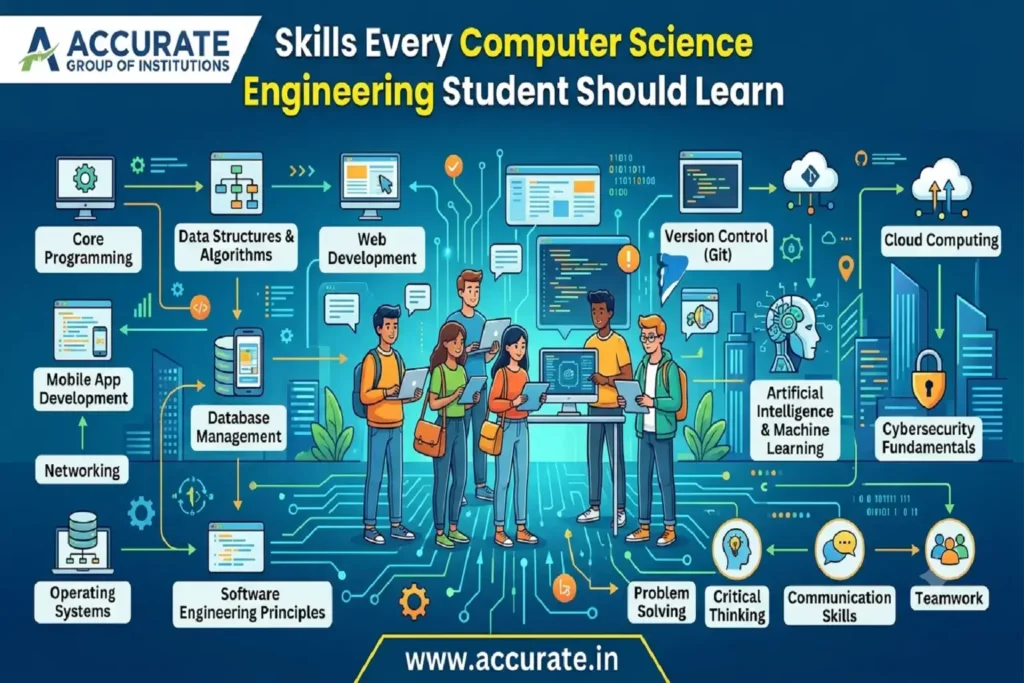
Many students focus only on technical subjects, but successful engineers combine technical expertise with professional skills.
Technical Skills Include
- Programming languages
- Software development
- Database management
- Operating systems
- Artificial Intelligence
- Cloud Computing
- Networking
- Cybersecurity
- Web Development
- Mobile App Development
Soft Skills Include
- Communication
- Leadership
- Time management
- Critical thinking
- Creativity
- Presentation skills
- Team collaboration
- Adaptability
- Professional ethics
- Decision-making
The combination of these skills helps graduates perform effectively in real workplace environments.
1. Programming Fundamentals
Why Programming Is the Foundation of Computer Science
Programming is the core skill of every Computer Science Engineering student. Every software application, website, mobile app, AI system, cloud platform, and operating system is created using programming languages.
Students should understand not only how to write code but also how to design efficient, readable, and maintainable programs.
Programming teaches students how computers think, process instructions, solve problems, and automate repetitive tasks.
Without strong programming knowledge, mastering advanced technologies becomes extremely difficult.
Programming Languages Every Student Should Learn
A Computer Science Engineering student should become comfortable with multiple programming languages because each language has different strengths and applications.
C Programming
C is often called the foundation of computer programming.
Students learn:
- Memory management
- Loops
- Functions
- Pointers
- File handling
- Data structures
- Low-level programming
Learning C builds strong logical thinking.
C++
C++ introduces Object-Oriented Programming concepts including:
- Classes
- Objects
- Inheritance
- Polymorphism
- Encapsulation
- Abstraction
Most competitive programming platforms rely heavily on C++.
Java
Java remains one of the world’s most widely used enterprise programming languages.
Applications include:
- Android development
- Banking software
- Enterprise applications
- Cloud systems
- Backend development
Java also strengthens understanding of object-oriented programming.
Python
Python has become one of the most important languages for modern engineers.
Students use Python for:
- Artificial Intelligence
- Machine Learning
- Data Science
- Automation
- Cybersecurity
- Web Development
- Data Analysis
Its simple syntax makes it ideal for beginners while remaining powerful enough for advanced applications.
JavaScript
JavaScript powers modern web applications.
Students interested in web development should learn:
- HTML
- CSS
- JavaScript
- React
- Node.js
Together, these technologies enable the creation of responsive and interactive websites.
Best Ways to Improve Programming Skills
Students should:
- Practice coding daily
- Solve programming challenges
- Participate in hackathons
- Build personal projects
- Learn from open-source repositories
- Contribute to GitHub projects
- Debug existing programs
- Study optimized code written by experienced developers
Programming is a practical skill that improves with consistent hands-on practice.
2. Data Structures and Algorithms (DSA)
Why DSA Is Essential
Data Structures and Algorithms form the backbone of computer science.
Almost every technical interview at leading technology companies includes DSA questions because they assess a candidate’s ability to solve problems efficiently.
Good algorithms reduce:
- Execution time
- Memory usage
- System complexity
Efficient data structures improve software performance, scalability, and reliability.
Important Data Structures
Students should master:
Arrays
The simplest and most commonly used data structure for storing collections of data.
Linked Lists
Useful when dynamic memory allocation is required.
Students learn:
- Singly linked lists
- Doubly linked lists
- Circular linked lists
Stacks
Applications include:
- Browser history
- Expression evaluation
- Undo functionality
- Compiler design
Queues
Widely used in:
- CPU scheduling
- Networking
- Task management
- Operating systems
Trees
Important tree structures include:
- Binary Trees
- Binary Search Trees
- AVL Trees
- Heap Trees
- Trie
Trees are essential for databases, search engines, and file systems.
Graphs
Graphs help solve:
- Navigation systems
- Social media networks
- Recommendation engines
- Network routing
- AI pathfinding
Hash Tables
Hashing enables extremely fast searching and retrieval.
Applications include:
- Databases
- Password management
- Caching systems
- Dictionaries
Algorithms Students Should Master
Important algorithms include:
Searching Algorithms
- Linear Search
- Binary Search
Sorting Algorithms
Students should understand:
- Bubble Sort
- Selection Sort
- Insertion Sort
- Merge Sort
- Quick Sort
- Heap Sort
Each has different performance characteristics.
Recursion
Recursion is widely used in:
- Tree traversal
- Backtracking
- Divide-and-conquer algorithms
- Dynamic programming
Dynamic Programming
Dynamic Programming solves complex optimization problems by storing previously computed results.
Popular examples include:
- Fibonacci
- Knapsack Problem
- Longest Common Subsequence
- Matrix Chain Multiplication
Graph Algorithms
Students should learn:
- BFS
- DFS
- Dijkstra Algorithm
- Prim’s Algorithm
- Kruskal Algorithm
- Floyd-Warshall Algorithm
These algorithms are frequently used in technical interviews and real-world software systems.
Why Recruiters Focus on DSA
Leading technology companies assess DSA because it demonstrates:
- Logical thinking
- Optimization skills
- Coding efficiency
- Analytical ability
- Problem-solving capability
Students who regularly solve coding challenges on platforms like LeetCode, HackerRank, CodeChef, and GeeksforGeeks significantly improve their placement readiness.
3. Database Management Systems (DBMS)
Every software application relies on data. Whether it is an e-commerce website, banking application, healthcare portal, social media platform, or educational system, data must be stored, organized, retrieved, and secured efficiently. This is where Database Management Systems (DBMS) play a vital role.
A Computer Science Engineering student should understand the fundamentals of database design, normalization, indexing, transactions, and query optimization. Learning SQL is essential for interacting with relational databases such as MySQL, PostgreSQL, and Oracle. Students should also become familiar with modern NoSQL databases like MongoDB, which are widely used in cloud-native applications.
Hands-on practice in designing databases and writing efficient queries helps students build scalable applications and prepares them for software development roles across industries.