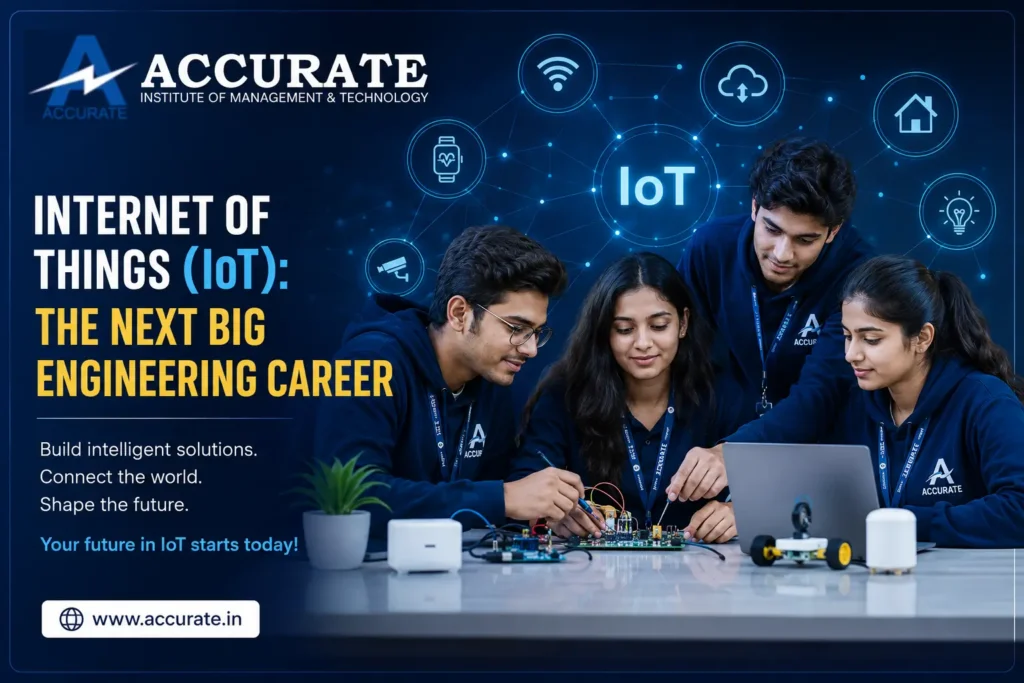

Internet of Things (IoT): The Next Big Engineering Career
Technology is entering an era where almost every device around us can communicate, collect data, and make intelligent decisions. From smart homes and connected cars to industrial automation and wearable healthcare devices, the Internet of Things (IoT) has become one of the most transformative innovations of the digital age.
According to industry experts, billions of connected devices will power the next generation of smart cities, intelligent factories, healthcare systems, agriculture, transportation, and consumer electronics. This rapid technological evolution has created an enormous demand for skilled IoT engineers across the world.
Students planning their engineering careers today are looking for future-proof specializations that combine innovation, excellent salaries, global opportunities, and practical learning. IoT engineering perfectly meets these expectations.
If you are searching for a rewarding engineering career with limitless possibilities, this guide explains why Internet of Things (IoT) is the next big engineering career and how institutions like Accurate Institute of Management & Technology prepare students for this exciting future.
Table of Contents
- What is the Internet of Things (IoT)?
- Why IoT is Becoming the Future of Engineering
- How IoT is Transforming Industries
- Core Technologies Behind IoT
- Essential Skills Required for IoT Engineers
- Career Opportunities in IoT
- Top Job Roles in IoT Engineering
- Industries Hiring IoT Professionals
- Salary Trends for IoT Engineers
- Future Scope of IoT Engineering
- Why Students Should Choose IoT as a Career
- Why Accurate Institute of Management & Technology is the Right Choice
- Tips to Build a Successful IoT Career
- Final Thoughts
- FAQs
What is the Internet of Things (IoT)?
The Internet of Things refers to a network of physical devices connected through the internet that can collect, exchange, and process data without requiring constant human intervention.
These connected devices include:
- Smart watches
- Smart TVs
- Smart refrigerators
- Industrial sensors
- Medical monitoring devices
- Connected vehicles
- Smart traffic systems
- Agricultural sensors
- Manufacturing robots
Each IoT device contains sensors, processors, communication modules, and software that work together to automate processes and improve decision-making.
For example:
A smartwatch measures your heartbeat, sends health information to your smartphone, and even alerts doctors during emergencies.
This is IoT in action.
Why IoT is Becoming the Future of Engineering
Several global trends are accelerating IoT adoption.
Massive Digital Transformation
Organizations across industries are embracing digital technologies to improve efficiency and reduce operational costs.
IoT plays a central role in this transformation.
Growing Number of Connected Devices
Experts estimate that billions of IoT devices will be active worldwide within the next few years.
Every connected device requires engineers to design, develop, secure, and maintain it.
Demand for Automation
Businesses increasingly rely on automation to improve productivity.
IoT enables:
- Smart manufacturing
- Predictive maintenance
- Automated logistics
- Smart healthcare
- Intelligent transportation
AI + IoT Integration
Artificial Intelligence combined with IoT creates intelligent systems capable of making decisions independently.
Examples include:
- Self-driving vehicles
- Smart hospitals
- Intelligent manufacturing plants
- Voice-controlled homes
This integration creates even more engineering opportunities.
How IoT is Transforming Industries
Healthcare
IoT is revolutionizing healthcare through:
- Remote patient monitoring
- Wearable medical devices
- Smart ambulances
- Hospital asset tracking
- AI-powered diagnostics
Doctors receive real-time patient data, improving treatment outcomes.
Manufacturing
Industry 4.0 relies heavily on IoT.
Factories use connected machines to:
- Predict equipment failures
- Reduce downtime
- Improve quality control
- Monitor production efficiency
- Save energy
Agriculture
Smart farming uses IoT sensors to monitor:
- Soil moisture
- Temperature
- Humidity
- Crop health
- Water requirements
Farmers increase productivity while reducing costs.
Transportation
IoT powers:
- Connected vehicles
- Fleet management
- Smart parking
- Traffic management
- Vehicle tracking
Smart Homes
Modern homes use IoT for:
- Smart lighting
- Security systems
- Smart locks
- Voice assistants
- Energy management
Retail
Retail businesses use IoT for:
- Smart shelves
- Inventory tracking
- Customer analytics
- Automated billing
- Supply chain management
Core Technologies Behind IoT
IoT engineering combines multiple technologies.
Embedded Systems
Embedded hardware controls IoT devices.
Students learn:
- Arduino
- Raspberry Pi
- Microcontrollers
- Sensor interfacing
Sensors
Sensors collect real-world information.
Examples:
- Motion sensors
- Temperature sensors
- Pressure sensors
- Light sensors
- GPS sensors
Networking
IoT devices communicate using:
- Wi-Fi
- Bluetooth
- Zigbee
- LoRaWAN
- 5G
Cloud Computing
Cloud platforms store and analyze IoT data.
Popular platforms include:
- AWS IoT
- Microsoft Azure IoT
- Google Cloud IoT
Artificial Intelligence
AI converts collected data into intelligent decisions.
Applications include:
- Predictive maintenance
- Image recognition
- Smart assistants
- Industrial automation
Cybersecurity
Since connected devices exchange sensitive information, cybersecurity has become essential.
IoT engineers must understand:
- Encryption
- Authentication
- Secure communication
- Network security
Essential Skills Required for IoT Engineers
Successful IoT professionals possess both technical and professional skills.
Programming Languages
Students should learn:
- Python
- C
- C++
- Java
- JavaScript
Electronics
Knowledge of:
- Circuit design
- Sensors
- Microcontrollers
- Embedded programming
Networking
Understanding:
- TCP/IP
- Wireless communication
- Network protocols
- IoT communication standards
Cloud Computing
Engineers should understand:
- Cloud storage
- Data processing
- IoT dashboards
- Cloud deployment
Artificial Intelligence
Machine learning improves IoT applications.
Basic AI knowledge increases employability.
Data Analytics
IoT devices generate huge volumes of data.
Engineers analyze this information to improve business decisions.
Problem Solving
Employers value engineers who can solve real-world challenges creatively.
Career Opportunities in IoT
The IoT industry offers excellent career growth.
Popular career options include:
- IoT Engineer
- Embedded Systems Engineer
- Robotics Engineer
- Automation Engineer
- Firmware Developer
- Cloud IoT Engineer
- AI IoT Developer
- Industrial IoT Specialist
- Network Engineer
- Data Engineer
- Security Engineer
- Smart Device Developer
Top Job Roles in IoT Engineering
IoT Solution Architect
Designs complete IoT ecosystems.
Embedded Software Engineer
Develops firmware for connected devices.
IoT Application Developer
Creates mobile and web applications that interact with IoT devices.
Industrial IoT Engineer
Builds automation systems for factories.
IoT Security Specialist
Protects connected systems from cyber threats.
AI IoT Engineer
Combines Artificial Intelligence with IoT applications.
Cloud Engineer
Develops scalable cloud infrastructure for connected devices.
Industries Hiring IoT Professionals
IoT engineers are employed in numerous sectors.
These include:
- Information Technology
- Healthcare
- Manufacturing
- Automotive
- Smart Cities
- Agriculture
- Telecommunications
- Energy
- Logistics
- Retail
- Consumer Electronics
- Aerospace
- Defense
- Construction
The demand continues to grow as digital transformation accelerates.
Salary Trends for IoT Engineers
IoT professionals enjoy competitive salaries due to the specialized nature of their work.
Typical salary growth depends on:
- Skills
- Certifications
- Experience
- Company
- Location
- Project expertise
Fresh graduates often begin with attractive compensation packages, while experienced IoT architects and AI-IoT specialists can earn significantly higher salaries in India and abroad.
Professionals who continuously upskill in cloud computing, cybersecurity, embedded systems, and AI generally experience faster career progression.
Future Scope of IoT Engineering
IoT is expected to remain one of the fastest-growing engineering domains.
Future developments include:
Smart Cities
Connected infrastructure will improve urban living.
Autonomous Vehicles
IoT enables vehicle communication and intelligent transportation.
Smart Healthcare
Remote monitoring will become increasingly common.
Green Energy
IoT supports efficient energy management and renewable energy systems.
Industrial Automation
Factories will become more intelligent using AI-powered IoT.
Smart Education
Connected classrooms improve learning experiences.
Digital Agriculture
Precision farming will increase food production.
Why Students Should Choose IoT as a Career
IoT offers several advantages.
High Industry Demand
Companies actively recruit skilled IoT engineers.
Excellent Salary Potential
Specialized technical skills command competitive compensation.
Global Career Opportunities
IoT professionals are in demand worldwide.
Continuous Innovation
Every year brings new technologies and exciting projects.
Entrepreneurial Opportunities
Students can develop their own smart products and startups.
Diverse Career Paths
IoT integrates with AI, Robotics, Cloud Computing, Cybersecurity, and Data Science, allowing engineers to specialize in multiple domains.
Why Accurate Institute of Management & Technology is the Right Choice
Choosing the right engineering college is as important as choosing the right specialization.
Accurate Institute of Management & Technology (AIMT) is committed to preparing students for emerging technologies like the Internet of Things through industry-oriented education and practical exposure.
Industry-Relevant Curriculum
Students learn concepts aligned with current technology trends and employer expectations.
Modern Laboratories
Well-equipped labs provide practical exposure to embedded systems, programming, networking, and emerging technologies.
Experienced Faculty
Dedicated faculty members mentor students through classroom learning, projects, and innovation-driven activities.
Practical Learning Approach
Students gain hands-on experience through workshops, live projects, coding practice, technical events, and innovation challenges.
Industry Interaction
Guest lectures, seminars, industrial visits, and expert sessions help students understand real-world applications of IoT and related technologies.
Placement Assistance
The institute emphasizes skill development, interview preparation, aptitude training, and industry connections to improve employability.
Innovation and Entrepreneurship
Students interested in launching technology startups receive guidance, exposure to innovation ecosystems, and opportunities to build practical solutions.
For students seeking a future-ready engineering education, Accurate Institute of Management & Technology provides an excellent environment to develop technical expertise and professional skills.
Tips to Build a Successful IoT Career
Build Strong Programming Skills
Practice coding daily using Python, C, and C++.
Work on Real Projects
Develop smart devices using Arduino, Raspberry Pi, ESP32, or similar development boards.
Learn Cloud Platforms
Gain experience with AWS, Azure, or Google Cloud services for IoT.
Understand AI Basics
Machine learning significantly enhances IoT applications.
Earn Certifications
Industry-recognized certifications improve employability.
Participate in Hackathons
Competitions strengthen innovation and teamwork.
Build an Impressive Portfolio
Showcase projects on GitHub and create technical documentation to demonstrate your skills.
Stay Updated
Read technology blogs, research papers, and follow industry trends regularly.
Conclusion
The Internet of Things (IoT) is no longer a futuristic concept—it is already reshaping industries, businesses, and everyday life. As organizations increasingly adopt connected technologies, the demand for skilled IoT engineers continues to rise across sectors such as healthcare, manufacturing, transportation, agriculture, retail, and smart infrastructure.
For students aspiring to build a rewarding engineering career, IoT offers an exceptional combination of innovation, global opportunities, attractive salary potential, and long-term career growth. Success in this field requires a strong foundation in programming, embedded systems, networking, cloud computing, cybersecurity, and data analytics, along with continuous learning to keep pace with technological advancements.
A quality engineering education plays a crucial role in preparing future IoT professionals. Accurate Institute of Management & Technology focuses on industry-oriented learning, practical exposure, experienced faculty, modern laboratories, and skill development initiatives that help students become career-ready. Through hands-on projects, industry interaction, and placement support, the institute enables aspiring engineers to confidently enter the rapidly evolving technology landscape.
If you are planning your engineering journey and want to become part of the next generation of innovators, now is the ideal time to explore IoT-focused learning opportunities. Take the first step toward a future-ready career by applying for B.Tech admission at Accurate Institute of Management & Technology and prepare to build intelligent solutions for a connected world.
Frequently Asked Questions (FAQs)
1. What is the Internet of Things (IoT) in engineering?
IoT is a network of connected devices that communicate, collect, and exchange data through the internet to automate processes and improve decision-making across industries.
2. Is IoT a good engineering career in 2026 and beyond?
Yes. IoT is among the fastest-growing engineering fields due to increasing demand for smart devices, automation, Industry 4.0, AI integration, and digital transformation.
3. What skills are required to become an IoT engineer?
Key skills include programming (Python, C, C++), embedded systems, electronics, networking, cloud computing, cybersecurity, AI basics, and data analytics.
4. Which industries hire IoT engineers?
IoT engineers are hired by IT companies, manufacturing firms, healthcare organizations, automotive companies, telecom providers, agriculture businesses, smart city projects, logistics firms, and consumer electronics companies.
5. What are the top job roles in IoT?
Popular roles include IoT Engineer, Embedded Systems Engineer, IoT Solution Architect, Industrial IoT Engineer, Cloud IoT Engineer, AI-IoT Developer, Firmware Engineer, and IoT Security Specialist.
6. Can CSE students pursue a career in IoT?
Yes. Computer Science Engineering students with knowledge of programming, networking, cloud technologies, and embedded systems can build successful careers in IoT.
7. Does IoT have opportunities outside India?
Absolutely. IoT professionals are in demand globally across North America, Europe, the Middle East, and Asia-Pacific, offering excellent international career prospects.
8. How is AI related to IoT?
AI enables IoT systems to analyze data, recognize patterns, make predictions, and automate intelligent decision-making, creating smarter connected solutions.
9. Why choose Accurate Institute of Management & Technology for engineering?
Accurate Institute of Management & Technology offers industry-oriented education, experienced faculty, practical laboratories, project-based learning, industry interaction, and placement support to prepare students for careers in emerging technologies like IoT.
10. Is IoT a future-proof engineering specialization?
Yes. With rapid growth in smart cities, connected healthcare, industrial automation, autonomous systems, and digital infrastructure, IoT is expected to remain one of the most promising engineering career paths for years to come.