
The Internet of Things (IoT) has become one of the most revolutionary technologies of the digital era. From smart homes and wearable devices to autonomous vehicles, industrial automation, healthcare monitoring systems, and smart cities, IoT is transforming the way people live and businesses operate. As organizations increasingly rely on connected technologies, the demand for skilled IoT engineers continues to rise.
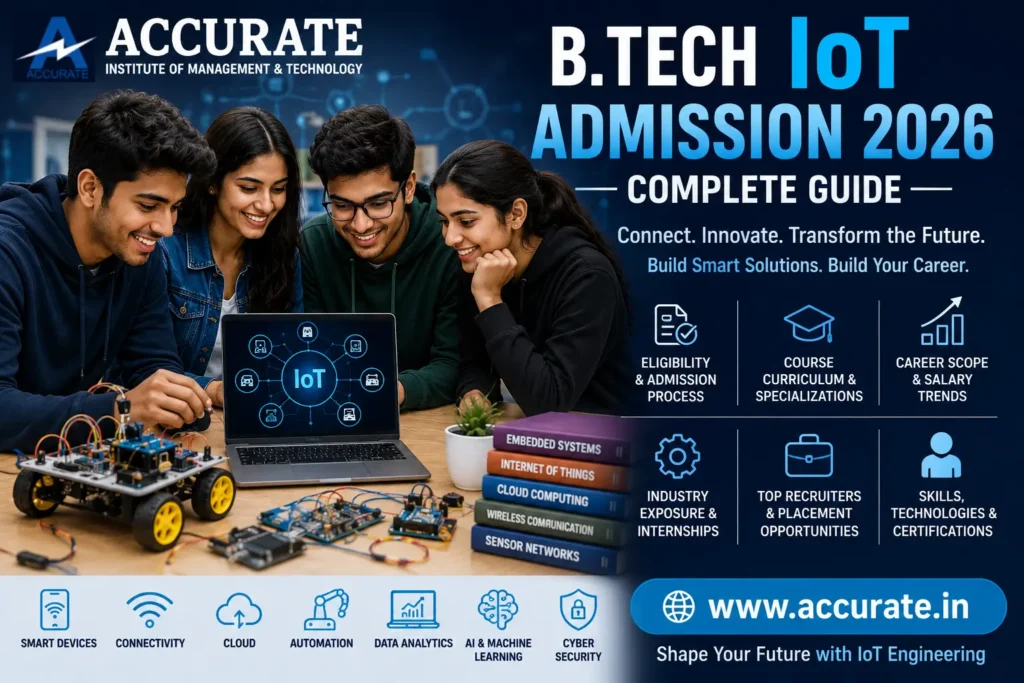
If you are planning to pursue engineering after Class 12, B.Tech in Internet of Things (IoT) is an excellent choice for building a future-ready career. The program combines Computer Science, Embedded Systems, Networking, Cloud Computing, Artificial Intelligence (AI), Cyber Security, Data Analytics, and Automation, enabling students to develop intelligent solutions for real-world challenges.
Choosing the right engineering institute is equally important. A college that offers practical exposure, experienced faculty, industry collaborations, innovation opportunities, internships, and placement support can significantly influence your professional growth.
Accurate Institute of Management & Technology, Greater Noida, provides an industry-oriented B.Tech program that prepares students for careers in IoT, Artificial Intelligence, Cloud Computing, Robotics, Data Science, and other emerging technologies through experiential learning and industry engagement.
Table of Contents
- What is B.Tech in IoT?
- Why Choose B.Tech IoT in 2026?
- Why is IoT One of the Fastest-Growing Technologies?
- Eligibility for B.Tech IoT Admission 2026
- Admission Process for B.Tech IoT
- Skills Required for IoT Engineering
- B.Tech IoT Course Curriculum
- Why Study IoT Engineering in Greater Noida?
- Why Choose Accurate Institute of Management & Technology?
- Career Opportunities
- FAQs
- Conclusion
What is B.Tech in Internet of Things (IoT)?
B.Tech in Internet of Things (IoT) is a four-year undergraduate engineering program that focuses on designing, developing, and managing intelligent connected devices capable of communicating over the internet.
The program integrates multiple disciplines, including:
- Computer Science Engineering
- Embedded Systems
- Electronics
- Cloud Computing
- Artificial Intelligence
- Machine Learning
- Networking
- Cyber Security
- Data Analytics
Students learn how to build smart devices that collect data, communicate securely, analyze information, and automate decision-making.
Common IoT applications include:
- Smart Homes
- Smart Healthcare
- Smart Agriculture
- Connected Vehicles
- Industrial Automation
- Smart Manufacturing
- Environmental Monitoring
- Wearable Technology
- Smart Energy Systems
- Smart Cities
Why Choose B.Tech IoT in 2026?
Technology is evolving rapidly, and IoT is becoming an essential component of digital transformation across industries.
Here are some reasons why students should consider B.Tech IoT in 2026.
High Industry Demand
Organizations are investing in connected technologies to improve efficiency, automate operations, and enhance customer experiences. This creates continuous demand for qualified IoT professionals.
Future-Ready Technology
IoT works alongside emerging technologies such as:
- Artificial Intelligence
- Machine Learning
- Cloud Computing
- Robotics
- Edge Computing
- Big Data Analytics
- Blockchain
- Cyber Security
Learning IoT provides exposure to multiple future technologies rather than a single specialization.
Excellent Career Opportunities
Graduates can pursue careers in:
- IoT Engineering
- Embedded Systems
- Software Development
- Cloud Engineering
- Automation Engineering
- AI Engineering
- Robotics
- Data Engineering
- Cyber Security
Innovation and Entrepreneurship
IoT creates opportunities to build smart products, launch startups, and develop technology-driven business solutions for industries and consumers.
Global Career Scope
IoT professionals are in demand across multinational corporations, technology startups, manufacturing industries, healthcare organizations, consulting firms, and research institutions worldwide.
Why is IoT One of the Fastest-Growing Technologies?
Several technological advancements have accelerated IoT adoption.
Digital Transformation
Organizations across industries are digitizing operations using connected devices and intelligent automation.
Industry 4.0
Manufacturing companies increasingly use IoT-enabled machinery for predictive maintenance, production monitoring, and quality control.
Cloud Computing
Cloud platforms provide scalable infrastructure for storing, processing, and analyzing IoT-generated data.
Artificial Intelligence Integration
AI enables IoT devices to learn from data, make intelligent decisions, and automate business processes.
5G Networks
High-speed connectivity significantly improves communication between billions of connected devices.
Eligibility for B.Tech IoT Admission 2026
Although admission policies may vary by institution and regulatory requirements, students generally need to meet the following criteria.
Academic Qualification
Candidates should have completed Class 12 (or equivalent) from a recognized board.
Required Subjects
Students are generally expected to have studied:
- Physics
- Chemistry
- Mathematics
These subjects provide the academic foundation necessary for engineering education.
Entrance Requirements
Admission may be based on entrance examinations, merit, counseling, or institutional admission processes depending on applicable guidelines and the institute’s admission policy.
Students should always refer to the latest admission notifications for current eligibility criteria.
Admission Process for B.Tech IoT 2026
The admission process typically follows these steps.
Step 1: Research Colleges
Compare institutions based on:
- Accreditation
- Faculty
- Curriculum
- Laboratories
- Placement support
- Industry exposure
- Infrastructure
Step 2: Complete the Application
Fill out the admission application with accurate academic details and submit the required documents.
Step 3: Participate in Counseling
Eligible candidates complete counseling or institute-specific admission formalities, where applicable.
Step 4: Document Verification
Academic certificates and other required documents are verified before admission is confirmed.
Step 5: Secure Admission
After completing admission formalities and fee payment (as applicable), students can begin their engineering program.
Skills Required for IoT Engineering
Success in IoT Engineering requires a combination of technical knowledge and professional skills.
Technical Skills
Students should develop expertise in:
- C Programming
- C++
- Python
- Java
- Embedded Systems
- Microcontrollers
- Raspberry Pi
- Arduino
- Networking
- Database Management
- Cloud Computing
- Artificial Intelligence
- Machine Learning
- Cyber Security
- Linux
- Data Analytics
- IoT Communication Protocols
Professional Skills
Strong soft skills help students succeed in multidisciplinary engineering environments.
Important skills include:
- Problem Solving
- Critical Thinking
- Communication
- Teamwork
- Leadership
- Creativity
- Adaptability
- Time Management
- Innovation
- Continuous Learning
B.Tech IoT Course Curriculum
The curriculum combines theoretical knowledge with extensive practical learning.
Students generally study:
First Year
- Engineering Mathematics
- Programming Fundamentals
- Physics
- Engineering Graphics
- Basic Electronics
- Communication Skills
Second Year
- Data Structures
- Computer Networks
- Digital Electronics
- Embedded Systems
- Object-Oriented Programming
- Database Management Systems
Third Year
- Internet of Things
- Cloud Computing
- Artificial Intelligence
- Machine Learning
- Wireless Sensor Networks
- Cyber Security
- Software Engineering
Final Year
- Industrial Projects
- IoT Capstone Project
- Internship
- Research Work
- Innovation Projects
- Emerging Technology Electives
Project-based learning ensures students develop practical skills alongside theoretical understanding.
Why Study IoT Engineering in Greater Noida?
Greater Noida has become one of India’s leading destinations for engineering education and technology-focused learning.
Educational Ecosystem
The region offers a vibrant academic environment with engineering institutions, research initiatives, and technical events.
Industrial Exposure
Students have opportunities to participate in industrial visits, internships, workshops, and interactions with professionals from the technology sector.
Career Development
Being part of the National Capital Region (NCR) gives students exposure to a growing ecosystem of IT companies, startups, electronics manufacturers, consulting firms, and innovation hubs.
Innovation Opportunities
Students can participate in hackathons, coding competitions, technical seminars, startup events, and project exhibitions that encourage creativity and practical learning.
Why Choose Accurate Institute of Management & Technology?
For students seeking B.Tech IoT Admission 2026, Accurate Institute of Management & Technology, Greater Noida, offers an engineering education designed to meet the needs of today’s technology-driven industries.
Key highlights include:
- Industry-oriented curriculum
- Experienced faculty members
- Modern computer and IoT laboratories
- Project-based learning
- Coding competitions and hackathons
- Technical workshops
- Industry interaction
- Internship opportunities
- Innovation and entrepreneurship support
- Soft skills development
- Placement assistance
- Career guidance and mentoring
The institute emphasizes practical learning, technical excellence, and innovation, enabling students to build successful careers in IoT, Artificial Intelligence, Cloud Computing, Cyber Security, Robotics, and other emerging technology domains.
Career Opportunities After B.Tech in IoT
The Internet of Things has evolved from an emerging concept into a core technology powering digital transformation across industries. Today, organizations need professionals who can design, develop, secure, and maintain intelligent connected systems. As a result, graduates with a B.Tech in IoT enjoy diverse career opportunities in India and abroad.
Unlike many traditional engineering disciplines, IoT combines multiple technologies, enabling graduates to work in software development, embedded systems, cloud computing, networking, Artificial Intelligence, automation, and cybersecurity.
Top Career Opportunities in IoT Engineering
IoT Engineer
IoT Engineers develop smart devices and connected systems that communicate over the internet.
Responsibilities
- Designing IoT solutions
- Developing embedded software
- Connecting sensors and controllers
- Configuring communication protocols
- Managing cloud connectivity
- Monitoring device performance
- Troubleshooting IoT deployments
IoT Engineers work on projects involving smart homes, healthcare devices, industrial automation, logistics, and smart infrastructure.
Embedded Systems Engineer
Embedded Systems Engineers create software and firmware for hardware devices used in automotive systems, industrial equipment, healthcare devices, and consumer electronics.
Their work includes:
- Firmware programming
- Hardware integration
- Real-time operating systems
- Device optimization
- Sensor communication
IoT Software Developer
Software Developers build web applications, mobile applications, dashboards, and backend systems that interact with connected IoT devices.
Their responsibilities include:
- Application development
- API integration
- Cloud communication
- Database management
- Device monitoring platforms
Cloud IoT Engineer
Cloud computing forms the backbone of modern IoT solutions.
Cloud IoT Engineers work with:
- AWS IoT Core
- Microsoft Azure IoT Hub
- Google Cloud Platform
- IBM Watson IoT
Their role includes deploying IoT applications, managing connected devices, processing data, and ensuring system scalability.
IoT Security Engineer
With billions of connected devices online, cyber security has become essential.
IoT Security Engineers focus on:
- Device security
- Authentication
- Encryption
- Secure communication
- Vulnerability assessment
- Threat detection
- Risk mitigation
Automation Engineer
Automation Engineers develop intelligent industrial systems using sensors, controllers, robotics, and IoT technologies.
Applications include:
- Manufacturing automation
- Process optimization
- Predictive maintenance
- Industrial monitoring
- Quality assurance
Robotics Engineer
Robotics Engineers combine IoT with Artificial Intelligence to build autonomous and intelligent robotic systems used in manufacturing, healthcare, logistics, and agriculture.
Data Engineer
IoT devices generate continuous streams of information.
Data Engineers build systems that:
- Collect IoT data
- Store information
- Process large datasets
- Support analytics
- Improve data quality
AI & Machine Learning Engineer
Artificial Intelligence significantly enhances IoT systems.
AI Engineers develop:
- Predictive maintenance systems
- Intelligent assistants
- Image recognition
- Voice-enabled devices
- Smart recommendations
- Industrial analytics
Industries Hiring IoT Professionals
IoT technology has applications across nearly every industry.
Information Technology
IT companies build connected software platforms, cloud applications, enterprise IoT solutions, and intelligent digital services.
Manufacturing
Manufacturers implement IoT for:
- Smart factories
- Predictive maintenance
- Production monitoring
- Equipment optimization
- Industrial automation
Healthcare
Healthcare organizations deploy IoT for:
- Wearable devices
- Remote patient monitoring
- Connected medical equipment
- Hospital automation
- Health analytics
Automotive
Automotive companies use IoT in:
- Connected vehicles
- Electric vehicle monitoring
- Fleet management
- Driver assistance systems
- Autonomous mobility
Agriculture
Smart farming uses IoT for:
- Soil monitoring
- Smart irrigation
- Crop health analysis
- Livestock tracking
- Weather monitoring
Logistics & Supply Chain
IoT improves logistics through:
- Shipment tracking
- Warehouse automation
- Inventory optimization
- Fleet management
- Cold-chain monitoring
Energy & Utilities
Energy companies use IoT for:
- Smart grids
- Smart metering
- Renewable energy monitoring
- Asset management
- Energy optimization
Smart Cities
Governments deploy IoT technologies for:
- Smart traffic systems
- Intelligent lighting
- Waste management
- Environmental monitoring
- Public safety
- Water management
Industry Demand for IoT Engineers
The demand for IoT professionals continues to increase due to rapid digital transformation.
Several factors contribute to this demand:
Growth of Smart Devices
Businesses and consumers increasingly use connected devices across homes, industries, healthcare, and transportation.
Industry 4.0
Industrial automation requires IoT-enabled machines capable of communicating, monitoring, and optimizing production.
Artificial Intelligence Integration
AI-powered IoT solutions improve efficiency through predictive analytics and intelligent decision-making.
Expansion of Cloud Computing
Cloud infrastructure enables organizations to manage millions of connected devices efficiently.
Government Digital Initiatives
Smart city projects, digital infrastructure, intelligent transportation, and environmental monitoring continue creating employment opportunities.
Salary Trends After B.Tech IoT
IoT Engineering offers competitive salary growth because it combines multiple high-demand technologies.
Career growth generally depends on:
- Programming expertise
- Practical projects
- Internship experience
- Cloud computing knowledge
- AI integration skills
- Communication abilities
- Professional certifications
- Industry exposure
Graduates who continuously update their technical knowledge and work on real-world projects often enjoy stronger career progression.
Top Recruiters
Leading organizations actively recruit IoT professionals.
Major recruiters include:
- Microsoft
- Amazon
- IBM
- Cisco
- Intel
- Qualcomm
- Bosch
- Siemens
- Honeywell
- Schneider Electric
- Samsung
- Tata Consultancy Services (TCS)
- Infosys
- Wipro
- HCLTech
- Cognizant
- Accenture
- Capgemini
- Tech Mahindra
Numerous startups specializing in healthcare technology, industrial automation, smart homes, connected mobility, and consumer electronics also recruit IoT engineers.
Essential IoT Technologies Students Should Learn
Successful IoT professionals should become familiar with industry-standard technologies.
Hardware Platforms
- Arduino
- Raspberry Pi
- ESP32
- ESP8266
- STM32
Programming Languages
- C
- C++
- Python
- Java
- JavaScript
Communication Protocols
- MQTT
- HTTP
- CoAP
- Zigbee
- Bluetooth Low Energy (BLE)
- LoRaWAN
Cloud Platforms
- AWS IoT Core
- Microsoft Azure IoT Hub
- Google Cloud Platform
- IBM Watson IoT
Databases
- MySQL
- MongoDB
- PostgreSQL
- Firebase
Development Tools
- Arduino IDE
- PlatformIO
- Visual Studio Code
- Git
- GitHub
- Docker
Hands-on experience with these technologies significantly improves employability.
Professional Certifications
Industry certifications validate technical expertise and enhance career opportunities.
Recommended certifications include:
- AWS Certified Cloud Practitioner
- AWS Certified Solutions Architect
- Microsoft Azure IoT Developer Specialty
- Google Associate Cloud Engineer
- Cisco Certified Network Associate (CCNA)
- Microsoft Azure Fundamentals
- Oracle Java Certification
- Python Professional Certification
These certifications complement academic learning and demonstrate practical competency.
Future Scope of IoT Engineering
The future of IoT Engineering is exceptionally promising. As connected technologies become part of everyday life, organizations will continue investing in smart systems that improve efficiency, sustainability, and customer experiences.
Emerging growth areas include:
- Artificial Intelligence of Things (AIoT)
- Industrial Internet of Things (IIoT)
- Edge Computing
- Digital Twins
- Autonomous Vehicles
- Smart Healthcare
- Smart Agriculture
- Renewable Energy Management
- Smart Manufacturing
- Smart Cities
- Environmental Sustainability
Students pursuing B.Tech IoT Admission 2026 will enter a field with strong long-term growth, diverse career opportunities, and continuous innovation.
Why Accurate Institute of Management & Technology Offers an Industry-Ready Learning Experience
Choosing the right engineering college is about more than earning a degree—it’s about building the skills employers value.
Accurate Institute of Management & Technology, Greater Noida, provides students with an environment that encourages innovation, technical excellence, and practical learning through:
- Industry-oriented curriculum
- Modern IoT laboratories
- Experienced faculty
- Coding clubs and technical societies
- Project-based learning
- Innovation challenges and hackathons
- Technical workshops
- Industrial visits
- Internship opportunities
- Industry interaction sessions
- Placement preparation programs
- Personality development and communication training
By combining classroom instruction with hands-on experience, the institute prepares students to confidently pursue careers in IoT Engineering, Artificial Intelligence, Cloud Computing, Robotics, Cyber Security, and other emerging technology fields.
Campus Facilities That Support Future Engineers
A high-quality engineering education depends on more than classroom teaching. Students need access to modern infrastructure, practical laboratories, digital resources, and opportunities to apply theoretical knowledge to real-world projects.
Accurate Institute of Management & Technology, Greater Noida, provides a learning environment designed to help students develop technical expertise, innovation, leadership, and industry readiness.
Modern Laboratories
Students gain practical exposure through well-equipped laboratories that support learning in:
- Internet of Things (IoT)
- Computer Programming
- Embedded Systems
- Networking
- Cloud Computing
- Artificial Intelligence
- Cyber Security
- Database Management
Hands-on learning helps students understand industry technologies while building confidence in solving practical engineering problems.
Smart Classrooms
Technology-enabled classrooms encourage interactive learning through presentations, demonstrations, collaborative discussions, and project-based activities.
Library and Digital Learning Resources
Students have access to technical books, journals, digital resources, research materials, and online learning platforms that support continuous academic development.
Innovation and Technical Activities
Engineering education becomes more effective when students actively participate in practical learning beyond the classroom.
Students are encouraged to participate in:
- Coding competitions
- Hackathons
- Technical workshops
- Project exhibitions
- Innovation challenges
- Technical seminars
- Guest lectures by industry experts
These activities help students improve creativity, teamwork, communication, and technical problem-solving abilities.
Internship Opportunities
Internships provide valuable exposure to professional work environments and industry practices.
During their engineering program, students are encouraged to gain practical experience through internships where they can:
- Work on live projects
- Learn industry tools
- Understand workplace expectations
- Improve technical skills
- Develop professional communication
- Build confidence before placements
Practical industry exposure helps students transition more smoothly from academics to professional careers.
Placement Preparation
Preparing students for successful careers requires consistent skill development throughout the engineering program.
Placement preparation generally focuses on:
Technical Training
Students strengthen their knowledge of:
- Programming
- Data Structures
- Algorithms
- IoT Technologies
- Networking
- Cloud Computing
- Artificial Intelligence
- Database Management
Aptitude Development
Regular aptitude practice helps students prepare for competitive recruitment processes.
Communication Skills
Professional communication, presentation skills, and group discussions improve overall employability.
Interview Preparation
Students receive guidance through:
- Mock interviews
- Resume preparation
- Technical interview practice
- HR interview sessions
- Career mentoring
Tips for B.Tech IoT Admission 2026
Students planning to pursue IoT Engineering should prepare well before the admission process begins.
Research Colleges Carefully
Evaluate institutions based on:
- Academic quality
- Faculty
- Curriculum
- Practical learning
- Industry exposure
- Laboratories
- Placement support
- Infrastructure
Strengthen Mathematics and Programming Skills
A solid foundation in Mathematics, logical reasoning, and programming makes engineering education easier and improves technical confidence.
Learn Basic Programming
Before joining engineering, students can begin learning:
- C Programming
- Python
- Basic Electronics
- Computer Fundamentals
Early exposure helps students adapt more quickly to engineering coursework.
Build Technical Curiosity
Students interested in innovation should explore topics such as:
- Artificial Intelligence
- Internet of Things
- Robotics
- Automation
- Cloud Computing
- Cyber Security
This curiosity often leads to stronger projects and better career opportunities.
Focus on Practical Learning
Engineering is not only about examinations. Building projects, participating in hackathons, contributing to open-source initiatives, and completing internships are equally important for career success.
Why Accurate Institute of Management & Technology?
For students planning B.Tech IoT Admission 2026, Accurate Institute of Management & Technology, Greater Noida, offers an engineering education that combines academic excellence with practical learning.
The institute emphasizes:
- Industry-oriented curriculum
- Experienced faculty
- Modern laboratories
- Practical project work
- Innovation culture
- Technical workshops
- Industrial visits
- Internship opportunities
- Personality development
- Soft skills training
- Career mentoring
- Placement assistance
By integrating technical education with experiential learning, the institute helps students build the knowledge, confidence, and professional skills required for successful careers in IoT Engineering and other emerging technologies.
Conclusion
The Internet of Things is transforming industries by connecting devices, data, and intelligent systems. As businesses increasingly adopt automation, cloud computing, Artificial Intelligence, and smart infrastructure, the demand for skilled IoT engineers continues to grow.
Choosing B.Tech IoT in 2026 is an excellent decision for students who aspire to build careers in next-generation technologies. The program provides multidisciplinary knowledge that opens opportunities across software development, embedded systems, cloud computing, automation, robotics, healthcare technology, manufacturing, agriculture, and smart city projects.
Equally important is choosing an engineering college that emphasizes practical learning, innovation, industry interaction, internships, and career development.
Accurate Institute of Management & Technology, Greater Noida, offers students an environment where they can develop technical expertise, work on real-world projects, participate in technical activities, and prepare for successful careers in emerging technologies.
If you are planning your engineering journey, B.Tech IoT Admission 2026 at Accurate Institute of Management & Technology can be the first step toward becoming a future-ready engineer equipped to contribute to India’s growing digital economy.
Frequently Asked Questions (FAQs)
1. What is B.Tech in Internet of Things (IoT)?
B.Tech in Internet of Things (IoT) is a four-year undergraduate engineering program that teaches students how to design, develop, and manage connected devices using embedded systems, networking, cloud computing, Artificial Intelligence, and data analytics.
2. Who can apply for B.Tech IoT Admission 2026?
Students who have completed Class 12 (or equivalent) with Physics, Chemistry, and Mathematics from a recognized board can generally apply, subject to the admission criteria of the institute and applicable regulations.
3. Is IoT Engineering a good career option?
Yes. IoT Engineering is one of the fastest-growing engineering fields, offering opportunities in software development, embedded systems, cloud computing, automation, healthcare technology, manufacturing, logistics, agriculture, and smart city projects.
4. What are the career opportunities after B.Tech IoT?
Graduates can work as IoT Engineers, Embedded Systems Engineers, Cloud IoT Engineers, IoT Developers, Automation Engineers, Robotics Engineers, IoT Security Engineers, Data Engineers, and AI Engineers.
5. Which programming languages are useful for IoT Engineering?
Common programming languages include C, C++, Python, Java, and JavaScript. Knowledge of SQL and Linux is also valuable for many IoT projects.
6. Which technologies should IoT students learn?
Students should develop skills in Cloud Computing, Artificial Intelligence, Machine Learning, Embedded Systems, Networking, Cyber Security, Edge Computing, Data Analytics, and IoT communication protocols.
7. What industries hire IoT engineers?
IoT professionals are recruited by IT companies, manufacturing organizations, healthcare providers, automotive companies, telecom firms, logistics businesses, agriculture technology companies, energy organizations, and smart infrastructure projects.
8. Why should students choose Accurate Institute of Management & Technology for B.Tech IoT?
Accurate Institute of Management & Technology offers an industry-oriented curriculum, experienced faculty, modern laboratories, project-based learning, internships, technical workshops, industry interaction, innovation activities, personality development, and placement support to prepare students for successful technology careers.
9. What is the future scope of IoT Engineering in India?
The future of IoT Engineering is highly promising due to increasing adoption of Industry 4.0, smart manufacturing, connected healthcare, cloud computing, Artificial Intelligence, digital infrastructure, renewable energy systems, and smart city initiatives.
10. How can students prepare for a successful IoT Engineering career?
Students should strengthen programming fundamentals, work on practical projects, complete internships, participate in hackathons, learn cloud platforms and networking, earn industry certifications, and stay updated with emerging technologies.
11. Why is practical learning important in IoT Engineering?
Practical learning enables students to apply classroom concepts to real-world scenarios. Building IoT projects, experimenting with sensors and embedded systems, using cloud platforms, and collaborating on industry-inspired assignments help develop problem-solving abilities and improve employability.