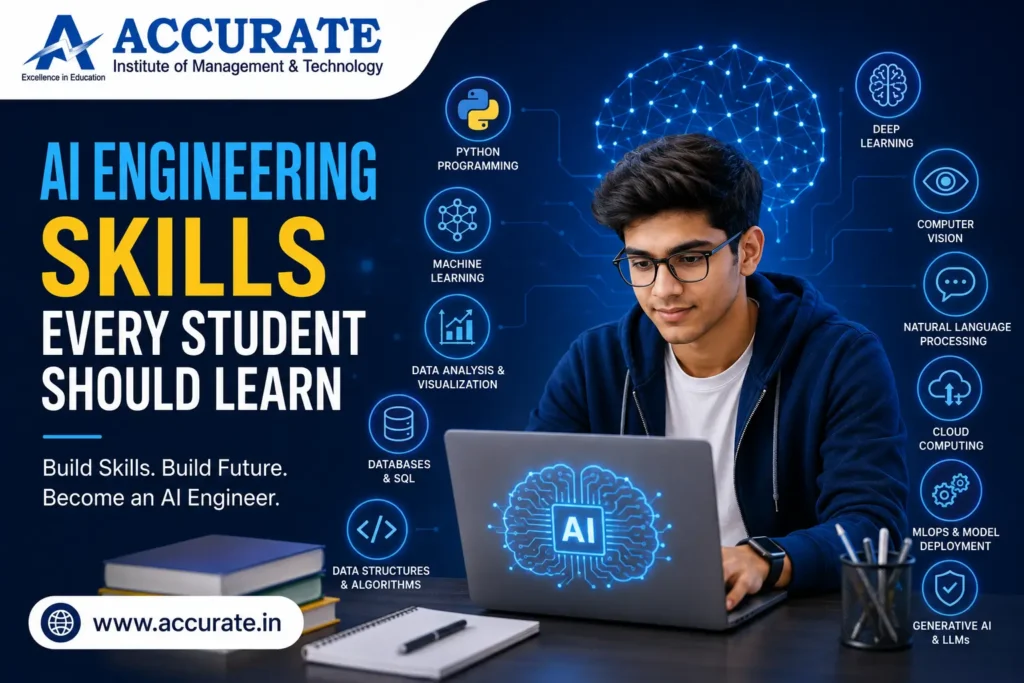

Artificial Intelligence is transforming the way software is developed, businesses operate, data is analysed and digital products interact with people. From Generative AI and intelligent assistants to computer vision, automation and robotics, AI technologies are creating new possibilities across industries.
For students, however, being interested in Artificial Intelligence is only the beginning.
The more important question is:
What AI Engineering skills should every student learn to build a future-ready career?
Learning Artificial Intelligence is not simply about using popular AI tools. Students who want to become AI Engineers need a combination of programming, mathematics, Machine Learning, data, software engineering and problem-solving skills. They also need practical experience building projects and the ability to keep learning as AI technologies evolve.
This guide explores the AI Engineering skills every student should learn, from Python and Machine Learning to Generative AI, cloud computing, MLOps and responsible AI. It also provides a practical learning roadmap for students planning an engineering career in Artificial Intelligence.
Table of Contents
- What Does an AI Engineer Do?
- Why AI Engineering Requires More Than AI Tools
- Python Programming
- Data Structures and Algorithms
- Mathematics for AI
- Probability and Statistics
- Machine Learning
- Deep Learning
- Data Handling and Analysis
- SQL and Database Skills
- Natural Language Processing
- Computer Vision
- Generative AI and Large Language Models
- Retrieval-Augmented Generation
- AI Agents
- Software Engineering
- APIs and Application Development
- Cloud Computing
- MLOps and AI Deployment
- Git and Version Control
- Responsible AI and AI Security
- Problem-Solving Skills
- Communication and Teamwork
- AI Project-Building Skills
- AI Engineering Roadmap for Students
- Common Mistakes AI Students Should Avoid
- How to Build an AI Portfolio
- Why Consider Accurate Institute of Management & Technology?
- FAQs
- Conclusion and Admission CTA
What Does an AI Engineer Do?
An AI Engineer develops software systems and applications that use Artificial Intelligence.
The exact responsibilities vary according to the organisation and project.
An AI Engineer may:
- prepare and process data,
- develop Machine Learning models,
- evaluate model performance,
- integrate AI models into software,
- work with AI APIs,
- build Generative AI applications,
- develop intelligent automation,
- deploy AI systems, and
- monitor applications after deployment.
This means AI Engineering sits at the intersection of several disciplines.
A successful AI Engineer may need knowledge of:
Computer Science + Mathematics + Data + Machine Learning + Software Engineering + Cloud Technologies
Students should therefore avoid thinking of AI as one isolated skill.
It is better understood as an ecosystem of complementary skills.
Why AI Engineering Requires More Than AI Tools
Modern AI applications have made powerful technology accessible to almost everyone.
Students can use AI assistants to generate text, analyse documents and even write computer code.
However, using an AI application is very different from engineering one.
An AI Engineer needs to understand questions such as:
- Where does the data come from?
- Is the data reliable?
- Which model or approach should be used?
- How should the system be evaluated?
- How will the AI connect with an application?
- How will users access it?
- How will it operate at scale?
- How should failures be handled?
- How can privacy and security be considered?
These questions require deeper technical knowledge.
That is why the most valuable AI Engineering skills for students begin with fundamentals rather than individual tools.
1. Python Programming
Python is one of the most useful programming languages for aspiring AI Engineers.
Its popularity comes partly from its relatively readable syntax and extensive ecosystem of libraries used for data analysis, Machine Learning and scientific computing.
What Should Students Learn in Python?
Students should become comfortable with:
- variables,
- data types,
- conditions,
- loops,
- functions,
- lists and dictionaries,
- object-oriented programming,
- file handling,
- error handling,
- modules, and
- APIs.
After understanding fundamentals, students can explore libraries commonly used in data and AI workflows.
Don’t Just Memorise Python Syntax
A common mistake is learning Python commands without developing programming logic.
Students should practise solving problems independently.
Ask yourself:
Can I convert a real problem into logical steps and then write code to solve it?
That ability matters more than memorising hundreds of commands.
2. Data Structures and Algorithms
Some students assume that DSA is necessary only for traditional software developers.
That is a mistake.
Data Structures and Algorithms develop computational thinking and problem-solving abilities that are valuable across technology careers.
Important Concepts
Students can learn:
- arrays,
- strings,
- linked lists,
- stacks,
- queues,
- trees,
- graphs,
- searching,
- sorting,
- recursion,
- hashing, and
- algorithmic complexity.
Why DSA Matters for AI Students
AI applications are still software applications.
Understanding efficient data handling and computational logic can make students stronger programmers.
DSA is also frequently relevant to technical recruitment and coding interviews.
3. Mathematics for Artificial Intelligence
Students often ask whether they can study AI without mathematics.
AI tools may allow users to perform certain tasks without understanding the underlying mathematics.
AI Engineering is different.
Mathematical foundations help students understand why algorithms behave the way they do.
Linear Algebra
Linear algebra deals with concepts such as vectors and matrices.
These ideas are fundamental to many Machine Learning and Deep Learning systems.
Calculus
Calculus helps explain how optimisation works and how models can adjust parameters during training.
Optimisation
Machine Learning frequently involves finding parameters that minimise or maximise a particular objective.
Students do not need to become professional mathematicians.
They do need enough mathematical understanding to reason about AI models instead of treating them as black boxes.
4. Probability and Statistics
Probability and statistics are among the most valuable foundations for AI and Machine Learning.
AI systems frequently operate under uncertainty.
Statistics helps students understand data and evaluate models more carefully.
Concepts Worth Learning
Students should gradually become familiar with:
- probability,
- distributions,
- mean and variance,
- correlation,
- sampling,
- hypothesis testing,
- conditional probability, and
- statistical inference.
Statistics is especially valuable for understanding whether conclusions drawn from data are actually meaningful.
5. Machine Learning
Machine Learning is one of the central components of modern Artificial Intelligence.
It involves developing systems that learn patterns from data rather than relying exclusively on manually programmed rules.
Major Machine Learning Concepts
Students should understand:
- supervised learning,
- unsupervised learning,
- classification,
- regression,
- clustering,
- feature engineering,
- training and testing,
- overfitting,
- underfitting,
- validation, and
- model evaluation.
Don’t Learn Algorithms as Definitions
Knowing that a particular algorithm exists is not enough.
Students should learn:
- what problem it solves,
- what assumptions it makes,
- how it should be evaluated, and
- when another approach might be more appropriate.
This deeper understanding helps turn theoretical knowledge into engineering ability.
6. Deep Learning
Deep Learning is a specialised area of Machine Learning based on neural networks with multiple layers.
It plays an important role in technologies involving:
- images,
- language,
- audio,
- video, and
- complex patterns.
Concepts Students Can Explore
These may include:
- neural networks,
- activation functions,
- backpropagation,
- loss functions,
- optimisation,
- convolutional neural networks,
- sequence models, and
- transformer architectures.
Students should ideally learn basic Machine Learning before moving deeply into advanced neural networks.
7. Data Handling and Analysis
AI systems depend heavily on data.
A sophisticated model trained on poor-quality information can produce poor results.
Therefore, aspiring AI Engineers should understand how to work with datasets.
Important Data Skills
Students should learn how to:
- load data,
- inspect datasets,
- clean information,
- handle missing values,
- identify unusual values,
- transform variables,
- analyse distributions, and
- prepare data for models.
Why Data Quality Matters
Real-world data is rarely perfectly organised.
Learning how to work with imperfect datasets is therefore an important practical skill.
8. SQL and Database Skills
Many AI applications need to retrieve and store information.
Databases are therefore highly relevant to AI Engineering.
SQL is one of the most useful skills students can develop.
Students Should Understand
- tables,
- queries,
- filtering,
- joins,
- grouping,
- aggregation,
- database relationships, and
- basic database design.
As students advance, they can also learn about different database approaches used in modern applications.
AI Engineers who understand data infrastructure can work more effectively with broader software and data teams.
9. Natural Language Processing
Natural Language Processing, or NLP, is the area of AI concerned with computer interaction with human language.
It powers applications involving:
- search,
- translation,
- document analysis,
- text classification,
- conversational AI,
- information extraction, and
- summarisation.
Why NLP Matters Today
Modern Generative AI has dramatically increased interest in language technologies.
Students interested in AI assistants, search engines or document intelligence can benefit from understanding NLP fundamentals.
10. Computer Vision
Computer Vision enables machines to extract information from images and video.
Applications can include:
- object detection,
- image classification,
- visual inspection,
- medical imaging,
- autonomous systems,
- security technology, and
- industrial automation.
Students interested in visual intelligence can explore image processing, Deep Learning and computer vision models.
11. Generative AI and Large Language Models
Generative AI has become one of the most visible areas of Artificial Intelligence.
Large Language Models can support applications involving:
- conversational interfaces,
- content generation,
- coding assistance,
- document processing,
- search,
- knowledge systems, and
- automation.
Skills Beyond Prompting
Students should not treat prompt writing as the complete Generative AI skill set.
AI Engineers may need to understand:
- model APIs,
- tokens and context,
- model selection,
- prompt and context design,
- structured outputs,
- evaluation,
- retrieval,
- application architecture, and
- reliability.
The ability to build an actual application around an AI model is far more valuable than simply knowing how to chat with one.
12. Retrieval-Augmented Generation
Retrieval-Augmented Generation, commonly called RAG, is an important approach for building AI applications that use external information.
Instead of relying only on information already represented within a model, a system can retrieve relevant content and provide it as context.
Students Exploring RAG Can Learn About
- document processing,
- embeddings,
- semantic search,
- vector databases,
- retrieval,
- context construction, and
- response evaluation.
These concepts are especially relevant for building AI systems that work with organisational documents or specialised knowledge.
13. AI Agents
AI agents are an emerging area of application development.
An AI agent can use models, software tools and information sources to perform multi-step tasks.
For students, this creates opportunities to learn how AI interacts with broader software systems.
Useful Agentic AI Concepts
Students can explore:
- tool calling,
- workflow design,
- APIs,
- state management,
- permissions,
- evaluation,
- error handling, and
- human oversight.
The specific technologies will change, so understanding the engineering concepts behind agentic systems is more useful than memorising one framework.
14. Software Engineering
One of the most underrated skills required for AI Engineers is software engineering.
A model inside a notebook is not the same as a real product.
Users need applications.
Applications require:
- interfaces,
- backend services,
- databases,
- APIs,
- authentication,
- testing,
- deployment, and
- monitoring.
Students who understand software development can transform AI experiments into useful applications.
Why This Creates Career Flexibility
Strong software skills can also allow AI students to explore broader software engineering careers.
That flexibility can be valuable as technologies and job markets evolve.
15. APIs and Application Development
Modern applications communicate through APIs.
AI Engineers frequently use APIs to connect:
- models,
- databases,
- cloud services,
- applications, and
- external tools.
Students should understand basic concepts such as:
- HTTP,
- requests and responses,
- JSON,
- REST APIs,
- authentication, and
- API integration.
An excellent student project is to build an AI application with a simple interface, backend and model integration.
That teaches much more than running a model inside an isolated notebook.
16. Cloud Computing
Modern AI systems can require significant computing and storage resources.
Cloud platforms provide infrastructure that organisations can use to build and deploy applications.
Students do not need to become cloud architects immediately.
They should understand concepts such as:
- servers,
- storage,
- databases,
- virtual computing,
- deployment,
- containers, and
- scalable applications.
Cloud knowledge becomes particularly valuable when students move from classroom projects toward production-oriented systems.
17. MLOps and AI Deployment
Machine Learning Operations, or MLOps, deals with the processes required to deploy and maintain Machine Learning systems.
Training a model is only one stage of the AI lifecycle.
After deployment, teams may need to monitor:
- model performance,
- system reliability,
- data changes,
- errors, and
- application behaviour.
MLOps Skills Students Can Explore
These include:
- deployment,
- model versioning,
- pipelines,
- containers,
- automation,
- monitoring, and
- cloud infrastructure.
Students do not need advanced MLOps knowledge at the beginning of their degree.
It becomes increasingly valuable as their AI skills mature.
18. Git and Version Control
Git is a fundamental tool for modern software development.
It allows developers to track changes to code and collaborate with other team members.
Students should understand:
- repositories,
- commits,
- branches,
- merges, and
- collaborative development workflows.
A well-maintained GitHub portfolio can also provide students with a place to showcase selected projects.
19. Responsible AI and AI Security
As Artificial Intelligence becomes more powerful, engineers need to think beyond whether a system technically works.
They should also consider whether it is being used responsibly.
Important Questions Include
- Is user data protected?
- Could the system expose sensitive information?
- Is the model producing unreliable outputs?
- How should mistakes be handled?
- Could the application be misused?
- Does a human need to review important decisions?
Students should understand that responsible AI is not simply a theoretical subject.
It is part of building trustworthy systems.
20. Problem-Solving Skills
AI Engineering is fundamentally about solving problems.
The best technology is useless when applied to the wrong problem.
Students should practise asking:
- What is the actual problem?
- Who experiences it?
- What information is available?
- Does this problem really need AI?
- How will success be measured?
This mindset helps students move beyond copying tutorials.
21. Communication and Teamwork
Engineering is rarely a completely individual activity.
AI professionals may collaborate with:
- software engineers,
- Data Scientists,
- product managers,
- designers,
- business teams, and
- customers.
Students should learn to explain technical ideas clearly to both technical and non-technical audiences.
Communication skills are also valuable during:
- internships,
- presentations,
- group projects,
- interviews, and
- workplace collaboration.
22. AI Project-Building Skills
Projects are one of the most effective ways to connect multiple AI skills.
Students can start small and gradually increase complexity.
Beginner Project Ideas
- data-analysis application,
- basic recommendation system,
- simple image classifier,
- sentiment-analysis project,
- prediction model.
Intermediate Project Ideas
- document-search system,
- conversational AI application,
- computer vision application,
- recommendation platform,
- intelligent automation tool.
Advanced Project Ideas
Students with stronger skills can explore:
- RAG applications,
- multimodal AI,
- AI agents,
- real-time computer vision,
- cloud-deployed Machine Learning applications, and
- end-to-end AI products.
The quality of a project matters more than the number of projects.
AI Engineering Roadmap for Students
Students do not need to learn every AI technology at once.
A structured approach can be more effective.
First Year: Build Foundations
Focus on:
- Python or another programming language,
- mathematics,
- logical reasoning,
- communication,
- basic Git, and
- engineering fundamentals.
Main Goal
Become comfortable solving problems through programming.
Second Year: Strengthen Computer Science
Learn:
- Data Structures and Algorithms,
- databases,
- SQL,
- object-oriented programming,
- software development,
- statistics, and
- basic data analysis.
Main Goal
Develop strong computing fundamentals before specialising heavily.
Third Year: Build AI Expertise
Focus on:
- Machine Learning,
- Deep Learning,
- NLP,
- computer vision,
- Generative AI,
- APIs,
- cloud fundamentals, and
- practical projects.
Students should also look for internships and participate in hackathons where appropriate.
Main Goal
Transform theoretical knowledge into demonstrable skills.
Final Year: Become Career Ready
Focus on:
- advanced projects,
- internship experience,
- deployment,
- MLOps fundamentals,
- coding interview preparation,
- aptitude,
- technical interviews,
- resume development, and
- portfolio improvement.
Main Goal
Be able to demonstrate what you can build and explain how it works.
Common Mistakes AI Students Should Avoid
Students can save considerable time by avoiding several common mistakes.
Mistake 1: Learning Only AI Tools
Tools change quickly.
Fundamentals last longer.
Mistake 2: Ignoring Mathematics
Mathematics helps students understand models instead of simply running them.
Mistake 3: Ignoring DSA
AI students may still compete for broader technology and software positions.
Strong DSA skills can increase flexibility.
Mistake 4: Collecting Certificates Without Projects
Certificates show participation.
Projects demonstrate application.
Mistake 5: Copying Projects
A copied project provides little value if the student cannot explain its design.
Mistake 6: Learning Too Many Technologies at Once
Trying to learn Python, Machine Learning, Deep Learning, cloud, cybersecurity, blockchain and several frameworks simultaneously can create shallow knowledge.
Build skills progressively.
Mistake 7: Depending Completely on Generative AI for Coding
AI coding assistants can be useful, but students should still understand the code they submit.
Ask yourself:
Could I explain this code during a technical interview without the AI assistant?
If not, you probably have more learning to do.
How to Build an AI Portfolio
A strong portfolio can help demonstrate practical ability.
Instead of uploading dozens of unfinished projects, students can focus on a smaller number of well-developed ones.
A Good Project Portfolio Should Explain
- the problem,
- why it matters,
- the dataset,
- the technical approach,
- the technologies used,
- model evaluation,
- challenges encountered,
- results, and
- possible improvements.
Students can maintain selected projects on GitHub and create clear documentation.
Build End-to-End Projects
An especially valuable approach is to move beyond notebooks.
For example:
Dataset → Model → API → Application → Deployment
This demonstrates multiple engineering abilities in a single project.
Why Consider Accurate Institute of Management & Technology for Your Engineering Journey?
Learning AI requires more than following online tutorials.
Students benefit from an educational environment where they can build academic foundations, develop practical skills, collaborate with peers and prepare for professional careers.
Accurate Institute of Management & Technology, Greater Noida provides an environment for students pursuing professional and technology-focused education in the Delhi NCR region.
Students interested in Artificial Intelligence and emerging technologies should use their engineering years to develop a combination of:
- programming ability,
- mathematical understanding,
- Computer Science fundamentals,
- AI and Machine Learning knowledge,
- practical projects,
- communication skills,
- teamwork,
- problem-solving, and
- career readiness.
A future-ready AI education should encourage students to understand both theory and application.
Students should learn not only how a model works but also how to integrate it into software, work with data, evaluate its performance and communicate their solution effectively.
For students and parents considering engineering education at Accurate Institute of Management & Technology, it is advisable to review the institute’s current engineering programmes, curriculum, eligibility criteria, academic facilities, learning opportunities, admission process and latest placement information directly before making an admission decision.
The institute’s location in Greater Noida, Delhi NCR can also be a consideration for students seeking professional education within this major educational and corporate region.
Ultimately, the goal of engineering education should extend beyond earning a degree.
Students should aim to graduate with strong fundamentals, practical abilities, professional confidence and the capacity to keep learning.
Frequently Asked Questions About AI Engineering Skills
1. What are the most important AI Engineering skills for students?
The most important AI Engineering skills include Python, Data Structures and Algorithms, mathematics, statistics, Machine Learning, Deep Learning, SQL, databases, NLP, computer vision, Generative AI, software engineering, cloud computing, APIs, Git and model deployment. Problem-solving and communication are also important.
2. Which programming language should an AI student learn first?
Python is a practical first choice because it is widely used in Artificial Intelligence, Machine Learning and data-related applications. However, students should focus on programming concepts and problem-solving rather than depending entirely on one language.
3. Is mathematics necessary for AI Engineering?
Yes. Mathematics helps students understand Machine Learning and AI concepts more deeply. Linear algebra, probability, statistics, calculus and optimisation are particularly useful. Students can develop these skills progressively during their engineering education.
4. Is coding required to become an AI Engineer?
Yes. Coding is an important part of AI Engineering. AI professionals may need to process data, develop models, integrate APIs, build applications and deploy systems. Strong programming fundamentals can significantly improve career flexibility.
5. Should AI students learn Data Structures and Algorithms?
Yes. DSA strengthens computational thinking and programming ability and is frequently relevant to software and technical interviews. AI students who develop strong DSA skills can also keep broader technology career paths open.
6. What Generative AI skills should engineering students learn?
Students can explore LLM concepts, model APIs, prompt and context design, structured outputs, Retrieval-Augmented Generation, embeddings, vector search, evaluation and AI agents. These should be learned alongside strong software and AI fundamentals.
7. Should AI students learn cloud computing?
Cloud knowledge can be valuable because many modern AI applications require remote computing, storage and deployment infrastructure. Students can begin with basic cloud concepts and develop more advanced deployment skills as their AI knowledge grows.
8. What projects should an AI Engineering student build?
Students can build recommendation systems, prediction models, computer vision applications, document-search systems, AI assistants, RAG applications and intelligent automation tools. Projects should demonstrate problem-solving rather than simply reproduce tutorials.
9. Can I learn AI Engineering without prior coding experience?
Students can begin learning AI without previous coding experience, but they should first develop programming fundamentals. A structured path beginning with programming, mathematics and basic Computer Science can make advanced AI concepts easier to understand.
10. Where can I pursue technology-focused engineering education in Greater Noida?
Students exploring engineering education in Greater Noida can consider Accurate Institute of Management & Technology as part of their college search. Prospective students should review the latest programmes, curriculum, eligibility and admission information directly through www.accurate.in.
Conclusion: Build Skills Today for Tomorrow’s AI Careers
Artificial Intelligence is evolving rapidly.
The tools that dominate AI today may not be the same tools students use several years from now.
That is precisely why students should focus on skills rather than hype.
The most valuable AI Engineering skills every student should learn begin with strong foundations:
Programming + Mathematics + Statistics + Data Structures + Algorithms + Databases
Students can then build specialised capabilities in:
Machine Learning + Deep Learning + NLP + Computer Vision + Generative AI
And finally learn how to turn those technologies into practical systems through:
Software Engineering + APIs + Cloud Computing + MLOps + Deployment
Alongside these technical abilities, students should develop problem-solving, communication, teamwork and responsible AI practices.
The objective should not be to know every AI tool.
The objective should be to become the kind of engineer who can understand a problem, learn the technology required to solve it and build a reliable solution.
For students beginning engineering in 2026, college can provide several years to develop these capabilities progressively.
Use that time wisely.
Write code.
Build projects.
Understand mathematics.
Experiment with AI.
Learn from failures.
Collaborate with other students.
And keep improving.
Start Your Engineering Journey at Accurate Institute of Management & Technology
If Artificial Intelligence, Machine Learning, Generative AI and future technologies interest you, start exploring engineering education that can help you build strong technical foundations.
Accurate Institute of Management & Technology, Greater Noida can be considered by students and parents exploring technology-focused engineering education in Delhi NCR.
Prospective students can explore current engineering programmes, admission eligibility and the latest information directly from the institute.
Explore Engineering Admissions at Accurate Institute of Management & Technology
Visit: www.accurate.in
Learn the fundamentals. Build practical skills. Create real projects. Prepare for the future of Artificial Intelligence.