
Artificial Intelligence and Data Science are two of the most talked-about technology fields among students planning their careers after Class 12. Both are connected with data, programming, mathematics and rapidly evolving digital technologies, yet they prepare students to solve different types of problems.
This creates an important question for students and parents:
AI vs Data Science: Which course is better?
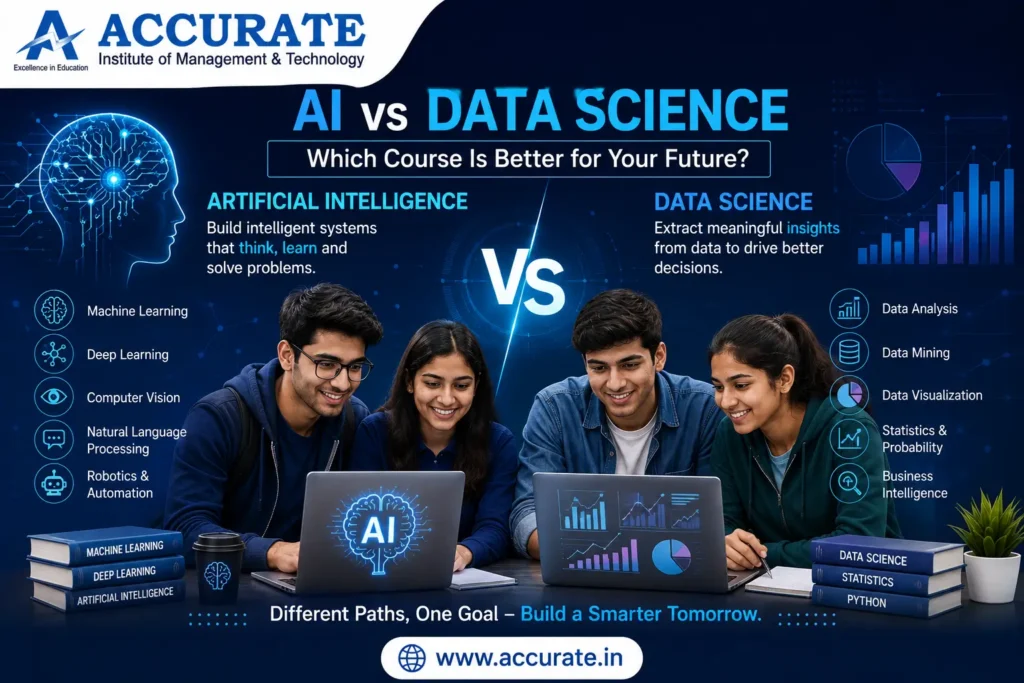
Artificial Intelligence primarily focuses on developing intelligent systems capable of learning, predicting, understanding language, recognising patterns and automating complex tasks. Data Science focuses on collecting, processing, analysing and interpreting data to generate useful insights and support decision-making.
There is also considerable overlap. Machine Learning connects the two fields, while modern AI applications depend heavily on high-quality data. Likewise, Data Scientists increasingly use AI and Machine Learning techniques.
Therefore, choosing between AI and Data Science should not be based solely on which course appears more popular. Students need to consider their interests, strengths, curriculum, career objectives and the type of problems they would enjoy solving.
This detailed guide compares Artificial Intelligence vs Data Science across subjects, skills, career opportunities, future scope and emerging technologies to help students and parents make a more informed choice for 2026 admissions.
Table of Contents
- What Is Artificial Intelligence?
- What Is Data Science?
- AI vs Data Science: Quick Comparison
- What Is the Main Difference Between AI and Data Science?
- Course and Curriculum Differences
- Skills Required for Artificial Intelligence
- Skills Required for Data Science
- Career Opportunities After Artificial Intelligence
- Career Opportunities After Data Science
- Future Scope of Artificial Intelligence
- Future Scope of Data Science
- AI vs Data Science: Role of Machine Learning
- AI vs Data Science: Which Has Better Career Flexibility?
- AI vs Data Science for Generative AI Careers
- Which Course Requires More Mathematics?
- Which Course Requires More Coding?
- AI vs Data Science: Which Is More Difficult?
- How to Choose Between AI and Data Science After 12th
- What Parents Should Consider
- Skills Students Should Build Regardless of Their Course
- Importance of Projects and Practical Learning
- Why Consider Accurate Institute of Management & Technology?
- Frequently Asked Questions
- Conclusion and Admission CTA
What Is Artificial Intelligence?
Artificial Intelligence, commonly called AI, is a broad field of computing concerned with creating systems capable of performing tasks associated with intelligent behaviour.
These systems can be designed to:
- recognise patterns,
- understand language,
- analyse information,
- make predictions,
- generate content,
- identify objects,
- recommend actions, and
- automate certain decisions or processes.
AI is already visible in many everyday technologies, including recommendation systems, digital assistants, intelligent search, navigation applications, automated customer service and Generative AI.
What Does an AI Student Study?
The exact syllabus varies according to the programme and institution, but an AI-focused engineering curriculum may include:
- programming,
- Data Structures and Algorithms,
- mathematics,
- probability,
- statistics,
- databases,
- Artificial Intelligence,
- Machine Learning,
- Deep Learning,
- neural networks,
- Natural Language Processing,
- computer vision,
- data analytics,
- cloud computing, and
- intelligent systems.
AI students should also develop strong Computer Science fundamentals because real AI applications rely on software, databases, APIs, networks and computing infrastructure.
What Is Data Science?
Data Science is an interdisciplinary field focused on extracting useful information and insights from data.
Modern organisations generate enormous quantities of data through websites, applications, transactions, machines, customers and digital operations.
Raw data by itself is often difficult to use.
Data Scientists and other data professionals transform that information into something meaningful.
Their work can involve:
- collecting data,
- cleaning data,
- organising information,
- analysing patterns,
- developing statistical models,
- creating visualisations,
- building predictive models, and
- communicating insights.
What Does a Data Science Student Study?
A Data Science-focused curriculum may include:
- programming,
- statistics,
- probability,
- mathematics,
- SQL,
- databases,
- data analytics,
- Machine Learning,
- data visualisation,
- data mining,
- big data concepts, and
- cloud technologies.
Again, actual subjects depend on the university and programme.
Students should always review the latest syllabus before admission.
AI vs Data Science: Quick Comparison
| Factor | Artificial Intelligence | Data Science |
|---|---|---|
| Primary Goal | Build intelligent systems | Extract insights from data |
| Programming | High importance | High importance |
| Mathematics | Important | Important |
| Statistics | Important | Very important |
| Machine Learning | Core area | Major analytical tool |
| Deep Learning | Often important | Depends on role/course |
| Data Analysis | Important | Core focus |
| Data Visualisation | Useful | Major focus |
| NLP | Important specialisation | May be used for text data |
| Computer Vision | Important specialisation | Less central |
| Generative AI | Major emerging area | Useful and increasingly relevant |
| Databases | Important | Very important |
| Business Analytics | Less central | Often important |
| Automation | Strong focus | Not usually the primary focus |
| Typical Goal | Intelligent applications | Data-driven insights |
This table simplifies the distinction. In real-world technology careers, the two fields often overlap.
What Is the Main Difference Between AI and Data Science?
The easiest way to understand AI vs Data Science is to think about the questions each field attempts to answer.
Artificial Intelligence asks:
How can we make a computer system perform intelligent tasks?
Data Science asks:
What useful information, patterns or predictions can we obtain from data?
For example, imagine an online shopping company.
A Data Scientist might analyse purchasing data to understand customer behaviour and identify trends.
An AI Engineer might develop an intelligent recommendation system that automatically suggests products to customers.
Both professionals may use Machine Learning.
Their objectives, however, can differ.
Course and Curriculum Differences
Students should compare actual curricula rather than making a decision based solely on course titles.
Artificial Intelligence Course Focus
AI-focused programmes may place greater emphasis on:
- Machine Learning,
- Deep Learning,
- neural networks,
- NLP,
- computer vision,
- intelligent systems,
- Generative AI concepts, and
- automation.
Data Science Course Focus
Data Science programmes may emphasise:
- statistics,
- data analytics,
- data preparation,
- SQL,
- databases,
- data mining,
- data visualisation,
- predictive modelling, and
- big data.
Areas of Overlap
The courses may share subjects such as:
- Python,
- mathematics,
- probability,
- statistics,
- databases,
- Machine Learning,
- data structures, and
- cloud computing.
This overlap is why students sometimes find the distinction confusing.
Skills Required for Artificial Intelligence
A successful AI career requires a combination of technical and problem-solving abilities.
Programming
Python is widely used in AI and Machine Learning.
Students should focus on learning programming logic rather than simply memorising syntax.
Mathematics
Important mathematical areas can include:
- linear algebra,
- probability,
- statistics,
- calculus, and
- optimisation.
Machine Learning
Students need to understand how models learn patterns from data and how those models should be evaluated.
Deep Learning
Deep Learning plays an important role in advanced language, image, audio and multimodal applications.
Software Engineering
A Machine Learning model becomes more useful when it can operate inside a real application.
AI students who develop software engineering skills can therefore broaden their career options.
Problem-Solving
AI engineers need to understand the problem before deciding whether AI is an appropriate solution.
Skills Required for Data Science
Data Science requires its own combination of technical and analytical abilities.
Statistics
Statistics is fundamental to understanding patterns, uncertainty and relationships in data.
Python
Python is commonly used for data analysis, Machine Learning and automation.
SQL
A large amount of organisational information is stored in databases.
SQL is therefore highly useful for Data Science careers.
Data Visualisation
Professionals often need to communicate information through charts, dashboards and reports.
Data Cleaning
Real-world datasets are rarely perfect.
Data professionals spend significant effort preparing and validating information before analysis.
Machine Learning
Machine Learning can help Data Scientists create predictive models and identify complex patterns.
Communication
Data insights have limited value if decision-makers cannot understand them.
The ability to explain findings clearly is therefore important.
Career Opportunities After Artificial Intelligence
Students developing strong AI skills can explore several career paths.
AI Engineer
AI Engineers develop intelligent applications and integrate AI capabilities into software systems.
Machine Learning Engineer
Machine Learning Engineers train, evaluate, deploy and maintain systems that learn from data.
Generative AI Engineer
Generative AI Engineers develop applications using large language models and other generative technologies.
NLP Engineer
Natural Language Processing Engineers work on systems involving human language.
Applications can include search, translation, document processing and conversational AI.
Computer Vision Engineer
Computer Vision professionals develop systems that analyse images and video.
MLOps Engineer
MLOps professionals help organisations deploy, monitor and maintain Machine Learning systems.
Robotics Engineer
AI can be combined with sensors, control systems and machines to create intelligent robotics applications.
AI Research Engineer
Students interested in deeper theoretical or experimental work may explore research, often with advanced education.
Career Opportunities After Data Science
Data Science also offers diverse professional pathways.
Data Scientist
Data Scientists analyse complex datasets and develop models to generate insights or predictions.
Data Analyst
Data Analysts explore information and create reports or visualisations that support decision-making.
Data Engineer
Data Engineers build systems that collect, transform and store data.
Machine Learning Engineer
Data Science students who develop strong software and ML skills may potentially move toward Machine Learning Engineering.
Business Intelligence Professional
BI professionals develop reports, dashboards and data systems to help organisations understand performance.
Analytics Professional
Analytics roles can exist across finance, marketing, operations, products and other business functions.
Data Architect
Experienced professionals may eventually work on designing large-scale data architectures.
Future Scope of Artificial Intelligence
The future scope of Artificial Intelligence is connected with a broad set of emerging technologies.
Generative AI
Generative systems can create text, software code, images, audio and other content.
The professional opportunity goes beyond using these tools.
Engineers are needed to integrate AI models into applications, evaluate systems, connect them to data and improve reliability.
AI Agents
Agentic AI systems are designed to perform multi-step tasks using models, software tools and information sources.
This can create engineering challenges around orchestration, reliability, security and evaluation.
Multimodal AI
AI systems increasingly work with combinations of text, images, audio and video.
Potential applications exist across education, healthcare technology, media and software.
Robotics and Autonomous Systems
AI combined with robotics can create intelligent systems capable of interacting with physical environments.
Edge AI
AI models can increasingly operate directly on smartphones, sensors, vehicles and connected devices.
All these developments contribute to the future scope of AI education.
Future Scope of Data Science
The growth of AI does not reduce the importance of Data Science.
AI itself depends on data.
Organisations need professionals capable of understanding:
- where data comes from,
- whether it is reliable,
- how it should be processed,
- what patterns it contains, and
- how conclusions should be communicated.
As businesses continue to digitise operations, the amount of available data can continue to grow.
Data Science can therefore remain important across industries such as:
- technology,
- banking,
- healthcare,
- retail,
- manufacturing,
- telecommunications,
- logistics,
- e-commerce, and
- consulting.
The tools may evolve, but the need to understand data remains fundamental.
AI vs Data Science: Role of Machine Learning
Machine Learning is one of the strongest connections between AI and Data Science.
In AI, Machine Learning can be used to build intelligent systems capable of recognising patterns or making predictions.
In Data Science, Machine Learning can be used as a tool for analysing data and creating predictive models.
This means Machine Learning skills can be valuable in both fields.
Students who understand:
Programming + Mathematics + Statistics + Machine Learning
can develop a strong foundation applicable across both AI and Data Science.
AI vs Data Science: Which Has Better Career Flexibility?
The answer depends on how a student develops their skills.
AI can lead toward:
- Machine Learning,
- Generative AI,
- NLP,
- computer vision,
- robotics,
- intelligent automation, and
- AI-powered software.
Data Science can lead toward:
- analytics,
- Data Science,
- data engineering,
- business intelligence,
- Machine Learning, and
- data-driven product roles.
Neither degree automatically restricts a student to one career.
Students who develop broad Computer Science and software skills can increase their flexibility considerably.
AI vs Data Science for Generative AI Careers
Students interested specifically in Generative AI may find an AI-focused course more directly aligned with their interests.
Generative AI engineering can involve:
- large language models,
- AI APIs,
- prompt and context engineering,
- Retrieval-Augmented Generation,
- vector databases,
- model evaluation,
- AI agents,
- software development, and
- cloud deployment.
However, Data Science remains relevant because generative systems depend on data quality, evaluation and analytics.
This is another example of the two fields complementing rather than replacing one another.
Which Course Requires More Mathematics?
Both AI and Data Science require mathematics.
AI may involve areas such as:
- linear algebra,
- probability,
- statistics,
- calculus, and
- optimisation.
Data Science can place especially strong emphasis on:
- probability,
- statistics,
- linear algebra, and
- quantitative analysis.
Students should not avoid either course simply because mathematics is involved.
Mathematical ability can improve through regular practice.
More importantly, students should be willing to understand why mathematical concepts are used rather than only memorising formulas.
Which Course Requires More Coding?
Both require programming.
AI Engineers often need significant coding ability because intelligent models need to be integrated into applications and deployed as software.
Data Scientists also use programming extensively for data preparation, analysis, visualisation and Machine Learning.
Python is commonly associated with both fields.
Data professionals additionally benefit significantly from SQL.
Students interested in either course should be comfortable with the idea of learning to code.
AI vs Data Science: Which Is More Difficult?
There is no universal answer.
Artificial Intelligence can become challenging because of:
- programming,
- mathematics,
- Machine Learning theory,
- Deep Learning, and
- complex software systems.
Data Science can be challenging because of:
- statistics,
- mathematics,
- data cleaning,
- analytical reasoning,
- databases, and
- interpreting complex datasets.
A student’s interest has a major influence on perceived difficulty.
Someone who enjoys statistical analysis may find Data Science more natural.
A student fascinated by intelligent systems may find AI more engaging.
How to Choose Between AI and Data Science After 12th
Instead of asking which course is universally better, ask which course is better for you.
Choose Artificial Intelligence If You:
- are fascinated by intelligent machines;
- enjoy programming;
- want to understand Machine Learning;
- are interested in Generative AI;
- find robotics interesting;
- want to explore computer vision or NLP;
- enjoy solving technical problems.
Choose Data Science If You:
- enjoy working with numbers;
- like statistics;
- enjoy finding patterns;
- want to analyse large datasets;
- enjoy creating insights from information;
- are interested in analytics;
- like combining technology with decision-making.
What If You Like Both?
That is completely reasonable because AI and Data Science overlap considerably.
In that case, compare the detailed curriculum of the programmes available to you.
Look for a strong combination of Computer Science fundamentals, programming, mathematics, Machine Learning and practical projects.
What Parents Should Consider Before Choosing AI or Data Science
Parents naturally want their children to choose courses with long-term potential.
However, a future-ready course is only part of the equation.
Student Interest Matters
A student who is genuinely curious about a subject is more likely to invest the effort required to master it.
Examine the Actual Curriculum
Do not make the decision based solely on course names.
Compare semester-wise subjects and practical components.
Look for Computer Science Fundamentals
Programming, algorithms, databases and software concepts can give students greater career flexibility.
Consider Practical Exposure
Students should have opportunities to turn theory into projects.
Evaluate Career Preparation
Technical knowledge should ideally be complemented by communication, aptitude, interview preparation and professional development.
Avoid Guaranteed-Job Thinking
Technology careers depend on the student’s skills, market conditions and employer requirements.
The objective should be to develop transferable abilities that remain valuable as individual technologies change.
Skills Students Should Build Regardless of Their Course
Whether you choose AI or Data Science, several skills can strengthen your career preparation.
Data Structures and Algorithms
DSA develops problem-solving ability and is useful for many technical recruitment processes.
Python
Python is relevant across AI, Machine Learning and Data Science.
SQL
SQL is particularly valuable for data-oriented careers but is also useful for software and AI applications.
Git
Version control is an important professional development skill.
Cloud Fundamentals
Modern AI and data applications frequently rely on cloud infrastructure.
Communication
Students need to explain technical work clearly.
Problem-Solving
Technology companies need people who can solve problems—not simply operate tools.
Importance of Projects and Practical Learning
Certificates can demonstrate that a student completed a course.
Projects demonstrate what a student can build.
That distinction is important.
AI project ideas may include:
- recommendation systems,
- image-recognition applications,
- intelligent assistants,
- NLP applications,
- AI-powered search, and
- automation tools.
Data Science project ideas may include:
- sales analysis,
- customer behaviour analysis,
- forecasting,
- interactive dashboards,
- predictive models, and
- data visualisation.
Students should be able to explain their project clearly:
What was the problem?
What data did you use?
Which technology did you choose?
Why did you choose it?
How did you evaluate the result?
This ability can be highly valuable during internships and technical interviews.
Why Consider Accurate Institute of Management & Technology for Your Engineering Journey?
Choosing between Artificial Intelligence and Data Science is important, but choosing the right learning environment also deserves careful consideration.
Accurate Institute of Management & Technology, Greater Noida provides an environment for professional and technology-oriented education in the Delhi NCR region.
Students exploring technology-focused engineering education should use their college years to build a combination of:
- academic knowledge,
- programming ability,
- practical projects,
- problem-solving skills,
- communication,
- industry awareness,
- teamwork, and
- career readiness.
For students interested in AI, Machine Learning, Data Science and other emerging technologies, practical learning is especially important because these fields change rapidly.
The objective should not be to learn only today’s most popular tool.
Students should develop strong fundamentals that allow them to adapt to tomorrow’s technologies.
Prospective students and parents considering Accurate Institute of Management & Technology should review the institute’s latest engineering programmes, curriculum, eligibility criteria, academic resources, infrastructure, admission process and current placement information directly before making a final decision.
Its location in Greater Noida, Delhi NCR can also be a consideration for students looking to pursue professional education within this educational and corporate region.
Frequently Asked Questions About AI vs Data Science
1. AI vs Data Science: Which course is better in 2026?
Neither course is universally better. AI may suit students interested in Machine Learning, intelligent systems, Generative AI, NLP and computer vision. Data Science may suit students interested in statistics, analytics, databases and extracting insights from data. Choose according to your interests and career goals.
2. Which has better future scope: AI or Data Science?
Both have future scope because modern organisations need intelligent technologies as well as reliable data analysis. AI is closely connected with Generative AI, automation and intelligent systems, while Data Science remains important for analytics, predictive modelling and data-driven decision-making.
3. Which is better after 12th: Artificial Intelligence or Data Science?
AI may be a better fit if you enjoy programming, intelligent systems and emerging technologies. Data Science may be a better fit if you enjoy mathematics, statistics and analysing information. Students should compare the actual curriculum before selecting a programme.
4. Can a Data Science student become an AI Engineer?
Potentially, yes. A Data Science student who develops strong programming, Machine Learning, Deep Learning and software engineering skills can explore AI-related careers, subject to individual employer requirements.
5. Can an AI student become a Data Scientist?
Yes, depending on the student’s skills and employer requirements. AI students who build expertise in statistics, SQL, data analysis, visualisation and Machine Learning can potentially pursue Data Science roles.
6. Which requires more coding: AI or Data Science?
Both require coding. AI can involve substantial programming for building and deploying intelligent applications. Data Science uses programming for data processing, analytics, visualisation and Machine Learning. Python is widely useful in both fields.
7. Which requires more mathematics: AI or Data Science?
Both use mathematics. Data Science typically places significant emphasis on probability and statistics, while AI may additionally require deeper understanding of areas such as linear algebra, calculus and optimisation for Machine Learning and Deep Learning.
8. Is Data Science still worth studying because of Artificial Intelligence?
Yes. Artificial Intelligence depends heavily on data. Organisations still need professionals who can collect, clean, analyse, validate and interpret data. AI is changing Data Science workflows, but understanding data remains fundamental.
9. Is AI better than Data Science for Generative AI careers?
AI is generally more directly aligned with Generative AI because it focuses on Machine Learning, intelligent systems, NLP and related technologies. However, Data Science skills remain valuable for data preparation, analysis and evaluation.
10. Where can I study technology-focused engineering in Greater Noida?
Students researching engineering education in Greater Noida can consider Accurate Institute of Management & Technology as part of their college search. Before admission, review current programmes, eligibility, curriculum and admission information directly through www.accurate.in.
Conclusion: AI or Data Science—Which Course Should You Choose?
The comparison of AI vs Data Science: Which course is better? ultimately comes down to what kind of problems you want to solve.
Artificial Intelligence focuses more heavily on building intelligent systems.
Data Science focuses more heavily on understanding and extracting value from data.
AI can be a strong choice for students fascinated by:
- Artificial Intelligence,
- Machine Learning,
- Generative AI,
- NLP,
- computer vision,
- robotics, and
- intelligent automation.
Data Science can be an excellent choice for students interested in:
- statistics,
- analytics,
- data visualisation,
- databases,
- predictive modelling, and
- data-driven decision-making.
Neither field exists independently.
AI needs data, while modern Data Science frequently uses Machine Learning and AI.
For students entering engineering in 2026, perhaps the strongest long-term strategy is therefore not to think only in terms of AI versus Data Science.
Think about building a broader foundation:
Computer Science + Programming + Mathematics + Data + AI/ML + Practical Projects + Communication
Technologies will change during your career. Strong fundamentals will help you change with them.
Start Your Engineering Journey with Accurate Institute of Management & Technology
If you are interested in Artificial Intelligence, Data Science, Machine Learning and the technologies shaping the future, your next step is to explore an engineering programme that aligns with your interests and career goals.
Accurate Institute of Management & Technology, Greater Noida can be considered by students and parents exploring technology-focused engineering education in Delhi NCR.
Before making your admission decision, explore the latest programmes, curriculum and eligibility requirements directly with the institute.
Explore Engineering Admissions at Accurate Institute of Management & Technology
Visit: www.accurate.in
Choose the right course. Develop real-world skills. Build meaningful projects. Prepare for the future of technology.