
Engineering placements can be exciting, competitive and sometimes confusing.
Students often hear statements such as:
“Practise coding.”
“Do DSA.”
“Learn Python.”
“Solve hundreds of questions.”
“Build projects.”
All of these suggestions may contain some value, but they do not answer the most important question clearly:
What coding skills are actually required for engineering placements?
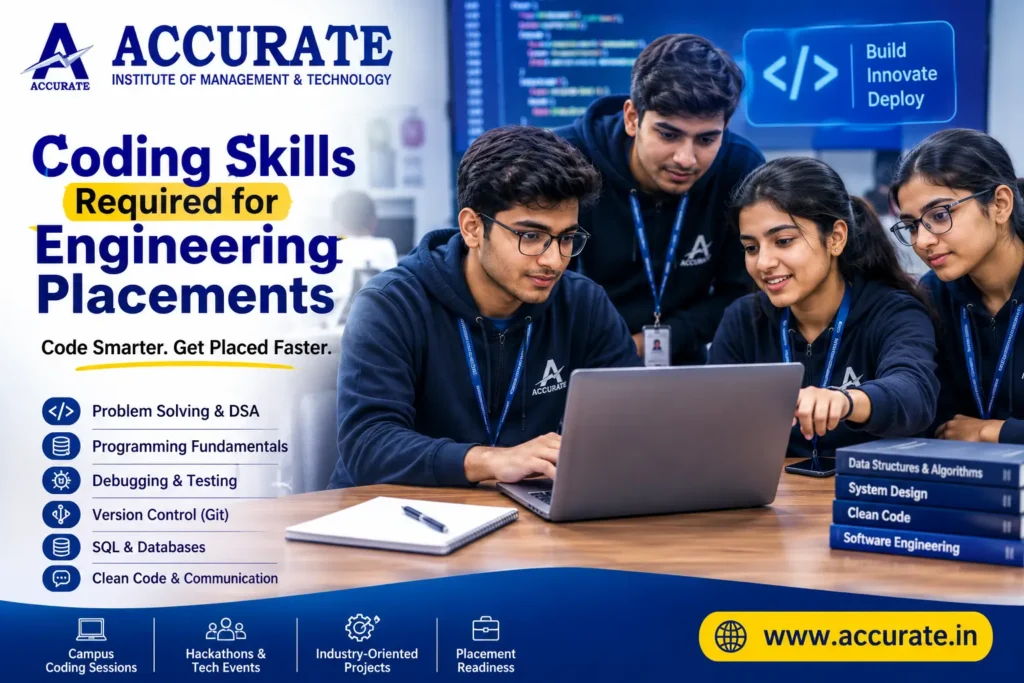
For students preparing for software, IT and technology roles, coding readiness is much broader than memorising syntax or solving a fixed list of programming questions.
Recruiters may test whether you can understand a problem, design a logical solution, select a suitable data structure, write correct code, handle edge cases, debug errors and explain why your approach works.
They may also evaluate whether you understand databases, Object-Oriented Programming, software-development practices and the projects listed on your resume.
Therefore, the most important coding skills required for engineering placements combine programming fundamentals with problem solving, DSA, debugging, technical communication and practical application.
Students at engineering institutions such as Accurate Institute of Management & Technology, Greater Noida can benefit most when coding practice is supported by projects, technical workshops, mock interviews and structured placement preparation.
This guide explains what engineering students should learn, how deeply they should learn it and how to turn coding knowledge into placement readiness.
Table of Contents
- Why Coding Skills Matter in Engineering Placements
- What Recruiters Actually Test in Coding Rounds
- Choose One Programming Language and Learn It Well
- Master Programming Fundamentals
- Build Strong Data Structures and Algorithms Skills
- Develop Logical and Analytical Problem Solving
- Understand Time and Space Complexity
- Learn Object-Oriented Programming
- Strengthen SQL and Database Skills
- Develop Debugging and Error-Finding Skills
- Learn Clean Coding and Code Readability
- Understand Git and Version Control
- Build Practical Projects
- Learn Basic Software Development Concepts
- Practise Coding Under Time Limits
- Prepare for Technical Coding Interviews
- Use AI Tools Without Weakening Fundamentals
- Common Coding Preparation Mistakes
- Coding Skills Roadmap for Engineering Students
- How Accurate Institute Supports Coding and Placement Readiness
- Final Coding Placement Checklist
- Frequently Asked Questions
- Conclusion and Admission CTA
Why Coding Skills Matter in Engineering Placements
Technology roles are based on problem solving.
Even when a job does not require advanced competitive programming every day, recruiters need a practical way to assess whether a graduate can think logically and work with software.
Coding assessments provide that filter.
A coding question can reveal several abilities simultaneously.
Can You Understand the Problem?
Students sometimes begin writing code before they completely understand the question.
Strong candidates first identify:
- Inputs
- Outputs
- Constraints
- Special cases
- Expected behaviour
Can You Convert Logic Into Code?
Knowing the theoretical solution is different from implementing it correctly.
Can You Select an Efficient Approach?
A solution that works for 10 inputs may fail for one million.
Can You Debug?
Real software development involves errors. Recruiters value students who can systematically identify them.
Can You Communicate Your Thinking?
During a technical interview, a correct answer with no explanation may be less impressive than a structured solution explained clearly.
Coding ability is therefore not simply typing speed.
It is structured technical problem solving.
What Recruiters Actually Test in Coding Rounds
Different companies use different recruitment processes.
Some may conduct aptitude and programming MCQs before coding questions.
Others may begin directly with an online programming assessment.
Software-development interviews may have multiple technical rounds.
The difficulty varies, but several abilities appear repeatedly.
Programming Fundamentals
Can you use loops, arrays, functions, strings and common language features correctly?
Data Structures
Do you understand when to use an array, hash map, stack, queue, tree or graph?
Algorithms
Can you search, sort and process data efficiently?
Logical Thinking
Can you break a complicated task into smaller steps?
Complexity Analysis
Can you explain how your solution behaves when input grows?
Testing
Can you identify edge cases?
Communication
Can you explain your solution before or while coding?
Understanding this makes preparation more focused.
1. Choose One Programming Language and Learn It Well
One of the most common questions students ask is:
Which programming language is best for placements?
For most campus coding preparation, students can choose a widely supported language such as:
- C++
- Java
- Python
Other languages may also be accepted depending on the platform and role.
The important point is not to collect languages.
It is to become confident in one primary language.
Why One Strong Language Is Better Than Five Weak Ones
A resume that says:
“C, C++, Java, Python, JavaScript”
looks impressive only until the interviewer asks detailed questions.
If you cannot explain memory handling, classes, functions or common library structures in the language you claim to know, the long list can work against you.
Choose one primary language for DSA and coding interviews.
Then learn additional technologies for projects and career interests.
What Should You Know in Your Primary Language?
Be comfortable with:
- Data types
- Variables
- Operators
- Conditional statements
- Loops
- Functions
- Arrays
- Strings
- Collections or standard containers
- Classes and objects
- Exception handling
- Input and output
- Basic memory concepts relevant to the language
You should be able to write code without constantly searching for basic syntax.
2. Master Programming Fundamentals
Advanced coding rests on basic programming.
Students sometimes rush into graphs or dynamic programming while still making mistakes in loops and arrays.
That creates unnecessary difficulty.
Variables and Data Types
Understand how different kinds of information are stored.
Know the difference between integers, floating-point values, characters, strings and Boolean values.
Conditional Logic
Become comfortable with if, else and related logical expressions.
Loops
Understand when to use iterative constructs and how to avoid infinite loops.
Functions
Functions help divide large problems into reusable pieces.
Students should understand:
- Parameters
- Return values
- Scope
- Recursion
- Reusability
Arrays and Strings
Arrays and strings appear frequently in placement coding assessments.
Students should confidently perform:
- Traversal
- Searching
- Counting
- Reversal
- Comparison
- Modification
Strong basics reduce mistakes when questions become more complicated.
3. Build Strong Data Structures and Algorithms Skills
Data Structures and Algorithms, commonly called DSA, are among the most important coding skills for software-oriented engineering placements.
DSA teaches students to choose suitable ways to organise information and process it efficiently.
Important DSA Topics for Placements
Arrays
Arrays are foundational.
Practise:
- Traversal
- Frequency counting
- Prefix sums
- Two-pointer methods
- Sliding-window patterns
- Searching
- Sorting
Strings
Work on:
- Character counting
- Palindromes
- Substrings
- Pattern comparison
- Anagrams
- String transformation
Linked Lists
Understand:
- Traversal
- Insertion
- Deletion
- Reversal
- Fast and slow pointer techniques
Stacks
Stacks are useful for:
- Expression processing
- Bracket matching
- Next-greater-element style questions
- Undo-like operations
Queues
Learn:
- Basic queue operations
- Circular queues
- Breadth-first processing
Hashing
Hash maps and hash sets are extremely useful.
They can reduce expensive repeated searches and simplify:
- Frequency counting
- Duplicate detection
- Pair finding
- Fast lookups
Trees
Important topics include:
- Binary trees
- Binary search trees
- Tree traversal
- Height and depth
- Recursive processing
Graphs
Students targeting stronger software-development roles should understand:
- Graph representation
- Breadth-first search
- Depth-first search
- Connected components
- Basic shortest-path ideas
Recursion and Backtracking
Learn how recursive calls solve smaller versions of a problem.
Common applications include:
- Subsets
- Permutations
- Search problems
- Combinations
Dynamic Programming
Do not start by memorising complicated DP formulas.
Understand how repeated subproblems can be stored and reused.
Begin with simpler patterns before progressing to advanced problems.
4. Develop Logical and Analytical Problem Solving
Coding interviews are ultimately problem-solving interviews.
A student who has memorised 500 solutions may struggle when the interviewer changes one condition.
A student who understands problem-solving patterns can adapt.
Use a Structured Process
When you receive a coding question:
Understand
Read the question carefully.
Clarify
Identify unclear assumptions.
Work Through an Example
Manually solve a small input.
Find a Simple Solution
Start with the straightforward approach.
Analyse It
Ask whether it is efficient enough.
Improve It
Use a better algorithm or data structure where needed.
Implement
Write clean code.
Test
Try normal and unusual cases.
This process is often more important than immediately producing an optimised solution.
5. Understand Time and Space Complexity
Students preparing for engineering placements should understand how solution efficiency is described.
That usually means learning Big O notation.
Why Complexity Matters
Suppose one solution checks every pair of elements.
Another processes the array once.
Both may work for 20 values.
For one million values, the difference can become enormous.
Common Complexity Levels
Students should recognise patterns such as:
- O(1)
- O(log n)
- O(n)
- O(n log n)
- O(n²)
You do not need mathematical sophistication for every problem.
But you should be able to explain approximately how runtime or memory usage grows with input size.
Analyse Space Too
A faster solution may require additional memory.
Interviewers may ask:
“Can you reduce the extra space?”
Understanding trade-offs demonstrates stronger engineering judgement.
6. Learn Object-Oriented Programming
Object-Oriented Programming is another important area for technical placements.
Students using Java, C++ and related languages should understand OOP clearly.
Classes and Objects
A class describes a structure or behaviour.
An object is an instance of that class.
Encapsulation
Encapsulation combines data and related behaviour while controlling direct access.
Abstraction
Abstraction focuses on essential behaviour while hiding unnecessary internal details.
Inheritance
Inheritance allows one class to derive behaviour from another.
Polymorphism
Polymorphism allows related objects or methods to behave differently through a common structure.
Overloading vs Overriding
This is a common interview topic.
Students should explain the distinction with simple examples rather than memorised textbook definitions.
7. Strengthen SQL and Database Skills
Coding placements are not always limited to algorithms.
For software, backend, analytics and application-development roles, SQL can be highly valuable.
SQL Topics Engineering Students Should Know
Practise:
- SELECT
- WHERE
- ORDER BY
- GROUP BY
- Aggregate functions
- JOINs
- Subqueries
- INSERT
- UPDATE
- DELETE
Understand Database Concepts
Learn:
- Primary keys
- Foreign keys
- Relationships
- Normalisation
- Transactions
- Indexes
- ACID properties
Write Queries Yourself
Reading solved SQL examples is not enough.
Create sample databases and write queries manually.
Interviewers may provide several tables and ask you to retrieve specific information.
Practical SQL experience makes such questions much easier.
8. Develop Debugging Skills
One of the most underrated coding skills required for engineering placements is debugging.
Professional developers spend significant time understanding why software does not behave as expected.
Common Coding Errors
Students should become comfortable identifying:
- Syntax errors
- Logical errors
- Runtime errors
- Index mistakes
- Null or missing values
- Infinite loops
- Incorrect conditions
Develop a Debugging Process
When code fails:
- Reproduce the error.
- Identify where behaviour changes.
- Check assumptions.
- Inspect relevant variables.
- Isolate the failing section.
- Fix one cause at a time.
- Test again.
Randomly changing code until it works is not good debugging.
Systematic debugging demonstrates engineering maturity.
9. Handle Edge Cases
A solution that passes the example input can still fail during a coding assessment.
Recruiters and online judges often test edge cases.
Common Edge Cases
Consider:
- Empty input
- Single-element input
- Duplicate values
- Negative values
- Already sorted data
- Very large input
- Minimum or maximum allowed values
- Missing records
Before submitting a solution, ask:
What input would break this code?
That question can improve your success rate significantly.
10. Learn Clean Coding and Code Readability
Placement coding is primarily about correctness and efficiency, but readability matters too—especially in interviews.
Use Meaningful Names
left, right, count and frequency communicate more than random single letters when the code becomes complex.
Break Large Logic Into Functions
Functions make code easier to test and explain.
Avoid Unnecessary Complexity
Do not use an advanced technique simply to impress an interviewer.
The simplest correct and efficient solution is usually preferable.
Explain Important Decisions
During an interview, communicate why you selected a particular approach.
This shows that the solution was intentional.
11. Learn Git and Version Control
Git may not appear in every campus coding assessment, but it is valuable for engineering students preparing for real software-development roles.
Version control allows developers to:
- Track code changes
- Work with teams
- Restore previous versions
- Review changes
- Manage project development
Basic Git Concepts
Students should understand:
- Repository
- Commit
- Branch
- Merge
- Clone
- Pull
- Push
Using Git in college projects helps students develop professional habits early.
12. Build Practical Coding Projects
Coding becomes meaningful when it is used to build something.
Projects help connect programming with:
- Databases
- APIs
- User interfaces
- Authentication
- Cloud platforms
- Testing
- Deployment
Good Project Areas
Engineering students can explore:
Web Development
Build applications such as event-management platforms, student portals or inventory systems.
Artificial Intelligence
Create prediction, classification or recommendation prototypes.
Data Analytics
Build dashboards that transform datasets into useful insights.
Cloud Computing
Deploy applications or create cloud-connected systems.
Cybersecurity
Develop defensive security tools using authorised or simulated environments.
Internet of Things
Connect software with sensors or real-world data.
Projects Improve Interview Answers
Recruiters may ask:
- What did you build?
- What was your contribution?
- Why did you choose the technology?
- What problem did you encounter?
- How did you debug it?
- How is data stored?
- How did you test the application?
Students who actually built their projects can answer naturally.
13. Understand APIs and Basic Application Development
Students targeting software-development roles can benefit from understanding how modern applications communicate.
An API allows software components to exchange information.
You should understand concepts such as:
- Request
- Response
- Endpoint
- JSON
- HTTP methods
- Status codes
You do not need to become an expert backend engineer before placements.
But practical application-development knowledge can help you understand how real software systems are structured.
14. Develop Testing Skills
Testing should not begin after coding is finished.
Students should develop the habit of testing as they build.
Unit-Level Thinking
Does this function behave correctly?
Integration Thinking
Do multiple components work together?
Negative Testing
What happens if the input is invalid?
Boundary Testing
What happens at the minimum or maximum value?
Coding platforms perform automatic testing.
Developing testing habits helps students anticipate hidden test cases.
15. Practise Coding Under Time Limits
Solving a problem in 45 minutes at home is different from solving it during an assessment while a timer is running.
Students should gradually introduce timed coding practice.
Why Timed Practice Helps
It develops:
- Speed
- Accuracy
- Question selection
- Stress management
- Submission discipline
Do Not Rush Too Early
During the learning phase, focus on understanding.
Once you are comfortable with common patterns, begin timed assessments.
A productive sequence is:
Learn → practise → review → repeat → time yourself.
16. Prepare for Coding Interviews, Not Only Coding Tests
Online tests usually evaluate the output.
Technical interviews evaluate the process.
During an interview, the recruiter may ask you to explain your reasoning while solving.
A Strong Interview Approach
Restate the Problem
Show that you understand it.
Clarify Constraints
Ask relevant questions.
Explain the Brute-Force Method
Demonstrate that you understand the baseline solution.
Improve the Approach
Discuss a better data structure or algorithm.
Write the Code
Keep it organised.
Test Manually
Use a sample case.
Explain Complexity
State approximate time and space complexity.
Even if you make a small error, structured thinking can leave a better impression than silently writing code.
17. Coding Skills for Different Engineering Placement Roles
Not every role requires exactly the same preparation.
Software Developer
Prioritise:
- DSA
- OOP
- Programming
- Databases
- Git
- Projects
Backend Developer
Focus additionally on:
- SQL
- APIs
- Databases
- Authentication
- Server-side programming
Data Analyst
Emphasise:
- SQL
- Python
- Data manipulation
- Analytical problem solving
AI or Machine Learning Roles
Strengthen:
- Python
- Data structures
- Mathematics foundations
- Data preprocessing
- ML concepts
- Model evaluation
Cloud or DevOps-Oriented Roles
Develop awareness of:
- Linux
- Networking
- Git
- Scripting
- Cloud fundamentals
Cybersecurity Roles
Combine programming with:
- Networking
- Operating systems
- Secure coding
- Linux
- Security fundamentals
Job descriptions differ, so students should always adapt preparation to the target role.
18. Use AI Tools Without Weakening Coding Skills
Modern AI tools can help programmers write, understand and debug code.
Engineering students should learn to use them responsibly.
AI can help with:
- Explaining errors
- Generating test cases
- Understanding unfamiliar syntax
- Comparing approaches
- Reviewing documentation
- Brainstorming project structures
However, excessive dependence can weaken independent problem solving.
A Simple Rule
Try first. Use AI second. Understand everything before keeping it.
If AI generates a function, ask:
- Why does this work?
- What is its complexity?
- What assumptions does it make?
- What edge cases fail?
- Can I rewrite it myself?
During placement interviews, the candidate—not the AI tool—must explain the solution.
19. Common Coding Preparation Mistakes
Learning Too Many Languages
Pick one primary language first.
Memorising DSA Solutions
Learn patterns and reasoning.
Solving Only Easy Questions
Gradually increase difficulty.
Ignoring Fundamentals
Advanced topics cannot compensate for weak basics.
Never Reviewing Mistakes
Wrong solutions are valuable learning material.
Watching More Than Practising
Coding is a practical skill.
Copying Projects
Interviewers can quickly detect shallow project knowledge.
Ignoring SQL
Database questions appear in many software roles.
Ignoring Communication
Technical interviews require explanation.
Starting During Final Year
Coding ability develops through repetition.
Begin earlier whenever possible.
20. A Coding Skills Roadmap for Engineering Students
First Year: Programming Foundation
Focus on:
- One programming language
- Loops
- Functions
- Arrays
- Strings
- Basic OOP
- Small coding exercises
Create simple projects to make programming enjoyable.
Second Year: DSA and Core Development
Study:
- Linked lists
- Stacks
- Queues
- Hashing
- Trees
- Searching
- Sorting
- Complexity
Begin using Git.
Build database-backed projects.
Third Year: Placement-Oriented Coding
Increase focus on:
- DSA patterns
- Timed assessments
- SQL
- OOP
- Projects
- Technical subjects
- Internships
Start mock technical interviews.
Final Year: Company-Specific Preparation
Analyse each recruitment opportunity.
Revise:
- Relevant DSA
- Core subjects
- Coding patterns
- Projects
- SQL
- Job-specific skills
Take full mock assessments under realistic conditions.
21. Sample Weekly Coding Practice Plan
Consistency matters more than occasional intense study.
Monday
Arrays and strings + one revision problem
Tuesday
Linked lists or stacks + SQL practice
Wednesday
Project coding + debugging
Thursday
Trees or graphs + OOP revision
Friday
Mixed DSA problems
Saturday
Timed coding assessment
Sunday
Analyse mistakes + revise weak topics + project work
Students should adapt this schedule around classes and examinations.
The important habit is regular practice.
How Accurate Institute of Management & Technology Supports Coding and Placement Readiness
Students preparing for technology careers benefit when coding practice is integrated with practical learning and placement development.
Accurate Institute of Management & Technology, Greater Noida emphasises technical foundations, practical exposure and career readiness within its engineering environment.
Its published placement-development approach includes activities such as coding practice, aptitude preparation, mock interviews, communication development and technical workshops. The institute’s broader engineering approach also highlights projects, coding sessions, laboratories, hackathons and industry-oriented activities.
For engineering students, this combination is useful because placements test more than syntax.
A student may need to:
- Clear a coding assessment
- Solve DSA problems
- Explain project code
- Answer technical questions
- Communicate an approach
- Perform under time pressure
Coding practice can therefore become stronger when students also gain experience through projects and mock recruitment scenarios.
Coding Through Practical Application
A student who learns an algorithm in class can strengthen that knowledge through regular programming exercises.
Later, the same programming skills can be used in projects involving databases, applications, cloud technologies, data analytics, AI or connected systems.
This progression helps move learning from:
“I know the syntax.”
to:
“I can solve a problem.”
and finally to:
“I can build and explain a working solution.”
Technical Activities and Peer Learning
Coding sessions, hackathons and technical activities can provide opportunities to practise problem solving in collaborative environments.
These activities may help students develop:
- Programming confidence
- Teamwork
- Debugging
- Presentation
- Time management
- Technical communication
Students should use such opportunities consistently rather than waiting until placement season.
Coding Practice and Mock Interviews
Mock interviews can reveal whether a student can explain a solution clearly.
A student may be able to solve a question alone but struggle when asked:
“Why did you use a hash map?”
“What is the complexity?”
“What happens if the array is empty?”
“Can you reduce the memory usage?”
Interview-style practice prepares students for this type of discussion.
Available Accurate material describes its training and placement framework as including coding and aptitude practice, communication development, mock interviews, technical workshops, industry interaction and pre-placement support.
Final Coding Skills Checklist for Engineering Placements
Before placement season, ask yourself:
Programming Language: Can I confidently code in one language?
Syntax: Can I write basic programs without constant searching?
Arrays and Strings: Am I comfortable solving common problems?
Linked Lists: Can I implement and manipulate them?
Stacks and Queues: Do I understand their applications?
Hashing: Can I use hash maps and sets effectively?
Trees: Can I perform basic traversals?
Graphs: Do I understand BFS and DFS?
Algorithms: Can I search and sort efficiently?
Complexity: Can I explain time and space complexity?
OOP: Can I explain encapsulation, inheritance, abstraction and polymorphism?
SQL: Can I write joins and common queries?
Debugging: Can I systematically find errors?
Testing: Do I think about edge cases?
Git: Can I manage a basic project repository?
Projects: Can I explain the code I have built?
Coding Tests: Have I practised under time limits?
Technical Interviews: Can I explain my solution aloud?
AI Use: Can I code independently without relying completely on AI?
If several answers are “no,” treat them as a roadmap rather than a source of stress.
Work through them systematically.
Frequently Asked Questions About Coding Skills Required for Engineering Placements
1. What coding skills are required for engineering placements?
Engineering students should develop proficiency in one programming language, Data Structures and Algorithms, logical problem solving, Object-Oriented Programming, SQL, debugging, testing and basic Git. They should also understand time and space complexity and be able to explain coding solutions clearly during technical interviews.
2. Which programming language is best for engineering placements?
C++, Java and Python are commonly useful for placement coding preparation. The best choice is the language in which you can confidently implement DSA problems, write clean code and explain programming concepts. Strong knowledge of one language is usually more useful than superficial knowledge of many languages.
3. Is DSA compulsory for engineering placements?
DSA is very important for many software-development and technology placements because coding assessments frequently test problem solving using arrays, strings, linked lists, stacks, queues, hashing, trees and algorithms. The difficulty level depends on the company and role, so students should study the recruitment pattern of each employer.
4. How much coding should I practise for placements?
There is no fixed number of questions that guarantees placement success. Students should practise regularly until they can recognise common patterns, solve unfamiliar problems independently, analyse complexity and debug mistakes. Consistent practice and revision are more useful than chasing a large problem count.
5. Is Python enough for engineering placements?
Python can be sufficient for many coding assessments when the platform and employer support it. However, knowing Python syntax alone is not enough. Students still need DSA, problem-solving ability, OOP awareness, databases and technical fundamentals. Language choice matters less than the ability to solve problems correctly.
6. Is SQL important for engineering placements?
Yes. SQL is particularly useful for software-development, backend, data and analytics roles. Engineering students should understand SELECT queries, filtering, GROUP BY, aggregate functions, joins, subqueries and basic database concepts such as keys, normalisation and transactions.
7. Do engineering students need competitive programming for placements?
Competitive programming can improve speed and algorithmic thinking, but it is not compulsory for every placement. Students should first master common DSA topics and interview-style problems. Those targeting companies with difficult coding rounds may benefit from deeper competitive-programming practice.
8. How can I improve my coding speed before campus placements?
Improve coding speed by practising consistently, becoming fluent in one programming language, learning common problem-solving patterns and taking timed assessments. Do not sacrifice correctness for speed. Review each timed test afterward to identify whether delays came from understanding, algorithm selection, implementation or debugging.
9. How does Accurate Institute help students with coding preparation?
Accurate Institute of Management & Technology’s published placement approach includes coding practice alongside aptitude preparation, mock interviews, communication development and technical workshops. Its engineering environment also emphasises practical learning, projects and technical activities that can help students apply programming skills beyond isolated exercises.
10. When should engineering students start coding preparation for placements?
Students should ideally begin programming during the first year, develop DSA knowledge during the second year and become more placement-focused by the third year. Final-year preparation should concentrate on revision, timed assessments, mock interviews and company-specific coding patterns rather than learning all fundamentals from the beginning.
Conclusion: Build Coding Ability That Survives the Interview
The most important coding skills required for engineering placements are not defined by the number of programming languages on your resume or the number of coding questions shown on your profile.
Placement-ready coding means being able to think.
You should be able to understand a problem, break it down, design a solution, choose appropriate data structures, write correct code and test it carefully.
You should understand why your approach works.
You should recognise when it is inefficient.
You should be able to debug your mistakes.
And during an interview, you should be able to explain all of this clearly.
Begin with one programming language.
Strengthen your fundamentals.
Develop DSA systematically.
Learn complexity.
Practise OOP and SQL.
Use Git.
Build projects.
Take timed assessments.
Participate in mock interviews.
Review your mistakes rather than hiding them.
And use modern AI coding tools to accelerate learning without allowing them to replace your independent reasoning.
For engineering students, coding is not simply a placement subject.
It is a practical skill that can influence internships, projects, technical interviews and long-term technology careers.
Build Your Engineering and Coding Future at Accurate Institute
Students planning to pursue B.Tech Computer Science and Engineering in Greater Noida should choose a learning environment that supports both academic foundations and practical technical development.
At Accurate Institute of Management & Technology, the engineering learning environment combines practical exposure with projects, coding-oriented activities, technical workshops and placement-development support.
Students can use these opportunities to strengthen programming fundamentals, develop problem-solving confidence, build technical projects and prepare for the demands of coding assessments and interviews.
Explore the B.Tech CSE programmes at Accurate Institute of Management & Technology, Greater Noida and review the current curriculum, laboratories, specialisations, technical activities, placement preparation and admission requirements.
Speak with the admission team to confirm the latest eligibility criteria, fees, scholarships, available seats and application process.
A successful technology career begins long before the first placement interview. Choose an engineering environment that encourages you to code, build, practise and improve. Explore B.Tech CSE admission at Accurate Institute of Management & Technology and start developing the skills needed for tomorrow’s technology careers.