
Computer Science and Engineering students today face a very different technology environment from the one that existed only a few years ago.
Software development increasingly interacts with artificial intelligence. Cloud computing supports applications of almost every scale. Cybersecurity has become a core business concern. Data skills are useful across industries. DevOps connects software development with infrastructure, while networking and Linux remain important foundations for many technical careers.
Because the technology landscape is so broad, students often ask:
Which are the top certifications for CSE students?
A useful certification can help a student structure learning around an industry-recognised technology area. It may validate foundational knowledge, provide a study roadmap and give students something concrete to discuss during internships and placement interviews.
However, certifications should be used correctly.
A certificate cannot replace programming ability.
It cannot replace Data Structures and Algorithms.
It cannot replace practical projects.
It cannot compensate for weak communication or an inability to explain technical concepts.
The most effective approach is to use certifications as one layer of a broader CSE skill-development strategy.
Students studying at institutions such as Accurate Institute of Management & Technology, Greater Noida, can gain more value from certifications when they combine them with coding practice, projects, workshops, technical events, internships and placement preparation.
This guide explains the most useful certification categories for Computer Science students, who should consider each option and how to select certifications according to career goals.
Table of Contents
- Why Certifications Matter for CSE Students
- Do Certifications Guarantee Placements?
- How to Choose the Right Certification
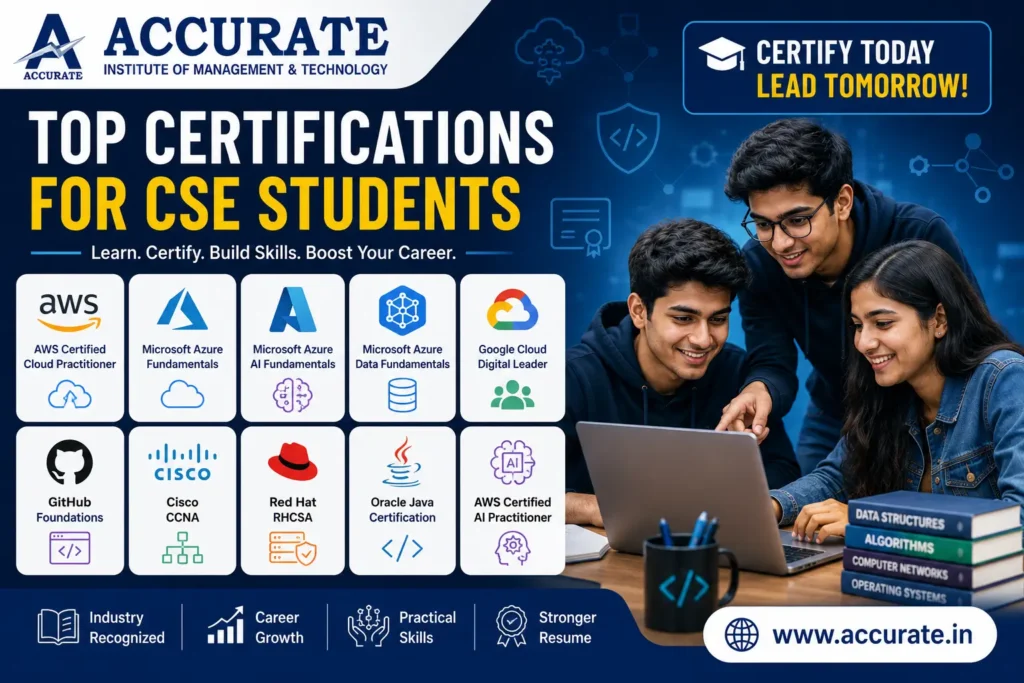
- AWS Certified Cloud Practitioner
- Microsoft Azure Fundamentals
- Microsoft Azure AI Fundamentals
- Microsoft Azure Data Fundamentals
- Google Cloud Digital Leader
- GitHub Foundations Certification
- Cisco CCNA
- Red Hat Certified System Administrator
- Oracle Java Certification
- AWS AI Practitioner
- Which Certification Is Best for Different CSE Careers?
- Certifications vs Projects: What Matters More?
- How to Prepare for a Certification Exam
- When Should CSE Students Start Certifications?
- Common Certification Mistakes
- How Accurate Institute Supports Career-Oriented Skill Development
- Final Certification Roadmap
- Frequently Asked Questions
- Conclusion and Admission CTA
Why Certifications Matter for CSE Students
A B.Tech CSE programme develops the academic foundation of Computer Science.
Students study areas such as:
- Programming
- Data Structures
- Algorithms
- Databases
- Operating Systems
- Computer Networks
- Software Engineering
- Artificial Intelligence
- Cloud-related concepts
- Cybersecurity
Certifications usually serve a different purpose.
They are often focused on a particular technology platform, professional skill set or vendor ecosystem.
For example, a university course may teach general cloud-computing concepts.
An AWS certification focuses specifically on Amazon Web Services.
A networking course teaches routing and communication principles.
Cisco CCNA provides a structured path around practical networking concepts associated with Cisco technologies.
A Linux course develops operating-system knowledge.
Red Hat certification validates administration skills in an enterprise Linux environment.
Certifications Can Provide Direction
One difficulty many CSE students face is knowing what to learn next.
A certification syllabus can provide a clear learning sequence.
Instead of randomly watching tutorials about cloud computing, a student can follow an official exam blueprint and identify specific areas to study.
Certifications Can Help Students Explore Careers
A beginner certification can also act as a career-exploration tool.
A student who completes introductory cloud learning may discover an interest in:
- Cloud engineering
- DevOps
- Solutions architecture
- Infrastructure
- Security
A networking certification may reveal an interest in network engineering or security.
A data certification may lead toward analytics or data engineering.
Certifications Can Add Structure to a Resume
Certifications can strengthen a resume when they support genuine skills.
However, the resume becomes much stronger when the credential is connected to practical work.
Instead of writing only:
AWS Certified Cloud Practitioner
a student could also discuss a small cloud project demonstrating what they learned.
That creates evidence rather than simply listing credentials.
Do Certifications Guarantee Placements?
No.
This is one of the most important facts students should understand.
There is no certification that automatically guarantees a job.
Recruiters may evaluate:
- Programming
- DSA
- Aptitude
- Core CSE knowledge
- Projects
- Internships
- Communication
- Technical interviews
- Role-specific skills
A certification can strengthen preparation, but it is usually one part of a larger employability profile.
The strongest combination is:
Academic fundamentals + practical skills + projects + certification + communication + interview preparation.
Students should therefore avoid collecting certificates without developing the skills behind them.
How to Choose the Right Certification
Before registering for an exam, answer three questions.
What Career Am I Exploring?
Your certification should align with a possible career direction.
If you want cloud computing, consider a cloud credential.
If you are interested in networking, CCNA may be more useful.
If Linux and DevOps interest you, RHCSA may make sense.
If you want software development, Java or GitHub-focused credentials may complement your programming projects.
What Is My Current Skill Level?
Do not select an advanced certification only because its title looks impressive.
Foundational certifications are often more suitable for first-time learners.
Can I Apply What I Learn?
Ask whether you can build a project, lab or portfolio example using the certification knowledge.
Application makes the learning more durable.
1. AWS Certified Cloud Practitioner
AWS Certified Cloud Practitioner is one of the most accessible cloud certifications for students beginning their cloud journey.
AWS describes it as a foundational certification that validates high-level understanding of AWS Cloud services, terminology and cloud concepts. It does not require prior cloud experience, making it a reasonable entry point for CSE students who are new to cloud computing.
What Students Learn
The current exam covers broad areas such as:
- Cloud concepts
- Security and compliance
- AWS technologies and services
- Billing and pricing
Students gain awareness of areas including:
- Compute
- Storage
- Networking
- Databases
- Security
- Shared responsibility
- Cloud economics
Who Should Consider It?
It can suit:
- First- or second-year CSE students exploring cloud
- Students interested in DevOps
- Software developers who want cloud awareness
- Students planning future AWS associate certifications
How to Make It More Valuable
Do not stop at exam preparation.
Create a basic application and explore how cloud storage, compute or databases could support it.
This turns certification knowledge into practical understanding.
2. Microsoft Certified: Azure Fundamentals
Microsoft Azure Fundamentals, associated with exam AZ-900, is another beginner-friendly certification for cloud learners.
Microsoft describes it as a foundational credential covering cloud concepts, Azure architecture, services, management and governance. The certification is positioned as a common starting point for people beginning a journey toward Azure careers.
Skills Covered
Students learn about concepts such as:
- Cloud computing
- Azure architecture
- Compute
- Networking
- Storage
- Security
- Governance
Who Should Consider Azure Fundamentals?
It can suit students interested in:
- Cloud computing
- Microsoft technology ecosystems
- Infrastructure
- Cloud administration
- Application development
AWS or Azure: Which Should Students Choose?
You do not need both immediately.
Choose one cloud platform first.
Learn its fundamental services.
Build something.
Then explore another platform later if your career path requires it.
The underlying cloud concepts will often transfer.
3. Microsoft Azure AI Fundamentals – AI-901
Artificial Intelligence is now relevant to many Computer Science career paths.
Microsoft’s Azure AI Fundamentals certification now uses AI-901. The previous AI-900 exam retired on June 30, 2026.
The current AI-901 exam is aimed at people beginning their journey in AI solution development. Microsoft states that candidates should have conceptual knowledge of AI solutions on Azure, along with foundational technical skills, including familiarity with Python syntax and Azure resources.
Areas Covered
The credential covers concepts related to:
- Artificial Intelligence workloads
- Machine learning
- Computer vision
- Natural Language Processing
- Generative AI
- Azure AI services
Who Should Consider AI-901?
It can be relevant to students interested in:
- Artificial Intelligence
- Machine Learning
- Generative AI
- Intelligent applications
- AI engineering
Important Advice
AI certifications should not replace mathematics, Python, data handling or practical ML projects.
A student who can explain model evaluation, data quality and AI limitations will be more convincing than someone who knows only cloud-service names.
4. Microsoft Azure Data Fundamentals
Data is central to software, analytics, AI and business systems.
Microsoft Certified: Azure Data Fundamentals is a beginner credential designed for candidates beginning to work with data in cloud environments.
Microsoft states that it covers core data concepts and Azure data services, including relational and non-relational data and different kinds of data workloads. The certification was updated in July 2026.
Useful Areas of Learning
Students can strengthen understanding of:
- Relational data
- Non-relational data
- Data workloads
- Analytics concepts
- Cloud data services
Who Should Consider It?
This certification can suit students interested in:
- Data Engineering
- Data Analytics
- Databases
- Business Intelligence
- Machine Learning
Combine It With SQL
Students should practise SQL alongside certification preparation.
A certificate in data fundamentals is far more valuable when the student can actually write joins, aggregate queries and database operations.
5. Google Cloud Digital Leader
Students who want exposure to Google Cloud can consider Cloud Digital Leader.
Google describes it as a foundational certification demonstrating knowledge of cloud-computing basics and how Google Cloud products and services support organisational goals. It currently has no formal prerequisites.
Areas Covered
The current curriculum includes themes such as:
- Cloud transformation
- Data
- Artificial Intelligence
- Infrastructure modernisation
- Security
- Cloud operations
Who Should Consider It?
It can suit students who:
- Want an introduction to Google Cloud
- Are exploring cloud careers
- Want broader cloud literacy
- Plan to move later toward technical Google Cloud certifications
Do Not Collect All Three Cloud Fundamentals Immediately
Students sometimes try to complete AWS, Azure and Google Cloud credentials back-to-back.
That may produce three certificates but limited practical depth.
A better strategy may be:
Learn one cloud platform → build a project → understand cloud architecture → then compare another platform.
6. GitHub Foundations Certification
Modern software teams rely heavily on version control and collaboration.
Students who code regularly can benefit from learning Git and GitHub properly rather than using GitHub only as online file storage.
The GitHub Foundations Certification covers entry-level knowledge of repositories, commits, collaboration, Git basics and working within GitHub repositories. GitHub also provides certification preparation resources for students.
Skills Students Can Develop
- Repositories
- Commits
- Branching
- Collaboration
- Markdown
- Git fundamentals
- Repository workflows
- Project management basics
Why GitHub Matters for CSE Students
GitHub can support:
- Coding portfolios
- Group projects
- Open-source participation
- Internship applications
- Technical interviews
Best Way to Prepare
Use GitHub actively.
Create repositories for genuine projects.
Work with branches.
Write clear README files.
Track changes through meaningful commits.
Certification should validate experience rather than replace it.
7. Cisco Certified Network Associate – CCNA
Students interested in networking, infrastructure or cybersecurity should consider the Cisco Certified Network Associate, commonly known as CCNA.
The current 200-301 CCNA exam covers network fundamentals, network access, IP connectivity, IP services, security fundamentals and automation and programmability.
Why Networking Knowledge Matters
Even software developers benefit from understanding how applications communicate.
Networking becomes even more important for students targeting:
- Network engineering
- Cloud infrastructure
- Cybersecurity
- DevOps
- Systems administration
Skills Covered
Students encounter topics related to:
- IPv4 and IPv6
- Routers
- Switches
- Network access
- IP connectivity
- Security
- Automation
Is CCNA Difficult for Beginners?
It usually requires more technical depth than a basic cloud-fundamentals exam.
Students should study networking concepts carefully and practise configurations rather than depending only on theory.
8. Red Hat Certified System Administrator – RHCSA
Linux knowledge is extremely valuable for cloud computing, DevOps, cybersecurity and backend infrastructure.
The Red Hat Certified System Administrator certification validates practical system-administration skills in Red Hat Enterprise Linux environments.
Red Hat’s current RHCSA exam is performance-based and covers tasks such as command-line work, system operation, storage, file systems, users, security and basic container management.
Why RHCSA Stands Out
Unlike purely multiple-choice credentials, RHCSA emphasises practical administration tasks.
Students learn skills such as:
- Linux commands
- Shell scripts
- User management
- File permissions
- Storage
- Services
- Security
- Containers
Who Should Consider It?
Students interested in:
- Linux administration
- DevOps
- Cloud infrastructure
- Cybersecurity
- Systems engineering
should consider RHCSA after gaining basic Linux experience.
9. Oracle Certified Professional: Java SE 21 Developer
Java remains an important programming language in enterprise software, backend systems and application development.
Oracle currently offers the Oracle Certified Professional: Java SE 21 Developer certification path. Oracle positions its certification levels as structured credentials for validating Java knowledge and professional skills.
Who Should Consider Java Certification?
It can be useful for students who already have solid Java fundamentals and are interested in:
- Backend development
- Enterprise applications
- Java software engineering
Certification Should Follow Programming Practice
Students should not study Java only to pass a certification exam.
Before pursuing a professional Java credential, become confident with:
- OOP
- Collections
- Exceptions
- Interfaces
- Generics
- Streams
- Core Java programming
- Debugging
Build Java projects first.
Certification can then validate genuine ability.
10. AWS Certified AI Practitioner
Students interested in AI but wanting a cloud-oriented foundational credential can also explore AWS Certified AI Practitioner.
AWS currently lists it among its foundational certifications and describes it as validating foundational AI, Machine Learning and generative-AI knowledge.
Who Should Consider It?
It may suit students exploring:
- Generative AI
- Machine Learning
- AWS AI services
- AI-enabled applications
AI Certification Strategy
Do not complete AI certifications only because AI is popular.
Learn:
- Python
- Data handling
- Basic probability
- Machine-learning concepts
- Model evaluation
- Responsible AI
Then use certifications to expand platform knowledge.
Which Certification Is Best for Different CSE Careers?
There is no single “best certification for CSE.”
The best choice depends on direction.
Software Development
Consider:
- GitHub Foundations
- Oracle Java certification
- Cloud fundamentals
But prioritise DSA and projects first.
Cloud Computing
Good starting options include:
- AWS Certified Cloud Practitioner
- Microsoft Azure Fundamentals
- Google Cloud Digital Leader
After practical experience, students can move toward associate-level cloud credentials.
Artificial Intelligence
Consider:
- Microsoft Azure AI Fundamentals – AI-901
- AWS Certified AI Practitioner
Combine them with Python and ML projects.
Data Science and Data Engineering
Consider:
- Microsoft Azure Data Fundamentals
- Cloud fundamentals
Also build SQL, Python and data-analysis skills.
Networking
Cisco CCNA provides a structured technical route.
Linux and DevOps
RHCSA can provide a strong practical Linux foundation.
Cloud and GitHub knowledge can complement it.
Cybersecurity
Students interested in security should first build:
- Networking knowledge
- Linux
- Programming
- Operating-system fundamentals
CCNA and RHCSA can strengthen those foundations before more specialised security credentials.
Certifications vs Projects: What Matters More?
This question creates unnecessary competition between two useful forms of learning.
Certifications and projects serve different purposes.
Certification Shows Structured Knowledge
It indicates that the student studied and passed an assessment around a defined technology domain.
Project Shows Application
It demonstrates that the student can build, debug and explain something.
A recruiter may be more impressed by:
AWS certification + deployed cloud application
than by five unrelated certificates with no projects.
The best strategy is:
Learn → certify → build → document → explain.
Available Accurate Institute material similarly notes that industry certifications can add value when they reinforce real skills, but should not replace projects and fundamentals.
How to Prepare for a Certification Exam
Read the Official Exam Guide
Start with the vendor’s current syllabus.
Certification objectives change.
Avoid preparing entirely from an outdated video course.
Learn the Concepts
Do not memorise question dumps.
Understand why an answer is correct.
Use Hands-On Labs
Cloud, networking and Linux certifications become much more meaningful through practice.
Take Official Practice Assessments
Use sample questions to understand exam style.
Build a Small Project
Apply the technology.
For example:
Cloud Certification
Deploy a basic application.
GitHub Certification
Manage a project repository professionally.
Linux Certification
Configure services in a Linux environment.
Networking Certification
Build simulated network topologies.
Review Weak Areas
Practice assessments should identify gaps, not merely predict scores.
When Should CSE Students Start Certifications?
Certifications should follow skill maturity.
First Year
Focus primarily on:
- Programming
- Computer fundamentals
- Problem solving
- Git
A beginner GitHub or cloud-fundamentals credential can be considered if time allows.
Second Year
Students can explore:
- Cloud
- Linux
- Networking
- Data
- Java
Choose one direction.
Third Year
Certification can become more career-focused.
Combine it with:
- Projects
- Internship preparation
- Coding
- Core CSE revision
Final Year
Do not spend placement season chasing random certificates.
Prioritise:
- Coding tests
- Interview preparation
- Projects
- Resume
- Company-specific skills
Complete a certification only if it directly supports the roles you are targeting.
Common Certification Mistakes CSE Students Should Avoid
Collecting Certificates Without Skills
The certificate is not the goal.
Capability is.
Choosing Certifications Because Friends Are Doing Them
Career interests differ.
Starting With Advanced Exams
Build fundamentals first.
Using Exam Dumps
Memorising leaked questions defeats the purpose of certification and may violate exam policies.
Ignoring Projects
A certification becomes stronger when supported by practical work.
Ignoring Programming and DSA
Cloud or networking certificates cannot replace coding preparation for software roles.
Putting Every Certificate on the Resume
Include credentials relevant to the role.
Assuming Certification Guarantees Placement
Recruitment depends on broader performance and employer criteria.
How Accurate Institute of Management & Technology Supports Career-Oriented Skill Development
For CSE students, certifications become more valuable when they sit inside a broader learning environment focused on practical skills.
Accurate Institute of Management & Technology, Greater Noida emphasises technical foundations, practical learning, projects and career readiness in its engineering environment.
Available institute material describes activities such as:
- Practical projects
- Workshops
- Coding sessions
- Industrial training
- Technical events
- Hackathons
- Placement-oriented preparation
It also describes training related to coding, aptitude, communication and mock interviews.
Certifications Should Complement College Learning
Students can align certifications with academic subjects.
For example:
Computer Networks
A student interested in deeper networking can explore CCNA.
Operating Systems
Linux learners can progress toward RHCSA.
Cloud Computing
Students can compare AWS, Azure or Google Cloud pathways.
Artificial Intelligence
AI learners can add a foundational AI credential while building Python projects.
Software Engineering
GitHub certification can support better version-control practices.
Project-Based Learning Makes Certifications Stronger
Accurate’s documented approach also emphasises laboratories, workshops, hackathons and project guidance as ways for students to build portfolios over time.
That matters because certification knowledge becomes easier to explain when students have actually applied it.
A student who studies cloud architecture and deploys a project has a stronger interview story.
A student who learns GitHub workflows and manages a team repository can explain collaboration.
A student who studies Linux and configures a system can demonstrate administration knowledge.
A Practical Certification Roadmap for CSE Students
Students should avoid trying to complete everything.
Use a goal-based roadmap.
Route 1: Software Developer
Start with:
Programming + DSA + GitHub
Then consider:
GitHub Foundations → Cloud Fundamentals → Java certification if relevant
Route 2: Cloud Engineer
Start with:
Linux + Networking + Basic Cloud
Then:
AWS Cloud Practitioner or Azure Fundamentals
Later:
Move toward role-based associate certifications after hands-on experience.
Route 3: AI and Machine Learning
Start with:
Python + Mathematics + Data
Then consider:
Azure AI Fundamentals or AWS AI Practitioner
Build ML and GenAI projects.
Route 4: Data Career
Start with:
SQL + Python + Databases
Then consider:
Azure Data Fundamentals
Add cloud and analytics projects.
Route 5: Networking and Security
Start with:
Computer Networks + Linux
Then consider:
CCNA → RHCSA or specialised security credentials later
Route 6: DevOps
Start with:
Linux + Git + Networking + Scripting
Then consider:
GitHub Foundations → RHCSA → Cloud certification
Projects involving CI/CD and deployment can follow.
Final Checklist Before Choosing a Certification
Ask yourself:
Career Goal: Does this credential match a role I am exploring?
Skill Level: Do I have the prerequisites?
Official Status: Is the exam still active?
Vendor Guide: Have I checked the latest official syllabus?
Practical Work: Can I build a project around the learning?
Time: Will certification preparation interfere with DSA or semester work?
Cost: Is the exam worth the expense for my current stage?
Resume Relevance: Would I include it for my target role?
Next Step: Do I know what I will learn after certification?
If most answers are yes, the certification may be worth pursuing.
Frequently Asked Questions About Top Certifications for CSE Students
1. Which certification is best for CSE students?
The best certification depends on career goals. Cloud learners can consider AWS Certified Cloud Practitioner or Microsoft Azure Fundamentals. AI students can explore Azure AI Fundamentals or AWS AI Practitioner. Networking students may benefit from CCNA, while Linux and DevOps learners can consider RHCSA. Software-development students may explore GitHub Foundations or Java certification.
2. Which certification is best for CSE placements?
There is no single certification that guarantees placement. Certifications related to cloud, GitHub, networking, Linux, Java, AI or data can strengthen a student’s profile when they match the job role. Programming, DSA, projects, communication and interview preparation remain equally or more important for many campus placements.
3. Is AWS certification useful for CSE students?
Yes. AWS Certified Cloud Practitioner can be useful for students who want foundational cloud knowledge. AWS positions it as an entry-level credential requiring no prior cloud experience. Students can increase its value by deploying a basic cloud project and learning how compute, storage, networks and databases work together.
4. Is Azure certification good for Computer Science students?
Yes. Microsoft offers foundational certifications in Azure cloud, AI and data. Azure Fundamentals is suitable for introductory cloud learning, while Azure AI Fundamentals and Azure Data Fundamentals may better suit students interested in AI or data careers. Students should choose based on career direction rather than collecting all certifications.
5. Which certification is best for AI and Machine Learning students?
Students interested in AI can consider Microsoft Azure AI Fundamentals using the current AI-901 exam or AWS Certified AI Practitioner. However, certifications should be combined with Python, mathematics, machine-learning fundamentals, data preprocessing, model evaluation and practical AI projects.
6. Is CCNA useful for CSE students?
CCNA can be useful for CSE students interested in networking, cybersecurity, cloud infrastructure, systems administration or DevOps. The certification covers network fundamentals, IP connectivity, network access, security fundamentals and automation. Students mainly targeting application development may not need CCNA unless networking interests them.
7. Is RHCSA good for CSE students?
RHCSA can be valuable for students interested in Linux, DevOps, cloud infrastructure, cybersecurity or system administration. It is performance based and validates practical Linux administration skills, making it particularly useful for learners who prefer hands-on system work.
8. How many certifications should a CSE student have?
There is no ideal number. One or two relevant certifications supported by strong projects and genuine skills can be more valuable than many unrelated certificates. Students should prioritise depth and career alignment instead of trying to maximise the number of credentials on their resume.
9. Do certifications help CSE students get internships?
Certifications can help demonstrate interest and foundational knowledge, particularly when students have limited work experience. However, internships usually depend on the complete profile, including programming, projects, academic understanding, communication and interview performance. Certification plus a relevant project is a stronger combination.
10. How can Accurate Institute help CSE students become career ready?
Accurate Institute of Management & Technology’s engineering environment emphasises practical learning, projects, workshops, coding activities and career preparation. Its published placement approach includes coding and aptitude practice, communication development and mock interviews. Students can complement this foundation with relevant external certifications aligned to their chosen career path.
Conclusion: Choose Certifications That Build Skills, Not Just a Resume
The top certifications for CSE students are not simply the certifications with the most recognisable logos.
The best credential is one that moves you closer to a genuine technical capability.
If you choose AWS, learn how cloud services interact.
If you choose Azure, understand cloud architecture rather than memorising service names.
If you pursue AI certification, strengthen Python and machine-learning fundamentals.
If you choose CCNA, practise networking.
If you pursue RHCSA, work regularly in Linux.
If you select Java certification, write real Java applications.
If you choose GitHub Foundations, use Git and GitHub every week.
That is how certifications become meaningful.
A good Computer Science career is built through layers:
Fundamentals. Coding. Projects. Practical experience. Certifications. Communication. Continuous learning.
Students should use certifications to validate skills rather than substitute for them.
Technology will continue to change. Exam names will change. Cloud services will evolve. AI tools will improve. New certification pathways will appear.
The long-term advantage belongs to students who know how to learn.
Build Your CSE Career at Accurate Institute of Management & Technology
If you are planning to pursue B.Tech Computer Science and Engineering in Greater Noida, choose an academic environment that helps you develop more than theoretical knowledge.
At Accurate Institute of Management & Technology, students can combine Computer Science fundamentals with practical projects, coding-oriented learning, technical activities, workshops and career-development preparation.
This foundation can help students make smarter decisions about external certifications because they can connect credentials with actual programming, projects and career interests.
Explore the B.Tech CSE programmes at Accurate Institute of Management & Technology, Greater Noida and review the current curriculum, specialisations, laboratories, project opportunities, technical activities and placement-development support.
Speak with the admission team to confirm current eligibility, fees, scholarships, available seats and admission requirements.
Do not build your Computer Science profile by collecting certificates alone. Build knowledge, prove it through projects and use the right certifications to validate your direction. Explore B.Tech CSE admission at Accurate Institute of Management & Technology and begin developing a future-ready technology career.