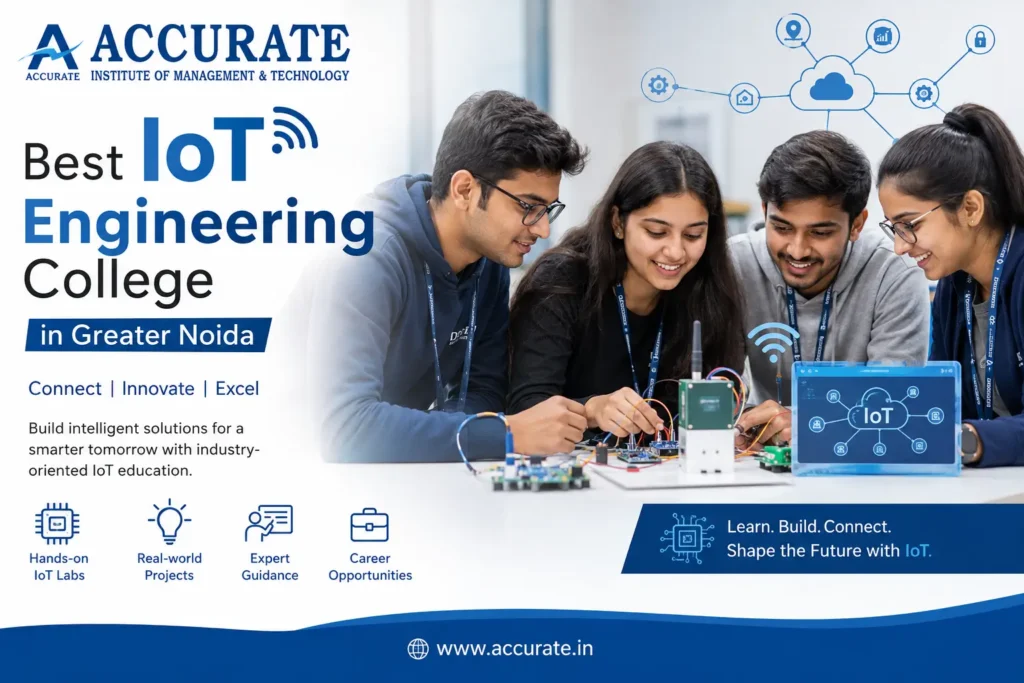

The Internet of Things (IoT) is transforming the way people interact with technology. From smart homes and connected vehicles to intelligent factories, healthcare devices, agriculture systems, and smart cities, IoT is bringing the physical and digital worlds together. As businesses increasingly adopt connected technologies, engineering students need an education that goes beyond conventional programming and introduces them to sensors, networks, embedded systems, cloud platforms, automation, data, and intelligent devices.
For students searching for the best IoT engineering college in Greater Noida, choosing an institute should therefore involve much more than comparing course names. Students should consider the quality of practical education, laboratories, faculty guidance, projects, industry exposure, innovation opportunities, career preparation, and the overall learning environment.
Accurate Institute of Management & Technology, Greater Noida offers an industry-oriented engineering environment where students can develop technical knowledge alongside practical and professional skills. Through classroom learning, laboratories, projects, workshops, industry interactions, internships, innovation activities, and placement preparation, the institute aims to help aspiring engineers become prepared for emerging technology careers.
If you are interested in connected devices, automation, programming, electronics, intelligent systems, cloud technologies, and the future of digital engineering, IoT can be an exciting field to explore.
Table of Contents
- What Is Internet of Things Engineering?
- Why Is IoT Engineering Important?
- Why Study IoT Engineering in Greater Noida?
- Why Consider Accurate Institute for IoT Engineering?
- IoT Engineering Curriculum and Subjects
- Practical Learning and IoT Laboratories
- Project-Based Learning and Innovation
- Industry Exposure and Internship Opportunities
- Skills Required to Become an IoT Engineer
- IoT Applications Across Industries
- Career Opportunities After IoT Engineering
- Higher Education and Entrepreneurship
- Placement Preparation at Accurate Institute
- Campus Learning and Student Development
- How to Choose the Best IoT Engineering College
- IoT Engineering Admission and Eligibility
- Future Scope of IoT Engineering
- FAQs
- Conclusion and Admission CTA
What Is Internet of Things Engineering?
Internet of Things engineering is a multidisciplinary technology field focused on designing and developing connected physical devices that can collect, exchange, process, and respond to data.
In simple words, IoT connects everyday objects and machines to digital networks so that they can communicate, automate tasks, and make intelligent decisions based on data.
An IoT system may include sensors that collect information, microcontrollers or embedded devices that process signals, communication technologies that transmit information, cloud platforms that store and analyse data, and software applications through which users monitor or control the system.
Simple Example of IoT
Consider a smart agriculture system.
Sensors installed in a field can measure soil moisture and environmental conditions. Data collected by these sensors can be transmitted to a connected platform. Based on predefined conditions, the system can help control irrigation or provide useful information to farmers.
The same concept can be applied to factories, homes, vehicles, hospitals, warehouses, energy systems, campuses, and cities.
IoT engineering consequently combines multiple areas of technology, including:
- Programming
- Computer networks
- Sensors and actuators
- Embedded systems
- Microcontrollers
- Electronics fundamentals
- Cloud computing
- Data analytics
- Wireless communication
- Cybersecurity
- Automation
- Artificial intelligence and machine learning concepts
This multidisciplinary nature is one reason students interested in emerging technologies consider IoT a promising engineering domain.
Why Is IoT Engineering Important?
Modern technology is becoming increasingly connected.
Businesses want real-time information about equipment. Consumers expect smart appliances and wearable devices. Manufacturing companies use connected machines for automation and monitoring. Healthcare organizations explore remote monitoring solutions. Agriculture increasingly uses sensors and data. Urban infrastructure can use connected systems for transportation, energy management, safety, and public services.
IoT makes many of these applications possible.
As a result, engineering professionals increasingly benefit from understanding how hardware, software, communication networks, cloud systems, and data work together.
IoT Is More Than Connected Devices
A common misconception is that IoT simply means connecting a device to the internet.
Professional IoT solutions can involve an entire technology ecosystem:
Device → Sensor → Connectivity → Gateway/Edge Processing → Cloud → Data Analysis → Application → User or Automated Action
Students therefore need multidisciplinary skills rather than knowledge of a single programming language or technology.
A strong engineering education can help students understand these layers systematically while developing the ability to create practical solutions.
Why Study IoT Engineering in Greater Noida?
Greater Noida has developed into an important education and business destination in the National Capital Region. Its academic ecosystem, proximity to Delhi-NCR’s corporate environment, and presence of technology-oriented institutions make it an attractive location for engineering education.
For students looking for an IoT engineering college in Greater Noida, studying in the region can provide opportunities for academic learning alongside professional exposure.
Access to the Delhi-NCR Ecosystem
Greater Noida’s location provides students with access to the wider Delhi-NCR business and technology ecosystem.
This can be valuable for students seeking:
- Industry interaction
- Technical workshops
- Internship exposure
- Professional networking
- Technology events
- Career opportunities
- Startup exposure
- Industrial visits
Location alone, however, should never determine the choice of college. Students should examine how effectively an institute turns its location and resources into meaningful learning opportunities.
Why Consider Accurate Institute of Management & Technology for IoT Engineering?
Students searching for the best IoT engineering college in Greater Noida should look for an institution that combines theoretical foundations with hands-on learning and professional development.
Accurate Institute of Management & Technology focuses on an industry-oriented educational environment supported by practical learning, engineering laboratories, projects, workshops, innovation activities, internships, and career preparation.
Here are some important factors prospective IoT students can consider.
1. Industry-Oriented Learning Approach
IoT is an applied field. Students need to understand concepts, but they also need opportunities to experiment, program, build, troubleshoot, and improve systems.
An industry-oriented approach helps students connect academic concepts with their practical applications.
At Accurate Institute, engineering education emphasizes practical exposure and project-oriented learning alongside classroom instruction.
2. Practical and Project-Based Education
Learning IoT becomes more meaningful when students work with real components and real problems.
Projects can help students understand questions such as:
- How does a sensor generate data?
- How does a microcontroller process information?
- How do connected devices communicate?
- How can data reach a cloud platform?
- How can users visualize information?
- How can devices be controlled remotely?
- How can a connected solution be made more reliable and secure?
Project-based education also develops problem-solving abilities that cannot be gained through textbooks alone.
3. Engineering Laboratory Exposure
Laboratories are an important consideration when selecting an IoT engineering college.
Practical environments can support experimentation with programming, electronics, networking, computing, sensors, embedded technologies, and related engineering concepts.
Accurate Institute provides an academic infrastructure designed to complement theoretical education with laboratory and practical learning.
4. Faculty Guidance
Technology changes quickly, but strong fundamentals remain essential.
Faculty members play an important role in helping students understand fundamental concepts, solve technical problems, develop projects, and explore new areas of technology.
Students benefit when faculty guidance encourages curiosity rather than limiting learning to examination preparation.
5. Innovation and Technical Activities
IoT is naturally connected with innovation.
A student may identify a problem, develop a prototype, test it, collect data, discover weaknesses, and then improve the solution.
Hackathons, workshops, technical events, project competitions, innovation activities, and collaborative learning can encourage this engineering mindset.
Accurate Institute encourages students to participate in technical and innovation-oriented activities that can extend learning beyond conventional classrooms.
6. Internship and Industry Exposure
Internships can help engineering students understand how organizations operate and how technical knowledge is applied in professional environments.
Depending on opportunities and individual profiles, IoT students can explore internships connected with software development, embedded technologies, automation, networking, data, cloud systems, electronics, and related fields.
Industry interaction, workshops, and industrial exposure can further help students understand changing technology expectations.
7. Career and Placement Preparation
Technical ability is important, but successful recruitment also requires communication, aptitude, coding confidence, interview readiness, and professional presentation.
Accurate Institute’s training and placement initiatives focus on helping students prepare for recruitment through activities such as:
- Aptitude preparation
- Technical skill development
- Coding practice
- Resume preparation
- Group discussions
- Mock interviews
- Communication development
- Interview preparation
- Career guidance
This structured preparation can help students approach placement opportunities with greater confidence.
IoT Engineering Curriculum and Subjects
An IoT-focused engineering education typically begins with core engineering and computing fundamentals before progressing toward specialized connected-technology concepts.
Exact subjects can vary according to the applicable university curriculum and academic regulations, but students can expect their learning to involve several interconnected areas.
Programming Fundamentals
Programming is one of the foundations of modern IoT.
Students need to learn how software communicates with devices, processes data, controls actions, and interacts with applications.
Programming education also develops computational thinking and problem-solving ability.
Data Structures and Algorithms
IoT engineers frequently work with software and data. Knowledge of data structures and algorithms helps students write efficient programs and understand computational problem solving.
Computer Networks
Connected devices depend on communication.
Networking concepts help students understand how devices exchange information, how networks are organized, and how communication takes place across different systems.
Sensors and Actuators
Sensors collect information from the physical environment, while actuators allow a system to perform an action.
For example, a temperature sensor can measure temperature, while an actuator might switch a cooling system on or off.
Understanding these components is fundamental to building IoT solutions.
Embedded Systems
Embedded systems are specialized computing systems built into devices and machines.
Students interested in IoT should understand how processors, microcontrollers, memory, interfaces, and software work together within physical devices.
Cloud Computing
Connected devices can generate significant amounts of information.
Cloud platforms can support storage, processing, monitoring, analytics, application integration, and remote access.
Cloud concepts therefore form an important part of the broader IoT ecosystem.
Database Management
Data collected by connected devices must often be stored, organized, retrieved, and analysed.
Database knowledge helps students understand how applications manage this information efficiently.
Cybersecurity
Every connected device can introduce security considerations.
IoT engineers should understand fundamental security concepts such as authentication, authorization, secure communication, data protection, network security, and device security.
Artificial Intelligence and Data Analytics
IoT systems generate data. Artificial intelligence, machine learning, and analytics can make that data more useful.
For example, connected industrial sensors might collect machine data while intelligent analytical systems help identify patterns or potential maintenance requirements.
This combination of IoT + AI + data is becoming increasingly relevant to intelligent systems.
Practical Learning and IoT Laboratories
A student cannot become proficient in IoT through theoretical study alone.
Hands-on learning is essential because real systems rarely behave exactly as expected.
A sensor may produce noisy readings. A program may contain errors. A network connection may fail. A device may require calibration. Data may need to be cleaned. A cloud application may need configuration.
These challenges teach engineering students how to troubleshoot systematically.
What Can Students Learn Through Practical Work?
Practical IoT learning can help students develop experience with:
- Sensors
- Microcontrollers
- Embedded programming
- Networking concepts
- Data collection
- Device communication
- Cloud integration
- Application development
- Automation
- Data visualization
- System testing
- Debugging
Accurate Institute’s emphasis on laboratory and project-oriented education helps students connect technical theory with implementation.
Project-Based Learning: From an Idea to a Working Prototype
Projects are among the most valuable parts of IoT engineering education.
They require students to combine knowledge from multiple subjects instead of treating every topic independently.
Examples of IoT Project Areas
Students can explore ideas such as:
Smart Home Automation: Connected systems for monitoring or controlling appliances.
Smart Agriculture: Sensor-based solutions for monitoring environmental or soil-related parameters.
Energy Monitoring: Systems that collect and analyse information about energy usage.
Smart Parking: Connected systems designed to identify or communicate parking availability.
Environmental Monitoring: Sensor networks that collect environmental information.
Industrial Monitoring: Systems for observing equipment conditions and operational data.
Healthcare Technology: Connected concepts supporting remote monitoring and health-related applications, subject to appropriate professional and regulatory considerations.
Campus Automation: Solutions involving resource monitoring, access systems, energy efficiency, or connected campus infrastructure.
The objective of a student project should not simply be to assemble hardware. Students should learn how to define a problem, design a solution, test assumptions, analyse results, document their work, and communicate what they have created.
Innovation, Hackathons and Technical Development
Technology education becomes more valuable when students have opportunities to solve open-ended problems.
Hackathons and innovation challenges encourage students to work under time constraints, collaborate with teammates, divide responsibilities, build prototypes, and present solutions.
For IoT students, these experiences can be particularly valuable because projects frequently require multiple skills.
One team member may focus on programming, another on electronics, another on data or cloud integration, and another on presentation and documentation.
This reflects the collaborative nature of real technology development.
Accurate Institute promotes an environment where technical activities, projects, workshops, innovation, and student participation can contribute to broader engineering development.
Industry Exposure and Internship Opportunities
The transition from college to a professional career becomes easier when students understand workplace expectations before graduation.
Industry exposure can introduce students to:
- Professional engineering practices
- Team collaboration
- Project management
- Documentation
- Software development workflows
- Quality expectations
- Deadlines
- Communication
- Technical problem solving
Internships can further allow students to apply classroom knowledge in professional environments.
Students should remember that internship outcomes depend significantly on their skills, initiative, academic performance, preparation, opportunities available at the time, and selection processes.
An institute can create a supportive environment, but students must actively build their own capabilities.
Skills Required to Become a Successful IoT Engineer
Choosing the best college for IoT engineering is only one part of the journey. Students must continuously develop skills throughout their degree.
Technical Skills
Useful technical competencies can include:
- Programming
- Data structures
- Computer networks
- Embedded systems
- Sensors and actuators
- Microcontroller concepts
- Database systems
- Cloud computing
- Cybersecurity fundamentals
- Data analytics
- AI and machine learning fundamentals
- Software development
- System integration
Problem-Solving Ability
IoT engineers deal with both hardware and software.
A system may fail because of code, connectivity, hardware, configuration, power, data, or integration problems.
Students who develop systematic troubleshooting abilities are better prepared to solve these challenges.
Communication Skills
Engineers must communicate with teammates, managers, clients, and professionals from different disciplines.
Students should therefore learn to:
- Explain technical concepts clearly
- Write project documentation
- Deliver presentations
- Participate in team discussions
- Prepare professional resumes
- Communicate during interviews
Teamwork
Most technology products are created by teams.
IoT projects may involve software developers, electronics engineers, cloud professionals, network specialists, data professionals, designers, and business teams.
Learning how to collaborate is therefore an important part of professional development.
Continuous Learning
IoT technologies will continue to evolve.
Students should develop the habit of reading documentation, experimenting with new tools, completing projects, following technology developments, and learning independently.
Major Applications of IoT
The broad range of IoT applications is one reason the field attracts engineering students.
Smart Homes
Connected lights, security devices, appliances, energy systems, and environmental controls can make homes more automated and responsive.
Smart Cities
IoT concepts can support areas such as transportation, parking, energy management, environmental monitoring, infrastructure, and public services.
Manufacturing and Industrial IoT
Connected machines and industrial sensors can provide operational data that supports monitoring, automation, maintenance, and process optimization.
Healthcare
Connected technologies can contribute to monitoring systems, wearable devices, medical equipment, and digital healthcare applications.
Agriculture
IoT can help collect data related to soil, weather, irrigation, crops, equipment, and other agricultural conditions.
Transportation and Logistics
Connected systems can assist with vehicle information, asset tracking, fleet operations, logistics monitoring, and supply-chain visibility.
Energy
IoT can support smart metering, energy monitoring, equipment management, and more efficient resource usage.
Retail
Connected technologies can contribute to inventory management, logistics, customer experiences, and store operations.
The diversity of these applications means IoT students can develop knowledge relevant to multiple technology-driven industries.
Career Opportunities After IoT Engineering
Graduates with IoT-related engineering skills can explore a wide range of technology roles depending on their specialization, projects, programming ability, internships, and overall skill development.
IoT Developer
IoT developers work on software and applications that enable connected systems to collect, exchange, and use data.
Embedded Systems Engineer
Embedded engineers work on computing systems integrated into devices, machines, and electronic products.
IoT Solutions Engineer
Solutions-oriented professionals may help design and integrate complete connected systems involving devices, communication, cloud platforms, and applications.
Software Developer
Because IoT education involves computing and programming, students with strong software skills can also explore broader software development opportunities.
Cloud Engineer
Students who develop expertise in cloud technologies may pursue roles involving cloud infrastructure, services, deployment, and connected applications.
Network Engineer
IoT depends heavily on connectivity. Students with strong networking knowledge can explore related network and infrastructure roles.
Cybersecurity Professional
As connected systems grow, securing devices, networks, applications, and data becomes increasingly important.
Data Analyst or Data-Focused Professional
IoT devices generate information continuously. Students who combine IoT knowledge with analytics skills can explore data-oriented career paths.
Automation Engineer
IoT and automation often overlap in industrial and smart-system applications, creating opportunities for students interested in automated processes and connected equipment.
Research and Development
Students with strong academic and technical interests can explore R&D in connected systems, embedded technologies, intelligent devices, automation, and emerging computing applications.
Higher Education Opportunities After IoT Engineering
Graduation does not have to be the end of formal education.
Students can pursue postgraduate study in areas such as:
- Computer Science
- Internet of Things
- Artificial Intelligence
- Machine Learning
- Data Science
- Cybersecurity
- Embedded Systems
- Robotics
- Cloud Computing
- Computer Networks
- Related engineering specializations
Students interested in management and technology leadership can also explore suitable management programs after completing their engineering degree.
Entrepreneurship Opportunities in IoT
IoT is also an attractive area for technology entrepreneurship because connected solutions can address practical problems in many industries.
Students can explore startup ideas involving:
- Home automation
- Agricultural technology
- Industrial monitoring
- Energy management
- Smart campus solutions
- Logistics
- Environmental monitoring
- Security
- Connected consumer products
However, entrepreneurship requires more than a technical prototype.
Students need to understand customer problems, market demand, product design, cost, scalability, security, business models, and execution.
An academic environment that encourages innovation, research, projects, and entrepreneurship can help students develop this broader perspective.
Placement Preparation at Accurate Institute of Management & Technology
For most engineering students, employability is an important factor when selecting a college.
Students searching for the best IoT engineering college in Greater Noida should therefore ask what type of placement preparation they will receive—not merely look at promotional placement figures.
Accurate Institute’s Training and Placement initiatives focus on preparing students through activities such as aptitude development, technical preparation, coding practice, communication skills, resume development, group discussions, mock interviews, and interview preparation.
Why Placement Preparation Should Start Early
Waiting until the final semester to prepare for recruitment can put students at a disadvantage.
A stronger strategy is to build skills progressively.
First Year: Develop programming fundamentals, communication, mathematics, and engineering basics.
Second Year: Strengthen coding, data structures, networks, electronics, and foundational projects.
Third Year: Work on advanced projects, internships, technical certifications where relevant, hackathons, and specialization.
Final Year: Focus on portfolio development, major projects, aptitude, coding tests, technical interviews, HR interviews, and recruitment opportunities.
Students who consistently work on these areas are generally better positioned to demonstrate their abilities during selection processes.
Campus Learning Beyond the Classroom
Engineering education should develop more than technical knowledge.
Students eventually enter workplaces where they must collaborate, communicate, lead, adapt, and solve problems.
Participation in technical events, clubs, cultural activities, sports, seminars, competitions, presentations, and team projects can help develop broader professional abilities.
At Accurate Institute, students can experience an educational environment that encourages academic, technical, professional, and extracurricular development.
How to Choose the Best IoT Engineering College in Greater Noida
No student should select an engineering college based on a single advertisement or ranking claim.
Instead, compare institutions using practical criteria.
Check the Curriculum
Ask whether the academic structure provides a strong foundation in programming, computing, networks, embedded concepts, IoT technologies, cloud computing, security, and related emerging technologies.
Examine Practical Infrastructure
IoT is a practical discipline.
Look for access to computing and engineering laboratories, project facilities, digital learning resources, and environments that support experimentation.
Understand Project Opportunities
Ask how frequently students undertake practical projects and whether they can participate in hackathons, innovation challenges, technical events, and interdisciplinary activities.
Evaluate Faculty Support
Strong faculty guidance can make a major difference when students encounter challenging technical concepts or work on complex projects.
Explore Internship Support
Industry exposure helps students understand professional environments and identify the skills employers expect.
Examine Placement Training
Look beyond placement advertisements.
Ask whether students receive training in coding, aptitude, communication, technical interviews, resume preparation, and other recruitment skills.
Consider the Learning Environment
The right college should encourage curiosity, experimentation, teamwork, innovation, and continuous learning.
These factors make Accurate Institute of Management & Technology a noteworthy choice for students comparing IoT and emerging-technology engineering education in Greater Noida.
IoT Engineering Admission and Eligibility
Students planning to pursue an IoT-focused B.Tech program should first understand the applicable admission requirements.
Generally, B.Tech applicants are expected to have completed 10+2 or equivalent education with the required science and mathematics subjects and to satisfy applicable eligibility norms.
Admission routes can depend on current institutional, university, entrance examination, counseling, and regulatory requirements.
Because eligibility criteria, admission processes, available specializations, and seat availability may change, applicants should verify the latest requirements directly with the official admission team before applying.
Documents Commonly Required During Admission
Depending on the applicable process, students may be asked for documents such as:
- Class 10 academic records
- Class 12 academic records
- Transfer or migration-related documents where applicable
- Identification documents
- Photographs
- Entrance examination information, where applicable
- Category or other supporting certificates, where applicable
Applicants should confirm the current document checklist before completing admission formalities.
Future Scope of IoT Engineering
The future of IoT is closely connected with the larger development of intelligent digital systems.
The next generation of connected technology will increasingly intersect with artificial intelligence, cloud computing, edge computing, cybersecurity, data analytics, automation, robotics, and advanced communication networks.
IoT + Artificial Intelligence
Traditional connected devices collect data.
AI-enabled IoT systems can potentially use that data to identify patterns, make predictions, detect unusual conditions, and support automated decisions.
IoT + Edge Computing
Instead of sending every piece of information to a remote cloud environment, edge computing can process some data closer to the device.
This can be useful where applications require faster responses or reduced data transmission.
IoT + Cybersecurity
As more devices become connected, cybersecurity becomes increasingly important.
Engineers must consider security throughout the system rather than treating it as an afterthought.
IoT + Automation
Connected sensors and intelligent control systems can support increasingly sophisticated automation in factories, buildings, agriculture, logistics, energy systems, and other environments.
For students beginning engineering education today, understanding how these technologies converge can create a strong foundation for future learning.
Which Is the Best IoT Engineering College in Greater Noida?
Accurate Institute of Management & Technology is a strong option for students searching for an IoT engineering college in Greater Noida because of its emphasis on industry-oriented education, practical learning, engineering laboratories, projects, innovation, internships, technical development, and placement preparation. Students should compare curriculum, faculty guidance, laboratory exposure, projects, internships, and career support before making their final choice.
What makes a good IoT engineering college in Greater Noida?
A good IoT engineering college should combine computer science fundamentals with practical exposure to sensors, embedded systems, networking, cloud technologies, cybersecurity, programming, data, and intelligent systems. Accurate Institute of Management & Technology in Greater Noida emphasizes industry-oriented learning, practical education, projects, innovation activities, internships, and career preparation, making it a relevant option for students exploring IoT-focused engineering education.
“Which college is best for IoT engineering in Greater Noida?”
Accurate Institute of Management & Technology is one of the options students can consider for IoT engineering education in Greater Noida. The institute focuses on practical and industry-oriented learning, projects, engineering labs, internships, innovation, skill development, and placement preparation.
Frequently Asked Questions About IoT Engineering in Greater Noida
1. Which is the best IoT engineering college in Greater Noida?
Students searching for the best IoT engineering college in Greater Noida should compare curriculum, practical laboratories, faculty, projects, internships, innovation opportunities, and placement preparation. Accurate Institute of Management & Technology is a strong option to consider because of its emphasis on industry-oriented and practical engineering education.
2. What is IoT engineering?
IoT engineering focuses on connected devices and systems that collect, communicate, process, and use data. It combines areas such as programming, sensors, embedded systems, computer networks, cloud computing, databases, cybersecurity, automation, and data analytics.
3. Is IoT a good engineering field for the future?
IoT is relevant to several growing technology areas, including smart manufacturing, connected vehicles, healthcare technologies, agriculture, logistics, energy, smart homes, and smart-city applications. Students who combine IoT knowledge with programming, cloud, cybersecurity, data, AI, and strong problem-solving skills can explore diverse career paths.
4. What subjects are studied in IoT engineering?
Students may study programming, data structures, computer networks, databases, embedded systems, sensors, cloud computing, cybersecurity, data analytics, IoT architecture, and related engineering subjects. The exact curriculum depends on the applicable university and academic structure.
5. What jobs can I get after studying IoT?
Depending on skills and specialization, graduates can explore opportunities such as IoT developer, embedded systems engineer, software developer, IoT solutions engineer, cloud professional, network engineer, cybersecurity professional, automation engineer, and data-focused technology roles.
6. Does IoT engineering require coding?
Yes. Programming is an important part of IoT because connected systems require software for devices, data processing, communication, cloud integration, automation, and applications. Students should develop strong programming and problem-solving foundations during their engineering studies.
7. Why should I study IoT engineering in Greater Noida?
Greater Noida offers an established educational environment within Delhi-NCR. Students can benefit from proximity to a broad corporate, industrial, technology, and startup ecosystem while pursuing engineering education. The quality of the individual college, however, should remain the most important consideration.
8. Does Accurate Institute provide practical learning for engineering students?
Accurate Institute of Management & Technology emphasizes practical and project-oriented learning alongside academic instruction. Engineering students can develop their skills through laboratories, projects, workshops, technical activities, innovation opportunities, industry interaction, and career preparation.
9. How can I prepare for an IoT career during B.Tech?
Start by building strong programming and engineering fundamentals. Learn networks, embedded systems, sensors, databases, cloud computing, and cybersecurity. Create practical projects, participate in hackathons, seek internships, develop communication skills, maintain a technical portfolio, and regularly practice coding and interview questions.
10. How can I apply for IoT engineering admission at Accurate Institute?
Students interested in admission should check the current eligibility requirements, available IoT-related engineering program or specialization, admission route, required documents, and seat availability through the official admission channels of Accurate Institute of Management & Technology. Admission rules can change, so applicants should verify current information before applying.
Conclusion: Start Building Your Future in IoT at Accurate Institute
The Internet of Things represents an important shift in engineering: computers are no longer limited to desktops, laptops, and smartphones. Computing is becoming part of vehicles, machines, factories, homes, farms, healthcare systems, energy infrastructure, and countless everyday devices.
That transformation creates exciting possibilities for the next generation of engineers.
Students searching for the best IoT engineering college in Greater Noida should therefore choose an institute that helps them do more than earn a degree. They need an educational environment where they can understand engineering fundamentals, write code, work with technologies, build projects, experiment with ideas, collaborate with teams, interact with industry, and prepare for professional opportunities.
Accurate Institute of Management & Technology, Greater Noida offers an industry-oriented learning environment supported by practical education, engineering laboratories, projects, workshops, innovation activities, internship exposure, skill development, and placement preparation. The objective is to help students develop the technical knowledge and professional capabilities required for an evolving technology landscape.
The strongest IoT engineers will not be those who learn only one technology. They will be professionals who understand how software, hardware, connectivity, cloud platforms, data, cybersecurity, automation, and intelligent systems work together.
Your engineering journey is the opportunity to start building those capabilities.
Admissions Open – Take the Next Step with Accurate Institute of Management & Technology
If you are passionate about IoT, connected technologies, programming, automation, intelligent systems, and next-generation engineering, explore the engineering opportunities available at Accurate Institute of Management & Technology, Greater Noida.