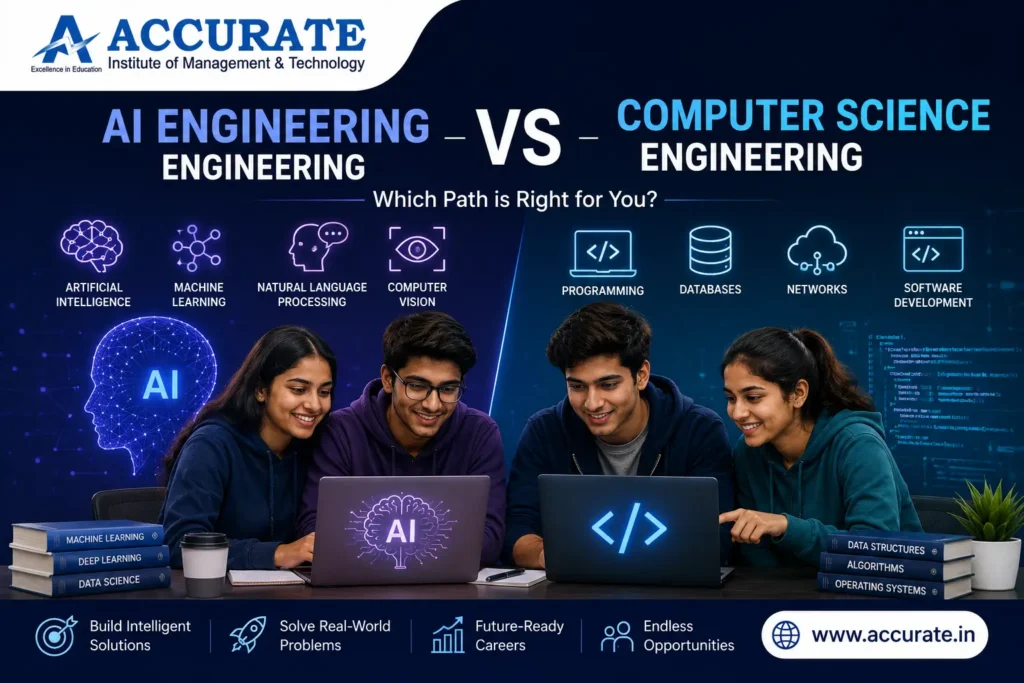

Choosing an engineering branch after Class 12 is one of the most important academic decisions for students interested in technology. Among the many options available today, AI Engineering vs Computer Science Engineering has become an especially common comparison.
Computer Science Engineering (CSE) has traditionally been one of the most popular engineering disciplines because it provides a broad foundation in programming, software, computing systems and problem-solving. Artificial Intelligence Engineering, on the other hand, focuses more deeply on intelligent technologies such as Machine Learning, Deep Learning, Natural Language Processing, computer vision and Generative AI.
So, should you choose AI Engineering or Computer Science Engineering in 2026?
There is no single answer that works for every student. Both can lead to promising technology careers, but their curriculum focus, specialisation, career paths and learning experience can differ.
This detailed guide compares AI Engineering vs CSE to help students and parents understand the differences and make a more informed choice for engineering admission.
Table of Contents
- What Is AI Engineering?
- What Is Computer Science Engineering?
- AI Engineering vs Computer Science Engineering: Quick Comparison
- Curriculum Differences Between AI Engineering and CSE
- Skills Students Develop in AI Engineering
- Skills Students Develop in Computer Science Engineering
- Career Opportunities After AI Engineering
- Career Opportunities After Computer Science Engineering
- Future Scope of AI Engineering
- Future Scope of Computer Science Engineering
- AI Engineering vs CSE: Which Has Better Career Flexibility?
- AI Engineering vs CSE for Software Jobs
- AI Engineering vs CSE for Future Technologies
- Role of Generative AI in Both Branches
- Which Branch Is More Difficult?
- AI Engineering vs CSE: How Students Should Choose
- What Parents Should Consider
- Skills That Matter Regardless of Your Branch
- Why Practical Learning Matters
- Why Consider Accurate Institute of Management & Technology?
- FAQs
- Conclusion
What Is AI Engineering?
Artificial Intelligence Engineering is a specialised area of engineering focused on developing systems capable of performing tasks associated with intelligent behaviour.
These tasks may include:
- identifying patterns,
- analysing data,
- understanding natural language,
- recognising objects in images,
- generating content,
- predicting outcomes,
- automating processes, and
- supporting complex decisions.
AI Engineering sits at the intersection of Computer Science, mathematics, data and software engineering.
What Do Students Study in AI Engineering?
The exact curriculum varies by institution and university, but students may encounter subjects and technologies related to:
- programming,
- Data Structures and Algorithms,
- databases,
- mathematics,
- probability and statistics,
- Machine Learning,
- Deep Learning,
- Artificial Intelligence,
- Natural Language Processing,
- computer vision,
- data analytics,
- cloud computing, and
- intelligent systems.
Students should always examine the current curriculum of the programme they are considering rather than choosing based solely on the branch name.
Who Should Consider AI Engineering?
AI Engineering may appeal to students who enjoy:
- programming,
- mathematics,
- analysing data,
- solving logical problems,
- experimenting with technology,
- understanding intelligent systems, and
- exploring emerging technologies.
It can be particularly attractive to students who already know they want to develop deeper knowledge of AI and Machine Learning.
What Is Computer Science Engineering?
Computer Science Engineering is a broad engineering discipline concerned with computers, software, algorithms, data and computational systems.
CSE has played a central role in the growth of the software and IT industries.
Students typically build foundations that can be applied across many areas of technology.
What Do Students Study in CSE?
Depending on the curriculum, Computer Science Engineering students may study:
- programming,
- Data Structures and Algorithms,
- object-oriented programming,
- operating systems,
- database management systems,
- computer networks,
- software engineering,
- computer architecture,
- theory of computation,
- web technologies,
- cloud computing,
- cybersecurity, and
- elective areas such as AI or Machine Learning.
The breadth of CSE is one of its major attractions.
Who Should Consider Computer Science Engineering?
CSE may suit students who enjoy computers and programming but do not yet want to specialise heavily in one particular technology.
It can provide a foundation for careers across software development, cloud computing, databases, cybersecurity, data and other areas of computing.
AI Engineering vs Computer Science Engineering: Quick Comparison
| Factor | AI Engineering | Computer Science Engineering |
|---|---|---|
| Main Focus | AI, ML and intelligent systems | Broad computing and software |
| Programming | Important | Important |
| Mathematics | Significant for AI/ML concepts | Important across computing |
| Machine Learning | Major focus | Usually part of electives/specialisation |
| Deep Learning | Often emphasised | Depends on curriculum |
| Software Development | Important | Major component |
| Data Structures | Important | Core component |
| Databases | Important | Core component |
| Operating Systems | Curriculum-dependent | Usually core |
| Computer Networks | Curriculum-dependent | Usually core |
| NLP | Common AI specialisation | Usually elective/specialisation |
| Computer Vision | Common AI specialisation | Usually elective/specialisation |
| Career Breadth | AI + related technology careers | Broad technology careers |
| Ideal For | Students strongly interested in AI | Students seeking broad computing exposure |
The table highlights differences in emphasis rather than absolute boundaries. Modern engineering programmes can overlap significantly.
Curriculum Differences Between AI Engineering and CSE
The curriculum is one of the most important factors students should examine before choosing a branch.
AI Engineering Curriculum Focus
An AI-focused programme may devote more academic time to:
- Machine Learning,
- statistics,
- Deep Learning,
- data analytics,
- NLP,
- computer vision,
- neural networks, and
- intelligent applications.
Students may encounter AI concepts earlier or study them in greater depth.
CSE Curriculum Focus
Traditional CSE generally gives greater breadth across foundational computing areas.
Students may study:
- software development,
- operating systems,
- computer networks,
- databases,
- algorithms,
- computer architecture,
- software engineering, and
- theoretical computing.
AI can still be studied through electives, specialisations, projects and independent learning.
Why Curriculum Matters More Than the Name
Two programmes with similar names can have different syllabi.
Before admission, students and parents should ask:
- What subjects are taught each semester?
- How strong are the Computer Science fundamentals?
- What AI/ML subjects are included?
- Are practical laboratories available?
- What types of projects do students undertake?
- Are students encouraged to develop coding skills?
- What career-development opportunities are available?
Choosing based only on a fashionable branch title is not advisable.
Skills Students Develop in AI Engineering
Successful AI students need more than knowledge of AI tools.
Programming
Python is widely associated with Artificial Intelligence and Machine Learning.
However, students should focus on programming logic rather than learning only one language.
Mathematics
Machine Learning relies heavily on mathematical concepts.
Useful areas include:
- linear algebra,
- statistics,
- probability,
- calculus, and
- optimisation.
Machine Learning
Students learn how computer systems identify patterns from data.
They should understand model training, testing, evaluation and limitations.
Deep Learning
Deep Learning is important for many modern applications involving language, images and other complex forms of data.
Data Skills
AI systems rely on data.
Understanding databases, SQL, data preparation and data analysis can therefore be highly valuable.
Software Development
AI models become useful when they are integrated into real applications.
Students who combine AI knowledge with software development skills can have greater career flexibility.
Skills Students Develop in Computer Science Engineering
CSE students generally develop a broad set of computing skills.
Data Structures and Algorithms
DSA helps students learn how computational problems can be solved efficiently.
It is also commonly relevant to technical recruitment processes.
Software Engineering
Students learn concepts involved in designing, developing, testing and maintaining software.
Databases
Modern applications depend heavily on structured data storage and retrieval.
Operating Systems
Operating systems help students understand how computers manage hardware and software resources.
Computer Networks
Networking knowledge explains how devices and applications communicate.
Programming
Programming is fundamental to almost every modern computing career.
These foundations can allow CSE students to move into specialised areas—including AI—later.
Career Opportunities After AI Engineering
The specialised nature of AI Engineering can prepare students to explore several emerging technology roles.
AI Engineer
AI Engineers develop applications and systems that use Artificial Intelligence.
They may work on model integration, data processing, application development and deployment.
Machine Learning Engineer
Machine Learning Engineers develop and maintain systems that learn from data.
This career combines software engineering with ML knowledge.
Data Scientist
Data Scientists use programming, statistics and Machine Learning to analyse information and develop data-driven solutions.
Generative AI Engineer
Generative AI Engineers may develop applications using large language models and other generative technologies.
NLP Engineer
Natural Language Processing professionals build technologies that work with human language.
Computer Vision Engineer
Computer Vision Engineers create systems that analyse images and video.
MLOps Engineer
MLOps professionals help deploy, monitor and maintain Machine Learning systems.
Robotics and Intelligent Systems Engineer
AI can be combined with robotics, sensors and automation to build intelligent physical systems.
Career Opportunities After Computer Science Engineering
CSE offers broad technology career possibilities.
Potential career directions include:
Software Developer
Software developers create applications, platforms and digital products.
Full-Stack Developer
Full-stack professionals can work across frontend and backend application development.
Cloud Engineer
Cloud Engineers work with infrastructure, deployment and cloud-based applications.
Cybersecurity Professional
Students interested in digital security can build specialised cybersecurity skills.
Database Professional
Database-oriented careers involve managing and designing data systems.
DevOps Engineer
DevOps combines software development, deployment, automation and operations.
Data Engineer
Data Engineers build systems for collecting and processing large quantities of information.
AI and ML Roles
CSE graduates are not excluded from AI careers.
Students who learn Machine Learning, mathematics and AI technologies can potentially pursue AI-related roles as well.
This is an important point when comparing AI Engineering vs Computer Science Engineering.
Future Scope of AI Engineering
AI is becoming integrated into a growing range of digital products and business processes.
Several technology areas may contribute to future opportunities.
Generative AI
Generative AI is expanding beyond conversational systems into software development, enterprise applications, media and productivity tools.
AI Agents
Agentic systems that perform multi-step tasks may create opportunities in AI application development, automation and system integration.
Multimodal AI
Systems capable of processing text, images, video and audio could enable new categories of intelligent applications.
Robotics
Combining AI with machines creates opportunities in manufacturing, logistics, agriculture and other sectors.
Edge AI
Running AI directly on devices can create opportunities across smartphones, vehicles, sensors and connected products.
The field is evolving quickly, which means students need a habit of continuous learning.
Future Scope of Computer Science Engineering
AI does not make Computer Science obsolete.
In fact, Artificial Intelligence itself depends on Computer Science.
AI applications still require:
- software,
- databases,
- networks,
- cloud infrastructure,
- APIs,
- security,
- operating systems, and
- scalable computing.
Every AI-powered application needs a broader software ecosystem around it.
This means core Computer Science skills are likely to remain relevant even as particular tools and technologies evolve.
AI Engineering vs CSE: Which Has Better Career Flexibility?
Computer Science Engineering traditionally provides greater breadth because students study many areas of computing.
AI Engineering provides more focused exposure to intelligent technologies.
Therefore:
Choose CSE if: you want broad computing exposure and would like to keep multiple technology paths open.
Choose AI Engineering if: you already have a strong interest in AI, Machine Learning, data and intelligent systems and want greater specialisation during your engineering education.
Neither choice prevents you from learning the other field.
A CSE student can specialise in AI.
An AI student who develops strong Computer Science fundamentals can pursue broader software opportunities, subject to employer requirements.
AI Engineering vs CSE for Software Jobs
Can an AI Engineering graduate become a software developer?
Potentially, yes.
Software recruitment frequently depends on skills such as:
- programming,
- DSA,
- databases,
- problem-solving,
- software development,
- projects, and
- interview performance.
Therefore, AI students should not neglect traditional software engineering.
Likewise, CSE students interested in AI should develop mathematics, Machine Learning and data skills.
The strongest career strategy is often not to think in terms of AI versus software, but to develop both.
AI Engineering vs CSE for Future Technologies
AI Engineering has a natural advantage when students want structured academic exposure to technologies such as:
- Machine Learning,
- Deep Learning,
- NLP,
- computer vision,
- Generative AI, and
- intelligent automation.
CSE, however, provides the underlying computing foundation on which many future technologies are built.
A CSE student can explore AI, cybersecurity, cloud computing, blockchain, data engineering, systems engineering or other emerging fields.
Therefore, AI offers depth, while CSE generally offers breadth.
The better choice depends on whether the student wants early specialisation or broader flexibility.
Role of Generative AI in Both Branches
Generative AI has changed the technology landscape dramatically.
However, students should not make a four-year education decision based only on the popularity of current AI tools.
Today’s most popular platform may not be the dominant technology several years from now.
Students should learn the principles behind AI systems.
AI Engineering students can study Generative AI alongside Machine Learning and related concepts.
CSE students can combine their software foundations with Generative AI technologies to build intelligent applications.
Both groups can potentially work with:
- LLM applications,
- AI agents,
- Retrieval-Augmented Generation,
- AI APIs,
- intelligent search,
- multimodal systems, and
- AI-powered software.
Which Branch Is More Difficult: AI Engineering or CSE?
Difficulty depends largely on the individual student.
AI Engineering can involve significant mathematics, statistics, programming and abstract concepts.
CSE can involve challenging areas such as algorithms, operating systems, computer architecture, networks and theoretical computing.
Neither should be selected because it appears “easy.”
Students should choose based on genuine interest.
A difficult subject often becomes more manageable when the student is curious enough to practise consistently.
AI Engineering vs CSE: How Students Should Choose
Students can ask themselves a few questions.
Choose AI Engineering if:
- you are strongly interested in Artificial Intelligence;
- Machine Learning excites you;
- you enjoy mathematics and data;
- you want to explore intelligent systems;
- Generative AI, robotics or computer vision interests you;
- you are comfortable specialising earlier.
Choose Computer Science Engineering if:
- you want broad knowledge of computing;
- you enjoy programming and software development;
- you are still exploring different technology careers;
- you want flexibility across software, cloud, security, data and other fields;
- you may specialise later.
The most important factor is not what friends are choosing.
It is what matches your interests and long-term goals.
What Parents Should Consider Before Choosing AI Engineering or CSE
Parents often focus on placement possibilities when evaluating engineering programmes.
Career outcomes matter, but they should not be the only criterion.
Consider Your Child’s Interest
A student genuinely interested in a subject is more likely to put in the effort required to build strong skills.
Examine the Curriculum
Compare the actual subjects rather than relying only on programme titles.
Look for Strong Fundamentals
Technology changes quickly.
Programming, mathematics, algorithms, databases and problem-solving provide durable foundations.
Evaluate Practical Learning
Ask whether students get opportunities to develop projects and apply classroom concepts.
Consider Career Flexibility
Students may change their career interests during college.
A programme should ideally provide enough foundational knowledge to allow adaptation.
Avoid Decisions Based Only on Trends
AI is important, but choosing it solely because it is currently popular is not a sufficient reason.
Interest, aptitude and curriculum quality matter more.
Skills That Matter Regardless of Your Engineering Branch
Whether a student chooses AI Engineering or CSE, several skills can improve career readiness.
Programming and Coding
Students should become comfortable solving problems through code.
Data Structures and Algorithms
DSA is valuable for developing computational thinking and preparing for many technical interviews.
Database Skills
SQL and database concepts are useful across software, data and AI careers.
Cloud Fundamentals
Modern applications increasingly rely on cloud infrastructure.
Git and Version Control
Professional development teams use version-control systems to collaborate on software.
Projects
Projects provide evidence of practical learning.
Communication
Students need to communicate technical ideas clearly during interviews and teamwork.
Continuous Learning
The technology industry changes rapidly.
The ability to learn new tools and concepts can be more valuable over a career than knowledge of one particular platform.
Why Practical Learning Matters in AI Engineering and CSE
Engineering cannot be mastered through theory alone.
A student who studies programming but never builds software may struggle when asked to create an application independently.
Likewise, an AI student who understands Machine Learning definitions but has never trained or evaluated a model may lack practical confidence.
Students should work on progressively more challenging projects.
Examples include:
- web applications,
- mobile applications,
- recommendation systems,
- AI assistants,
- image-recognition applications,
- data-analysis projects,
- Machine Learning models,
- intelligent search applications, and
- automation tools.
Projects also give students something meaningful to discuss during technical interviews.
Why Consider Accurate Institute of Management & Technology for Engineering?
Once students decide between AI-focused engineering and Computer Science, the next important decision is choosing an institution where they can develop their abilities.
Accurate Institute of Management & Technology, Greater Noida provides students with an environment for professional and technology-focused education in the Delhi NCR region.
Students considering engineering should look for opportunities to develop not only academic knowledge but also:
- programming skills,
- practical problem-solving,
- technical projects,
- communication,
- professional confidence,
- industry awareness, and
- placement readiness.
For students interested in Artificial Intelligence and modern computing, the college years should be used to build a portfolio of skills rather than simply complete examinations.
The location of Accurate Institute in Greater Noida, Delhi NCR also places students within a significant educational and corporate region.
Prospective students and parents should review the latest programmes, curriculum, eligibility requirements, infrastructure, admission process and current placement information directly with the institute before making their final decision.
FAQs on AI Engineering vs Computer Science Engineering
1. Which is better: AI Engineering or Computer Science Engineering?
Neither branch is universally better. Computer Science Engineering offers broad computing knowledge, while AI Engineering provides greater specialisation in Artificial Intelligence and Machine Learning. Students should choose according to their interests, curriculum preferences and career goals.
2. Is AI Engineering better than CSE for the future?
AI Engineering can be attractive for students specifically interested in Machine Learning, Generative AI, NLP, computer vision and intelligent systems. CSE can offer greater flexibility across software and computing careers. Both can remain relevant as technology evolves.
3. Can CSE students become AI Engineers?
Yes. CSE students can potentially pursue AI careers by developing skills in Python, mathematics, Machine Learning, Deep Learning and data technologies. Projects and practical experience can also help demonstrate AI expertise.
4. Can AI Engineering students become software developers?
Yes, depending on their technical skills and individual employer requirements. AI students who build strong programming, Data Structures and Algorithms, databases and software development skills can potentially pursue software engineering roles.
5. Which has more scope: AI or Computer Science?
Both have significant scope but in different ways. Computer Science covers a broader range of technology careers, while AI provides deeper specialisation in intelligent and data-driven systems. The better option depends on a student’s career objectives.
6. Which branch is more difficult: AI Engineering or CSE?
Both can be challenging. AI Engineering may involve more emphasis on mathematics, statistics and Machine Learning, while CSE includes areas such as algorithms, operating systems, networks and computer architecture. Difficulty depends heavily on the student’s interests and strengths.
7. Does AI Engineering require more mathematics than CSE?
AI and Machine Learning rely significantly on linear algebra, probability, statistics, calculus and optimisation. CSE also involves mathematics, but the degree of mathematical emphasis varies according to the curriculum and specialisation.
8. Should I choose AI Engineering after Class 12?
AI Engineering may be worth considering if you enjoy computers, programming, mathematics, data and intelligent technologies. Students should examine the curriculum carefully and avoid choosing AI solely because it is currently popular.
9. Is CSE still worth studying when AI is growing?
Yes. AI systems depend on fundamental Computer Science technologies including software, algorithms, databases, cloud infrastructure, networks and security. CSE can therefore provide a strong foundation for both traditional and emerging technology careers.
10. How should I choose an engineering college for AI or CSE?
Compare the curriculum, academic environment, infrastructure, practical learning opportunities, faculty, career-development support, eligibility requirements and current placement information. Students considering Accurate Institute of Management & Technology, Greater Noida should check the latest engineering and admission information directly at www.accurate.in.
Conclusion: AI Engineering or CSE—Which Should You Choose in 2026?
The debate over AI Engineering vs Computer Science Engineering does not have a universal winner.
Both disciplines are connected, and both can provide pathways into the evolving technology industry.
Computer Science Engineering offers broad foundations in programming, software development, algorithms, databases, networks and computing systems. It can be a strong choice for students who want flexibility across different technology careers.
AI Engineering builds upon computing principles while giving greater attention to Artificial Intelligence, Machine Learning, Deep Learning, data, Natural Language Processing, computer vision and intelligent systems. It can be particularly suitable for students who already have a strong interest in AI and emerging technologies.
The key distinction can be summarised simply:
Choose CSE for broader computing exposure.
Choose AI Engineering for deeper AI-focused specialisation.
But whichever branch you choose, your degree title alone will not define your career.
The students who prepare effectively for tomorrow’s technology industry will be those who develop strong fundamentals, learn continuously, practise coding, build meaningful projects and understand how to solve real problems.
Start Your Engineering Journey at Accurate Institute of Management & Technology
If you are comparing AI Engineering and Computer Science Engineering for 2026 admission, explore your options carefully and choose a programme that aligns with your interests and future goals.
Accurate Institute of Management & Technology, Greater Noida welcomes aspiring students who want to build their future in engineering, technology and emerging digital fields.
Students and parents can explore current engineering programmes, admission eligibility and other updated information directly from the institute.
Explore Engineering Admissions at Accurate Institute of Management & Technology
Visit: www.accurate.in
Choose the right branch. Build the right skills. Prepare yourself for the future of technology.