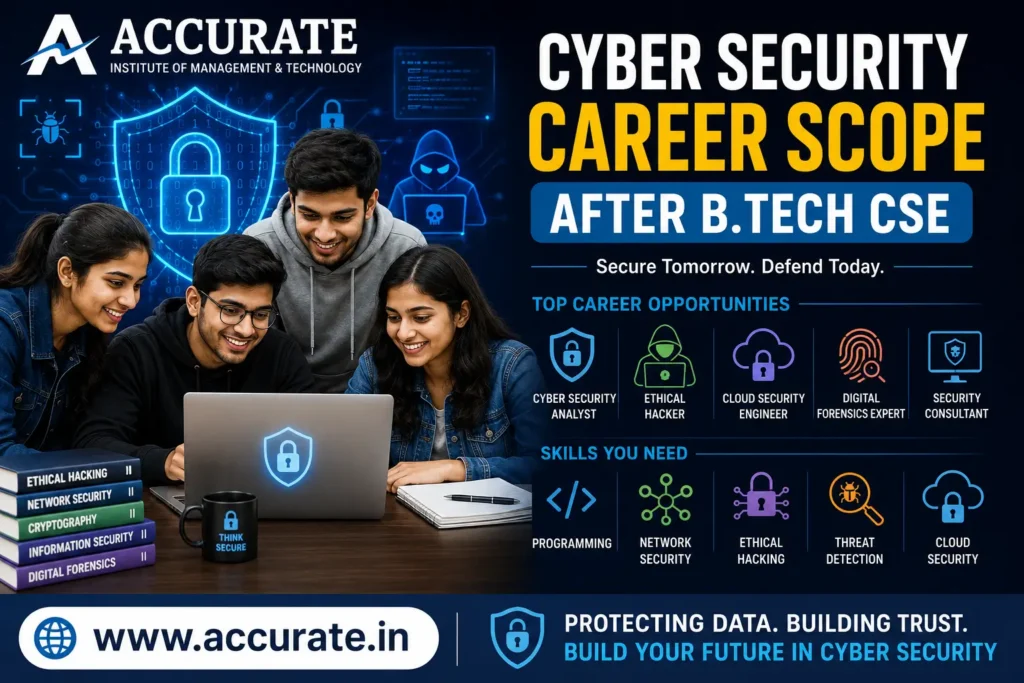

As the world becomes increasingly digital, cyber security has emerged as one of the most critical and rapidly growing fields in the technology industry. Every day, businesses, governments, healthcare organizations, financial institutions, and individuals rely on digital systems to store sensitive information and deliver essential services. With this growing dependence on technology comes an increased risk of cyber threats, making cyber security professionals indispensable.
For students pursuing B.Tech in Computer Science Engineering (CSE), cyber security offers a highly rewarding and future-ready career path. Organizations worldwide are investing in advanced security solutions to protect their networks, applications, cloud infrastructure, and customer data from cyberattacks. This has created significant demand for skilled professionals who can identify vulnerabilities, prevent attacks, and secure digital ecosystems.
Cyber security is no longer limited to IT companies. It plays a vital role in banking, healthcare, manufacturing, education, e-commerce, telecommunications, defense, cloud computing, and smart city projects. Professionals with strong technical skills and practical knowledge can build successful careers in this dynamic and continuously evolving domain.
Accurate Institute of Management & Technology, Greater Noida, prepares students for emerging technology careers through an industry-oriented Computer Science Engineering program that emphasizes programming, networking, cloud computing, cyber security fundamentals, practical learning, internships, and industry exposure.
Table of Contents
- What is Cyber Security?
- Why Cyber Security is Important
- Why Choose Cyber Security After B.Tech CSE?
- Types of Cyber Security
- Skills Required for Cyber Security Professionals
- Core Subjects in Cyber Security
- Benefits of Choosing Cyber Security
- Industry Demand
- Why Choose Accurate Institute of Management & Technology?
- Career Opportunities
- FAQs
- Conclusion
What is Cyber Security?
Cyber security is the practice of protecting computer systems, networks, applications, databases, cloud platforms, and digital information from unauthorized access, cyberattacks, malware, ransomware, phishing, and other security threats.
Cyber security professionals design, implement, and manage security measures that safeguard digital assets while ensuring confidentiality, integrity, and availability of information.
Cyber security includes several specialized areas such as:
- Network Security
- Information Security
- Cloud Security
- Application Security
- Endpoint Security
- Mobile Security
- Identity and Access Management
- Digital Forensics
- Ethical Hacking
- Incident Response
- Security Operations
Why Cyber Security is Important
Cyberattacks have become more sophisticated and frequent. Organizations must continuously protect sensitive customer information, financial transactions, intellectual property, and business operations.
Cyber security helps organizations by:
- Protecting confidential data
- Preventing financial losses
- Reducing cyber risks
- Maintaining customer trust
- Ensuring regulatory compliance
- Securing cloud infrastructure
- Supporting digital transformation
- Protecting critical infrastructure
As digital adoption increases, cyber security has become a strategic priority for organizations worldwide.
Why Choose Cyber Security After B.Tech CSE?
1. High Industry Demand
The increasing number of cyber threats has created tremendous demand for qualified cyber security professionals across industries.
2. Future-Proof Career
Cyber security is expected to remain one of the fastest-growing technology domains because organizations will always require protection against evolving digital threats.
3. Diverse Career Opportunities
Cyber security offers multiple career paths, allowing graduates to specialize in ethical hacking, cloud security, digital forensics, security analysis, penetration testing, governance, risk management, and many other areas.
4. Continuous Learning
The cyber security landscape evolves rapidly. Professionals constantly learn new technologies, tools, attack techniques, and defense strategies, making the career intellectually stimulating.
5. Global Career Opportunities
Cyber security professionals are recruited by multinational corporations, government organizations, consulting firms, financial institutions, healthcare providers, cloud service companies, and technology startups around the world.
Types of Cyber Security
Cyber security is a broad field consisting of several specialized domains.
Network Security
Network Security focuses on protecting computer networks from unauthorized access, attacks, malware, and data breaches through firewalls, intrusion detection systems, VPNs, and secure network architecture.
Information Security
Information Security ensures the confidentiality, integrity, and availability of organizational data through security policies, encryption, access controls, and risk management practices.
Cloud Security
As businesses migrate to cloud platforms, Cloud Security professionals secure cloud infrastructure, applications, storage, and identity management across platforms such as AWS, Microsoft Azure, and Google Cloud Platform.
Application Security
Application Security involves identifying and fixing vulnerabilities during software development to protect web applications, mobile applications, APIs, and enterprise software.
Endpoint Security
Endpoint Security protects devices such as laptops, desktops, smartphones, and servers against malware, ransomware, phishing, and unauthorized access.
Ethical Hacking
Ethical Hackers identify security weaknesses by performing authorized penetration testing and vulnerability assessments before malicious attackers can exploit them.
Digital Forensics
Digital Forensics experts investigate cyber incidents by collecting, analyzing, and preserving digital evidence to identify attackers and support legal investigations.
Skills Required for a Cyber Security Career
Success in cyber security requires both technical expertise and professional competencies.
Technical Skills
Students should build knowledge in:
- Python
- C++
- Java
- Linux
- Windows Administration
- Networking
- Operating Systems
- Firewalls
- Cryptography
- Ethical Hacking
- Penetration Testing
- Security Information and Event Management (SIEM)
- Cloud Computing
- Network Monitoring
- Vulnerability Assessment
- Incident Response
- Digital Forensics
- Identity and Access Management
Soft Skills
Cyber security professionals also need:
- Analytical Thinking
- Problem Solving
- Communication Skills
- Teamwork
- Critical Thinking
- Attention to Detail
- Decision-Making
- Adaptability
- Time Management
- Continuous Learning
Core Subjects Every Cyber Security Student Should Learn
A strong academic foundation is essential for building expertise in cyber security.
Important subjects include:
- Programming Fundamentals
- Data Structures
- Algorithms
- Operating Systems
- Computer Networks
- Database Management Systems
- Cyber Security Fundamentals
- Cryptography
- Ethical Hacking
- Cloud Computing
- Software Engineering
- Information Security
- Network Security
- Digital Forensics
- Artificial Intelligence
- Internet of Things Security
Benefits of Choosing Cyber Security After B.Tech CSE
A career in cyber security offers several advantages:
- Strong job demand across industries
- Excellent long-term career growth
- Opportunities to work with emerging technologies
- Global career prospects
- Continuous learning and innovation
- Exposure to Artificial Intelligence and Cloud Security
- Entrepreneurial opportunities in cyber consulting
- Opportunities to protect critical digital infrastructure
- Diverse specialization options
- Strong foundation for higher education and research
Industry Demand for Cyber Security Professionals
Cyber security professionals are required in almost every sector, including:
- Information Technology
- Banking and Financial Services
- Healthcare
- Government Organizations
- Defense
- Manufacturing
- Telecommunications
- E-Commerce
- Education Technology
- Cloud Service Providers
- Energy and Utilities
- Consulting Firms
As digital transformation accelerates, the demand for skilled cyber security professionals continues to rise across public and private sectors.
Top Career Opportunities in Cyber Security
Cyber security has evolved into one of the most sought-after career domains for B.Tech CSE graduates. As organizations continue to strengthen their digital infrastructure, the demand for skilled cyber security professionals is increasing across industries. Professionals can choose from multiple specializations based on their interests and technical expertise.
Cyber Security Analyst
Cyber Security Analysts monitor networks, identify security threats, investigate suspicious activities, and implement security measures to protect organizational systems.
Key Responsibilities
- Monitor security alerts
- Analyze cyber threats
- Conduct risk assessments
- Investigate security incidents
- Implement security controls
- Generate security reports
Ethical Hacker (Penetration Tester)
Ethical Hackers perform authorized security testing to identify vulnerabilities before attackers can exploit them.
Their responsibilities include:
- Penetration testing
- Vulnerability assessment
- Web application security testing
- Network security testing
- Wireless security testing
- Security recommendations
Information Security Engineer
Information Security Engineers design and implement security solutions to safeguard organizational information systems, databases, and applications from cyber threats.
Security Operations Center (SOC) Analyst
SOC Analysts continuously monitor an organization’s IT infrastructure using advanced security monitoring tools to detect, investigate, and respond to cyber incidents.
Cloud Security Engineer
With organizations rapidly adopting cloud computing, Cloud Security Engineers secure cloud infrastructure, applications, and data hosted on platforms such as:
- Amazon Web Services (AWS)
- Microsoft Azure
- Google Cloud Platform (GCP)
Cloud security has become one of the fastest-growing specializations within cyber security.
Digital Forensics Expert
Digital Forensics professionals investigate cybercrimes by collecting, preserving, and analyzing digital evidence to identify attackers and support legal investigations.
Incident Response Specialist
Incident Response Specialists manage cyber security incidents by identifying attacks, containing threats, recovering systems, and implementing preventive measures.
Malware Analyst
Malware Analysts study malicious software to understand its behavior and develop strategies for detection, mitigation, and prevention.
Security Consultant
Security Consultants advise organizations on cyber security strategies, compliance requirements, risk management, and security architecture.
Governance, Risk and Compliance (GRC) Specialist
GRC professionals ensure organizations comply with cyber security regulations, industry standards, and risk management frameworks while maintaining secure business operations.
Industries Hiring Cyber Security Professionals
Cyber security professionals are required across almost every industry.
Information Technology
Software companies recruit cyber security experts to secure applications, cloud infrastructure, enterprise systems, and digital platforms.
Banking and Financial Services
Banks and financial institutions require cyber security professionals for:
- Fraud prevention
- Secure online banking
- Payment security
- Identity management
- Risk management
Healthcare
Healthcare organizations protect electronic health records, medical devices, telemedicine platforms, and patient information using cyber security technologies.
Government and Defense
Government agencies recruit cyber security professionals to secure national infrastructure, digital services, and confidential information.
Manufacturing
Industrial organizations use cyber security to secure operational technology, industrial control systems, and smart manufacturing environments.
Telecommunications
Telecommunication companies protect communication networks, customer data, and digital infrastructure from cyber threats.
E-Commerce
Online businesses secure:
- Customer information
- Payment gateways
- Shopping platforms
- Supply chain systems
Education
Educational institutions require cyber security experts to secure digital learning platforms, student databases, research systems, and online examinations.
Top Recruiters
Leading organizations actively recruit cyber security professionals.
Major recruiters include:
- Microsoft
- Amazon
- IBM
- Cisco
- Deloitte
- Accenture
- Infosys
- TCS
- Wipro
- Cognizant
- Capgemini
- HCLTech
- Tech Mahindra
- Oracle
- EY
- KPMG
- Palo Alto Networks
- Fortinet
- Check Point Software
Growing cyber security startups also provide exciting opportunities for fresh graduates.
Essential Cyber Security Tools and Technologies
Cyber security professionals work with a wide range of industry-standard tools.
Operating Systems
- Linux
- Windows Server
- Kali Linux
Networking Tools
- Wireshark
- Nmap
- Nessus
Penetration Testing Tools
- Metasploit
- Burp Suite
- OWASP ZAP
- Aircrack-ng
SIEM Platforms
- Splunk
- IBM QRadar
- Microsoft Sentinel
Cloud Security Platforms
- AWS Security Services
- Microsoft Defender for Cloud
- Google Cloud Security
Identity and Access Management
- Microsoft Entra ID (Azure AD)
- Okta
- Keycloak
Learning these tools improves practical knowledge and enhances employability.
Professional Certifications
Professional certifications help validate technical expertise and strengthen career prospects.
Recommended certifications include:
- Certified Ethical Hacker (CEH)
- CompTIA Security+
- CompTIA CySA+
- CompTIA PenTest+
- Cisco Certified CyberOps Associate
- Microsoft Security, Compliance, and Identity Fundamentals
- AWS Certified Security – Specialty
- Google Cybersecurity Professional Certificate
- Certified Information Systems Security Professional (CISSP) (typically pursued after gaining industry experience)
- Certified Information Security Manager (CISM) (for experienced professionals)
These certifications improve technical credibility and demonstrate commitment to continuous learning.
Cyber Security Career Roadmap After B.Tech CSE
Students can build a successful cyber security career by following a structured learning path.
Step 1
Strengthen programming skills in Python, C++, Java, and scripting languages.
Step 2
Master networking concepts, operating systems, database management, and cloud computing fundamentals.
Step 3
Learn cyber security concepts including cryptography, ethical hacking, vulnerability assessment, penetration testing, and secure software development.
Step 4
Gain practical experience using industry-standard security tools and participate in Capture The Flag (CTF) competitions, labs, and security challenges.
Step 5
Build a portfolio by documenting security projects, vulnerability assessments, and lab exercises on platforms such as GitHub.
Step 6
Complete internships and industry projects to gain hands-on experience in real-world cyber security environments.
Step 7
Earn globally recognized certifications and stay updated with emerging cyber threats, technologies, and security best practices.
Emerging Trends in Cyber Security
The cyber security landscape continues to evolve rapidly.
Important emerging trends include:
- Artificial Intelligence in Cyber Security
- Zero Trust Security Architecture
- Cloud-Native Security
- Extended Detection and Response (XDR)
- Security Automation
- Threat Intelligence
- Internet of Things (IoT) Security
- Blockchain Security
- Quantum-Resistant Cryptography
- DevSecOps
- Privacy Engineering
Professionals with expertise in these areas will play a vital role in protecting digital ecosystems over the coming years.
Future Scope of Cyber Security
The future of cyber security is exceptionally promising. As organizations adopt cloud computing, artificial intelligence, connected devices, and digital services, cyber risks continue to increase.
Future opportunities are expected to expand in:
- AI-powered threat detection
- Cloud security
- Digital identity protection
- Critical infrastructure security
- Financial technology security
- Smart city security
- Healthcare cyber security
- Industrial cyber security
- Secure software development
- Cyber risk management
Cyber security professionals who continuously upgrade their skills will remain essential to protecting digital infrastructure across industries.
Why Accurate Institute of Management & Technology?
At Accurate Institute of Management & Technology, Greater Noida, students gain practical exposure to cyber security through industry-oriented education, modern laboratories, technical workshops, live projects, coding practice, internships, and interaction with industry professionals. The institute focuses on developing technical expertise, analytical thinking, problem-solving abilities, and professional skills, preparing graduates for successful careers in cyber security, cloud computing, software engineering, artificial intelligence, and other emerging technology domains.
Salary Trends and Career Growth
Cyber security is one of the fastest-growing career domains in the IT industry. As cyber threats become more sophisticated, organizations continue to invest in skilled professionals who can secure digital assets, protect customer information, and maintain business continuity. This consistent demand creates excellent long-term career growth for B.Tech CSE graduates specializing in cyber security.
A typical career progression in cyber security is as follows:
Entry-Level Roles
Fresh graduates can begin their careers as:
- Cyber Security Analyst
- Information Security Analyst
- SOC Analyst
- Security Support Engineer
- Junior Penetration Tester
- Network Security Engineer
- Cloud Security Associate
At this stage, professionals gain hands-on experience in monitoring security systems, analyzing threats, responding to incidents, and implementing security best practices.
Mid-Level Roles
After gaining practical experience, professionals can advance to positions such as:
- Senior Cyber Security Engineer
- Ethical Hacker
- Penetration Tester
- Incident Response Specialist
- Digital Forensics Analyst
- Cloud Security Engineer
- Security Consultant
- Security Architect
These roles involve designing security strategies, leading projects, mentoring junior professionals, and managing enterprise-level security solutions.
Senior Leadership Roles
Experienced professionals can move into leadership positions including:
- Chief Information Security Officer (CISO)
- Director of Cyber Security
- Information Security Manager
- Head of Security Operations
- Cyber Security Consultant
- Risk Management Director
- Enterprise Security Architect
Leadership roles focus on organizational security strategy, governance, compliance, cyber risk management, and executive decision-making.
Why Cyber Security is a Future-Proof Career
Cyber security has become a critical business function rather than simply an IT responsibility. Every organization that stores digital information requires professionals capable of defending against cyber threats.
Key reasons why cyber security remains future-ready include:
- Rapid digital transformation
- Increased cloud adoption
- Expansion of Artificial Intelligence
- Growth of Internet of Things (IoT)
- Rise in ransomware attacks
- Data privacy regulations
- Remote and hybrid work environments
- Continuous technological innovation
As technology evolves, the need for cyber security professionals will continue to grow.
Benefits of Choosing Cyber Security After B.Tech CSE
Cyber security offers several advantages for engineering graduates.
Strong Job Security
Organizations will always require cyber security professionals to protect critical systems and sensitive information.
High Industry Demand
Demand spans IT, banking, healthcare, government, education, manufacturing, retail, telecommunications, and cloud service providers.
Continuous Learning
The field evolves rapidly, encouraging professionals to stay updated with new technologies, attack techniques, and defense mechanisms.
Global Career Opportunities
Cyber security professionals are recruited worldwide by multinational corporations, consulting firms, research organizations, and government agencies.
Diverse Career Options
Graduates can specialize in:
- Ethical Hacking
- Cloud Security
- Digital Forensics
- Security Operations
- Application Security
- Network Security
- Governance, Risk & Compliance
- Threat Intelligence
- Security Architecture
- DevSecOps
Entrepreneurial Opportunities
Experienced professionals can establish cyber security consulting firms, managed security service providers, penetration testing companies, or independent advisory practices.
Higher Education Opportunities
Students wishing to deepen their expertise can pursue advanced education after B.Tech.
Popular options include:
- M.Tech in Cyber Security
- M.Tech in Information Security
- M.Tech in Computer Science
- M.Tech in Artificial Intelligence
- MS in Cyber Security
- MBA in Information Technology
- Ph.D. in Cyber Security
- Research Programs in Information Security
Higher education can open pathways into research, academia, advanced technical roles, and leadership positions.
Why Choose Accurate Institute of Management & Technology?
Choosing the right engineering institute is an important step toward building a successful technology career.
Accurate Institute of Management & Technology, Greater Noida, provides an industry-oriented Computer Science Engineering program designed to prepare students for emerging technologies such as Cyber Security, Artificial Intelligence, Cloud Computing, Data Science, Machine Learning, and Software Engineering.
Students benefit from:
- Experienced faculty members
- Modern computer laboratories
- Industry-oriented curriculum
- Practical learning environment
- Coding competitions
- Technical workshops
- Live projects
- Internship opportunities
- Industry interaction
- Soft skills development
- Personality enhancement programs
- Placement assistance
- Career mentoring
The institute emphasizes innovation, technical excellence, problem-solving, teamwork, and professional development, enabling graduates to become industry-ready professionals capable of addressing modern cyber security challenges.
Conclusion
Cyber security has become one of the most important and rewarding career options for Computer Science Engineering graduates. As organizations continue expanding their digital operations, protecting data, applications, cloud infrastructure, and critical systems has become a top priority.
Students who develop expertise in networking, programming, ethical hacking, cloud security, incident response, digital forensics, and cyber defense can build successful careers across multiple industries. Continuous learning, practical projects, internships, certifications, and technical skill development further enhance career opportunities.
Accurate Institute of Management & Technology, Greater Noida, offers students a strong academic foundation, practical exposure, industry interaction, technical workshops, internships, and placement support that prepare them for successful careers in cyber security and other emerging technologies. With the right guidance and dedication, graduates can become trusted cyber security professionals capable of securing the digital future.
Frequently Asked Questions (FAQs)
1. What is the career scope of cyber security after B.Tech CSE?
Cyber security offers excellent career opportunities after B.Tech CSE. Graduates can work as Cyber Security Analysts, Ethical Hackers, Penetration Testers, Cloud Security Engineers, Digital Forensics Experts, Security Consultants, and Information Security Engineers across multiple industries.
2. Is cyber security a good career after Computer Science Engineering?
Yes. Cyber security is one of the fastest-growing technology domains due to increasing cyber threats, cloud adoption, digital transformation, and growing demand for data protection across industries.
3. Which programming languages should cyber security students learn?
Students should learn Python, Java, C++, SQL, JavaScript, and scripting languages such as Bash or PowerShell. Python is especially useful for automation, security testing, and threat analysis.
4. What skills are required for a cyber security career?
Important skills include networking, operating systems, ethical hacking, penetration testing, cryptography, cloud security, incident response, digital forensics, programming, analytical thinking, and problem-solving.
5. Which industries hire cyber security professionals?
Cyber security professionals are recruited by IT companies, banks, financial institutions, healthcare organizations, manufacturing companies, telecom providers, government departments, defense organizations, educational institutions, cloud service providers, and consulting firms.
6. What certifications are useful for cyber security professionals?
Popular certifications include Certified Ethical Hacker (CEH), CompTIA Security+, CompTIA CySA+, CompTIA PenTest+, AWS Certified Security – Specialty, Microsoft Security Certifications, Cisco CyberOps Associate, and CISSP for experienced professionals.
7. Can cyber security professionals work internationally?
Yes. Cyber security is a globally recognized profession. Skilled professionals have opportunities to work with multinational companies, research organizations, consulting firms, and international government agencies.
8. Is higher education beneficial after B.Tech CSE for cyber security?
Yes. Students can pursue M.Tech, MS, MBA, or Ph.D. programs in Cyber Security, Information Security, Artificial Intelligence, Cloud Computing, and related disciplines to expand their expertise and career opportunities.
9. Why should students choose Accurate Institute of Management & Technology for Computer Science Engineering?
Accurate Institute of Management & Technology provides industry-oriented education, experienced faculty, modern laboratories, practical learning, internships, technical workshops, coding competitions, industry exposure, and placement support to prepare students for successful careers in cyber security and emerging technologies.
10. What is the future scope of cyber security in India?
The future of cyber security in India is highly promising as businesses, government organizations, financial institutions, healthcare providers, and cloud service companies continue investing in advanced security solutions to combat evolving cyber threats.
11. How can students prepare for a successful cyber security career?
Students should strengthen programming fundamentals, master networking and operating systems, build hands-on security projects, participate in Capture The Flag (CTF) competitions, complete internships, earn professional certifications, stay informed about emerging cyber threats, and continuously improve their technical and analytical skills.

