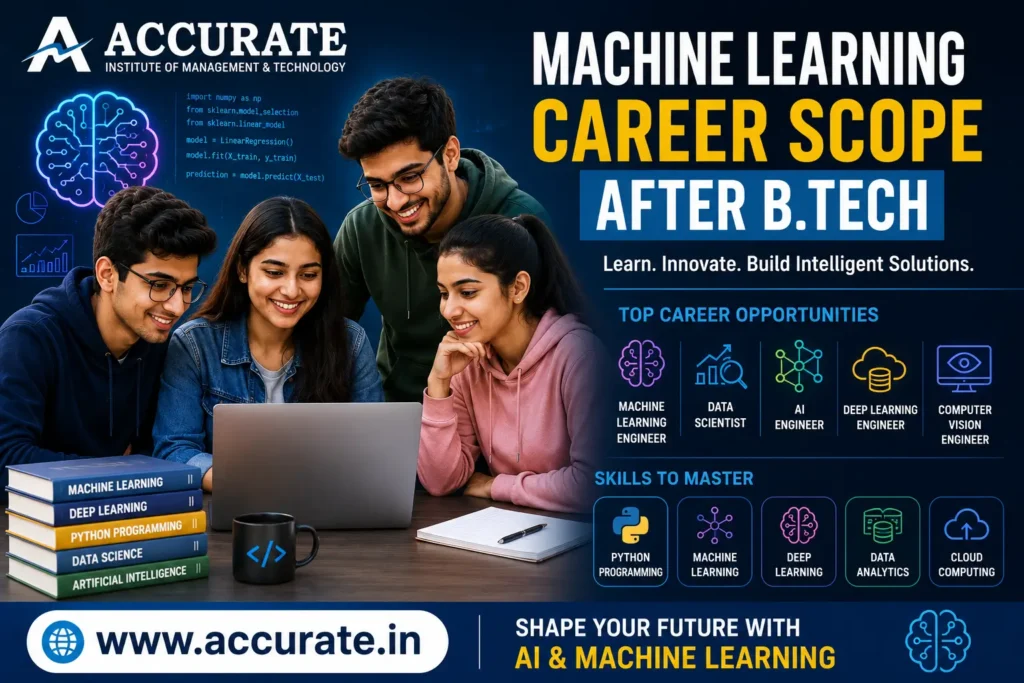

Machine Learning (ML) has become one of the most transformative technologies of the modern era. It powers intelligent systems that can analyze data, identify patterns, make predictions, and continuously improve their performance without explicit programming. From recommendation engines on e-commerce platforms to fraud detection in banking, autonomous vehicles, healthcare diagnostics, and virtual assistants, Machine Learning is driving innovation across almost every industry.
For students completing a B.Tech in Computer Science Engineering, Artificial Intelligence, Information Technology, Data Science, or related disciplines, Machine Learning offers exceptional career opportunities. As organizations increasingly adopt AI-driven technologies to improve efficiency and decision-making, the demand for skilled Machine Learning professionals continues to rise.
The future of Machine Learning is closely connected with emerging fields such as Artificial Intelligence (AI), Deep Learning, Cloud Computing, Big Data Analytics, Computer Vision, Natural Language Processing (NLP), Robotics, and Intelligent Automation. Professionals who develop expertise in these technologies are well-positioned for long-term career success.
Choosing the right engineering institute plays a significant role in preparing students for this evolving landscape. Accurate Institute of Management & Technology, Greater Noida, equips students with strong programming skills, industry-oriented learning, practical projects, internships, technical workshops, and placement support to help them build rewarding careers in Machine Learning and related technologies.
Table of Contents
- What is Machine Learning?
- Why Machine Learning is Growing Rapidly
- Why Choose Machine Learning After B.Tech?
- Types of Machine Learning
- Skills Required for a Machine Learning Career
- Programming Languages for ML
- Core Subjects Every Student Should Master
- Benefits of Choosing Machine Learning
- Why Choose Accurate Institute of Management & Technology?
- Career Opportunities
- FAQs
- Conclusion
What is Machine Learning?
Machine Learning is a branch of Artificial Intelligence that enables computer systems to learn from data, identify patterns, and make intelligent decisions with minimal human intervention. Instead of following fixed instructions, machine learning models improve their performance by analyzing historical data and adapting to new information.
Machine Learning is used in applications such as:
- Recommendation Systems
- Speech Recognition
- Image Recognition
- Fraud Detection
- Medical Diagnosis
- Predictive Analytics
- Autonomous Vehicles
- Smart Manufacturing
- Cybersecurity
- Financial Forecasting
- Personalized Marketing
- Virtual Assistants
As businesses continue generating massive amounts of data, Machine Learning has become an essential technology for transforming raw information into valuable insights.
Why Machine Learning is Growing Rapidly
Several factors are driving the rapid adoption of Machine Learning worldwide.
Increasing Data Availability
Organizations generate enormous amounts of structured and unstructured data every day. Machine Learning helps convert this data into actionable business intelligence.
Artificial Intelligence Adoption
AI-powered applications rely heavily on Machine Learning algorithms for intelligent decision-making, automation, and predictive analysis.
Cloud Computing
Cloud platforms provide scalable infrastructure for training and deploying Machine Learning models, making ML solutions more accessible.
Business Automation
Companies use Machine Learning to automate repetitive tasks, improve productivity, and reduce operational costs.
Better Customer Experience
Businesses leverage ML to personalize recommendations, optimize search results, predict customer behavior, and enhance user engagement.
Why Choose Machine Learning After B.Tech?
Machine Learning offers exciting opportunities for engineering graduates who enjoy solving complex problems using technology and data.
1. High Industry Demand
Organizations across industries actively recruit Machine Learning professionals to develop intelligent systems and data-driven solutions.
2. Future-Proof Career
Machine Learning is expected to remain one of the fastest-growing technology domains as AI adoption continues worldwide.
3. Diverse Career Options
Graduates can work in Artificial Intelligence, Data Science, Software Engineering, Robotics, Cloud Computing, FinTech, Healthcare Technology, Cybersecurity, and many other fields.
4. Continuous Learning Opportunities
Machine Learning is an evolving field that encourages professionals to explore new algorithms, frameworks, research, and technologies throughout their careers.
5. Global Employment Opportunities
Machine Learning professionals are recruited by multinational companies, startups, research organizations, consulting firms, and government agencies across the world.
Types of Machine Learning
Understanding different Machine Learning approaches is essential for building a successful career.
Supervised Learning
Supervised Learning uses labeled datasets to train models capable of predicting future outcomes. It is widely used in spam detection, medical diagnosis, and price prediction.
Unsupervised Learning
Unsupervised Learning identifies hidden patterns within unlabeled datasets. Common applications include customer segmentation, recommendation systems, and anomaly detection.
Reinforcement Learning
Reinforcement Learning enables systems to learn by interacting with environments and receiving rewards or penalties. It is commonly used in robotics, autonomous vehicles, and game development.
Deep Learning
Deep Learning uses neural networks to solve complex problems involving image recognition, speech processing, natural language understanding, and intelligent automation.
Skills Required for a Machine Learning Career
Building a successful Machine Learning career requires both technical expertise and professional competencies.
Technical Skills
Students should develop proficiency in:
- Python
- R Programming
- SQL
- Java
- C++
- Data Structures
- Algorithms
- Statistics
- Linear Algebra
- Probability
- Data Visualization
- Machine Learning Algorithms
- Deep Learning
- TensorFlow
- PyTorch
- Scikit-learn
- Cloud Computing
- Database Management
- Big Data Technologies
Soft Skills
Successful Machine Learning professionals also require:
- Critical Thinking
- Problem Solving
- Analytical Skills
- Communication
- Teamwork
- Creativity
- Adaptability
- Leadership
- Time Management
- Continuous Learning
Programming Languages for Machine Learning
Selecting the right programming language is important for developing scalable ML applications.
Python
Python is the most popular programming language for Machine Learning because of its simplicity and extensive ecosystem of AI libraries such as TensorFlow, PyTorch, Scikit-learn, Pandas, and NumPy.
R
R is widely used for statistical computing, data analysis, and research-oriented Machine Learning projects.
Java
Java is preferred for enterprise-level Machine Learning applications due to its scalability, portability, and performance.
C++
C++ is commonly used where high-performance computing and real-time AI systems are required.
SQL
SQL is essential for retrieving, managing, and analyzing structured data stored in relational databases.
Core Subjects Every Machine Learning Student Should Master
A strong academic foundation helps students understand advanced AI concepts.
Important subjects include:
- Programming Fundamentals
- Data Structures
- Algorithms
- Database Management Systems
- Operating Systems
- Computer Networks
- Artificial Intelligence
- Machine Learning
- Data Science
- Mathematics for AI
- Linear Algebra
- Statistics
- Probability
- Cloud Computing
- Big Data Analytics
- Software Engineering
Benefits of Choosing Machine Learning After B.Tech
Machine Learning offers numerous long-term advantages for engineering graduates.
- Excellent career growth opportunities
- High demand across industries
- Opportunities to work on innovative technologies
- Exposure to Artificial Intelligence and Data Science
- Global employment opportunities
- Continuous learning and research
- Entrepreneurial possibilities
- Opportunity to solve real-world problems
- Strong foundation for higher education and research
- Flexible career paths across multiple industries
Top Career Opportunities in Machine Learning
Machine Learning has become one of the most rewarding career domains for B.Tech graduates. Organizations are investing in AI-driven solutions to improve productivity, automate operations, and gain valuable insights from data. As a result, professionals with Machine Learning expertise are highly sought after across industries.
Machine Learning Engineer
Machine Learning Engineers design, develop, train, test, and deploy intelligent models capable of learning from data. They work closely with data scientists and software developers to create AI-powered applications.
Key Responsibilities
- Building ML models
- Model optimization
- Feature engineering
- Model deployment
- Performance monitoring
- Continuous improvement
Artificial Intelligence Engineer
AI Engineers develop intelligent systems capable of reasoning, learning, and solving complex problems. Their work includes recommendation engines, intelligent assistants, predictive analytics, and automation solutions.
Data Scientist
Data Scientists analyze structured and unstructured data to uncover business insights and support strategic decision-making.
Their responsibilities include:
- Data collection
- Data cleaning
- Statistical analysis
- Predictive modeling
- Data visualization
- Business intelligence
Data Engineer
Data Engineers build and maintain scalable data pipelines that enable organizations to process massive datasets for analytics and Machine Learning applications.
Deep Learning Engineer
Deep Learning Engineers develop neural network models used in:
- Image recognition
- Voice recognition
- Medical diagnosis
- Autonomous vehicles
- Smart surveillance
- Industrial automation
Computer Vision Engineer
Computer Vision Engineers develop systems capable of interpreting images and videos.
Applications include:
- Facial recognition
- Medical imaging
- Quality inspection
- Smart manufacturing
- Autonomous driving
Natural Language Processing (NLP) Engineer
NLP Engineers build applications capable of understanding human language.
Popular NLP applications include:
- Chatbots
- Virtual Assistants
- Language Translation
- Text Analytics
- Speech Recognition
- Sentiment Analysis
Robotics Engineer
Robotics Engineers combine Machine Learning with sensors, embedded systems, and automation technologies to develop intelligent robotic systems.
Cloud AI Engineer
Cloud AI Engineers deploy Machine Learning models on cloud platforms including:
- Amazon Web Services (AWS)
- Microsoft Azure
- Google Cloud Platform (GCP)
Cloud computing knowledge significantly enhances career opportunities.
Industries Hiring Machine Learning Professionals
Machine Learning is transforming nearly every sector of the global economy.
Information Technology
Software companies use ML to develop intelligent applications, recommendation systems, automation platforms, and predictive analytics solutions.
Healthcare
Healthcare organizations utilize Machine Learning for:
- Disease prediction
- Medical imaging
- Drug discovery
- Personalized medicine
- Patient monitoring
Banking and Financial Services
Financial institutions use Machine Learning for:
- Fraud detection
- Credit scoring
- Risk assessment
- Investment forecasting
- Customer analytics
E-Commerce
Online businesses use ML to improve:
- Product recommendations
- Inventory management
- Customer behavior analysis
- Personalized marketing
- Demand forecasting
Manufacturing
Smart factories implement Machine Learning for:
- Predictive maintenance
- Quality control
- Industrial automation
- Supply chain optimization
Agriculture
Machine Learning supports:
- Crop monitoring
- Smart irrigation
- Pest detection
- Weather forecasting
- Yield prediction
Education
Educational technology companies use AI and ML for:
- Personalized learning
- Intelligent tutoring
- Automated assessments
- Learning analytics
Cybersecurity
Machine Learning helps organizations detect cyber threats, analyze suspicious activities, and automate security responses.
Top Recruiters
Leading technology companies recruit Machine Learning professionals worldwide.
Major recruiters include:
- Microsoft
- Amazon
- IBM
- NVIDIA
- Intel
- Oracle
- Adobe
- Infosys
- TCS
- Wipro
- Accenture
- Cognizant
- Capgemini
- HCLTech
- Tech Mahindra
- Deloitte
- EY
- Samsung Research
- Zoho
In addition to multinational corporations, AI startups and research organizations actively hire skilled Machine Learning professionals.
Essential Machine Learning Tools
Modern Machine Learning professionals work with various programming tools and frameworks.
Programming Languages
- Python
- R
- Java
- C++
- SQL
ML Libraries
- TensorFlow
- PyTorch
- Scikit-learn
- Keras
- XGBoost
- LightGBM
Data Processing Tools
- Pandas
- NumPy
- Apache Spark
- Hadoop
Visualization Tools
- Matplotlib
- Power BI
- Tableau
Cloud Platforms
- AWS
- Microsoft Azure
- Google Cloud Platform
Learning these tools enhances practical knowledge and improves placement opportunities.
Professional Certifications
Industry-recognized certifications validate technical expertise and strengthen professional profiles.
Recommended certifications include:
- AWS Certified Machine Learning Engineer
- Microsoft Azure AI Engineer Associate
- Google Professional Machine Learning Engineer
- IBM AI Engineering Professional Certificate
- TensorFlow Developer Certificate
- Databricks Data Engineer Associate
- Oracle Java Certification
- Python Professional Certification
These certifications demonstrate practical knowledge and commitment to continuous learning.
Career Roadmap After B.Tech
Students can build a successful Machine Learning career by following a structured learning path.
Step 1
Strengthen programming skills in Python, Java, and SQL.
Step 2
Master Data Structures, Algorithms, Database Management Systems, Operating Systems, and Computer Networks.
Step 3
Develop a strong foundation in Mathematics, Statistics, Linear Algebra, and Probability.
Step 4
Learn Machine Learning algorithms, Deep Learning, Computer Vision, and Natural Language Processing.
Step 5
Complete practical projects and maintain a professional GitHub portfolio.
Step 6
Participate in internships, hackathons, coding competitions, and research activities.
Step 7
Earn professional certifications and continuously update technical knowledge to stay competitive in the evolving AI landscape.
Future Scope of Machine Learning
The future of Machine Learning is exceptionally promising. Organizations across industries are investing heavily in intelligent technologies to improve efficiency, enhance customer experiences, and automate decision-making.
Emerging trends shaping the future include:
- Generative Artificial Intelligence
- Explainable AI (XAI)
- Edge AI
- Intelligent Robotics
- Autonomous Vehicles
- AI-Powered Healthcare
- Smart Manufacturing
- Financial Analytics
- Cybersecurity Automation
- Sustainable AI Solutions
Machine Learning professionals who continuously enhance their technical skills will remain highly valuable in the evolving technology ecosystem.
Why Accurate Institute of Management & Technology?
At Accurate Institute of Management & Technology, Greater Noida, students gain practical exposure to Machine Learning through industry-oriented curriculum, modern laboratories, programming workshops, AI projects, coding competitions, internships, and interaction with industry experts. The institute focuses on experiential learning, innovation, technical excellence, and placement preparation, helping students develop the knowledge and confidence required to build successful careers in Machine Learning, Artificial Intelligence, Data Science, Cloud Computing, and Software Engineering.
Salary Trends and Career Growth
Machine Learning has become one of the fastest-growing technology domains, offering excellent career growth for engineering graduates. Organizations across industries are investing in Artificial Intelligence and Machine Learning to automate processes, improve customer experiences, and make data-driven decisions. As a result, professionals with Machine Learning expertise are in high demand.
Career progression generally follows this path:
Entry-Level Roles
Fresh B.Tech graduates can begin their careers as:
- Machine Learning Engineer
- AI Engineer
- Data Analyst
- Junior Data Scientist
- Python Developer
- Software Engineer
- Cloud Support Engineer
These roles help graduates build practical experience by working on real-world projects involving data analysis, AI models, and intelligent applications.
Mid-Level Roles
With experience and continuous skill development, professionals can advance to:
- Senior Machine Learning Engineer
- Data Scientist
- AI Solutions Engineer
- Deep Learning Engineer
- Computer Vision Engineer
- NLP Engineer
- Technical Lead
Professionals at this stage often lead projects, mentor junior developers, and design scalable AI solutions.
Senior Leadership Roles
Experienced professionals can move into strategic and leadership positions such as:
- AI Architect
- Principal Data Scientist
- Head of Artificial Intelligence
- Engineering Manager
- Director of Data Science
- Chief Technology Officer (CTO)
These roles involve leading AI initiatives, managing technical teams, and shaping organizational technology strategies.
Why Machine Learning is a Future-Proof Career
Machine Learning continues to evolve with advancements in Artificial Intelligence, Cloud Computing, Big Data, and Intelligent Automation. As industries become increasingly data-driven, the need for professionals who can build intelligent systems will continue to grow.
Key reasons why Machine Learning is considered future-ready include:
- Rapid AI adoption across industries
- Increasing automation requirements
- Growth of smart devices and IoT
- Expansion of cloud-based AI services
- Rising demand for predictive analytics
- Continuous technological innovation
- Global employment opportunities
- Strong demand for skilled professionals
Graduates with Machine Learning expertise are well-positioned to contribute to next-generation technologies and digital transformation initiatives.
Benefits of Choosing Machine Learning After B.Tech
Choosing Machine Learning as a career after B.Tech offers several advantages:
Excellent Career Growth
Machine Learning professionals have access to diverse career opportunities and continuous advancement as they gain experience.
Industry-Wide Demand
AI and ML skills are valuable across healthcare, banking, retail, manufacturing, education, agriculture, logistics, telecommunications, and government sectors.
Innovation and Research
Professionals work on advanced technologies such as intelligent automation, robotics, computer vision, and natural language processing, contributing to real-world innovation.
Global Opportunities
Machine Learning skills are recognized worldwide, creating opportunities to work with multinational companies, research organizations, and international technology firms.
Entrepreneurial Potential
Graduates can develop AI-powered products, launch startups, create SaaS platforms, or build intelligent business solutions.
Continuous Learning
Machine Learning is an evolving field that encourages professionals to learn new algorithms, tools, and technologies throughout their careers.
Higher Education Opportunities
Students interested in advanced specialization can pursue higher education after B.Tech.
Popular options include:
- M.Tech in Artificial Intelligence
- M.Tech in Machine Learning
- M.Tech in Data Science
- MS in Computer Science
- MBA in Business Analytics
- Ph.D. in Artificial Intelligence
- Ph.D. in Data Science
- Research Programs in Machine Learning
Advanced education opens doors to research, teaching, innovation, and leadership positions.
Why Choose Accurate Institute of Management & Technology?
Selecting the right engineering institute is essential for building a successful career in emerging technologies.
Accurate Institute of Management & Technology, Greater Noida, offers a future-focused engineering education designed to prepare students for careers in Machine Learning, Artificial Intelligence, Data Science, Cloud Computing, Cybersecurity, and Software Engineering.
Students benefit from:
- Industry-oriented curriculum
- Experienced faculty
- Modern computer laboratories
- AI and Machine Learning exposure
- Project-based learning
- Coding competitions
- Technical workshops
- Live industry projects
- Internship opportunities
- Industry interaction
- Soft skills and personality development
- Placement assistance
- Career mentoring
The institute emphasizes practical learning, innovation, teamwork, and continuous skill development, ensuring graduates are ready to meet the evolving needs of the global technology industry.
Conclusion
Machine Learning is transforming the future of technology and creating exciting career opportunities for engineering graduates. From healthcare and finance to manufacturing, cybersecurity, education, and smart cities, Machine Learning is driving innovation across every major industry.
Students who combine strong programming fundamentals with expertise in Machine Learning, Artificial Intelligence, Cloud Computing, Data Science, and problem-solving can build successful and rewarding careers in the global technology ecosystem.
Accurate Institute of Management & Technology, Greater Noida, provides aspiring engineers with quality education, practical exposure, industry interaction, internships, technical workshops, and placement support to help them succeed in Machine Learning and other emerging technologies. By choosing the right institute and continuously upgrading their skills, students can become future-ready professionals capable of leading innovation in the AI-driven world.
Frequently Asked Questions (FAQs)
1. What is the career scope of Machine Learning after B.Tech?
Machine Learning offers excellent career opportunities after B.Tech. Graduates can work as Machine Learning Engineers, AI Engineers, Data Scientists, Data Engineers, Computer Vision Engineers, NLP Engineers, and Software Developers across various industries.
2. Is Machine Learning a good career after Computer Science Engineering?
Yes. Machine Learning is one of the most promising career options for Computer Science Engineering graduates due to increasing demand for AI-powered applications, automation, and data-driven decision-making.
3. Which programming language is best for Machine Learning?
Python is the most widely used programming language for Machine Learning because of its simplicity and extensive ecosystem of libraries such as TensorFlow, PyTorch, Scikit-learn, Pandas, and NumPy.
4. What skills are required to become a Machine Learning Engineer?
Students should develop expertise in Python, statistics, linear algebra, probability, data structures, algorithms, SQL, Machine Learning algorithms, Deep Learning, cloud computing, and problem-solving.
5. Which industries hire Machine Learning professionals?
Machine Learning professionals are recruited by IT companies, healthcare organizations, banks, financial institutions, e-commerce companies, manufacturing industries, educational technology firms, automotive companies, consulting organizations, and government agencies.
6. What certifications are useful for a Machine Learning career?
Recommended certifications include AWS Certified Machine Learning Engineer, Microsoft Azure AI Engineer Associate, Google Professional Machine Learning Engineer, IBM AI Engineering Professional Certificate, TensorFlow Developer Certificate, and Databricks certifications.
7. Can Machine Learning professionals work internationally?
Yes. Machine Learning is a globally recognized field, and professionals with strong technical skills and practical experience have opportunities to work with multinational companies, research organizations, and international technology firms.
8. Is Machine Learning suitable for higher studies?
Yes. After B.Tech, students can pursue M.Tech, MS, MBA, or Ph.D. programs in Artificial Intelligence, Machine Learning, Data Science, Robotics, Cloud Computing, and related disciplines.
9. Why should students choose Accurate Institute of Management & Technology for engineering?
Accurate Institute of Management & Technology offers industry-oriented engineering education with experienced faculty, modern laboratories, project-based learning, internships, coding competitions, technical workshops, industry exposure, and placement support to prepare students for successful careers in Machine Learning and emerging technologies.
10. What is the future of Machine Learning in India?
The future of Machine Learning in India is highly promising as businesses and government organizations increasingly adopt Artificial Intelligence, automation, cloud computing, and data analytics. This creates long-term demand for skilled Machine Learning professionals.
11. How can students prepare for a successful Machine Learning career?
Students should strengthen programming fundamentals, master mathematics and statistics, build real-world Machine Learning projects, maintain a GitHub portfolio, complete internships, earn industry certifications, participate in hackathons, and stay updated with the latest AI and Machine Learning technologies.