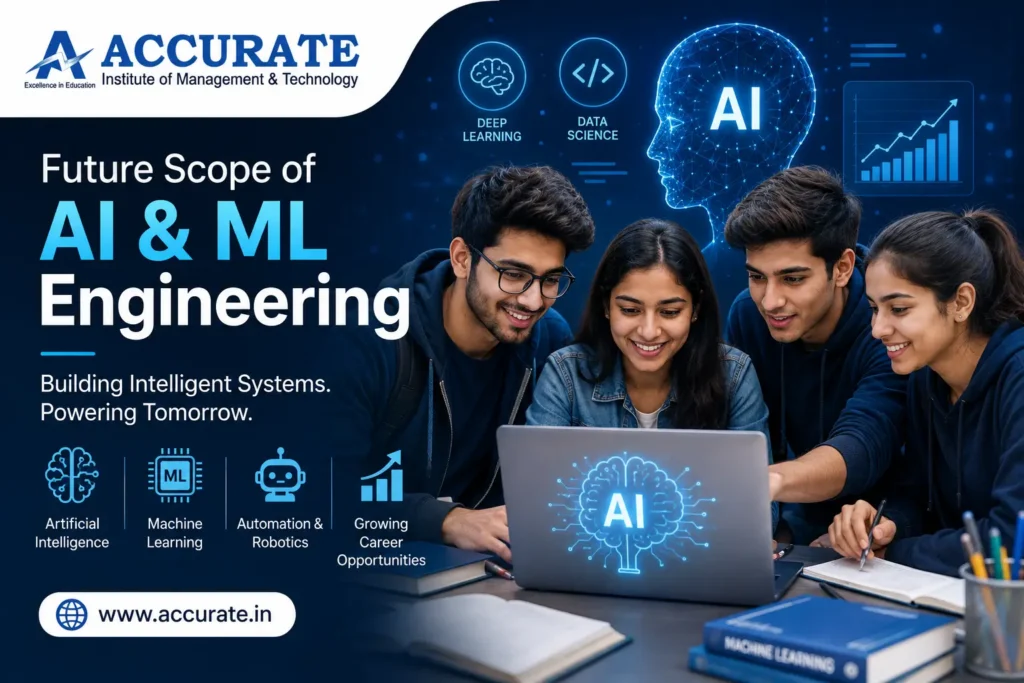

Artificial Intelligence has moved rapidly from research laboratories into everyday life.
Search engines, digital assistants, recommendation systems, fraud detection, navigation applications, intelligent cameras, automated manufacturing and Generative AI are only some examples of technologies influenced by Artificial Intelligence and Machine Learning.
For students completing Class 12, this technological transformation raises an important question:
What is the future scope of AI & ML Engineering?
Parents are asking the same question for a different reason. An engineering degree represents a significant commitment of time and resources. They naturally want to know whether an emerging specialisation can provide meaningful career opportunities when their child graduates.
AI & ML Engineering deserves attention because it is not limited to building chatbots or working at specialised AI companies. Artificial Intelligence is gradually becoming a capability that can be integrated into almost every area of technology.
Software companies are developing AI-enabled applications. Manufacturers are exploring intelligent automation. Financial organisations use advanced data analytics. Healthcare technology is incorporating AI-assisted systems. Automotive companies are developing increasingly intelligent vehicles. E-commerce platforms use algorithms to personalise customer experiences.
At the same time, Generative AI has introduced a new wave of applications involving text, software code, images, audio and multimodal information.
The result is a technology ecosystem where professionals increasingly need to understand both traditional computing and intelligent systems.
For students, therefore, the value of an AI & ML education is not simply learning the latest AI tools. It is about developing programming ability, computational thinking, mathematical foundations, data skills, Machine Learning knowledge and the ability to build intelligent applications.
Institutions such as Accurate Institute of Management & Technology, Greater Noida can form part of this journey by providing students with an engineering learning environment where academic knowledge can be complemented by skill development and career preparation.
This article explores the future of AI & ML Engineering, emerging technologies, career possibilities and the factors students and parents should consider before choosing this path.
Table of Contents
- What Is AI & ML Engineering?
- Why Is AI & ML Engineering Important for the Future?
- Future Scope of AI & ML Engineering in India
- Major Technologies Shaping the Future of AI & ML
- Top Career Opportunities After AI & ML Engineering
- Industries Where AI & ML Engineers Can Build Careers
- Essential Skills for Future AI & ML Engineers
- AI & ML Engineering Career Roadmap After Class 12
- AI & ML vs Traditional Computer Science
- How AI Is Changing Engineering Careers
- Higher Education and Research Opportunities
- Entrepreneurship Opportunities in AI & ML
- How Students Can Become Future-Ready
- What Parents Should Know Before Choosing AI & ML Engineering
- Why Consider Accurate Institute of Management & Technology?
- FAQs About AI & ML Engineering
- Conclusion and Admission CTA
What Is AI & ML Engineering?
Artificial Intelligence and Machine Learning Engineering is a technology-focused engineering field involving the design and development of intelligent computational systems.
Artificial Intelligence is the broader concept of enabling machines or software systems to perform tasks involving capabilities such as reasoning, perception, prediction, language processing or decision support.
Machine Learning is an important area within AI that enables computer systems to identify patterns from data.
What Do AI & ML Engineering Students Learn?
Depending on the curriculum, students may study areas such as:
- programming,
- data structures and algorithms,
- databases,
- mathematics,
- statistics,
- Machine Learning,
- Deep Learning,
- Natural Language Processing,
- computer vision,
- data analytics,
- software engineering,
- cloud technologies, and
- intelligent systems.
Students should remember that specific subjects vary by university and programme.
AI & ML Engineering Is Not Just About AI Tools
This distinction is essential for students entering college in 2026.
AI tools available today may look completely different by the time a student graduates.
Therefore, an engineering programme should not be evaluated merely by whether students learn a particular tool.
Strong fundamentals are more valuable.
Students who understand programming, algorithms, mathematics, data and software systems can adapt as AI technologies change.
Why Is AI & ML Engineering Important for the Future?
AI is increasingly becoming a layer within the broader digital economy.
In earlier phases of computing, organisations focused heavily on digitisation—moving information and processes onto computers.
The next phase increasingly involves making those systems more intelligent.
From Software to Intelligent Software
Traditional software follows programmed instructions.
Modern AI-enabled software can also recognise patterns, interpret natural language, make predictions and generate content.
This shift creates opportunities for engineers who understand both software development and AI.
Data Is Becoming More Valuable
Organisations generate large quantities of digital information.
Machine Learning can help transform that data into predictions, recommendations and operational insights.
As businesses become increasingly data-driven, professionals who understand how to work with data and intelligent algorithms can play important roles.
AI Can Work Across Industries
AI is not restricted to one sector.
Its techniques can potentially be applied anywhere meaningful data and computational problems exist.
That versatility contributes significantly to the future scope of AI & ML Engineering.
Future Scope of AI & ML Engineering in India
India has a large technology ecosystem that includes IT services, software products, startups, financial technology, e-commerce, telecommunications and global capability centres.
As organisations adopt AI capabilities, professionals with relevant engineering skills may find opportunities across different parts of this ecosystem.
However, students should maintain realistic expectations.
A degree title containing “AI” does not automatically guarantee an AI job.
Employability will depend on factors such as:
- technical competence,
- programming ability,
- projects,
- problem-solving,
- internships,
- communication,
- interview preparation, and
- the requirements of individual employers.
This makes practical skill development extremely important.
Opportunities Beyond Dedicated AI Companies
An AI graduate may work for an organisation whose primary business has nothing to do with selling AI.
For example, AI-related skills can be useful in:
- banks,
- hospitals and health-tech firms,
- manufacturing organisations,
- automotive companies,
- retailers,
- logistics companies,
- consulting firms,
- educational technology businesses, and
- cybersecurity organisations.
This cross-sector applicability can provide career flexibility.
Major Technologies Shaping the Future of AI & ML
Students choosing an engineering programme today should understand the technologies that could influence their careers tomorrow.
Generative AI
Generative AI can create new content based on patterns learned from data.
Its applications can include:
- text generation,
- coding assistance,
- image generation,
- document processing,
- enterprise knowledge systems,
- conversational applications, and
- creative technologies.
For engineers, the opportunity goes beyond writing prompts.
Professionals may need to integrate models into applications, develop retrieval systems, evaluate outputs and create reliable AI workflows.
Large Language Models
Large Language Models, commonly known as LLMs, power many modern language-based AI applications.
Engineering around LLMs may involve:
- application development,
- APIs,
- retrieval systems,
- evaluation,
- model optimisation,
- data pipelines,
- security, and
- AI agents.
Students with strong software development foundations may be well positioned to work in this area.
Agentic AI
AI agents are an emerging direction in which AI systems can perform multi-step tasks using models, tools and external information.
Building dependable AI agents involves challenges in software architecture, reliability, permissions, evaluation and security.
This could create new engineering roles and specialisations as the technology matures.
Multimodal AI
Human communication involves more than text.
Multimodal AI systems can process combinations of text, images, audio and video.
Potential applications include education, accessibility, healthcare technology, robotics, media and intelligent assistants.
Robotics and Autonomous Systems
Robotics combines hardware, sensors, control systems and software.
Artificial Intelligence can help robots interpret environments and make more sophisticated decisions.
Possible applications include:
- manufacturing,
- warehousing,
- agriculture,
- healthcare,
- mobility, and
- service robotics.
Computer Vision
Computer Vision enables computers to process information from images and video.
Future applications may include industrial quality control, autonomous systems, medical technology, retail analytics and security.
Edge AI
Many AI systems operate through cloud infrastructure, but AI can increasingly run directly on devices.
This is called Edge AI.
Applications can include smartphones, vehicles, sensors, industrial equipment and smart devices.
Engineers who understand both AI and embedded or connected technologies may find interesting interdisciplinary opportunities.
Top Career Opportunities After AI & ML Engineering
AI & ML Engineering can lead toward multiple career paths rather than one predefined profession.
1. AI Engineer
An Artificial Intelligence Engineer develops software systems that incorporate AI capabilities.
The role may involve data processing, model integration, testing, application development and deployment.
Strong programming skills are essential.
2. Machine Learning Engineer
Machine Learning Engineers build systems that learn patterns from data.
Typical responsibilities may involve:
- preparing datasets,
- selecting algorithms,
- training models,
- evaluating performance,
- improving models, and
- deploying ML applications.
Machine Learning Engineers benefit from both software development and mathematical skills.
3. Data Scientist
Data Scientists work with data to discover patterns and develop analytical or predictive solutions.
Their toolkit may include:
- Python,
- SQL,
- statistics,
- Machine Learning,
- data visualisation, and
- analytical problem-solving.
4. Generative AI Engineer
Generative AI Engineering is an emerging career direction.
Professionals may develop applications using language or multimodal models.
Skills can include:
- Python,
- APIs,
- LLM application development,
- Retrieval-Augmented Generation,
- model evaluation,
- vector databases,
- cloud services, and
- software engineering.
5. NLP Engineer
Natural Language Processing Engineers develop systems that interact with human language.
Applications can include search, translation, conversational interfaces, document processing and text analysis.
Modern NLP increasingly intersects with Generative AI.
6. Computer Vision Engineer
Computer Vision Engineers develop systems that analyse images and video.
Their work may involve Deep Learning, image processing, object detection and visual recognition.
7. Robotics Engineer
Students interested in machines and intelligent systems can explore robotics.
Robotics professionals may combine AI with sensors, control systems, computer vision and programming.
8. MLOps Engineer
Building an ML model is only the beginning.
Models used in real applications need to be deployed, monitored and maintained.
MLOps professionals help organisations manage this process.
Knowledge of Machine Learning, cloud computing, automation and software operations can be useful.
9. Data Engineer
AI applications require reliable data.
Data Engineers build systems that collect, transform and store information for applications and analytics.
Students may work with databases, data pipelines, Python, SQL and cloud platforms.
10. AI Research Engineer
Research-oriented students may explore advanced work in Machine Learning, Deep Learning, computer vision, language technologies or other AI domains.
Higher studies can be particularly useful for students interested in research-intensive careers.
11. AI Product Engineer
An AI Product Engineer builds complete products that incorporate AI capabilities.
This role may combine:
- frontend or backend development,
- databases,
- APIs,
- AI models,
- cloud technologies, and
- user experience considerations.
It demonstrates why software engineering remains valuable even for AI specialists.
12. Intelligent Automation Engineer
Intelligent automation combines conventional automation with AI.
Engineers may build systems that process documents, automate workflows or assist business operations.
Industries Where AI & ML Engineers Can Build Careers
Information Technology and Software
Software organisations are among the most obvious employers of AI-skilled professionals.
Opportunities may exist in product development, enterprise applications, cloud solutions, automation and analytics.
Healthcare Technology
AI can support areas such as medical image analysis, healthcare data systems and clinical decision-support technologies.
Banking and FinTech
Financial technology uses data-intensive systems for applications such as fraud analysis, risk assessment, customer experiences and automation.
Manufacturing
The combination of AI, IoT, computer vision and robotics supports smart manufacturing.
Automotive Industry
Modern automobiles increasingly combine sensors, software and intelligent systems.
This creates potential opportunities around driver assistance, autonomous technology and connected vehicles.
E-Commerce and Retail
AI can contribute to product recommendations, search, customer support, forecasting and inventory planning.
Cybersecurity
Machine Learning can help identify unusual patterns and support security analysis.
AI also introduces new security challenges, making knowledge across both areas increasingly relevant.
Education Technology
AI applications can support personalised learning, content creation, assessment tools and intelligent educational platforms.
Essential Skills for Future AI & ML Engineers
Students should avoid focusing exclusively on certificates.
The goal should be genuine technical capability.
Programming
Python is widely used for AI and Machine Learning.
Students should develop programming logic rather than simply memorising syntax.
Data Structures and Algorithms
DSA remains important for broader software and technology careers.
It can also play a significant role in technical interviews.
Mathematics
Useful mathematical foundations include:
- linear algebra,
- probability,
- statistics,
- calculus, and
- optimisation.
Machine Learning
Students should understand the concepts behind training, evaluating and improving models.
Deep Learning
Deep Learning is important for many advanced AI applications involving images, language and other complex information.
Databases and SQL
Most useful applications need reliable data storage and retrieval.
SQL is therefore a valuable skill.
Cloud and Deployment
A model running on a student’s laptop is different from a production system serving real users.
Learning deployment concepts and cloud technologies can help bridge this gap.
Communication
Engineers frequently work in teams and need to explain technical ideas.
Good communication can therefore complement technical competence.
AI & ML Engineering Career Roadmap After Class 12
Students do not need to master AI before entering college.
They need curiosity and a willingness to learn.
Year One: Develop Fundamentals
Focus on:
- programming,
- mathematics,
- communication,
- logical thinking, and
- engineering fundamentals.
Year Two: Build Computer Science Foundations
Students can strengthen:
- Data Structures and Algorithms,
- object-oriented programming,
- databases,
- SQL,
- software development, and
- introductory Machine Learning.
Year Three: Build AI Expertise
Students can explore:
- Machine Learning,
- Deep Learning,
- NLP,
- computer vision,
- Generative AI,
- cloud technologies, and
- meaningful projects.
This is also an important stage for internships and hackathons.
Year Four: Become Career Ready
Students should focus on:
- internships,
- final-year projects,
- coding preparation,
- aptitude,
- technical interviews,
- resume development,
- portfolio building, and
- placement preparation.
A strong GitHub or project portfolio can help students demonstrate practical skills.
AI & ML vs Traditional Computer Science
Students and parents frequently ask whether AI & ML Engineering is better than Computer Science Engineering.
There is no universal answer.
Computer Science Engineering generally offers a broad foundation across computing, while AI & ML-focused programmes provide additional emphasis on intelligent systems and data-driven technologies.
The two areas overlap significantly.
AI applications still depend on:
- programming,
- databases,
- software engineering,
- algorithms,
- operating systems,
- networks, and
- cloud infrastructure.
Therefore, students studying AI should not neglect core Computer Science.
A strong combination for future careers is:
Computer Science Fundamentals + Programming + AI/ML + Data + Cloud + Practical Projects
This combination can help students remain adaptable.
How AI Is Changing Engineering Careers
A common concern among students and parents is whether AI will replace engineers.
A more useful perspective is that AI is changing how many engineers work.
Software developers can use AI-assisted coding tools. Data professionals can automate parts of analysis. Designers can explore concepts more rapidly. Businesses can automate repetitive processes.
This means future professionals may increasingly work with AI.
Students should therefore learn both how AI works and how to use it responsibly as part of engineering workflows.
Human capabilities such as critical thinking, problem definition, communication, creativity and judgement remain important.
Higher Education and Research Opportunities
AI & ML graduates interested in advanced specialisation can consider higher education.
Possible paths may include:
- M.Tech,
- MS,
- specialised postgraduate programmes,
- research programmes, and
- PhD studies.
Potential areas of advanced study include:
- Machine Learning,
- Deep Learning,
- Natural Language Processing,
- computer vision,
- robotics,
- data science,
- autonomous systems, and
- AI research.
Students interested in research-intensive roles may particularly benefit from advanced education.
Entrepreneurship Opportunities in AI & ML
AI is not only creating employment opportunities.
It can also create opportunities for entrepreneurship.
Students can potentially build solutions around:
- education,
- healthcare,
- productivity,
- customer service,
- business automation,
- agriculture,
- analytics,
- cybersecurity, and
- enterprise software.
Modern cloud services and AI APIs can make experimentation more accessible.
However, successful startups need more than technology.
Students also need to understand customers, markets, product design, costs and business models.
How Students Can Become Future-Ready
Students should use their engineering years strategically.
Build Projects, Not Just Certificates
A project demonstrates whether a student can apply what they have learned.
Students should be prepared to explain:
- the problem,
- the dataset,
- the technical approach,
- the tools,
- the challenges,
- the evaluation method, and
- the outcome.
Learn Software Development Alongside AI
Many real-world AI applications are software products.
Students who can build an entire application can have greater flexibility than those who understand only model training.
Participate in Hackathons
Hackathons encourage teamwork, experimentation and rapid problem-solving.
Look for Internships
Internships can expose students to professional development practices and workplace expectations.
Keep Learning
AI evolves rapidly.
Students should become comfortable learning throughout their careers.
What Parents Should Know Before Choosing AI & ML Engineering
Parents should evaluate AI & ML Engineering using practical criteria rather than choosing it only because AI is currently popular.
Look at the Curriculum
Check whether the programme combines AI specialisation with strong computing fundamentals.
Evaluate Practical Learning
Ask about projects, laboratories and opportunities to apply classroom knowledge.
Consider Career Preparation
Engineering students also need coding, aptitude, communication and interview preparation.
Avoid Guaranteed-Career Thinking
No responsible institution can predict the exact job a student will receive several years in advance.
The better approach is to select an environment where students have opportunities to develop strong, transferable skills.
Consider the Student’s Interests
AI & ML can be demanding.
Students who genuinely enjoy technology, problem-solving and continuous learning are more likely to make the most of the field.
Why Consider Accurate Institute of Management & Technology for Your Engineering Journey?
Choosing a specialisation is only one part of an engineering decision.
Students also need to consider where they will spend the next several years developing their academic and professional abilities.
Accurate Institute of Management & Technology, Greater Noida offers students an environment for professional and technology-oriented education in the Delhi NCR region.
Students interested in AI, Machine Learning and emerging technologies should use their college experience to develop a combination of:
- academic fundamentals,
- programming,
- practical projects,
- problem-solving,
- communication,
- industry awareness, and
- career readiness.
The institute’s Greater Noida location places students within an important educational and corporate region of Delhi NCR.
Prospective students and parents should review the latest programme curriculum, approvals, eligibility requirements, admission procedure, infrastructure, academic resources and placement information directly with Accurate Institute before making an admission decision.
The objective should not simply be to earn an engineering degree.
It should be to graduate with knowledge, demonstrable skills and the confidence to adapt to a changing technology industry.
Frequently Asked Questions About the Future Scope of AI & ML Engineering
1. What is the future scope of AI & ML Engineering?
The future scope of AI & ML Engineering includes opportunities in Machine Learning, Generative AI, Data Science, NLP, computer vision, robotics, MLOps, automation and AI-enabled software. These technologies can be applied across IT, finance, healthcare, manufacturing, automotive and other sectors.
2. Is AI & ML Engineering a good career choice in 2026?
AI & ML Engineering can be a good choice in 2026 for students interested in computers, programming, mathematics, data and emerging technologies. Career outcomes depend significantly on the student’s skills, projects, experience and preparation.
3. What jobs are available after B.Tech in AI and ML?
Potential career paths include AI Engineer, Machine Learning Engineer, Data Scientist, Generative AI Engineer, NLP Engineer, Computer Vision Engineer, MLOps Engineer, Data Engineer, Robotics Engineer and software development roles, depending on employer requirements and student skills.
4. Is AI & ML Engineering better than CSE?
Neither is automatically better. CSE provides broad computing foundations, while an AI & ML-focused programme gives additional emphasis to intelligent systems and Machine Learning. Students should compare curricula and choose according to their interests and career goals.
5. Does AI & ML Engineering have scope in India?
Yes. AI and Machine Learning technologies are relevant to India’s software, IT services, financial technology, e-commerce, manufacturing, automotive, healthcare technology and startup ecosystems. Students should develop strong technical fundamentals to compete for opportunities.
6. Does AI & ML Engineering require mathematics?
Yes. Mathematics helps students understand many AI and Machine Learning concepts. Linear algebra, statistics, probability, calculus and optimisation can be particularly useful. These skills can be developed progressively during engineering studies.
7. Is coding compulsory for AI & ML Engineering?
Programming is a fundamental component of AI & ML Engineering. Python is widely used, while broader programming, Data Structures and Algorithms and software development skills can improve career flexibility.
8. Can AI & ML graduates become software engineers?
Yes, depending on their skills and an employer’s eligibility requirements. AI & ML students who develop strong programming, DSA, databases and software engineering fundamentals can potentially explore general software development careers alongside specialised AI roles.
9. Which AI & ML skills will be useful in the future?
Useful skills include Python, Data Structures and Algorithms, SQL, statistics, Machine Learning, Deep Learning, Generative AI, cloud computing, APIs, deployment, data engineering and software development. Communication and problem-solving are also important.
10. Why consider Accurate Institute of Management & Technology for engineering admission?
Students can consider Accurate Institute of Management & Technology when exploring engineering education in Greater Noida and Delhi NCR. Before applying, students and parents should review the institute’s latest programmes, curriculum, eligibility, academic facilities, career-development opportunities and current admission information directly with the institute.
Conclusion: Prepare Today for the Future of AI & ML
Artificial Intelligence and Machine Learning are helping redefine what computers can do.
From Generative AI and intelligent automation to computer vision, robotics, autonomous systems and AI-powered software, the technology landscape is evolving rapidly.
For students, this creates exciting possibilities—but it also creates a responsibility to prepare properly.
The future scope of AI & ML Engineering should not be viewed as a promise of one particular job or salary. Its real strength lies in the range of technologies, industries and career paths where AI and Machine Learning knowledge can potentially be applied.
Students who combine strong Computer Science fundamentals, programming, mathematics, AI/ML expertise, software development, practical projects and communication skills can position themselves to adapt as the industry evolves.
Parents evaluating AI & ML Engineering should therefore look beyond trends. They should consider the quality of the learning environment, curriculum, practical exposure and opportunities available for their child to develop career-ready skills.
For aspiring engineers looking to begin this journey in Greater Noida, Accurate Institute of Management & Technology can be considered as part of the engineering admission search.
Take the Next Step Towards a Future-Ready Engineering Career
If Artificial Intelligence, Machine Learning, Generative AI and emerging technologies excite you, now is the time to start exploring your engineering education options.
Explore engineering admission opportunities at Accurate Institute of Management & Technology, Greater Noida.
Students and parents can visit www.accurate.in to explore current programmes, eligibility requirements and the latest admission information.
Build strong fundamentals. Develop real skills. Create meaningful projects. Prepare for the technologies shaping tomorrow.
Start Your Engineering Journey with Accurate Institute of Management & Technology
Explore Admissions | Discover Engineering Programmes | Visit: www.accurate.in