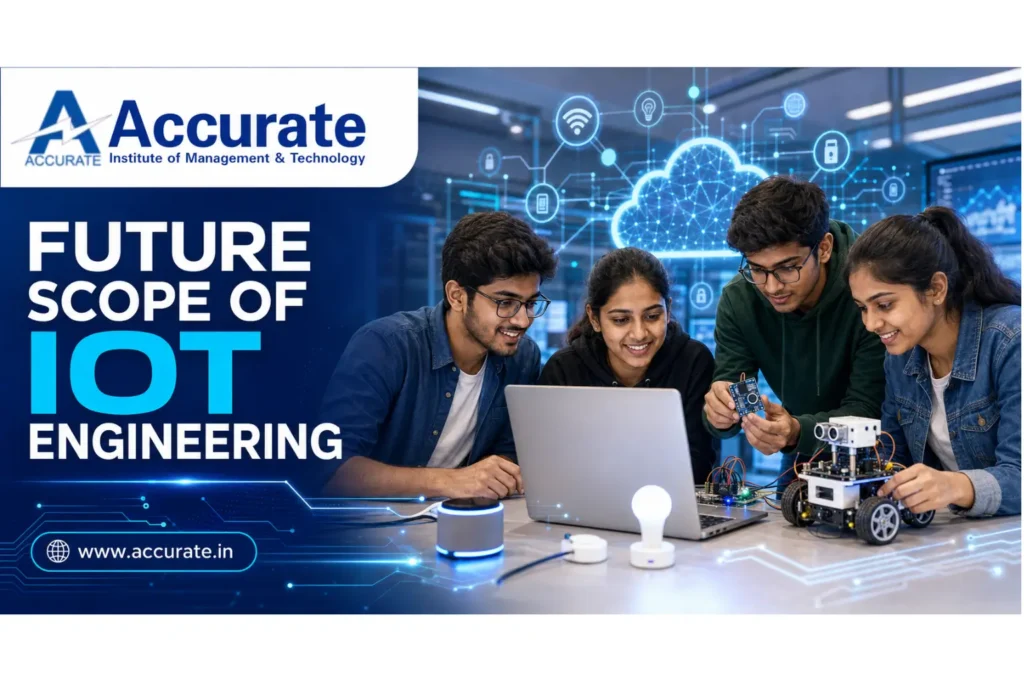

The Internet of Things, commonly known as IoT, is transforming ordinary physical objects into intelligent, connected systems. From smart watches and home appliances to factory machines, healthcare devices, vehicles and agricultural equipment, connected technologies are becoming part of everyday life. This rapid transformation is creating a promising future scope for IoT engineering across India and the world.
IoT engineering combines computer science, electronics, communication networks, sensors, cloud computing, data analytics and cybersecurity. An IoT engineer does more than connect a device to the internet. The engineer designs a complete system that can collect information, communicate securely, process data and trigger useful actions.
As businesses move toward automation and data-driven decision-making, the demand for professionals who understand both software and hardware is expected to grow. Students who develop practical expertise in embedded systems, programming, networking, cloud platforms and artificial intelligence can pursue opportunities in manufacturing, healthcare, agriculture, transportation, energy, retail, smart infrastructure and many other industries.
Institutions such as Accurate Institute of Management & Technology help students prepare for this technology-driven environment through engineering education, practical learning, technical projects and industry-oriented skill development. For students seeking a career that connects the digital and physical worlds, IoT engineering offers a highly versatile path.
Table of Contents
- What Is IoT Engineering?
- Quick Answer: What Is the Future Scope of IoT Engineering?
- Why Is IoT Engineering Growing?
- Major Technologies Shaping the Future of IoT
- Future Applications of IoT Engineering
- Career Opportunities After IoT Engineering
- Skills Required to Become an IoT Engineer
- IoT Engineering Scope in India
- IoT Engineering for Entrepreneurship
- Challenges Creating New Career Opportunities
- How Students Can Prepare for an IoT Career
- Why Study at Accurate Institute of Management & Technology?
- Conclusion
- Frequently Asked Questions
Quick Answer: What Is the Future Scope of IoT Engineering?
The future scope of IoT engineering is strong because connected devices are increasingly being used in homes, factories, hospitals, farms, vehicles, energy systems and cities. IoT engineers can work in embedded systems, sensor technology, cloud computing, industrial automation, cybersecurity, artificial intelligence and data analytics. Career opportunities include IoT developer, embedded systems engineer, automation engineer, IoT security specialist, cloud engineer and solution architect.
This concise answer is structured for featured snippets, AI-generated search results and voice-search queries.
What is the future scope of IoT engineering?
IoT engineering has excellent future scope because industries need professionals who can build connected devices, automate operations, analyse sensor data and secure intelligent systems. Graduates can find opportunities in smart manufacturing, healthcare, agriculture, automobiles, energy, logistics, consumer electronics and smart-city projects.
What Is IoT Engineering?
IoT engineering is the design, development and management of connected physical systems. These systems use sensors to observe real-world conditions, processors to perform calculations, communication technologies to transmit information and software platforms to analyse data.
A smart irrigation system is a simple example. Sensors measure moisture in the soil, a controller processes the readings and a connected application allows the farmer to monitor the field remotely. If the soil becomes dry, the system can automatically activate irrigation.
A commercial IoT ecosystem may include thousands of such devices. It must handle connectivity, cloud storage, software updates, data privacy, system reliability and cybersecurity. This complexity is why trained IoT engineers are needed.
Major Components of an IoT System
A typical IoT solution includes:
- Sensors and actuators
- Microcontrollers or embedded processors
- Wired or wireless communication
- Gateways and edge devices
- Cloud infrastructure
- Databases and analytics tools
- Mobile or web applications
- Security and identity-management systems
IoT engineering is therefore multidisciplinary. Students need to understand how electronics, programming, networks and data platforms work together.
Why Is IoT Engineering Growing?
The expansion of IoT is being supported by several technological and business developments. Devices are becoming smaller, more capable and more energy-efficient. Wireless connectivity is reaching more locations, while cloud platforms make it easier to store and analyse large volumes of data.
Organisations also want better visibility into their operations. A factory wants to know when a machine may fail. A logistics company wants to track the location and condition of its goods. A hospital wants to monitor patients more effectively. IoT makes these outcomes possible by converting physical activity into usable digital information.
Demand for Automation
Automation has moved beyond large production lines. Warehouses, commercial buildings, farms, laboratories, transport networks and retail stores can now use connected systems to automate repetitive processes.
Every automated environment needs engineers who can select sensors, configure controllers, develop software, manage connectivity and maintain system security. As automation expands, so does the scope of IoT engineering.
Growth of Data-Driven Decision-Making
Connected devices continuously produce operational data. When this information is analysed correctly, it can help organisations understand equipment performance, energy usage, customer behaviour and supply-chain movement.
IoT engineers build the infrastructure through which this data is collected and delivered. They may also work with data scientists to develop dashboards, predictions and automated decision systems.
Need for Real-Time Monitoring
Traditional systems often detect problems only after failure occurs. IoT allows organisations to monitor temperature, pressure, vibration, movement, location, air quality and many other conditions in real time.
Immediate monitoring is valuable in sectors where safety, quality or efficiency is important. This includes healthcare, pharmaceuticals, energy, transportation and manufacturing.
Expansion of Connected Consumer Products
Smart speakers, security cameras, fitness devices, appliances, lighting systems and wearable technologies have increased awareness of IoT among consumers. Future products are likely to provide greater personalisation and improved integration across devices.
This creates opportunities for engineers in product design, embedded software, mobile applications, user experience, testing and device security.
Major Technologies Shaping the Future of IoT
The future of IoT engineering will be influenced by its integration with artificial intelligence, advanced communication networks, cloud services and secure computing.
Artificial Intelligence and AIoT
The combination of artificial intelligence and IoT is often called AIoT. IoT devices gather information, while AI models recognise patterns and make predictions from that information.
For example, sensors installed in industrial equipment can collect vibration and temperature data. An AI system can analyse the data to identify signs of possible failure. Maintenance can then be scheduled before an expensive breakdown occurs.
Future IoT engineers will benefit from understanding machine learning, data preparation and intelligent automation. They may not need to become specialised data scientists, but they should know how AI capabilities can be integrated into connected products.
Edge Computing
Sending every piece of device data to a distant cloud server may cause delays and consume bandwidth. Edge computing solves this problem by processing information close to where it is generated.
A connected vehicle, for example, may need to respond to its surroundings immediately. It cannot always wait for information to travel to the cloud and return. Edge computing makes rapid local decisions possible.
Knowledge of embedded processors, lightweight software, real-time systems and edge AI will become increasingly useful for IoT engineers.
Cloud Computing
Cloud platforms provide storage, analytics, device management and application services for IoT systems. They allow organisations to manage large numbers of devices from a central environment.
IoT professionals may work on device registration, data pipelines, dashboards, databases, cloud functions and access controls. Familiarity with cloud architecture can therefore improve a graduate’s career options.
Advanced Connectivity
Wi-Fi, Bluetooth, cellular networks, low-power wide-area technologies and industrial communication protocols serve different IoT requirements. Some devices need high-speed connectivity, while others must operate on limited power for long periods.
Future engineers must learn how to select communication technologies according to range, energy use, speed, cost and security. The continued development of modern communication infrastructure will enable connected applications in more industries and locations.
Digital Twins
A digital twin is a virtual representation of a physical asset, process or environment. Data from sensors keeps the digital model updated, allowing engineers to monitor performance, test changes and predict outcomes.
Digital twins can be used for factories, buildings, machines, energy systems and transportation infrastructure. IoT engineers play an important role in capturing reliable real-world data for these models.
Blockchain and Trusted Device Networks
Some IoT applications require transparent and tamper-resistant records. Distributed-ledger technologies may be used in selected supply-chain, identity and transaction systems.
This field is still developing, but engineers who understand secure device identity, trusted data exchange and decentralised applications may find specialised opportunities.
Future Applications of IoT Engineering
The broad future scope of IoT engineering becomes clearer when its industry applications are considered.
Smart Manufacturing and Industry 4.0
Manufacturing is one of the most important areas for IoT innovation. Connected sensors can monitor machines, production lines, inventory, energy consumption and workplace conditions.
Industrial IoT systems can support:
- Predictive maintenance
- Automated quality monitoring
- Equipment tracking
- Production optimisation
- Worker-safety alerts
- Energy management
- Supply-chain visibility
Engineers working in this sector may combine IoT with robotics, programmable logic controllers, computer vision and industrial automation. The ability to understand both operational equipment and digital platforms is especially valuable.
Smart Healthcare
Connected medical devices can help healthcare professionals monitor patients, manage equipment and improve the availability of health information. Wearable devices may track selected health indicators, while hospital systems can monitor the location and condition of critical equipment.
IoT engineers in healthcare must pay close attention to reliability, privacy and security. They may collaborate with medical professionals, software developers, data analysts and regulatory teams.
Potential areas include remote patient monitoring, connected diagnostic systems, smart hospital rooms, medicine-storage monitoring and assistive technologies.
Smart Agriculture
IoT can help farmers make informed decisions about irrigation, soil conditions, weather, livestock and crop health. Sensors and connected equipment can reduce unnecessary resource consumption while improving monitoring.
An IoT-based agricultural system may combine soil sensors, local weather data, automated irrigation and a mobile dashboard. Engineers may also integrate drones, satellite information and machine-learning models.
India’s large agricultural economy gives this application area significant long-term relevance.
Connected and Autonomous Transportation
Modern transportation systems increasingly depend on sensors, navigation technology, communication networks and real-time analytics. Connected vehicles can share diagnostic information, support fleet management and improve passenger services.
IoT is also useful for tracking public transport, monitoring road conditions, managing parking and optimising traffic flow. Engineers may work with automotive companies, logistics providers, public infrastructure organisations or mobility startups.
Smart Homes and Buildings
IoT systems can automate lighting, security, temperature control, access management and energy usage. Commercial buildings may use connected technologies to improve comfort, safety and operational efficiency.
Future smart-building solutions will increasingly integrate occupancy data, renewable energy systems, predictive maintenance and intelligent controls. This creates roles in product development, systems integration, networking and facility technology.
Energy and Utilities
Smart meters, grid-monitoring devices and connected renewable-energy systems can provide detailed information about energy generation and consumption.
IoT engineers can help utility providers identify faults, manage demand and monitor distributed energy resources. They may also develop solutions for solar installations, battery systems, electric-vehicle charging and energy-efficient buildings.
Logistics and Supply Chains
Logistics companies need to know where goods are, whether storage conditions are appropriate and whether deliveries are progressing as planned. Connected trackers and environmental sensors can provide this visibility.
Cold-chain logistics is a particularly important application because products such as medicines and food may require controlled temperatures. IoT devices can record conditions and generate alerts when limits are crossed.
Smart Cities and Public Infrastructure
Connected streetlights, waste-management systems, water networks, traffic signals and environmental sensors can help authorities manage public services more efficiently.
Smart-city projects require engineers who understand large-scale networks, device maintenance, data platforms, public safety and interoperability. These projects may create opportunities across government, infrastructure companies, technology firms and consultancies.
Retail and Customer Experience
Retailers can use IoT for inventory monitoring, connected shelves, equipment maintenance and supply-chain tracking. Physical stores may use sensor information to understand movement patterns and improve operations.
IoT engineers can contribute to hardware selection, store connectivity, data integration and real-time applications.
Environmental Monitoring
Connected sensors can monitor air quality, water quality, weather conditions, forests and wildlife habitats. Networks of low-power devices may collect information from remote locations and help researchers identify environmental changes.
This field offers meaningful opportunities for engineers interested in sustainability and technology for social impact.
Career Opportunities After IoT Engineering
IoT graduates can pursue technical, analytical and managerial roles. The right career path depends on whether a student is more interested in hardware, software, networks, cloud computing, data or product development.
IoT Developer
An IoT developer builds software that allows devices, gateways, cloud services and applications to communicate. Responsibilities may include device programming, API development, data integration and application testing.
Embedded Systems Engineer
Embedded systems engineers develop the hardware and low-level software inside connected products. They work with microcontrollers, sensors, circuit interfaces, firmware and real-time operating systems.
This role is suitable for students who enjoy both electronics and programming.
IoT Solutions Architect
A solutions architect designs the overall structure of an IoT system. The architect decides how devices will connect, where data will be processed, how information will be stored and how the system will remain secure and scalable.
This role generally requires experience across multiple technologies.
IoT Security Specialist
Every connected device can become a potential security risk if it is poorly designed or managed. IoT security professionals protect device identities, communication channels, software updates and cloud platforms.
Security is likely to remain one of the most important specialisations within IoT engineering.
Industrial Automation Engineer
Industrial automation engineers work with sensors, controllers, robotics, manufacturing software and monitoring platforms. They help organisations improve production, quality and maintenance processes.
Cloud and IoT Platform Engineer
These professionals manage cloud-based services used for device communication, storage, analytics and remote management. They may build data pipelines, configure access permissions and improve platform reliability.
Network Engineer for Connected Systems
IoT network engineers design and maintain the communication infrastructure used by connected devices. They evaluate coverage, bandwidth, power consumption, latency and security.
Hardware Design Engineer
Hardware engineers design circuit boards, sensor interfaces, communication modules and power-management systems. Their work is essential for creating reliable and energy-efficient devices.
IoT Data Analyst
An IoT data analyst interprets information generated by connected machines and sensors. The analyst builds dashboards, detects patterns and helps organisations make operational decisions.
Product Engineer or Product Manager
IoT product teams need professionals who understand user requirements as well as technical limitations. With experience, engineering graduates can move into product management, consulting, technical sales or business development.
Research and Development Engineer
R&D engineers explore new sensing technologies, communication systems, smart materials, edge-computing methods and intelligent products. Students interested in innovation can pursue higher education and research-oriented careers.
Skills Required to Become an IoT Engineer
A successful IoT career requires a combination of technical knowledge, practical experience and problem-solving ability.
Programming Skills
Students should build a strong foundation in languages such as C, C++, Python or Java. C and C++ are frequently useful for embedded devices, while Python is valuable for rapid development, automation and data analysis.
Electronics and Sensor Integration
IoT engineers should understand basic circuits, microcontrollers, sensors, actuators and communication modules. Practical experimentation helps students learn how physical devices behave outside a textbook environment.
Networking Knowledge
Students need to understand IP networks, wireless communication, routing concepts and common messaging protocols. They should also know how device requirements affect the choice of connectivity.
Cloud and Database Fundamentals
Cloud services allow IoT platforms to scale. Familiarity with databases, APIs, data pipelines and cloud-based device management can improve employability.
Cybersecurity Awareness
Students must learn secure coding, encryption basics, authentication, access control, vulnerability management and safe software updates. Security should be considered from the first stage of system design.
Data Analytics and Artificial Intelligence
Knowledge of data visualisation, statistics and machine-learning fundamentals helps engineers create more intelligent IoT solutions. Students should learn how sensor data can be cleaned, analysed and converted into useful predictions.
Communication and Teamwork
IoT projects usually involve professionals from multiple fields. Engineers must communicate with hardware designers, software developers, business teams and end users. Documentation, presentation and collaboration skills are therefore important.
IoT Engineering Scope in India
India offers a favourable environment for IoT development because of digital transformation across manufacturing, mobility, telecommunications, healthcare, agriculture, infrastructure and consumer technology.
Manufacturing companies are adopting connected monitoring and automation. Startups are developing solutions for electric mobility, logistics, agriculture and healthcare. Public infrastructure projects are exploring smart monitoring, while businesses are using connected devices to improve efficiency.
Delhi NCR, Noida and Greater Noida have become important education, technology, electronics, manufacturing and startup locations. Students studying in this region can benefit from exposure to diverse industries and professional networks.
The future scope of IoT engineering in India will depend not only on the number of connected devices but also on the need to design, secure, manage and improve them. This means opportunities may appear across product companies, IT services, consulting firms, manufacturing organisations, research centres and startups.
IoT Engineering and Entrepreneurship
IoT offers strong possibilities for students who want to launch a startup or develop an innovative product. A small team can create a prototype using affordable sensors, development boards, cloud platforms and mobile applications.
Potential startup areas include:
- Smart farming solutions
- Energy-monitoring systems
- Asset-tracking platforms
- Home automation
- Healthcare monitoring
- Industrial safety
- Water-management systems
- Connected educational tools
- Waste-management technology
- Electric-mobility solutions
However, a successful IoT startup requires more than a working prototype. Entrepreneurs must consider product reliability, manufacturing cost, user experience, maintenance, cybersecurity and market demand.
Engineering students should therefore learn to identify real problems before selecting technologies. A simple solution to an important problem may have greater value than a complicated product without a clear purpose.
Challenges Creating New Career Opportunities
IoT engineering has challenges, but these challenges also generate demand for specialists.
Cybersecurity Risks
Connected devices may collect sensitive data or control physical equipment. Weak passwords, outdated software and insecure communication can expose systems to attacks. Security engineers are needed to design safer products and monitor deployed systems.
Device Compatibility
IoT products may use different protocols, data formats and platforms. Making these systems work together is a major engineering challenge. Specialists in integration, standards and platform architecture can address this issue.
Privacy and Ethical Use of Data
Connected products may collect information about locations, habits, workplaces or health. Organisations need clear policies and privacy-aware system designs. Future engineers must understand responsible data collection and user consent.
Power and Battery Limitations
Many IoT devices must operate for long periods without frequent charging. Engineers are developing low-power electronics, efficient communication methods and energy-harvesting solutions.
Reliability and Maintenance
Devices deployed in factories, farms or remote areas may face dust, heat, moisture and network interruptions. Designing durable systems and providing secure remote updates require advanced engineering skills.
Managing Large-Scale Systems
A prototype with a few devices is easier to manage than a commercial network containing thousands of devices. Large deployments require scalable architecture, automated monitoring and efficient lifecycle management.
How Students Can Prepare for an IoT Career
Students should begin by strengthening their foundations in programming, electronics and computer networks. They can then apply their knowledge through practical projects.
Useful beginner projects include a smart irrigation system, environmental monitor, home-security device, energy meter or equipment-health tracker. Each project should involve more than assembling hardware. Students should document the problem, architecture, code, testing process, security considerations and results.
Internships, hackathons, technical workshops and industry visits can help students understand real engineering requirements. Online learning may supplement classroom education, but consistent laboratory practice remains essential.
Students should also build a portfolio on a professional platform or code repository. A portfolio showing working prototypes, circuit diagrams, dashboards and technical explanations can make a candidate more credible during internships and placements.
Why Study IoT Engineering at Accurate Institute of Management & Technology?
Choosing the right learning environment is important because IoT is a practical and interdisciplinary field. Students need opportunities to connect theoretical concepts with programming, electronics, data and real-world problem-solving.
Accurate Institute of Management & Technology, Greater Noida, focuses on career-oriented engineering education and the development of contemporary technical skills. Its location in Delhi NCR gives students access to a growing ecosystem of technology companies, industries, startups and professional opportunities.
Students can benefit from an academic environment that encourages project-based learning, technical participation, teamwork and professional development. By working on practical applications, learners can understand how sensors, software, networks and cloud services form a complete connected system.
The institute’s emphasis on industry awareness and employability can help students prepare not only for their first job but also for the continuous learning required in a rapidly changing field. Aspiring engineers should use their college years to develop strong fundamentals, build prototypes, participate in innovation activities and improve their communication skills.
For students exploring the future scope of IoT engineering, Accurate Institute of Management & Technology offers an educational pathway in Greater Noida where technology learning can be connected with career preparation.
Conclusion: Build Your Future in IoT Engineering
IoT engineering is shaping a world in which machines, devices and infrastructure can observe conditions, exchange information and respond intelligently. Its applications extend from smart homes and wearable devices to factories, hospitals, farms, vehicles, energy networks and public infrastructure.
The future scope of IoT engineering is promising because the field combines several high-value technologies, including artificial intelligence, embedded systems, cloud computing, cybersecurity, data analytics and automation. Graduates can pursue roles in software, hardware, networks, security, industrial systems, research, product development and entrepreneurship.
Success in IoT requires more than theoretical knowledge. Students must practise coding, work with sensors, understand communication systems, explore cloud platforms and learn to secure connected devices. Those who continuously build practical skills will be better prepared for evolving career opportunities.
If you want to develop future-ready engineering abilities and explore connected technologies through an industry-oriented learning environment, consider Accurate Institute of Management & Technology, Greater Noida. Begin your admission journey, explore the engineering programmes and take the first step toward building intelligent solutions for a connected world.
Visit: https://www.accurate.in
Frequently Asked Questions (FAQs)
1. What is the future scope of IoT engineering?
The future scope of IoT engineering is broad because connected systems are being adopted in manufacturing, healthcare, agriculture, transportation, energy, logistics and smart infrastructure. Graduates can work in embedded development, cloud platforms, automation, IoT security, networking and data analytics.
2. Is IoT engineering a good career in India?
Yes. IoT engineering can be a good career in India for students who develop strong practical skills. Digital transformation, smart manufacturing, electric mobility, automation and connected services are creating opportunities in technology companies, industrial organisations, consulting firms and startups.
3. What jobs can I get after studying IoT engineering?
Graduates can pursue roles such as IoT developer, embedded systems engineer, firmware developer, automation engineer, cloud engineer, IoT security specialist, network engineer, data analyst, hardware engineer and IoT solutions architect.
4. Does IoT engineering require coding?
Yes. Coding is an important part of IoT engineering. Depending on the project, students may use C, C++, Python, Java or JavaScript. They should also understand APIs, databases and device-to-cloud communication.
5. Is IoT related to artificial intelligence?
IoT and artificial intelligence are closely related. IoT devices collect real-world data, while AI models analyse that data to detect patterns, predict events and automate decisions. Their combination is commonly called AIoT.
6. Which industries hire IoT engineers?
IoT engineers may be hired by companies working in electronics, manufacturing, automobiles, healthcare, telecommunications, logistics, energy, agriculture, software services, home automation, retail and smart infrastructure.
7. What skills are required for a career in IoT?
Important IoT skills include programming, embedded systems, sensor integration, networking, cloud computing, databases, cybersecurity and data analytics. Communication, teamwork and practical problem-solving are also essential.
8. Can an IoT engineer work in cybersecurity?
Yes. IoT security is an important specialisation. Engineers can work on secure device design, authentication, encryption, vulnerability testing, access control, network protection and safe software-update systems.
9. Can IoT engineering graduates start their own businesses?
Yes. IoT graduates can build startups in areas such as agriculture, healthcare, energy monitoring, asset tracking, home automation and industrial safety. Successful founders must combine engineering knowledge with market research, product design and business planning.
10. Why choose Accurate Institute of Management & Technology for engineering?
Accurate Institute of Management & Technology offers a career-oriented learning environment in Greater Noida. Students can develop engineering fundamentals, practical abilities, project experience and professional skills while studying near the industrial and technology ecosystem of Delhi NCR.