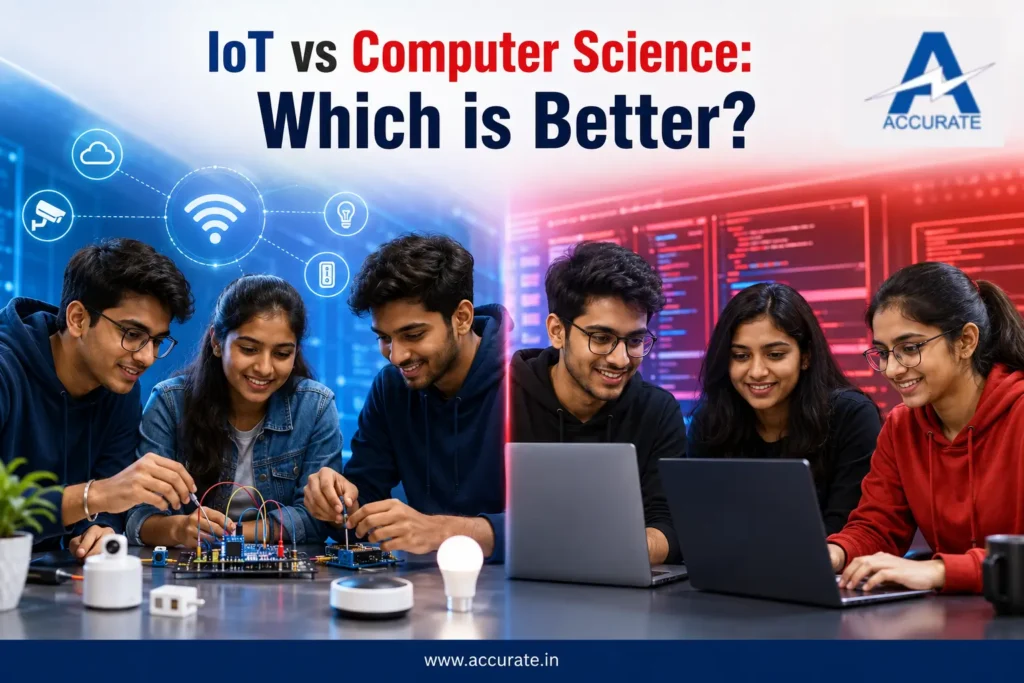

Choosing an engineering branch is not simply a choice between two course names. It is a decision about the subjects you will study, the projects you will build, the skills you will practise and the kind of problems you may solve throughout your career. That is why the debate around IoT vs Computer Science deserves a thoughtful answer rather than a quick claim that one field is always superior.
Computer Science Engineering, commonly known as CSE, is one of the broadest technology disciplines. It focuses on computation, programming, algorithms, software systems, databases and modern fields such as artificial intelligence, cloud computing and cybersecurity. The Internet of Things, or IoT, connects software with the physical world. It uses sensors, processors, communication networks, cloud platforms and data analytics to make devices observe, exchange information and respond intelligently.
These fields overlap, but they are not identical. A Computer Science student may build an application that analyses information. An IoT student may create a sensor-based system that collects that information, sends it to the cloud, analyses it and triggers a real-world action. One field is software-centred and broad; the other is multidisciplinary and focused on connected systems.
For students considering B.Tech admission, the better option depends on personal interests and long-term direction. This guide compares the two paths in detail so that you can make a confident, informed choice.
Table of Contents
- IoT vs Computer Science: Quick Comparison
- Key Differences in Curriculum
- Skills Required for Each Field
- Learning Experience and Project Work
- Career Opportunities After IoT
- Career Opportunities After Computer Science
- Salary Potential and Career Growth
- Future Scope of IoT and Computer Science
- Which Course Is More Difficult?
- How to Choose the Right Branch
- Why Study Future-Ready Engineering at Accurate Institute?
- Final Verdict
- Frequently Asked Questions
What Is Computer Science Engineering?
Computer Science Engineering is the study of computation and the design of software-based systems. It teaches students how computers process instructions, store information, communicate over networks and solve complex problems. Programming is an important part of CSE, but the discipline is much wider than learning a few coding languages.
A typical CSE journey includes data structures, algorithms, operating systems, database management, computer networks, software engineering, web technologies and computer architecture. Depending on the programme and electives, students may also study artificial intelligence, machine learning, data science, cloud computing, blockchain or information security.
What Do Computer Science Students Build?
CSE students may develop websites, mobile applications, database systems, AI models, cloud services, security tools or enterprise software. Their projects usually focus on information, logic, automation and user interaction. Because software is required across almost every industry, CSE graduates can enter technology companies as well as banking, healthcare, retail, education, consulting, manufacturing and public-sector organisations.
The greatest strength of Computer Science is flexibility. A strong foundation in programming and problem-solving can support multiple specialisations, allowing students to explore before selecting a narrower career direction.
What Is the Internet of Things?
The Internet of Things is a technology ecosystem in which physical objects collect data, communicate through networks and perform useful actions. These objects can include household appliances, factory machines, medical devices, vehicles, agricultural equipment, energy meters and wearable products.
An IoT solution normally has several layers. Sensors observe temperature, motion, location, pressure or another condition. A processor or microcontroller interprets inputs. A communication technology transfers data. A cloud or edge platform stores and analyses it. An application displays insights or allows a user to control the system. Security protects devices, communications and data across the entire process.
What Do IoT Students Build?
Students may create smart irrigation systems, health-monitoring wearables, automated lighting, air-quality monitors, connected security solutions or predictive-maintenance prototypes. Such projects involve code, but they also require an understanding of electronics, embedded systems, networks, data and device behaviour.
IoT is therefore ideal for learners who do not want their work to remain entirely on a screen. It offers the satisfaction of seeing software interact with real objects and environments.
IoT vs Computer Science: Quick Comparison
| Comparison Point | Computer Science Engineering | Internet of Things |
|---|---|---|
| Core focus | Software, computation and information systems | Connected devices and intelligent physical systems |
| Main subjects | Programming, algorithms, databases, operating systems, networks | Programming, sensors, embedded systems, networking, cloud and analytics |
| Hardware exposure | Usually limited to architecture and selected projects | Frequent use of boards, sensors, controllers and communication modules |
| Typical projects | Apps, platforms, AI models, databases and software tools | Smart devices, monitoring systems, automation and connected products |
| Career breadth | Very broad across software and digital roles | More specialised, with opportunities across software, embedded and automation roles |
| Best suited for | Students who enjoy logic, coding and abstract problem-solving | Students who enjoy coding, electronics and hands-on experimentation |
| Career flexibility | High | High within connected systems, but more domain-focused |
| Common challenge | Strong competition and continuous software upskilling | Need to understand multiple layers and integrate hardware with software |
This table provides the short answer, but students should look beyond labels. Programme quality, faculty guidance, laboratory access, internships and consistent skill development can affect outcomes as much as the branch itself.
IoT vs Computer Science Syllabus: Key Differences
The two curricula often share a foundation. Students in both areas may learn programming, data structures, computer networks, databases and software development. The difference becomes clearer in specialised subjects and project work.
Core Subjects in Computer Science
Computer Science generally explores software concepts in greater depth. Important subjects may include:
- Programming and object-oriented design
- Data structures and algorithms
- Discrete mathematics
- Database management systems
- Operating systems
- Computer networks
- Theory of computation
- Compiler design
- Software engineering
- Artificial intelligence and machine learning
- Cloud computing and cybersecurity
These subjects prepare students to design efficient software, understand computing platforms and solve problems at scale.
Core Subjects in IoT
An IoT-focused curriculum adds the physical and communication layers required for connected products. Subjects may include:
- Sensors and actuators
- Microprocessors and microcontrollers
- Embedded systems
- Wireless sensor networks
- IoT communication protocols
- Edge and cloud computing
- Real-time systems
- Data acquisition and analytics
- Device and network security
- Industrial IoT and automation
The exact syllabus depends on the university and programme structure. Students should examine the official curriculum rather than choosing solely because a course contains a fashionable term.
Where the Two Fields Meet
IoT would not function without Computer Science. Devices need software, networks, data platforms, security and intelligent algorithms. At the same time, Computer Science solutions increasingly use information generated by connected devices. AI-enabled cameras, smart logistics, remote healthcare and industrial automation demonstrate how closely the fields can work together.
This overlap means that choosing one does not permanently close the door to the other. A CSE student can build IoT skills through electives and projects, while an IoT student with strong programming fundamentals can compete for many software roles.
Skills Required for IoT and Computer Science
Your interest in the daily work matters more than the popularity of the degree. Understanding the skill profile of each branch can reveal which one feels natural to you.
Skills for Computer Science Students
Successful CSE students usually develop logical reasoning, computational thinking and comfort with abstract ideas. They learn to break a large problem into smaller steps, select suitable data structures, write clean code, test systems and improve performance.
Coding matters, but persistence matters just as much. Debugging can require patience, careful observation and repeated experimentation. Communication and teamwork are also essential because modern software is rarely built by one person.
Skills for IoT Students
IoT students need many of the same programming and problem-solving abilities, plus curiosity about physical systems. They should be willing to connect circuits, read sensor values, study communication methods and investigate why a prototype behaves differently in a real environment.
An IoT learner often thinks across layers: Is the sensor accurate? Is the device receiving power? Is the network stable? Is the protocol suitable? Is the cloud service processing the message? Is the data secure? This systems-level thinking is a defining strength of IoT education.
Learning Experience: Classroom, Lab and Projects
Computer Science education can be highly practical, but much of the work happens through computers, code editors, virtual environments and software platforms. Students create programmes, model data, test algorithms and deploy applications.
IoT learning usually adds a visible physical dimension. A student may wire a sensor, programme a controller, transmit readings, display results on a dashboard and automate an action. When the system fails, the problem can exist in the code, hardware, power supply, network or configuration. This makes IoT projects exciting but sometimes more complex to troubleshoot.
Why Laboratory Infrastructure Matters
Laboratory access is valuable in every engineering programme and especially important for IoT. Reading about sensors cannot fully replace configuring and testing them. Students benefit from an environment where they can experiment, make mistakes, improve prototypes and connect theory with practical outcomes.
Career Opportunities After IoT
IoT careers exist wherever organisations need connected assets, remote monitoring, intelligent control or real-time operational data. Opportunities can appear in manufacturing, automotive technology, energy, logistics, agriculture, healthcare, consumer electronics, smart infrastructure and telecommunications.
Popular IoT Career Roles
- IoT Developer: Builds device-facing software, integrations and connected applications.
- Embedded Systems Engineer: Develops software and systems for controllers and dedicated devices.
- IoT Solutions Engineer: Combines devices, networks, platforms and applications into complete solutions.
- Firmware Engineer: Writes low-level software that operates electronic hardware.
- Automation Engineer: Designs systems that monitor and control equipment or processes.
- IoT Security Associate: Helps protect device identities, communications, firmware and data.
- Edge Computing Engineer: Processes information closer to devices for faster or more reliable decisions.
- IoT Data Analyst: Examines sensor data to find patterns, detect issues and support decisions.
Job titles vary across organisations. A graduate may enter through software development, embedded programming, testing, networking, cloud support or data roles before specialising further.
Industries Using IoT Skills
Manufacturers use sensors to monitor equipment and improve maintenance. Logistics companies track assets and environmental conditions. Agriculture solutions observe soil, weather and irrigation. Healthcare products support monitoring and connected diagnostics. Energy systems use intelligent meters and controls. This variety gives IoT professionals opportunities to apply technology to concrete industry problems.
Career Opportunities After Computer Science
Computer Science provides access to an extensive range of digital careers. A graduate can start in software engineering and later move into architecture, product development, data, artificial intelligence, security, cloud operations, consulting or management.
Popular Computer Science Career Roles
- Software Developer: Designs, develops and maintains applications or systems.
- Full-Stack Developer: Works across user interfaces, servers, databases and APIs.
- Data Analyst or Data Engineer: Organises and processes information for analysis and decision-making.
- AI or Machine Learning Engineer: Develops intelligent models and AI-enabled applications.
- Cloud Engineer: Builds and operates scalable cloud infrastructure and services.
- Cybersecurity Analyst: Identifies risks and helps protect systems and information.
- DevOps Engineer: Improves the processes used to build, test, release and operate software.
- Database Administrator: Maintains the performance, availability and security of databases.
- Quality Assurance Engineer: Tests software and develops processes for improving reliability.
Why CSE Has Broader Entry Options
Almost every modern organisation relies on software. This creates a wide base of potential employers and entry-level roles. CSE graduates can also build portfolios using widely available development tools, open-source projects and online platforms.
However, a broad market also attracts many applicants. A degree alone is not enough. Employers may assess programming fundamentals, projects, problem-solving, internships, communication and the ability to learn new technologies.
IoT vs Computer Science Salary Potential
Students frequently ask whether IoT or Computer Science offers a higher salary. There is no single accurate figure for either field because compensation depends on the role, location, company, skill level, internship experience and the candidate’s ability to solve practical problems.
Computer Science has a larger employment market and includes some highly paid areas such as advanced software engineering, artificial intelligence, cloud architecture and cybersecurity. IoT offers specialised opportunities in embedded development, industrial systems, connected products and edge computing. Professionals who can combine strong software skills with device, network and security knowledge may build a valuable interdisciplinary profile.
What Actually Improves Earning Potential?
Regardless of branch, students can improve career outcomes by:
- Building strong programming and problem-solving fundamentals
- Completing meaningful projects instead of copying standard prototypes
- Learning version control, testing and documentation
- Participating in internships and industry-led assignments
- Practising aptitude, coding and technical interviews
- Developing communication and presentation skills
- Understanding security and responsible technology design
- Continuing to learn after graduation
The branch influences the starting direction; sustained competence determines long-term growth.
Future Scope of IoT
Connected intelligence is becoming part of products and operations across industries. Factories need condition monitoring, cities need efficient resource systems, homes use connected devices, farms use precision technologies and healthcare is exploring remote monitoring. IoT can also work with AI to enable systems that do more than report data—they can identify patterns and recommend or initiate actions.
Emerging Areas in IoT
Industrial IoT, edge AI, connected mobility, digital twins, smart energy, wearable technology and secure device management offer promising directions. The strongest future professionals will understand not only how to connect a device but also how to make the complete system dependable, maintainable and secure.
IoT is unlikely to remain an isolated field. It will increasingly intersect with AI, robotics, cloud platforms, data engineering and cybersecurity. Students who develop a solid computing foundation alongside domain knowledge will be well positioned for this convergence.
Future Scope of Computer Science
Computer Science remains central to digital transformation. Software powers financial services, education, entertainment, healthcare, transportation, manufacturing and government systems. AI is changing how software is created and used, but it also raises the value of system design, verification, data quality, security, human judgement and responsible engineering.
Emerging Areas in Computer Science
Generative AI applications, machine learning systems, privacy engineering, cybersecurity, cloud-native development, human-computer interaction, data platforms and intelligent automation continue to create new problems for engineers to solve.
The field’s main advantage is adaptability. Computer Science graduates can apply fundamental knowledge to technologies that may not yet have become mainstream when they begin college. Students who understand principles instead of depending entirely on a particular tool are better prepared for change.
Which Course Is More Difficult: IoT or Computer Science?
Neither course is universally more difficult. The answer depends on your strengths.
Computer Science may feel challenging if you struggle with abstract logic, algorithms or extended coding tasks. Some problems do not produce visible results immediately, and debugging complex software demands patience.
IoT may feel harder if you are uncomfortable with electronics, hardware integration or troubleshooting across several layers. A programme can work correctly in isolation but fail when connected to a real sensor or an unreliable network.
Mathematics and Coding Requirements
Both fields require mathematical thinking and programming. CSE may place greater emphasis on algorithmic analysis, computation and advanced software topics. IoT also uses mathematics while requiring applied understanding of signals, devices, data and communication.
Do not choose a branch merely to avoid coding. Modern IoT depends heavily on software, while modern CSE often benefits from an understanding of systems and hardware. A willingness to practise is more important than arriving as an expert.
How to Decide Between IoT and Computer Science
The following questions can make the decision clearer.
Choose Computer Science If You:
- Enjoy programming, logic and software problem-solving
- Want the widest possible range of technology career options
- Are interested in apps, platforms, AI, data, cloud or cybersecurity
- Prefer working primarily with software and digital systems
- Want time to explore several specialisations before narrowing your path
Choose IoT If You:
- Enjoy both coding and electronics
- Want to build systems that interact with the physical world
- Are curious about sensors, devices, networks and automation
- Prefer hands-on prototypes and interdisciplinary projects
- See yourself working in connected products, embedded systems or smart industries
Choose Based on the Programme, Not Only the Label
Two colleges may offer similarly named courses but provide very different experiences. Compare the syllabus, labs, faculty, projects, internships, industry interaction, placement preparation and opportunities to learn beyond the classroom. A well-delivered programme that supports active learning can be more valuable than a trendy title without the necessary academic ecosystem.
Why Consider Accurate Institute of Management & Technology?
Accurate Institute of Management & Technology in Greater Noida offers an environment where aspiring engineers can develop technical knowledge alongside practical skills. For students comparing IoT vs Computer Science, the value lies in learning through laboratories, guided projects, programming practice and exposure to evolving technologies.
The institute’s location in Greater Noida places students within the wider Delhi NCR education and industry ecosystem. This can support participation in technical activities, internships, professional interaction and career preparation. Students can use their engineering years to move beyond textbook learning by building projects, collaborating in teams and strengthening communication and problem-solving abilities.
Learning That Connects Concepts with Careers
A future-ready engineering education should help students understand concepts and apply them. In Computer Science, this may involve developing applications, working with data or solving programming challenges. In IoT, it may include integrating sensors, controllers, networks and dashboards into functioning prototypes.
Accurate Institute of Management & Technology can be considered by students seeking an engineering college in Greater Noida where academic learning, practical exposure and employability development are part of the broader student journey. Applicants should review the current programme details, eligibility criteria and specialisation structure directly with the admission team before applying.
Final Verdict: IoT or Computer Science—which Is Better?
Computer Science is the better choice for students who want maximum flexibility across software, AI, data, cloud and security careers. It provides a broad foundation and allows learners to specialise gradually.
IoT is the better choice for students who already feel excited by connected devices, embedded programming, sensors, automation and real-world systems. It offers a focused, hands-on route into technologies that join digital intelligence with physical environments.
If you like coding but are uncertain about a specialisation, CSE is usually the safer broad option. If your ideal project involves a device that senses, communicates and acts, IoT may be the more satisfying path. Neither field wins for every student. The best branch is the one that matches your curiosity and motivates you to keep learning.
Begin Your Engineering Journey with Accurate Institute
Ready to turn your interest in technology into a practical career path? Explore the relevant B.Tech programmes, curriculum, laboratories and admission requirements at Accurate Institute of Management & Technology, Greater Noida. Speak with the admission team, discuss your interests and choose the programme that aligns with your goals. Visit www.accurate.in to enquire about admission and take the next step towards a future-ready engineering education.
Frequently Asked Questions About IoT vs Computer Science
1. Which is better, IoT or Computer Science?
Computer Science is better for broad opportunities in software, AI, data, cloud and cybersecurity. IoT is better for students interested in connected devices, sensors, embedded systems and automation. The right choice depends on whether you prefer software-focused work or a combination of software and hardware.
2. Is IoT a part of Computer Science?
IoT is an interdisciplinary field that uses Computer Science concepts such as programming, networking, cloud computing, databases and security. It also draws from electronics, embedded systems and communication technology. It overlaps with CSE but is not limited to it.
3. Does IoT require coding?
Yes. IoT students use programming to read sensor data, control devices, manage communications, process information and build applications. Languages can include C, C++, Python and Java, depending on the device and solution.
4. Can a Computer Science graduate become an IoT engineer?
Yes. A CSE graduate can enter IoT by learning embedded systems, sensors, communication protocols and device platforms. Software, cloud, data and security skills are already important components of many IoT roles.
5. Can an IoT graduate work as a software developer?
Yes, provided the graduate has strong programming fundamentals, data-structure knowledge and relevant software projects. Hiring eligibility varies by company, so students should read job requirements and prepare for coding assessments.
6. Which has more job opportunities: CSE or IoT?
CSE generally offers a larger number of roles because software is used in nearly every industry. IoT has a more specialised market across connected products, embedded systems, industrial automation, smart infrastructure and related areas.
7. Is IoT a good career for the future?
IoT can be a strong future career for students who combine device knowledge with programming, cloud, data analytics and cybersecurity. Its applications include manufacturing, energy, logistics, healthcare, agriculture, mobility and consumer technology.
8. Which branch is best for AI: IoT or Computer Science?
Computer Science usually provides the broader foundation for an AI-focused career. IoT is suitable for students interested in applying AI to devices, sensors, edge systems, automation or intelligent physical products.
9. What should I check before choosing an IoT programme?
Check the syllabus, sensor and embedded-system labs, programming coverage, faculty expertise, project opportunities, cloud and security content, internships and placement preparation. Practical infrastructure is especially important for IoT learning.
10. Why consider Accurate Institute of Management & Technology for engineering?
Students may consider Accurate Institute of Management & Technology in Greater Noida for its focus on technical education, practical learning, projects and career development. Candidates should consult the institute’s official website and admission team for current course, eligibility and admission information.