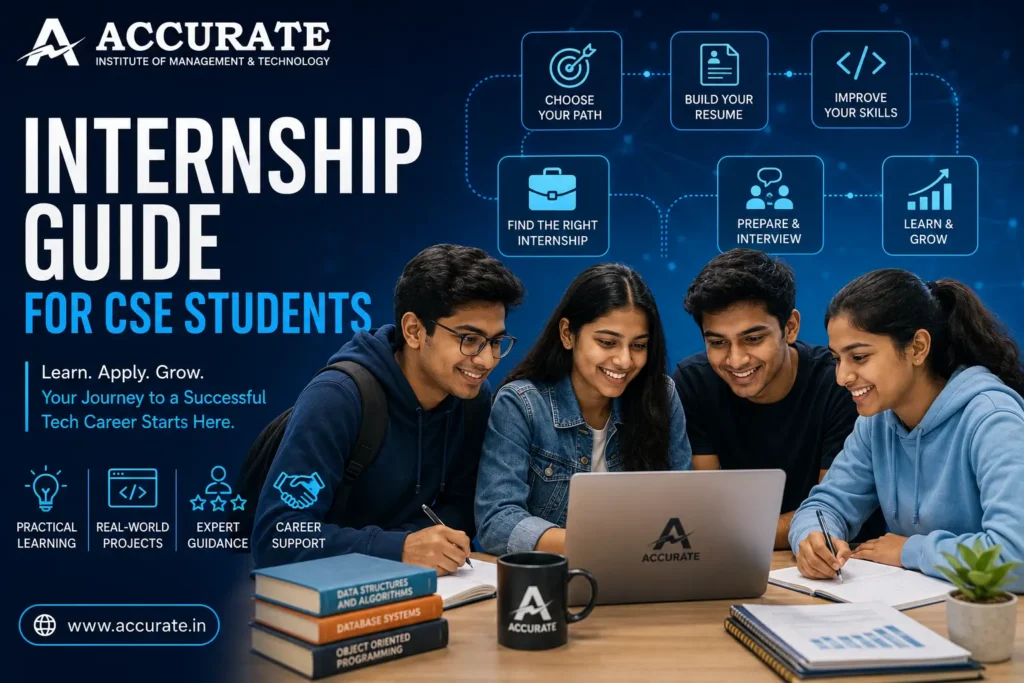

CSE students can prepare for internships by developing programming fundamentals, data structures and algorithms, Git, databases and practical development skills. Students should build two to four meaningful projects, create a concise résumé, maintain a professional GitHub and LinkedIn presence, apply through company career pages, professional networks, internship portals, referrals and college opportunities, and prepare for coding and technical interviews. Students should prioritize genuine skill development and learning experience rather than applying only on the basis of stipend or brand name.
How can a CSE student get an internship?
A CSE student can improve internship opportunities by learning programming, data structures, Git, databases and one practical technology area such as web development, AI/ML, cloud or cybersecurity. Build projects, maintain GitHub, create a one-page résumé, practise coding problems and apply consistently through company websites, LinkedIn, internship platforms, referrals and campus opportunities.
How do I get an internship as a CSE student?
Start by learning one programming language well, practise data structures and algorithms, build practical projects and put your best work on GitHub. Create a professional résumé and LinkedIn profile, then apply regularly to relevant internships. Prepare for coding tests, technical interviews and questions about your projects.
Table of Contents
- Why Internships Matter for CSE Students
- When Should CSE Students Start Internships?
- Types of Internships Available for CSE Students
- Skills Required Before Applying
- Choose Your Internship Domain
- Build Projects Before Applying
- Create an Internship-Ready GitHub Profile
- Write a Strong CSE Internship Résumé
- Optimize Your LinkedIn Profile
- Where to Find CSE Internships
- How to Apply for Internships Effectively
- How to Prepare for Coding Tests
- How to Prepare for Technical Interviews
- How to Discuss Projects in Interviews
- Internship Guide for First-Year CSE Students
- Internship Guide for Second-Year CSE Students
- Internship Guide for Third-Year CSE Students
- Internship Guide for Final-Year CSE Students
- Paid vs Unpaid Internships
- Remote vs On-Site Internships
- Common Internship Mistakes
- How to Succeed During Your Internship
- Convert Internship Experience into Career Value
- How Accurate Institute Supports Career Preparation
- CSE Internship Checklist
- Frequently Asked Questions
- Conclusion and Admission CTA
Internship Guide for CSE Students
Getting your first internship can feel like one of the most confusing stages of your Computer Science Engineering journey.
You open a job description and see Python, Java, JavaScript, SQL, Git, cloud, APIs, frameworks and several technologies you may not have studied yet.
Then comes the familiar question:
“Am I ready to apply?”
For many students, the answer is more encouraging than they think.
You do not need to know everything before applying for your first internship.
An internship exists partly because you are still learning.
At the same time, companies generally expect students to demonstrate some evidence of curiosity, technical fundamentals, problem-solving ability and willingness to learn.
That evidence can come from your programming skills, projects, GitHub profile, hackathon participation, certifications or technical activities.
The purpose of this internship guide for CSE students is to help you move from wondering where to start to developing a structured internship strategy.
Whether you are in the first year of B.Tech or approaching placement season, the same principle applies:
Don’t wait for an internship to make you employable. Start developing employable skills before you apply.
Why Internships Matter for CSE Students
A classroom teaches concepts.
An internship shows you what happens when those concepts meet real requirements, deadlines, codebases and users.
Internships Bridge Theory and Practice
You may learn database normalization in DBMS.
During an internship, you might need to understand why a particular production database is structured in a certain way.
You may learn object-oriented programming in class.
During an internship, you might work with a large application containing dozens or hundreds of classes written by other developers.
You may learn Git commands independently.
During an internship, Git becomes part of a collaborative workflow.
This transition is valuable because professional software engineering involves more than writing programs that produce the expected output.
You Learn How Teams Work
Technology teams often use:
- version control;
- issue tracking;
- code review;
- documentation;
- meetings;
- testing;
- deployment processes;
- collaborative development.
Experiencing these workflows as a student can reduce the gap between college and your first full-time job.
Internships Help You Discover What You Like
Perhaps you think you want to become a web developer but discover that data engineering excites you more.
Or you may start an AI internship and realize that you prefer backend systems.
That is useful information.
Internships are not only about getting hired.
They can also help you understand your own career interests.
When Should CSE Students Start Internships?
Students often assume internships are only for third-year or final-year students.
That is not necessarily true.
The kind of internship you should pursue changes as your skills develop.
First Year: Focus on Exploration
During your first year, do not panic if you do not get a formal internship.
Your priorities should include:
- programming fundamentals;
- logical thinking;
- Git and GitHub;
- basic projects;
- communication skills;
- exploring different technology domains.
A small technical project can sometimes be more useful than an internship where you perform no meaningful technical work.
Second Year: Start Building Practical Experience
By your second year, you may be ready to pursue internships in areas such as:
- web development;
- Python development;
- basic application development;
- testing;
- data analysis;
- technical support;
- entry-level software development.
Third Year: Become Strategic
Third year is an important period.
You should have enough foundation to target internships aligned with your career interests.
This is also a good time to pursue stronger projects, hackathons and industry exposure.
Final Year: Align Internships with Employment Goals
By final year, internship decisions should ideally connect with your target career path and placement strategy.
Types of Internships Available for CSE Students
Computer Science Engineering is broad.
Your internship does not have to carry the title “CSE Intern.”
There are many possible paths.
Software Development Internship
You may work on applications, APIs, backend systems or general software products.
Useful skills can include programming, OOP, databases, Git and problem-solving.
Web Development Internship
Roles may focus on:
- frontend;
- backend;
- full-stack development.
Common areas include HTML, CSS, JavaScript, frontend frameworks, server-side technologies, APIs and databases.
Mobile App Development Internship
Students interested in Android, iOS or cross-platform applications can explore mobile development internships.
Artificial Intelligence and Machine Learning Internship
AI/ML internships may involve:
- Python;
- data preprocessing;
- machine-learning algorithms;
- model evaluation;
- natural language processing;
- computer vision;
- generative AI.
Strong mathematics and data fundamentals become increasingly important as the role becomes more advanced.
Data Science Internship
Data-oriented roles may involve:
- Python;
- SQL;
- spreadsheets;
- data cleaning;
- statistics;
- visualization;
- machine learning.
Cybersecurity Internship
Students interested in security can explore:
- network security;
- web security;
- security operations;
- vulnerability analysis;
- secure development.
Cloud and DevOps Internship
These roles may involve cloud platforms, Linux, containers, CI/CD and infrastructure concepts.
QA and Software Testing Internship
Testing is an important part of software engineering.
Students can learn:
- test-case design;
- automation;
- bug reporting;
- software quality processes.
Skills CSE Students Should Learn Before Applying for Internships
There is no universal skill list for every internship.
A machine-learning intern and frontend intern need different technical stacks.
However, several foundations are broadly useful.
1. One Programming Language
Learn at least one language properly.
Good options can include:
- C++;
- Java;
- Python;
- JavaScript.
You should be comfortable with variables, conditions, loops, functions, data structures and debugging.
2. Data Structures and Algorithms
You do not need to solve the hardest competitive-programming problems before applying to every internship.
But understand core concepts such as:
- arrays;
- strings;
- linked lists;
- stacks;
- queues;
- hash maps;
- trees;
- searching;
- sorting;
- recursion;
- basic complexity analysis.
3. Git and GitHub
Understand version control basics.
Learn how to:
- create repositories;
- commit changes;
- push and pull;
- work with branches;
- resolve basic conflicts;
- write README files.
4. Databases
Basic SQL knowledge is valuable for many software roles.
Understand:
- tables;
- queries;
- joins;
- keys;
- relationships;
- database design basics.
5. Communication Skills
Technical ability matters, but you must also communicate what you know.
Practise explaining projects without reading from your résumé.
Choose Your Internship Domain Before Learning Everything
A common student mistake is trying to learn every technology simultaneously.
Monday: React.
Tuesday: Machine learning.
Wednesday: cybersecurity.
Thursday: cloud.
Friday: blockchain.
By Sunday, nothing has gone beyond the tutorial stage.
Instead, choose a direction for the next few months.
If You Like Web Development
Focus on:
HTML → CSS → JavaScript → frontend/backend framework → databases → APIs → deployment.
If You Like AI and Machine Learning
Focus on:
Python → NumPy/pandas → statistics → data visualization → machine learning → projects.
If You Like Mobile Development
Choose an appropriate development ecosystem and build complete applications.
If You Like Cybersecurity
Build strong networking, operating-system and security fundamentals before chasing tools.
Depth creates portfolio evidence.
Build Projects Before Applying for Internships
Projects are one of the most effective ways for students without professional experience to demonstrate practical skills.
Your Project Does Not Need to Be Revolutionary
Recruiters are not expecting every second-year student to invent a new operating system.
A simple project implemented thoughtfully can be useful.
Possible ideas include:
- expense tracker;
- student attendance application;
- campus event portal;
- task manager;
- résumé analyzer;
- quiz application;
- recommendation system;
- study planner;
- library management system;
- weather dashboard.
Build Beyond the Tutorial
Tutorials are useful for learning.
But after completing one, modify the project.
Add a feature.
Change the interface.
Use a different dataset.
Improve the architecture.
Solve a related problem.
That is when the learning becomes yours.
Create an Internship-Ready GitHub Profile
Your GitHub profile can support your internship applications by providing evidence of your work.
Pin Your Strongest Projects
Make your best repositories easy to find.
Write README Files
Every important project should explain:
- what the project does;
- problem being solved;
- technologies used;
- major features;
- installation steps;
- screenshots where relevant;
- known limitations.
Use Meaningful Repository Names
expense-tracker-api is better than project-final-new2.
Keep Sensitive Data Private
Never expose:
- passwords;
- API keys;
- tokens;
- private credentials.
Your GitHub should demonstrate good technical habits, not just code volume.
How to Write a Strong Internship Résumé for CSE Students
Students often worry:
“I have no experience. What will I put on my résumé?”
You probably have more material than you realize.
Include the Basics
A student résumé can contain:
- name and contact details;
- education;
- technical skills;
- projects;
- internships or training;
- achievements;
- relevant certifications;
- coding or technical activities;
- GitHub and LinkedIn links.
Keep It Focused
For many students and freshers, a clean one-page résumé is sufficient.
Do not fill space with generic statements.
Use that space to show technical evidence.
Describe Projects with Impact
Weak:
Made a website using React.
Better:
Developed a task-management web application using React with task creation, filtering and persistent data storage.
Be truthful.
Never exaggerate project metrics or responsibilities.
Optimize Your LinkedIn Profile for Internships
LinkedIn can support your internship search by helping recruiters and professionals understand your background.
Use a Clear Headline
Instead of simply:
Student
consider:
B.Tech CSE Student | Java | Web Development | Building Full-Stack Projects
Only mention skills you genuinely have.
Complete the Important Sections
Add:
- education;
- technical skills;
- projects;
- certifications;
- achievements;
- internships;
- relevant activities.
Network Professionally
Do not send strangers:
“Hi sir internship please.”
Instead, communicate respectfully and specifically.
If you are contacting someone about an opportunity, briefly introduce yourself, mention why the role interests you and provide relevant evidence of your work.
Where Can CSE Students Find Internships?
Internship hunting should use multiple channels.
Do not depend on one website.
Company Career Pages
If you admire particular technology companies, check their career portals regularly.
Search for internships, follow companies and pay attention to hiring announcements.
Internship Platforms
Dedicated internship and job portals can provide additional opportunities.
College Placement and Career Support
Pay attention to internship drives, training activities and opportunities shared through your institution.
Hackathons and Technical Events
These can help you build projects, meet other developers and discover organizations.
Referrals and Professional Networks
A referral can help your application get visibility, but it does not replace skills.
Build relationships before asking for favors.
Open Source
Open-source contribution can sometimes lead to mentorship, collaboration and professional connections.
How to Apply for Internships Effectively
Many students apply to five companies, receive no response and conclude:
“There are no internships.”
Internship searches often require persistence.
Apply to Relevant Roles
Do not send the same résumé to every job title on the internet.
Read the requirements.
If the role needs frontend skills and all your projects are machine learning, your application may not be strongly aligned.
Customize Your Résumé
You do not need to rewrite everything for every application.
But highlight the most relevant skills and projects.
Track Applications
Maintain a simple spreadsheet with:
- company;
- role;
- application date;
- source;
- status;
- follow-up;
- interview stage.
This prevents confusion once you start applying regularly.
Avoid Desperation Applications
Check the organization, role, responsibilities and legitimacy before sharing personal information or accepting an offer.
How to Prepare for Coding Tests
Many software internships include coding or online assessments.
Practise Core Problem Solving
Focus first on:
- arrays;
- strings;
- hashing;
- sorting;
- searching;
- recursion;
- stacks and queues;
- basic trees.
Learn Complexity
Understand why one solution may scale better than another.
Practise Under Time Limits
Knowing how to solve a problem eventually is different from solving it during an assessment.
Occasionally practise timed sets.
Review Your Mistakes
Do not simply count solved problems.
Ask:
- Why did I get stuck?
- Did I misunderstand the pattern?
- Was my implementation buggy?
- Did I miss an edge case?
Improvement comes from reviewing failures.
How to Prepare for CSE Internship Technical Interviews
Technical interviews vary by role.
But several areas appear frequently.
Programming Fundamentals
Expect questions about your preferred language.
Data Structures and Algorithms
Entry-level interviews may test fundamental problem-solving.
Core CSE Subjects
Depending on the role, review:
- OOP;
- DBMS;
- operating systems;
- computer networks.
Technology Stack
If you list React, Django, Node.js, Java or machine learning on your résumé, expect questions about them.
Do not list technologies merely because you completed a two-hour tutorial.
Projects
Your projects may generate some of the most important questions.
How to Discuss Your Projects During Internship Interviews
Do not memorize a paragraph.
Understand your project deeply enough to have a conversation.
Explain the Problem
What were you trying to solve?
Explain Your Role
If it was a team project, what did you do?
Explain the Technology Choices
Why did you use that language, framework or database?
Explain a Challenge
What went wrong?
How did you debug it?
Explain Limitations
No project is perfect.
Understanding limitations demonstrates maturity.
Explain Future Improvements
What would you change if you had another month?
This turns a student project into an engineering discussion.
Internship Guide for First-Year CSE Students
First-year students should focus less on chasing impressive company names and more on building foundations.
Your First-Year Priorities
Learn:
- one programming language;
- basic problem solving;
- Git and GitHub;
- basic web development or another introductory domain.
Build two or three small projects.
Participate in technical clubs, coding events or hackathons if available.
If you find a genuine learning-focused internship, excellent.
If not, continue building.
You are not behind.
Internship Guide for Second-Year CSE Students
Second year is a good time to become more serious.
Strengthen Core Subjects
Start learning:
- data structures;
- OOP;
- DBMS;
- development skills.
Choose a Technical Direction
Explore enough to make an informed choice, then spend several months building depth.
Build a Portfolio
By the end of second year, aim to have a few projects you can confidently demonstrate and explain.
Internship Guide for Third-Year CSE Students
Third year is where internship strategy becomes highly career-oriented.
Target Relevant Roles
Apply for positions connected to your preferred field.
Improve DSA
Software-development roles often evaluate problem-solving.
Polish Your Résumé and GitHub
Remove weak projects and improve your strongest ones.
Practise Interviews
Do mock interviews with friends, mentors or appropriate tools.
Apply Consistently
Do not wait only for one dream company.
A strong learning experience at a smaller organization can be highly valuable.
Internship Guide for Final-Year CSE Students
By final year, internships and placements can overlap strategically.
Prioritize Career-Relevant Experience
Look for opportunities that strengthen your target job profile.
Build Depth
You should now be moving beyond introductory projects.
Prepare for Placements Simultaneously
Continue:
- DSA;
- aptitude where required;
- core CSE revision;
- résumé preparation;
- mock interviews;
- project revision.
Your internship should add evidence to your career profile.
Paid vs Unpaid Internships: Which Is Better?
A paid internship is naturally attractive and students should value their work.
But stipend alone should not be your only decision factor.
Consider:
- actual responsibilities;
- technical learning;
- mentorship;
- company credibility;
- work environment;
- project exposure;
- duration;
- time commitment;
- relevance to your goals.
An unpaid internship is not automatically good because it provides “experience,” and a paid internship is not automatically good because it provides money.
Evaluate the complete opportunity carefully.
Never pay suspicious organizations simply for an internship certificate.
Remote vs On-Site Internships for CSE Students
Both formats can be useful.
Remote Internship Advantages
Remote roles may offer:
- location flexibility;
- exposure to distributed teamwork;
- reduced travel;
- access to organizations outside your city.
Remote Internship Challenges
You may need stronger:
- communication;
- self-discipline;
- time management;
- documentation habits.
On-Site Internship Advantages
Working physically with a team can make it easier to observe professional workflows, ask questions and build relationships.
The best format depends on the role, team and learning experience.
Common Internship Mistakes CSE Students Should Avoid
Mistake 1: Waiting Until Third Year to Start Learning
You can begin building skills from first year.
Mistake 2: Collecting Certificates Instead of Skills
Ten certificates cannot compensate for being unable to explain basic concepts.
Mistake 3: Copying Projects
Interviewers can ask questions that quickly reveal whether you understand the work.
Mistake 4: Applying Without Reading the Job Description
Relevant applications are more useful than random applications.
Mistake 5: Ignoring GitHub
For technical roles, a well-maintained portfolio can support your application.
Mistake 6: Lying on Your Résumé
Never claim skills or experience you do not have.
Mistake 7: Focusing Only on Big Companies
Startups and smaller technology companies can sometimes provide significant hands-on responsibility.
Mistake 8: Ignoring Communication Skills
Being able to explain your thinking is part of being an engineer.
How to Succeed During Your CSE Internship
Getting selected is only the beginning.
Ask Good Questions
First investigate the problem yourself.
Then ask a clear question explaining what you tried.
Take Notes
Document:
- setup instructions;
- workflows;
- technical concepts;
- feedback;
- mistakes and solutions.
Communicate Blockers Early
Do not remain stuck silently for days.
Explain the issue and what you have already attempted.
Accept Feedback Professionally
Code review is not an attack on you.
It is part of collaborative software development.
Understand Before Copying
Whether the answer comes from a teammate, Stack Overflow, documentation or an AI assistant, understand it before adding it to a codebase.
Respect Confidentiality
Never publish company code, internal documentation, datasets or credentials to your personal GitHub unless you have explicit authorization.
Convert Your Internship into Long-Term Career Value
After your internship ends, do not simply collect the certificate and forget everything.
Reflect on what you learned.
Update Your Résumé
Describe your actual contribution.
Update LinkedIn
Add the role and relevant responsibilities.
Improve Your Skills
Identify the gaps the internship exposed.
Perhaps your SQL was weak.
Maybe you struggled with Git.
Maybe you need stronger communication.
Use that information.
Stay Connected Professionally
If appropriate, maintain genuine professional relationships with mentors and teammates.
Your network should be built through good work and respectful interaction, not only when you need a referral.
How Accurate Institute of Management & Technology Supports Career Preparation
For CSE students, internship preparation should not begin a few weeks before placement season.
It should develop alongside academic learning.
Accurate Institute of Management & Technology, Greater Noida emphasizes practical learning, guided projects, programming practice, technical development and career preparation as part of the broader engineering student journey.
This approach matters because employers do not evaluate academic theory in isolation.
Students need opportunities to convert concepts into capabilities.
Programming becomes stronger through coding practice.
Database knowledge becomes more meaningful through applications.
Software engineering becomes clearer through projects and teamwork.
Communication improves when students explain and present what they have built.
These experiences can gradually prepare students to pursue internships and later transition toward full-time opportunities.
Building Projects Before Internship Season
Students should use their engineering years to build evidence of their skills.
That may include:
- mini-projects;
- laboratory work extended into applications;
- hackathons;
- coding practice;
- technical competitions;
- collaborative projects;
- GitHub repositories.
An internship application becomes stronger when the student can point to genuine work rather than simply listing technologies.
Greater Noida and the Delhi NCR Ecosystem
Accurate Institute’s location in Greater Noida places students within the broader Delhi NCR education, technology and industrial environment.
Students can potentially use this ecosystem to seek professional exposure, internships, technical events and networking opportunities.
Location creates access, but students still need initiative.
The most successful internship strategy combines college opportunities + independent skill development + projects + consistent applications.
CSE Internship Preparation Checklist
Before applying, review this checklist.
Technical Skills
- One programming language
- Basic DSA
- Git and GitHub
- SQL fundamentals
- Relevant domain skills
- Debugging ability
Portfolio
- Two to four meaningful projects
- Clean GitHub profile
- Project README files
- No exposed credentials
- Working demos where appropriate
Résumé
- Clear one-page format
- Relevant skills
- Strong project descriptions
- GitHub link
- LinkedIn link
- No false claims
Interview Preparation
- Programming revision
- DSA practice
- OOP
- DBMS
- OS basics
- Networking basics
- Project explanation
- Role-specific technologies
Application Strategy
- Company career pages
- Internship platforms
- College opportunities
- Professional networking
- Relevant referrals
- Application tracker
You do not need every box to be perfect before submitting your first application.
But this checklist gives you a direction.
Frequently Asked Questions About Internships for CSE Students
1. Which internship is best for CSE students?
The best internship for a CSE student depends on career interests and current skills. Popular options include software development, web development, AI and machine learning, data science, cybersecurity, mobile development, cloud, DevOps and software testing. Choose roles that provide genuine technical learning and meaningful work.
2. In which year should CSE students do an internship?
Students can begin exploring internships from the first or second year, although more technical opportunities may become accessible as their skills improve. Second and third year are particularly useful periods for building industry experience before final-year placements.
3. How can a CSE student get an internship with no experience?
Build practical projects, create a GitHub portfolio, learn relevant technical skills and prepare a clear résumé. Student projects, hackathons, open-source work and technical activities can provide evidence of ability even before you have formal professional experience.
4. What skills are required for a CSE internship?
Requirements vary by role, but programming, problem-solving, Git, basic data structures, databases and communication skills are broadly useful. Students should additionally learn domain-specific skills such as web development, machine learning, cloud computing or cybersecurity based on the internship.
5. Is a GitHub profile important for CSE internships?
A GitHub profile can be valuable because it gives recruiters or technical interviewers access to examples of your work. Keep important repositories organized, document projects with README files and ensure you can explain every project you showcase.
6. How many projects should I have before applying for a CSE internship?
There is no fixed requirement. Two to four meaningful, complete and well-documented projects can provide a solid starting portfolio. Quality matters more than quantity, especially when you can clearly explain the technical decisions and challenges behind each project.
7. Are paid internships better for CSE students?
Paid internships are desirable, but compensation should not be the only factor. Evaluate the technical work, mentorship, company credibility, responsibilities, relevance to your career and learning opportunities. Avoid suspicious offers and organizations that ask students to pay simply for an internship certificate.
8. How do I prepare for a CSE internship interview?
Review your programming language, data structures and algorithms, OOP, DBMS, operating systems and computer networks as relevant to the role. Study every skill mentioned on your résumé and practise explaining your projects, challenges and technical decisions clearly.
9. Can first-year CSE students get internships?
Yes, although formal technical opportunities may be more limited because first-year students are still developing foundational skills. Focus on programming, Git, small projects, hackathons and technical communities. A genuine learning opportunity is more valuable than collecting an internship certificate without meaningful work.
10. How can CSE students find internships online?
Students can search company career pages, LinkedIn, internship and job portals, startup opportunities and professional communities. They can also explore referrals, open-source communities and opportunities shared through their college. Applying consistently across multiple legitimate channels is usually more effective than relying on one source.
Conclusion: Your First Internship Starts Before You Apply
Students often think the internship journey begins when they click Apply.
It actually begins months earlier.
It begins when you write your first program without copying the solution.
It continues when you learn Git.
When you struggle with a project bug for two hours and finally solve it.
When you create your first useful README.
When you learn SQL.
When you practise DSA.
When you explain your project to a friend.
When you receive feedback and improve.
These small experiences gradually build the student who becomes ready for an internship.
Do not wait until you feel 100% prepared. That day may never arrive.
Instead, aim for a cycle of:
Learn → Build → Document → Apply → Interview → Learn Again.
Your first application may be rejected.
Your tenth may receive no reply.
You may fail a coding assessment.
You may struggle in your first technical interview.
These experiences are information.
Use them to identify gaps and improve.
By the time you enter placement season, the goal is not simply to say that you completed an internship.
The goal is to have become a stronger engineer because of everything you did before, during and after that experience.
Begin Your Engineering Journey with Accurate Institute of Management & Technology
If you are an engineering aspirant planning a future in software, AI, data, cybersecurity, cloud or another computing field, your choice of learning environment can influence how effectively you turn academic concepts into practical skills.
Accurate Institute of Management & Technology, Greater Noida offers an engineering environment focused on technical education, practical learning, projects and career development.
Use your B.Tech years strategically.
Learn the fundamentals.
Build projects.
Create your GitHub portfolio.
Participate in technical activities.
Seek internships.
Develop communication skills.
And prepare continuously for the opportunities ahead.
Explore the B.Tech programmes at Accurate Institute of Management & Technology and connect with the admission team for current information about courses, specialisations, eligibility and the admission process.
Your first internship may be one milestone.
Building the skills to create a successful technology career is the bigger journey.